ART CITIES: Vienna-Sofia Mitsola

Sofia Mitsola is working primarily with paintings in which she investigates the female form. Her invented characters are informed by ancient Greek and Egyptian sculptures, usually depictions of goddesses or mythical creatures. These are set in simple geometric backgrounds with intensely bright and almost flat colours and are depicted naked and larger than human scale. Through them, she is playing with ideas about voyeurism, confrontation, and power.
By Efi Michalarou
Photo: Galerie Eva Presenhuber Archive
The boudoir has long been a paradoxical space. Literally translated as a “room for sulking,” it was historically conceived as a female retreat, a chamber of dressing, undressing, and transformation. In the eighteenth century, the Marquis de Sade turned it into a libertarian cabinet for his fantasies, while in the twentieth, Anaïs Nin made it the stage for her erotic tales. Today, the term is most often associated with a genre of photography that commercializes lingerie-clad posing as an act of empowerment. Yet Sofia Mitsola, in her solo exhibition “Psyche of Fae O”, reclaims the boudoir as an atmospheric backdrop for painting, a linchpin in her reflection on how nude imagery—laden with art-historical references—can be given a contemporary perspective once again.
Mitsola’s new oil paintings are populated by reincarnations of Klimt’s female figures, long a source of inspiration for her, now merged with the visual codes of vintage pornography. The result is a neo-Art Deco style dominated by porcelain-white skin and cascades of red hair. Her ultra-slim, naked bodies, flattened to the surface, glow against golden or smoky backgrounds, sometimes decadently framed by fur. They thrust spread legs toward the viewer or pose coquettishly with ponytails, oscillating between provocation and melancholy. A face emerges from a diffuse black void, another dissolves into glazed surroundings. These apparitions fade even as they are conjured with rapid brushstrokes—fleeting, spectral, yet insistently present.
The figures intuitively recall their predecessors, but Mitsola reduces their canonized language to poses and ciphers. Impressionistic backgrounds reminiscent of Bonnard or glazed color fields dissolve historical specificity, opening a pictorial space where artificial yet affecting physicality takes shape.
Mitsola’s women are sexualized but also deformed, echoing the severed limbs of Schiele’s nudes or the torsions of Hans Bellmer’s dolls. Their large eyes and pouting lips link them to camp courtesans of the 1970s, while simultaneously evoking the manga-inspired filters of Instagram. These beings are curves and lines, opaque surfaces and expressive brushstrokes—fictional constructs that function as projection surfaces for a perception aware of the numbing effects of a media-saturated present.
They are not modeled on real life but are pictorial fantasies on a meta-level, conscious of the voyeurism once evoked by their predecessors and of transgressions that today no longer shock. Above all, they are aware of the latent irritation of being creations of a female painter who renders them with supreme self-assurance, freeing them from resentments that might otherwise cling to such imagery.
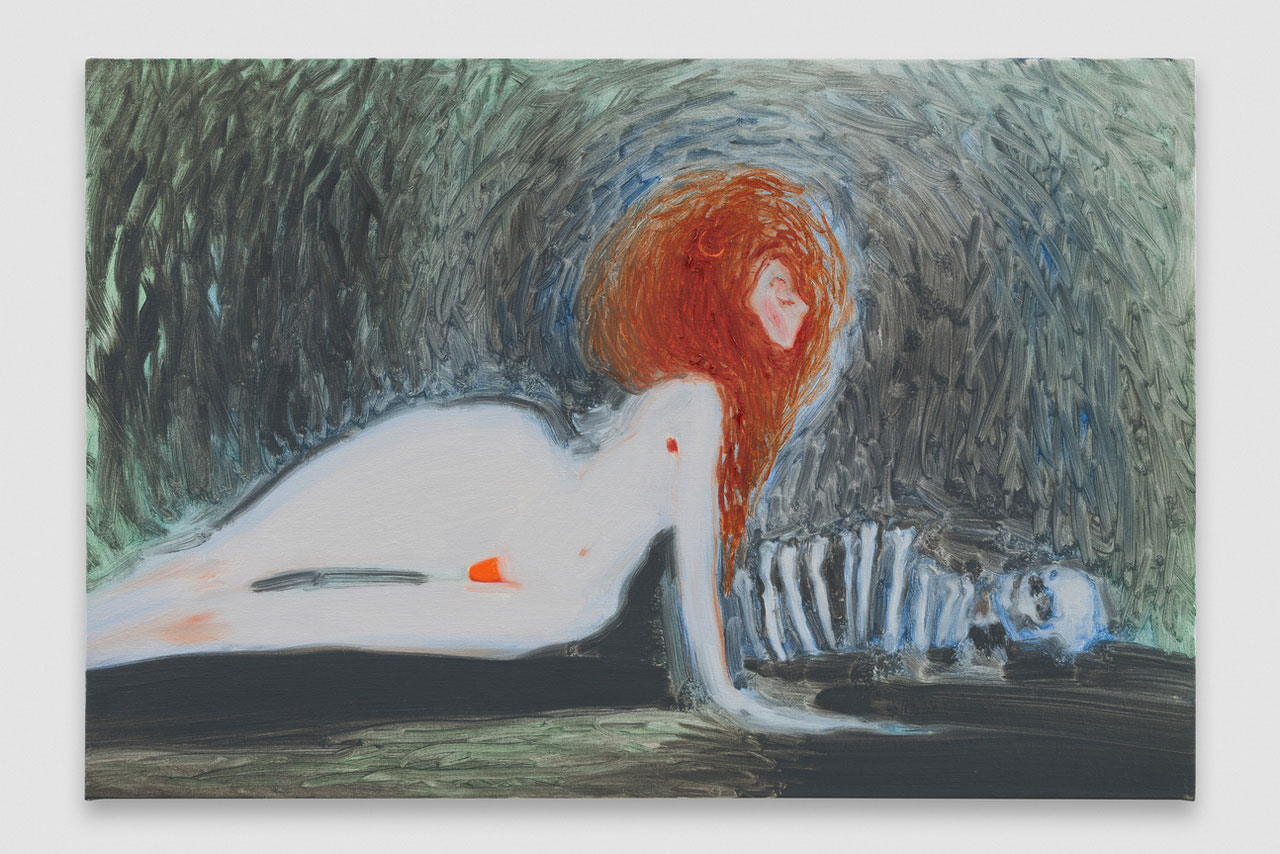
Unlike the Arcadian sirens of Mitsola’s earlier works, the atmosphere here is one of emotional dissonance. “Psyche of Fae O” becomes a psychological introspection of an unknown protagonist, dislocated from time and place, caught between glamour and gloom. Freud’s theory of Eros and Thanatos flickers through post-coital figures suspended between sleep and apathy, fading into disappearance. Couples merge into one another, or encounter their twin as figures of light and shadow. In “La Petite Mort” (2025), the lonely climax becomes an encounter with a skeleton, echoing Lacan’s dictum that jouissance is the path toward death.
The stylized boudoir, staged as if for someone absent, emphasizes this tonality. It asks who was there, what might have happened. Music composed for the exhibition wafts through the gallery, contrasting melody and atonality. At the center stands a dressing table—a “Psyche” in Austrian parlance—equipped with the repertoire of worldly metamorphosis. Yet the mirror reflects only us, the viewers. The furniture is steel, the utensils stripped of plushness, recalling Marina Abramović’s “Rhythm 0”, where objects placed on a table invited the audience to act upon the artist.
This scenography relies on contrasts: hard and soft, warm and cold. The theatrical atmosphere evokes intimate, self-contained spaces of pent-up emotion, where euphoria can swiftly turn to despair. Mitsola cites Fassbinder’s “The Bitter Tears of Petra von Kant” and Powell & Pressburger’s ballet film “The Tales of Hoffmann” as inspirations. Their horror vacui* and lavish sets resonate in her dissected staging of opulence and sentiment, where love, desire, submission, and downfall shimmer through every detail.
And yet the central figure, Fae O, is ultimately linguistic. “Fae” derives from the Greek word Φαΐω, meaning “to shine brightly.” Mitsola, fascinated by etymology, crafts a name that resonates with fame even in its incompleteness, like Anna or Jackie O. But it remains more a phonetic paraphrase, an initial sound—fancy, phantasm, fantasy—something that materializes in speech only to vanish again.
Fae O’s psyche, explored across the series, is a composite of conscious and unconscious feelings, emotional outbursts, jouissance, glamour, and melancholy. She is both protagonist and cipher, a linguistic shimmer that refuses to settle into identity.
With “Psyche of Fae O,” Sofia Mitsola reimagines the boudoir not as a site of sulking or seduction, but as a stage for psychological and pictorial transformation. Her paintings, steeped in art-historical echoes yet resolutely contemporary, probe the tensions between eroticism and deformation, glamour and gloom, fiction and projection. The exhibition’s scenography—music, steel furniture, theatrical contrasts—extends the canvas into space, enveloping viewers in a mise-en-scène** of desire and disappearance.
Mitsola’s women are not real, nor are they simply fantasies. They are meta-images, aware of their own history and of the gaze that consumes them. In their porcelain skin and red cascades of hair, in their melancholy faces and coquettish poses, they embody the contradictions of femininity in a media-saturated age. And in Fae O, Mitsola offers not a character but a linguistic spark, a name that shines only to fade, leaving behind the echo of a psyche both intimate and elusive.
* In visual art, horror vacui or kenophobia is a phenomenon in which the entire surface of a space or an artwork is filled with detail and content, leaving as little perceived emptiness as possible. It relates to the antiquated physical idea, horror vacui, proposed by Aristotle who held that “nature abhors an empty space”.
** In art, especially film and theatre, mise-en-scène refers to everything placed within the frame or on the stage – the arrangement of actors, sets, props, costumes, makeup, and lighting – to create meaning, atmosphere, and tell the story visually, beyond just dialogue. It’s the director’s deliberate control over the visual elements to convey mood, character, or themes, encompassing the overall look and feel of a scene.
Photo: Sofia Mitsola, Booty Training, 2025, Oil on linen, 70 x 90 cm / 27 1/2 x 35 3/8 in, © Sofia Mitsola, Courtesy the artist and Galerie Eva Presenhuber
Info: Galerie Eva Presenhuber, Lichtenfelsgasse 5, Vienna, Austria, Duration: 16/1-10/4/2026, Days & Hours: Tue-Fri 11:00-18:00, www.presenhuber.com/
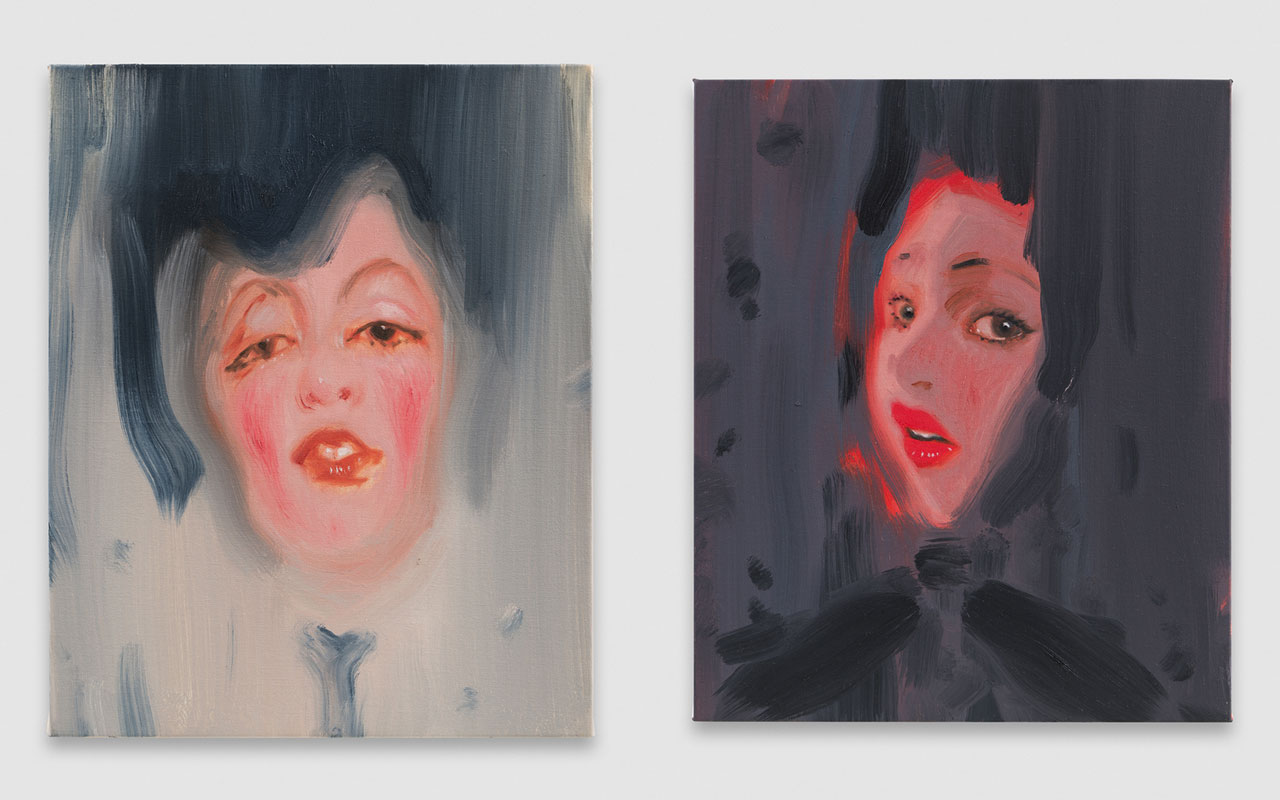
Right: Sofia Mitsola, Ophelia, 2025, Oil on linen, 60 x 50 cm / 23 5/8 x 19 5/8 in, © Sofia Mitsola, Courtesy the artist and Galerie Eva Presenhuber
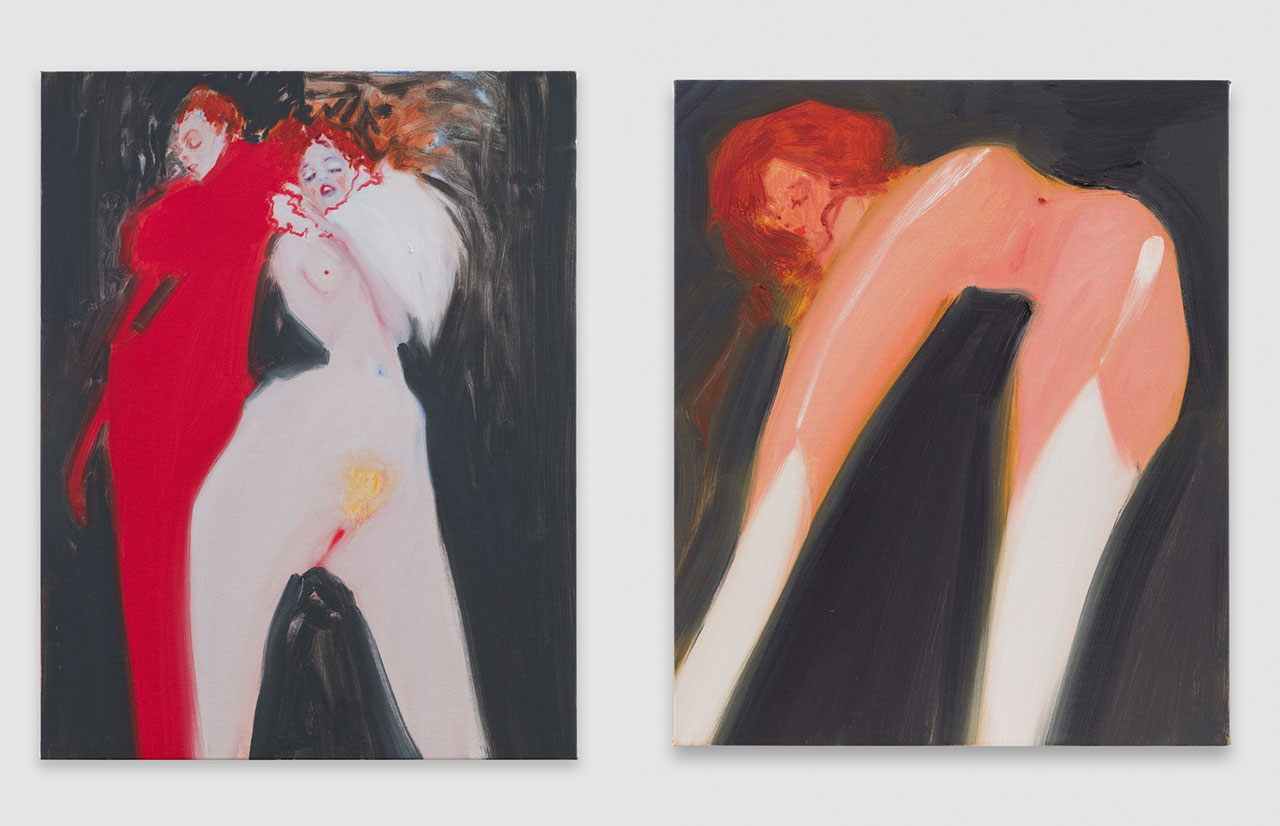
Right: Sofia Mitsola, Entrée, 2025, Oil on linen, 60 x 50 cm / 23 5/8 x 19 5/8 in, © Sofia Mitsola, Courtesy the artist and Galerie Eva Presenhuber
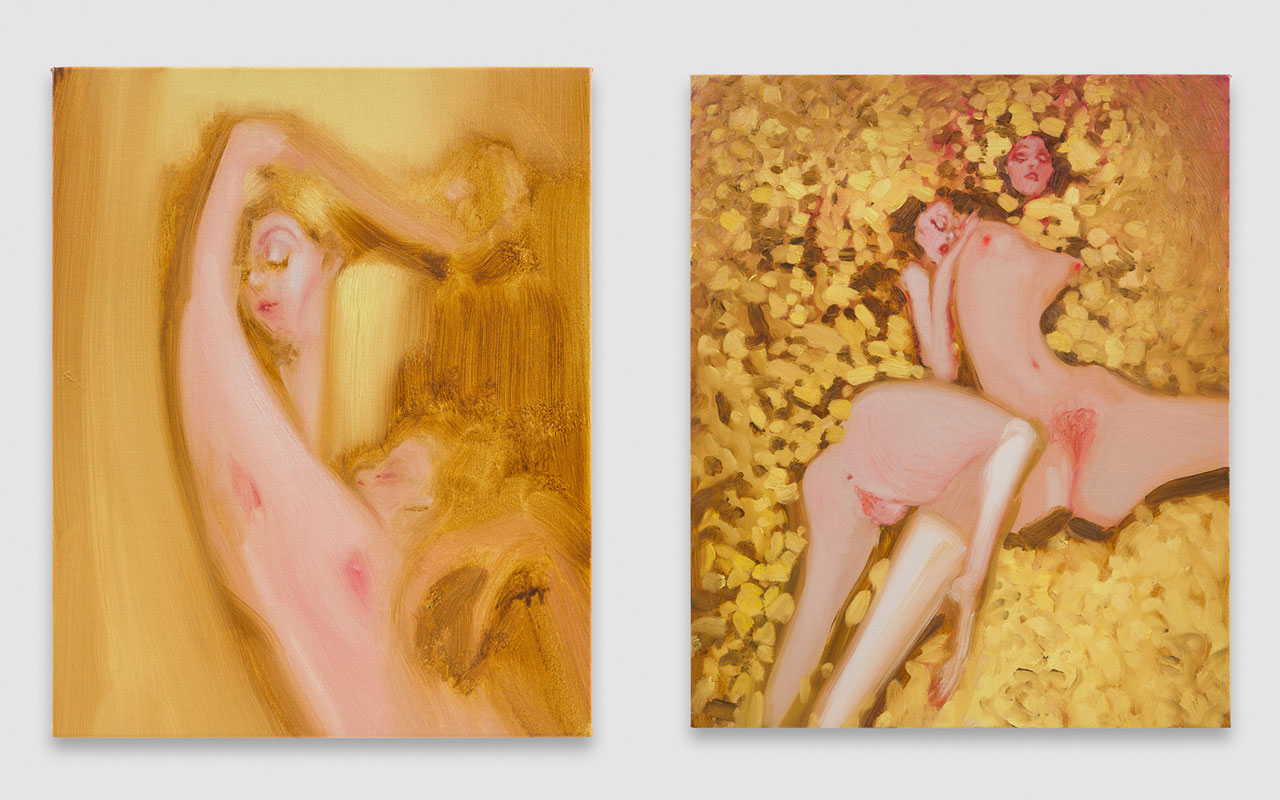
Right: Sofia Mitsola, Silhouettes, 2025, Oil on linen, 85 x 70 cm / 33 1/2 x 27 1/2 in, © Sofia Mitsola, Courtesy the artist and Galerie Eva Presenhuber
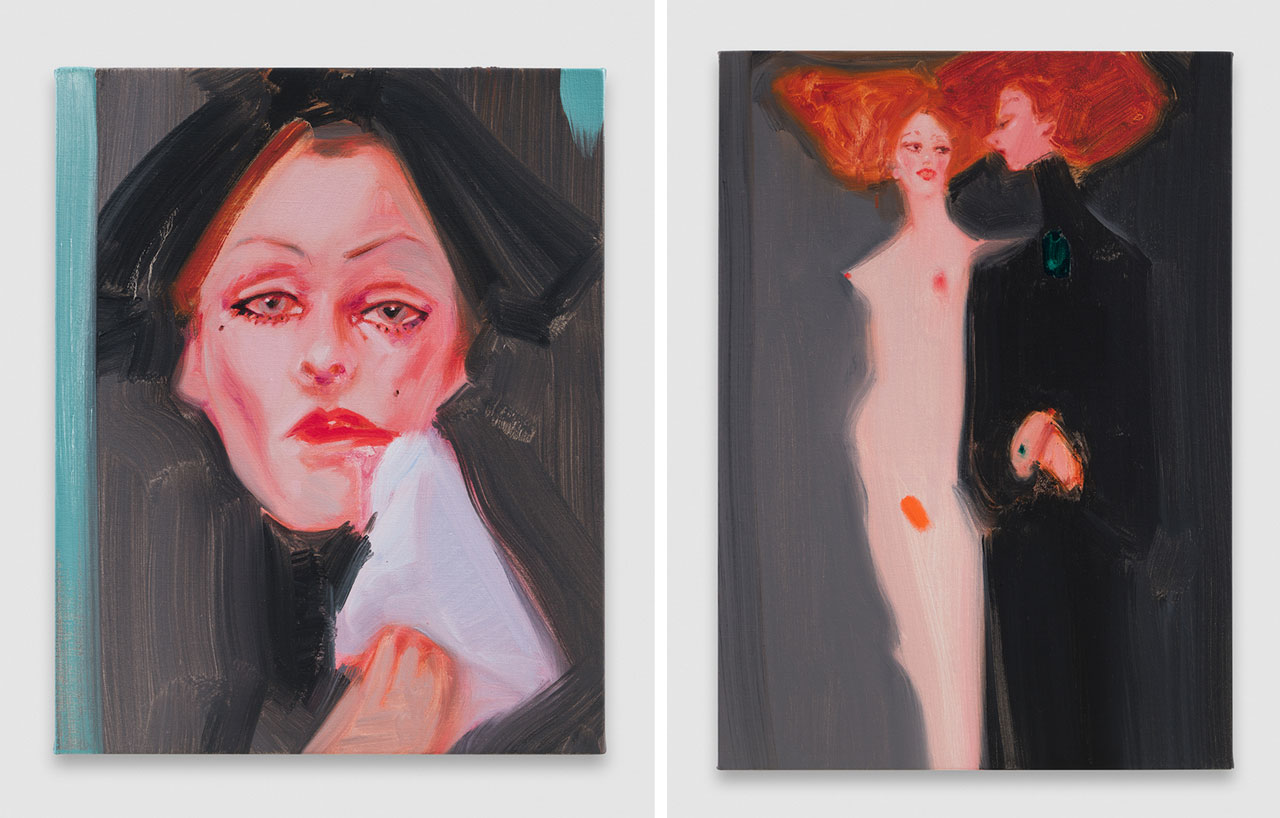
Right: Sofia Mitsola, Sasha and Prudence, 2025, Oil on linen, 70 x 50 cm / 27 1/2 x 19 5/8 in, © Sofia Mitsola, Courtesy the artist and Galerie Eva Presenhuber
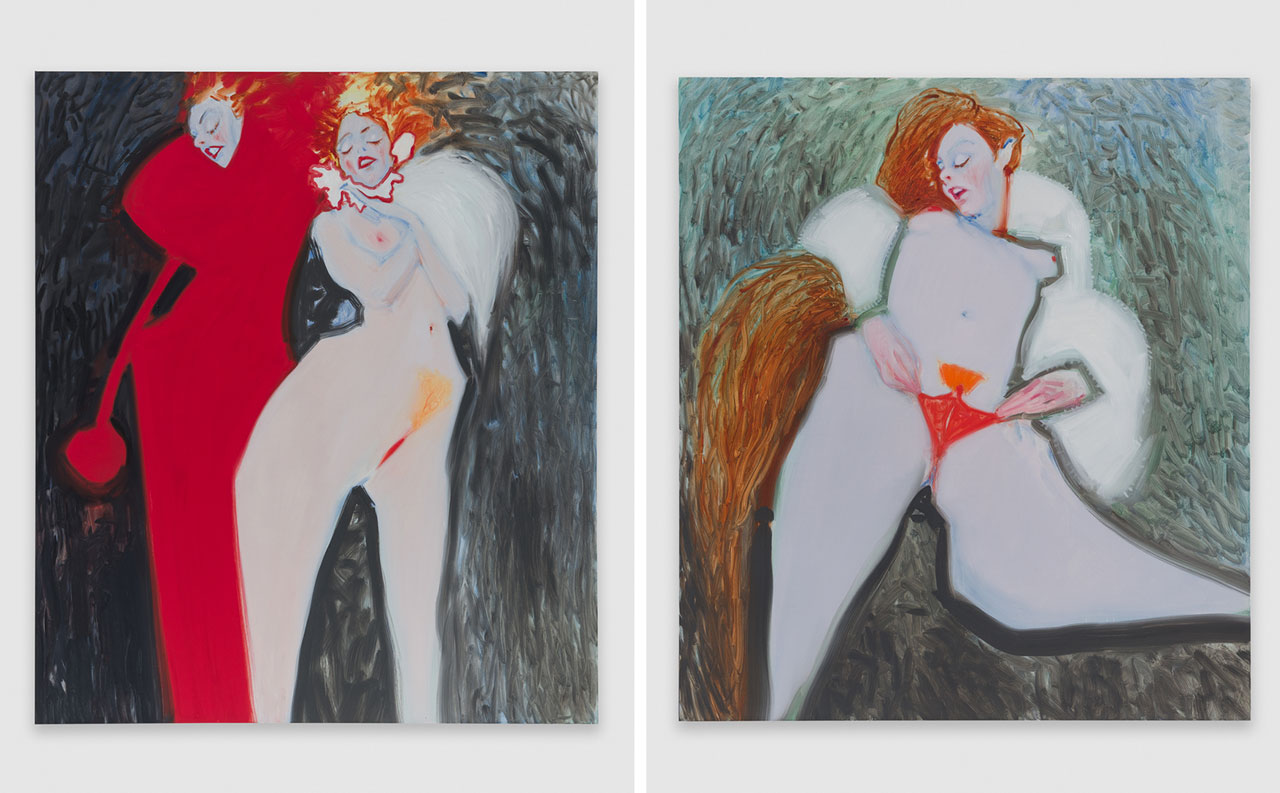
Right: Sofia Mitsola, Leda, 2025, Oil on linen, 180 x 160 cm / 70 7/8 x 63 in, © Sofia Mitsola, Courtesy the artist and Galerie Eva Presenhuber
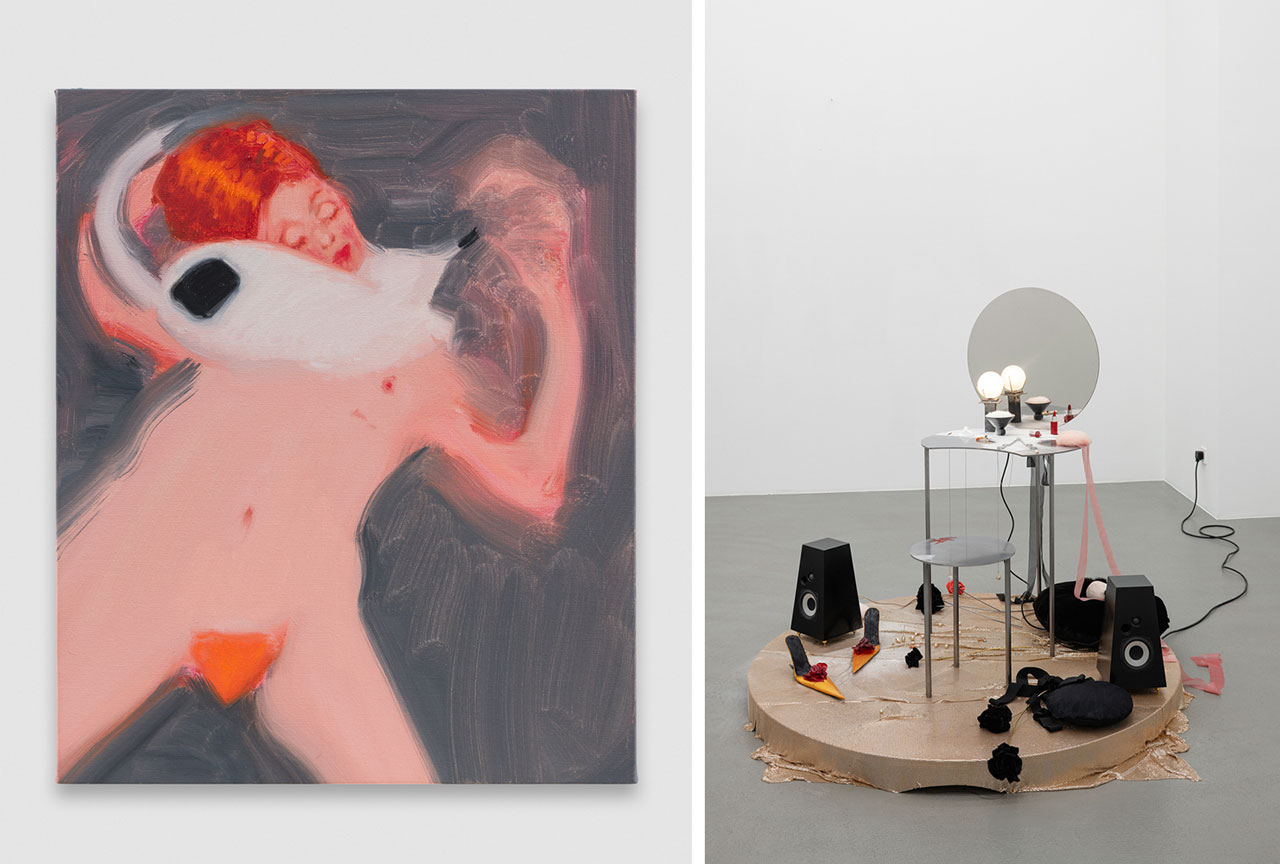
Right: Sofia Mitsola, Psyche, 2026, Plywood, steel, Total dims. 135 x ø 144 cm / 53 1/8 x ø 56 3/4 in, © Sofia Mitsola, Courtesy the artist and Galerie Eva Presenhuber