
ART CITIES: N.York-Dan Flavin

Dan Flavin used widely available fluorescent tube lights to radically alter and rearticulate the space shared by work and viewer while maintaining formal and material consistency from one project to the next. In doing so, he also circumvented the limitations imposed by handwrought armatures, as well as by pedestals and other conventional means of object display.
By Efi Michalarou
Photo: David Zwirner Gallery Archive
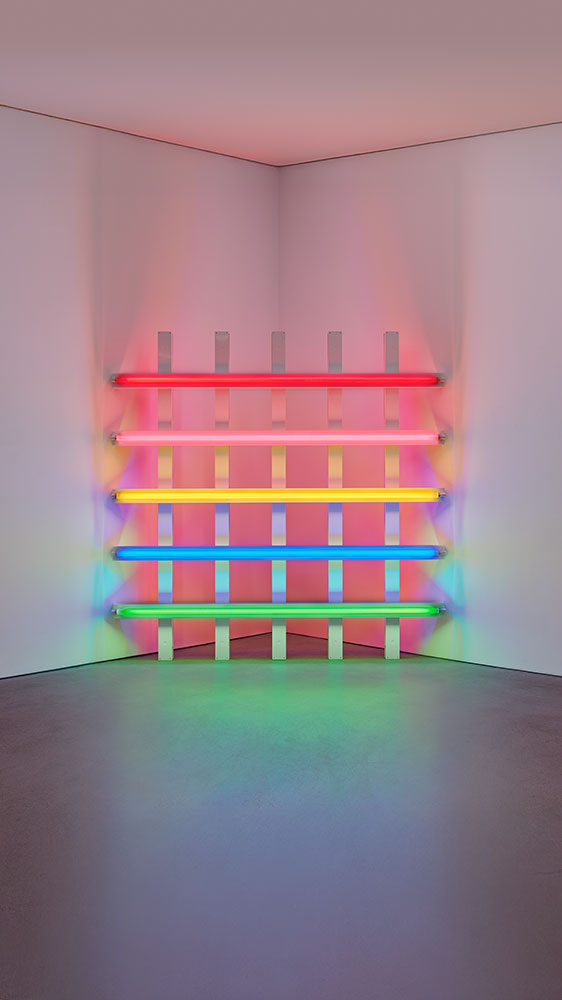
The exhibition “Grids” presents the first focused examination of one of the most rigorous and conceptually charged bodies of work in Dan Flavin’s oeuvre. Begun in 1976, the grid works represent a late but decisive development in Flavin’s sustained investigation of light as both material and spatial agent. Bringing together key examples from public collections and the Estate of Dan Flavin, the exhibition also re-creates several historically significant installations, allowing contemporary viewers to encounter the grids as Flavin originally conceived them—embedded in and activated by architectural space. From the moment Flavin introduced “the diagonal of May 25, 1963 (to Constantin Brancusi)”—a single fluorescent tube mounted at a 45-degree angle—his practice committed itself to an economy of means paired with extraordinary perceptual consequence. Over the next three decades, until his death in 1996, Flavin produced a remarkably consistent body of work using commercially available fluorescent lamps to construct what he termed “situations” rather than sculptures. These works do not merely occupy space; they establish it. Walls, corners, and ceilings become active participants, transformed through light, color, and reflection into dynamic perceptual fields. Within this trajectory, the grids stand apart for their intensity and structural complexity. As curator Michael Govan has observed, they count “among the most intense and concentrated of Flavin’s lights.” Each grid is composed of an equal number of vertical fixtures facing backward and horizontal fixtures facing forward, arranged in precise chromatic relationships. Installed in the corner of a room, the grids generate a dual projection: outward toward the viewer and inward into the architectural recess. Color accumulates, blends, and rebounds, illuminating not only the space but the conditions of perception itself.
More than almost any other format Flavin employed, the grids embody a productive tension between phenomenological experience and rational order. Their serial logic and orthogonal structure recall the systems-driven ethos of Minimalism, yet their optical effects resist purely intellectual apprehension. In a 1978 letter to Thomas Armstrong, then director of the Whitney Museum of American Art, Flavin articulated this balance with characteristic clarity, describing the grid’s “rich contrast, front over rear, and an optical interplay… modified by reflected color mixes and shadows of the grid structure itself.” He concluded by noting the rarity of such “intense fluorescent light use/abuse” within his own production—a self-assessment that underscores the grids’ exceptional status. The exhibition opens with Flavin’s first grid works, “untitled (for Mary Ann and Hal with fondest regards) 1 and 2” (1976). Each eight-foot-square construction consists of five pink lamps oriented in one direction and five green lamps in the other, arranged in inverse configurations. Originally shown at the Otis Art Institute Gallery in Los Angeles, where they were installed diagonally opposite one another, these works are reunited here in their original spatial relationship. Dedicated to Hal Glicksman, then director of the gallery, and his wife Mary Ann, the grids signal both a formal breakthrough and a personal moment within Flavin’s practice.
Several subsequent grids are dedicated to Leo Castelli, Flavin’s longtime New York dealer and one of the most influential figures in postwar American art. “Untitled (for you, Leo, in long respect and affection) 1 and 2” (1977) mark a shift toward freer chromatic interplay, combining yellow, blue, green, and pink lamps in complex opposing orientations. First exhibited at Heiner Friedrich, Inc., these works also introduce questions of scale that would preoccupy Flavin in later years. Their four-foot counterparts, “untitled (for you, Leo, in long respect and affection) 3 and 4” (1978), were designed to be suspended across a corner, extending the grid’s reach into the surrounding volume of space.
The exhibition culminates with the re-creation of “untitled (in honor of Leo at the 30th anniversary of his gallery)” (1987), originally presented at Castelli Gallery’s SoHo location. Comprising three joined editions and spanning twenty-four feet across a corner, the work exemplifies Flavin’s mature command of scale, color, and architectural transformation. Reassembled here for the first time since its original presentation, the installation demonstrates the grid’s capacity not only to articulate space but to redefine it entirely. Seen together, the works in “Grids” reveal a sustained inquiry into how light can function simultaneously as structure, medium, and experience. They confirm the grid not as a late-career anomaly but as a concentrated distillation of Flavin’s lifelong concerns—an arena in which logic and sensation, system and excess, are held in luminous, unstable balance.
Photo: Installation view, Dan Flavin: Grids, David Zwirner, New York, January 15–February 21, 2026., Courtesy David Zwirner
Info: David Zwirner Gallery, 537 West 20th Street, New York, NY, USA, Duration: 15/1-21/2/2026, Days & Hours: Tue-Sat 10:00-18:00, www.davidzwirner.com/
