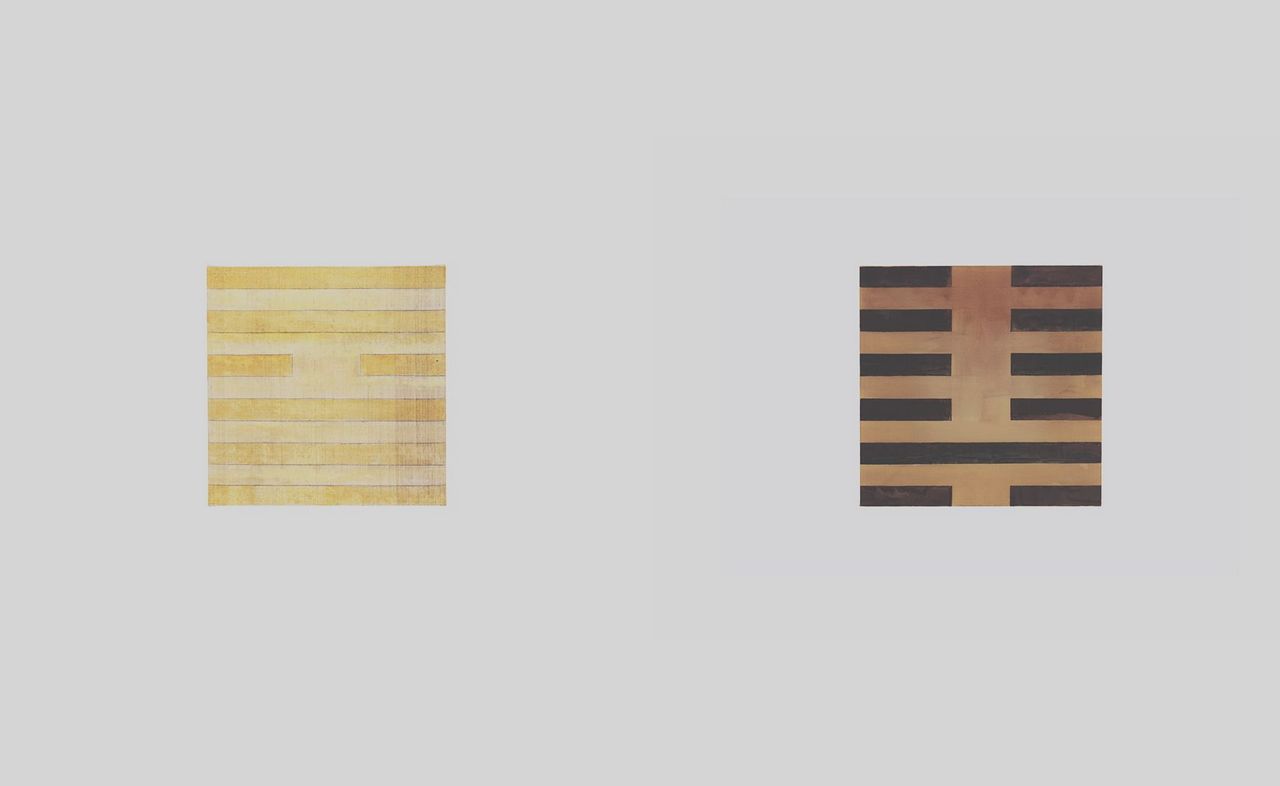
PRESENTATION: Leah Ke Yi Zheng-Change, I Ching (64 Paintings)
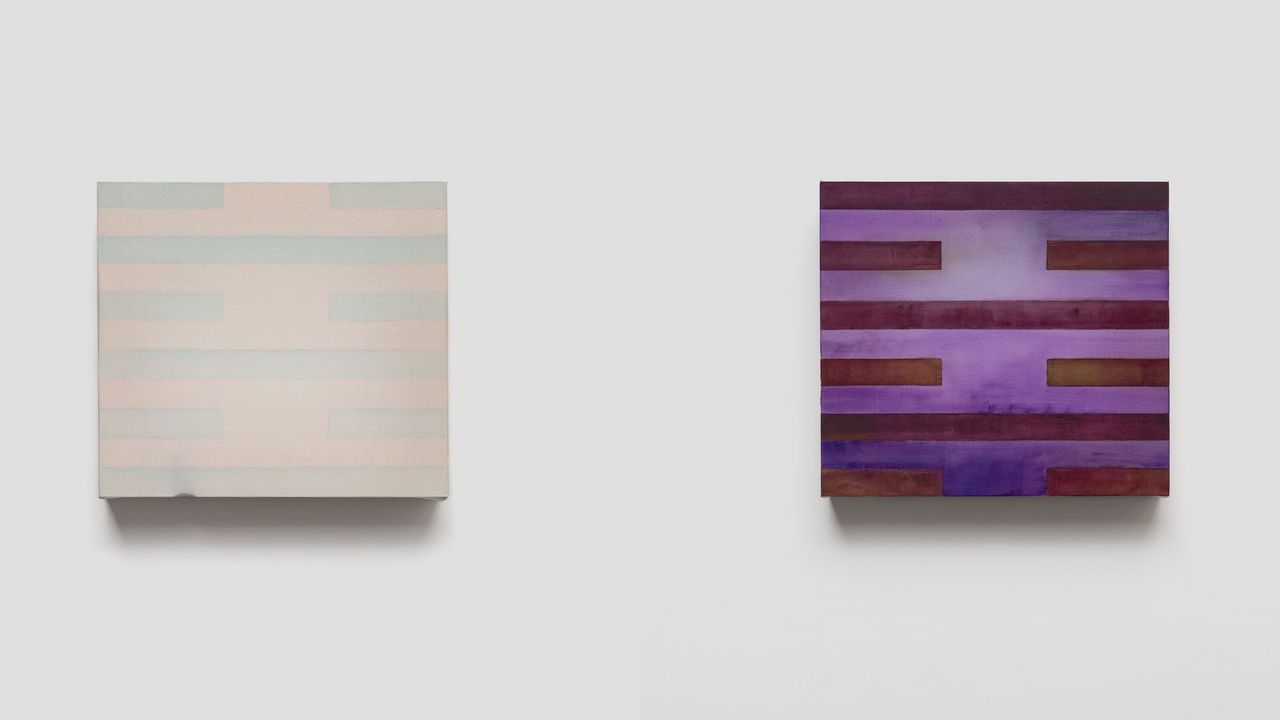
Leah Ke Yi Zheng’s practice articulates a compelling synthesis of cultural lineage and contemporary inquiry, marrying the refined techniques of traditional Chinese painting with the conceptual legacies of the Western avant-garde. Her work operates at the threshold of these two realms, yielding a visual language that is at once historically resonant and singularly innovative. Silk stretched across custom-made hardwood frames—each uniquely contoured—forms the corporeal basis of her paintings, establishing an intrinsic dialogue between structure and fluidity, form and formlessness. This physical duality mirrors Zheng’s broader artistic project: a persistent negotiation between differing traditions of thought and expression.
By Dimitris Lempesis
Photo: The Renaissance Society Archive
Zheng, born in Wuyishan, China, and based in Chicago, apprenticed in traditional Chinese painting from a young age before pursuing further art studies in the United States. This bicultural formation underpins a practice attuned to questions of temporality, perception, and cultural exchange. Working with silk—a material historically bound to Chinese artistic heritage—she recontextualizes its delicate translucence within a contemporary framework that is as much philosophical as it is painterly. Her surfaces embody a liminal space: translucent yet substantial, tactile yet elusive, inviting contemplation and sustained attention.
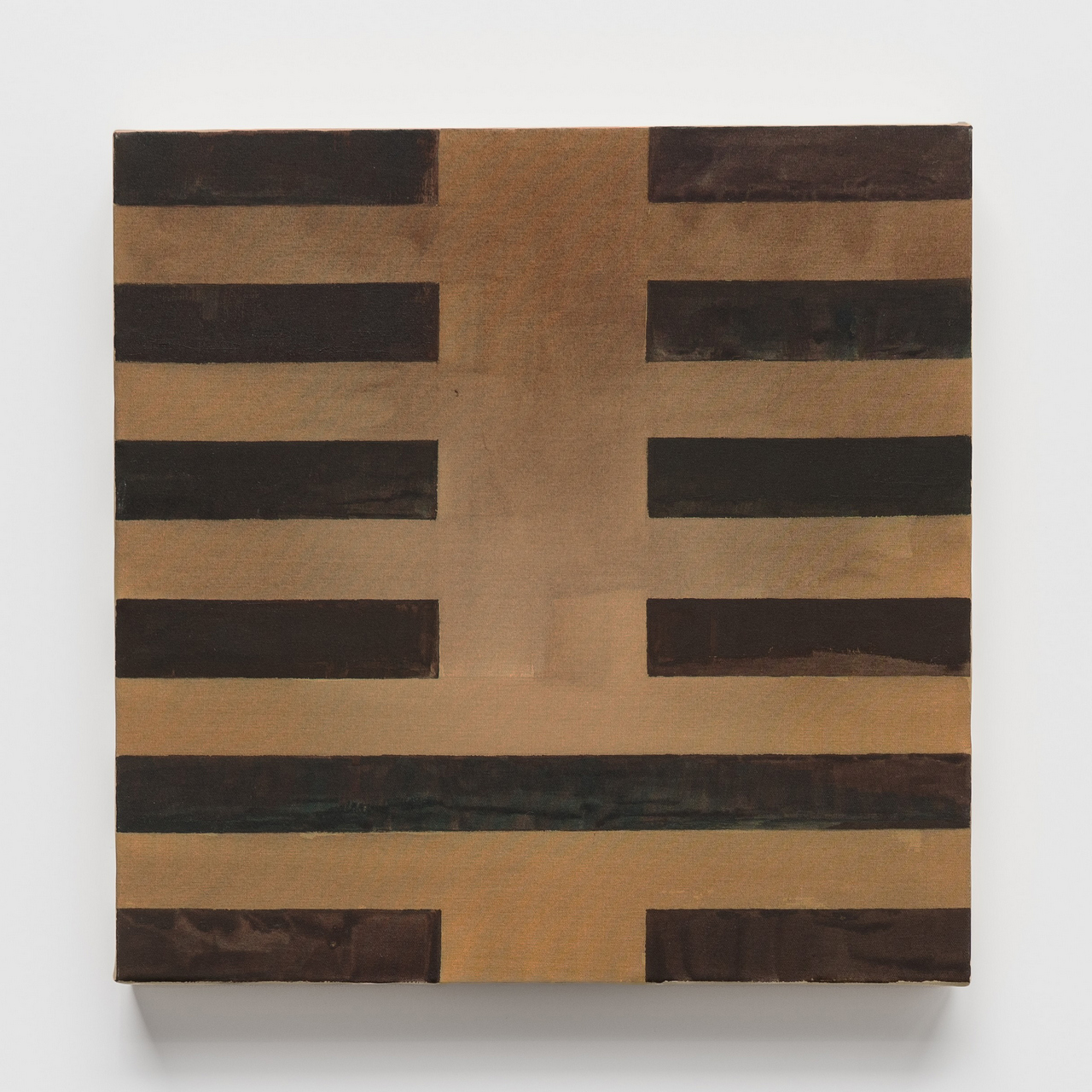
At the core of “Change, I Ching (64 Paintings)” —Zheng’s inaugural solo institutional exhibition at The Renaissance Society in Chicago—is a complete sequence of 64 paintings based on the hexagrams of the I Ching (Book of Changes), one of the oldest texts in Chinese philosophical thought. Each hexagram, composed of six stacked lines, traditionally functions as an archetype of cosmic and human conditions, offering guidance and reflection on transformation and contingency. Rather than depict these hexagrams literally, Zheng abstracts their essence into forms of line, tone, and spatial relation, generating a visual lexicon that resonates with both intuitive immediacy and layered complexity.
These paintings, executed on silk and supported by shaped hardwood stretchers, are not uniform canvases but distinct objects that engage light, space, and perception in subtle yet profound ways. The silk’s translucence activates the interplay between surface and illumination, rendering color and form sensitive to shifts in daylight and architectural context. Zheng’s manipulation of architectural elements within the exhibition space—modulating walls, selectively obscuring windows, and calibrating the perimeter’s rhythm—further attunes the viewer to what she terms “the light of the here and now.” In doing so, light itself becomes a collaborator in the work, animating subtle variations in each piece over the course of the day and establishing a co-responsive relationship between painting and environment. (Conceptually, Zheng situates her practice within a lineage of philosophical inquiry, drawing from thinkers such as John Cage and Yuk Hui, and engaging the I Ching not simply as inspiration but as methodological structure. The I Ching informs the process of making as much as it informs the interpretive horizon of the work: change is not an outcome but an operative principle. Zheng’s paintings thus become meditations on variation and transformation, registers of flux that resist fixed interpretation while implicating the viewer in an active encounter with possibility and contingency.
Importantly, “Change, I Ching (64 Paintings)” is conceived as a singular, total work, despite comprising 64 individual pieces. Each painting contributes to a larger sequence that functions as a comprehensive field of relation, structured yet open, systematic yet intuitive. The exhibition, in this sense, resists compartmentalization; it unfolds as an extended reflection on multiplicity, logic, and the dynamics of change itself.
Zheng’s engagement with form and material—her willingness to allow structural specificity and sensuous ambiguity to coexist—places her work within a broader contemporary discourse on painting’s capacities in the twenty-first century. Her silk surfaces do not merely bear images; they implicate vision in a state of becoming, responsive to shifts in light, space, and perception. In Change, I Ching (64 Paintings), painting becomes an act of transformation, a practice of seeing that foregrounds process, contingency, and the ever-unfolding reality of change.
In bringing Eastern philosophical paradigms into sustained dialogue with Western art histories and contemporary configurational space, Zheng’s work stands as a testament to painting’s enduring relevance—as a mode of thought, a material practice, and a poetic form of inquiry into the conditions of being and becoming.
Photo: Leah Ke Yi Zheng, Change, I Ching (64 Paintings), Exhibition view The Renaissance Society -Chicago, 2026, Photo by Robert Chase Heishman for Bob, Courtesy the artist and The Renaissance Society
Info: Curators: Myriam Ben Salah and Karsten Lund, The Renaissance Society at The University of Chicago, Cobb Hall, 4th Floor, 5811 S. Ellis Ave, Chicago, Il, USA, Duration: 10/1-12/4/2026, Days & Hours: Wed-Fri 12:00-18:00, Sat-Sun 10:00-18:00, https://renaissancesociety.org/