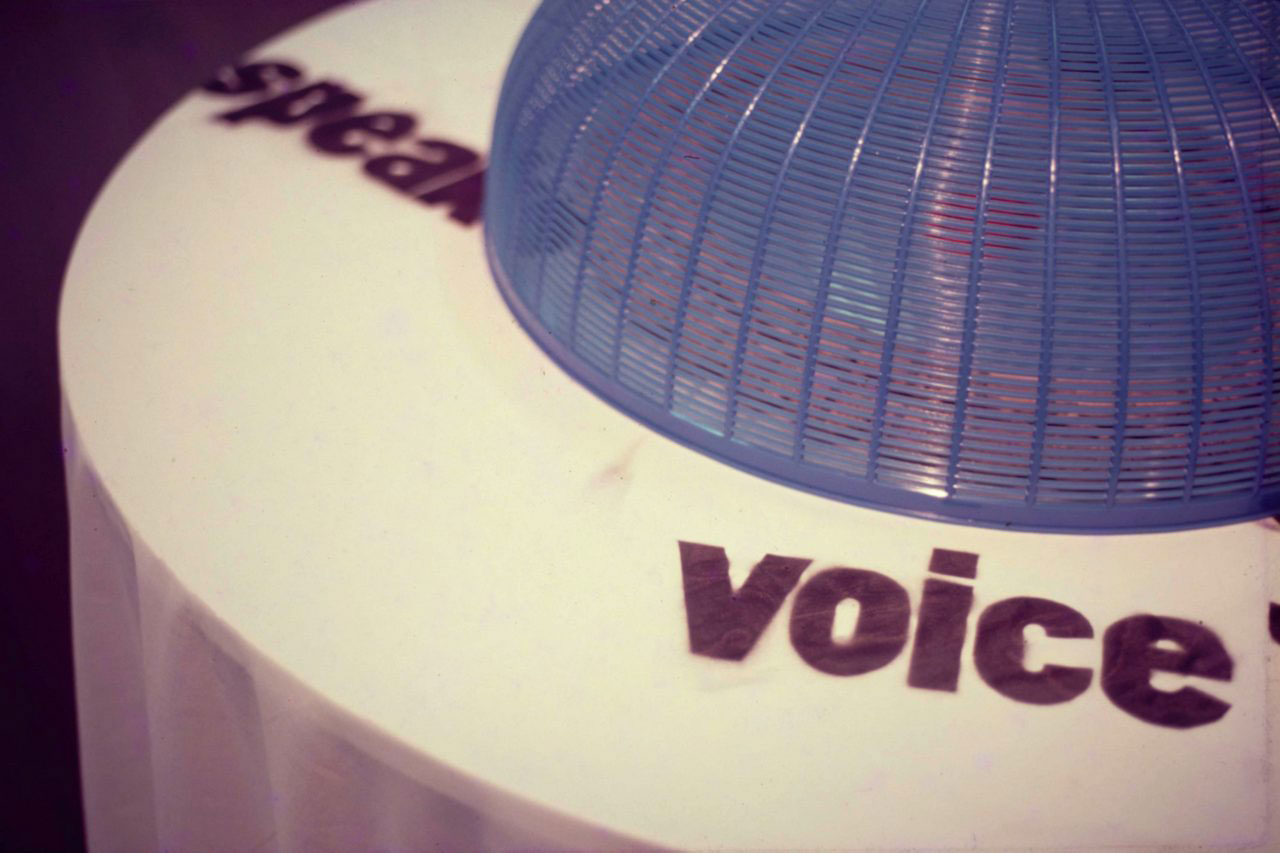
PREVIEW: Fear No Power-Women Imagining Otherwise

The exhibition “Fear No Power: Women Imagining Otherwise” its first exhibition comparing five groundbreaking Southeast Asian artists whose practices reshaped artistic and social norms across the region. The exhibition gathers more than 45 major artworks by and over 110 rarely seen archival materials of Amanda Heng, Dolorosa Sinaga, Imelda Cajipe Endaya, Nirmala Dutt, and Phaptawan Suwannakudt; many which are being presented for the first time.
By Dimitris Lempesis
Photo: National Gallery Singapore Archive
Spanning performance, painting, photography, sculpture, and archival materials, “Fear No Power: Women Imagining Otherwise” offers a rare comparative perspective on how these women used art not only as a form of expression to challenge dominant cultural narratives, but as a means of social engagement, resistance, and collective care. Beyond their individual artistic practices, these five artists have played influential roles as educators, writers, organisers, and community builders whose work shaped cultural conversations within and beyond the art world.
Working across overlapping decades from the 1960s to the 2020s, these artists developed their practices during a period when women in Southeast Asia were navigating deeply entrenched patriarchal norms. Artistic and cultural fields were largely male-dominated, with women’s roles often confined to the domestic sphere, and issues such as care work, reproductive labour, political dissent, and gendered violence were marginalised or rendered invisible in public discourse. Against this backdrop, the artists used art to challenge who could speak, what could be represented, and whose experiences were considered worthy of attention.
The exhibition title is drawn from Dolorosa Sinaga’s sculpture on display “Fear No Power” (2003) and celebrates the artists’ fearlessness in their artistic journeys. It aims to remind that ‘power’ not only refers to the political and authoritarian, but to one’s own inner strength and capacity for resistance, care, and responsibility to others. By extension, the exhibition invites visitors to reflect on what courage might mean to them, and how that strength can be extended to the communities they inhabit.
Presented across three interconnected zones, the exhibition traces how the artists’ practices moved between personal experience, resistance, and collective action. Where the Body Thinks, Worlds Open begins with works rooted in lived experience, reflecting on the body, memory, domestic space, and artistic inheritance as these artists navigated gendered expectations. The second zone, Refusal and Hope, examines how these personal perspectives informed the artists’ responses to wider political, environmental, and social issues. The works bear witness to women’s often overlooked participation in public life and address inequality, displacement, and social change through acts of resistance grounded in everyday realities. The exhibition concludes with Imagining Otherwise, which highlights how these artists’ work and commitments extended beyond individual artmaking, building collectives, sustaining traditions, and creating spaces for dialogue, support, and solidarity.
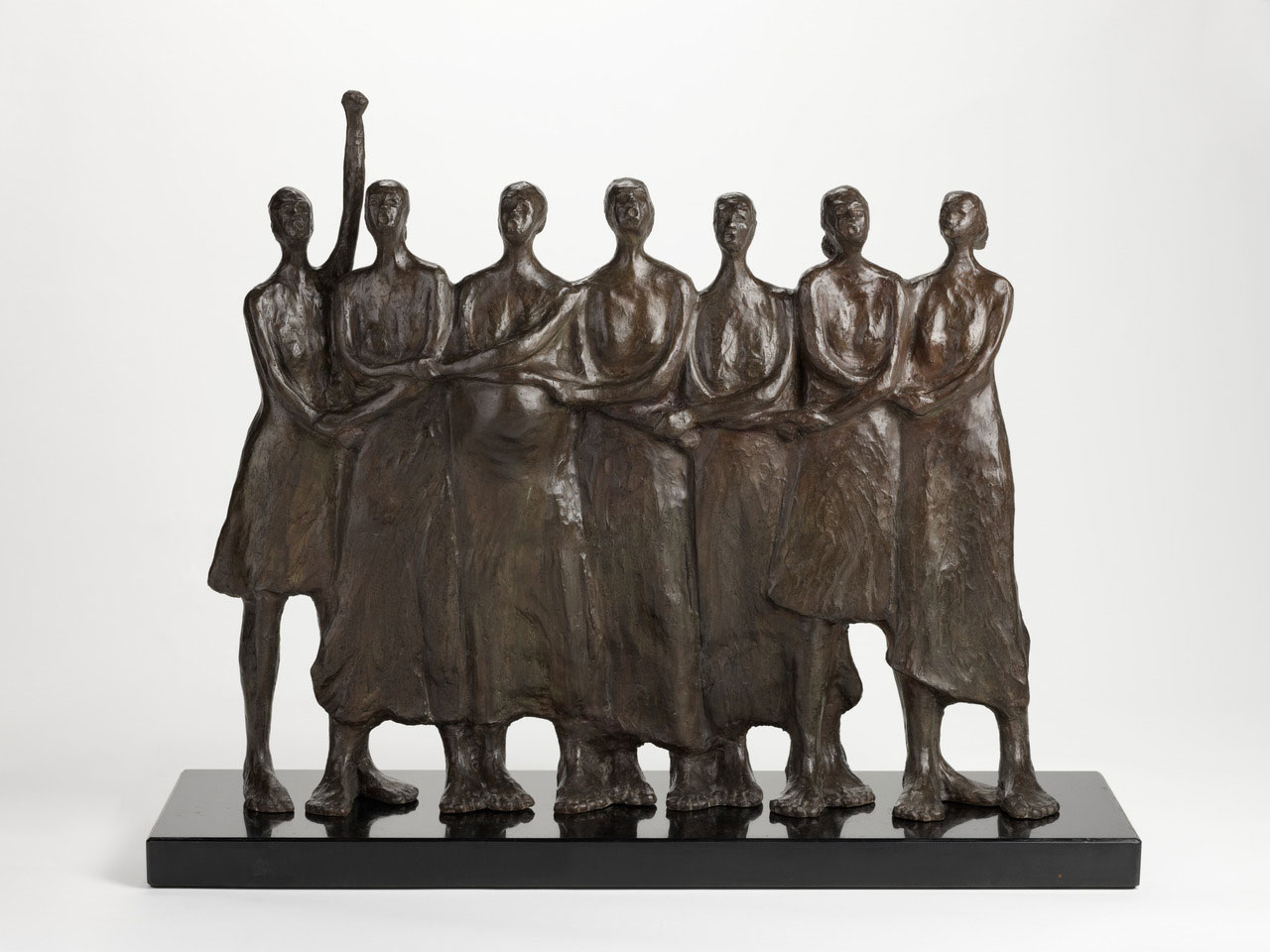
Dolorosa Sinaga’s bronze sculpture “We Will Fight” (2004/2025) is situated outside the gallery’s doors in the Spine Hall. Featuring a group of women leaning upon each other, the sculpture embodies collective strength and solidarity despite the struggles they face. As the first encounter with the exhibition, the sculpture sets the tone for the exhibitin foregrounding women’s experiences and perspectives that have often been displaced from dominant narratives and making space for more diverse voices to be heard.
Inside the gallery, visitors are greeted by Phaptawan Suwannakudt’s “The Sun’s Spell”( 2026), a multi-panel mural installation specially commissioned for the exhibition’s anteroom. Conceived as a palimpsest, the work layers old and new memories, reflecting the artist’s five decades of practice and the communities that have shaped her practice. Featuring texts, motifs, and elements from past works, The Sun’s Spell is a meditation on Suwannakudt’s artistic lineage, expanding upon Thai Buddhist mural painting inherited from her father while reconfiguring it in response to the shifting social and cultural contexts of Thailand and Sydney, where she now lives. The work underscores the inseparability of her art, life, family, and community, making it a compelling anchor for the exhibition’s core themes.
“Where the Body Thinks, Worlds Open”, foregrounds the lived, embodied experiences of the artists and how they have navigated questions of identity, gendered roles, and inequality. Experiences from motherhood, familial relationships, migration, and daily life become starting points for artistic inquiry. Rather than keeping the personal private, these artists drew on their own memories and emotions to interrogate broader power relations, gendered structures, and social expectations, while critically examining the histories of artistic production and representations of women’s bodies.
For instance, Imelda Cajipe Endaya’s early 1974 etching reflects on pregnancy, motherhood, and the shifting inner lives of women at a moment when such themes received little attention in art. Nirmala Dutt’s “Self-Portrait” (1999) conveys her own anguish while urging viewers to confront their own complicity within wider social systems. In “My Mother Was a Nun” I (1998), Phaptawan Suwannakudt bears witness to her mother’s experience as a Buddhist nun, when she was assigned to kitchen duties instead of being allowed access to higher levels of meditative practice – a moment that exposed the artist to entrenched gender hierarchies in Thai society. Dolorosa Sinaga’s sculptures, such as “Resistante” (1994), recast the female figure as an embodiment of agency and resilience, challenging conventional portrayals of women as passive subjects.
The second zonefocuses on the different ways the artists used art to address urgent political, social, and environmental injustices of their time, expressing both refusal to the status quo and expressions of hope. Their works also draw on women’s participation in the socio-political realm, amplifying voices long marginalised or overlooked, and connecting local struggles to broader global forces. Through these acts, they reveal how art can hold both critique and care, offering ways to envision solidarity, agency, and collective transformation.
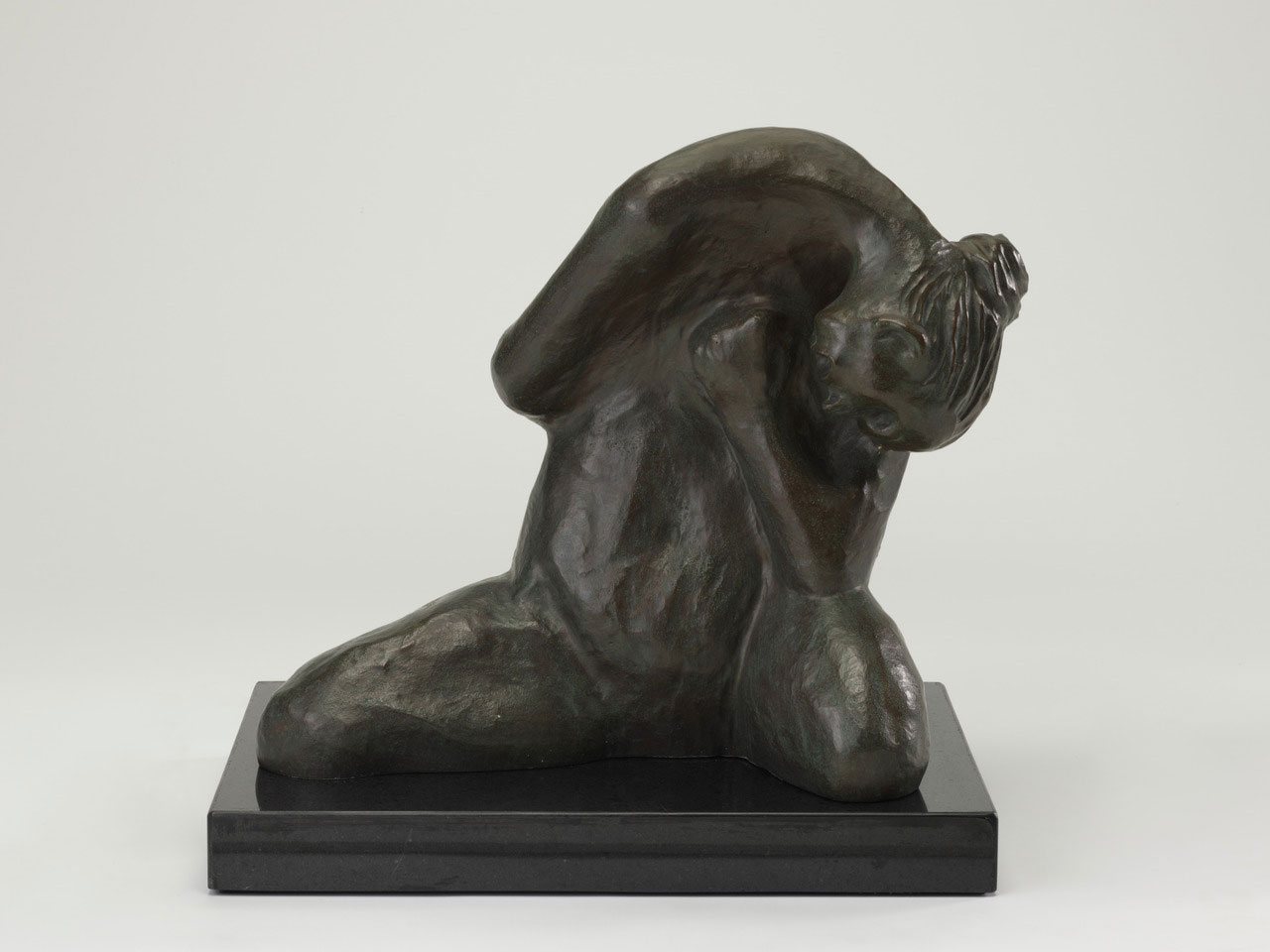
Dolorosa Sinaga’s bronze sculptures “Solidarity” (2000/2025) and “Fear No Power” (2003) are works that reveal the importance of the artist’s humanitarian and cultural activism in shaping her practice. Following her political awakening in the 1990s, Sinaga began producing artworks through which women are at the centre of resisting repressive and political powers. Created in response to the May 1998 Tragedy, “Solidarity” depicts a group of women banded together to form a wall-like structure, suggesting collective empowerment. Their differing clothing suggests varied backgrounds yet unity in shared struggles – a quiet but powerful reminder of collective strength in the face of violence and erasure.
This belief in standing together carries into “Fear No Power” (2003), the sculpture that lends the exhibition its title. Depicting a gagged woman before a wall, with her hands clasped over her chest, honouring the silenced histories of women political prisoners under Indonesia’s New Order regime. Seen together in this section, these works reveal how Sinaga uses art to transform personal and collective hardship into gestures of courage and communal resolve, embodying the zone’s central idea: that refusal – to be silent, to be divided, or to be diminished – can itself be an act of hope.
Imelda Cajipe Endaya’s posters like “Woman Power/Stop Nuclear Plant” were made in protest of the construction of a nuclear power plant in Bataan in the 1970s and 1980s, a province vulnerable to seismic and volcanic activity. Joining women’s activist groups and fellow artists in street protests, Cajipe Endaya and her peers sought new visual languages to situate Filipino women at the centre of sociopolitical events rather than the peripheries. This engagement with the Cold War politics of nuclear power echoed in Nirmala Dutt’s “Anti-Nuclear Piece (Commemoration of Hiroshima day)” (1988). Using the visual language of wayang kulit, Dutt reinforces her anti-war stance and examines how power operates on the global stage through conflict, fear, and the shaping of public narratives.
Other works in this section reflect on questions of labour, with particular attention to domestic work. In the four-month durational project “Home Service” (2003), Amanda Heng, together with her collaborators Twardzik Ching Chor Leng and Vincent Twardzik Ching, reframes domestic labour as a site of dialogue and exchange. The project prompts reflection on the social value of care work that sustains everyday life, yet often remains invisible. The artwork is presented through a video that consists of the advertisement for Home Service, documentation of the dialogues and encounters at some of the homes where the artists serviced, accompanied by the service billboard, flyers, namecards and aprons that were created for this project.
The third zone, “Imagining Otherwise”, highlights how these artists pursued a collective ethos, creating and reimagining spaces that are responsive to women’s needs, and where they are agents of change. Featuring artworks alongside archival materials, this zone focuses on how these artists engage in collective work grounded in ethics of care, shared responsibility, and continuous self-critique. Extending their work beyond the studio, these artists took on roles as teachers, writers, and organisers, often working without hierarchy to foster exchange, friendship, and solidarity.
This section explores collectives including KASIBULAN (est. 1987), People’s Veranda of Garuda (c. 1990s), Womanifesto (est. 1997), and Women in the Arts in Singapore (est. 2000). Together, these initiatives underscore the continuum of the artists’ practices and the critical role women have played in shaping art worlds through collaboration, dialogue, and care.
Imelda Cajipe Endaya’s collage series “Conversations on the Spoliarium” and “Women’s Work”, which engages directly with the gendered hierarchies of Philippine art historical narratives, is featured in this section. Layering reproductions of Juan Luna’s Spoliarium – emblematic of the national masterpiece – with visual elements in the style of artists such as Paz Paterno (1867–1914), Pacita Abad (b. 1946–2004), Agnes Arellano (b. 1949), and Alma Quinto (b.1961), Cajipe Endaya brings them into conversation and restores visibility to women’s work that have long been marginalised in art historical narratives. Mobilising materials historically associated with craft and domesticity; she challenges masculinist notions of mastery and the myth of the singular genius. As the artist reflects, the series questions why women’s work has remained invisible in art history and asserts its place as a vital counter-narrative – honouring women’s creative contributions while troubling the very idea of the “masterpiece.”
Works by: Amanda Heng, Dolorosa Sinaga, Imelda Cajipe Endaya, Nirmala Dutt, and Phaptawan Suwannakudt
Photo left: Imelda Cajipe Endaya. Juan Luna and Pacita Abad. 2004. Oil, acrylic and collage on paper, 63.5 × 44.5 cm. Collection of National Gallery Singapore. © Imelda Cajipe Endaya. Photo right: Imelda Cajipe Endaya. Juan Luna and Paz Paterno. 2004. Oil, acrylic, watercolour, and collage of silkscreen and crochet on arches paper, 65.5 × 45.5 cm. Collection of Amaryllis T. Torres
Info: National Gallery Singapore, 1 St Andrew’s Road,Singapore, Duration: 9/1-15/11/2026, Days & Hours: Daily 10:00-19:00, www.nationalgallery.sg
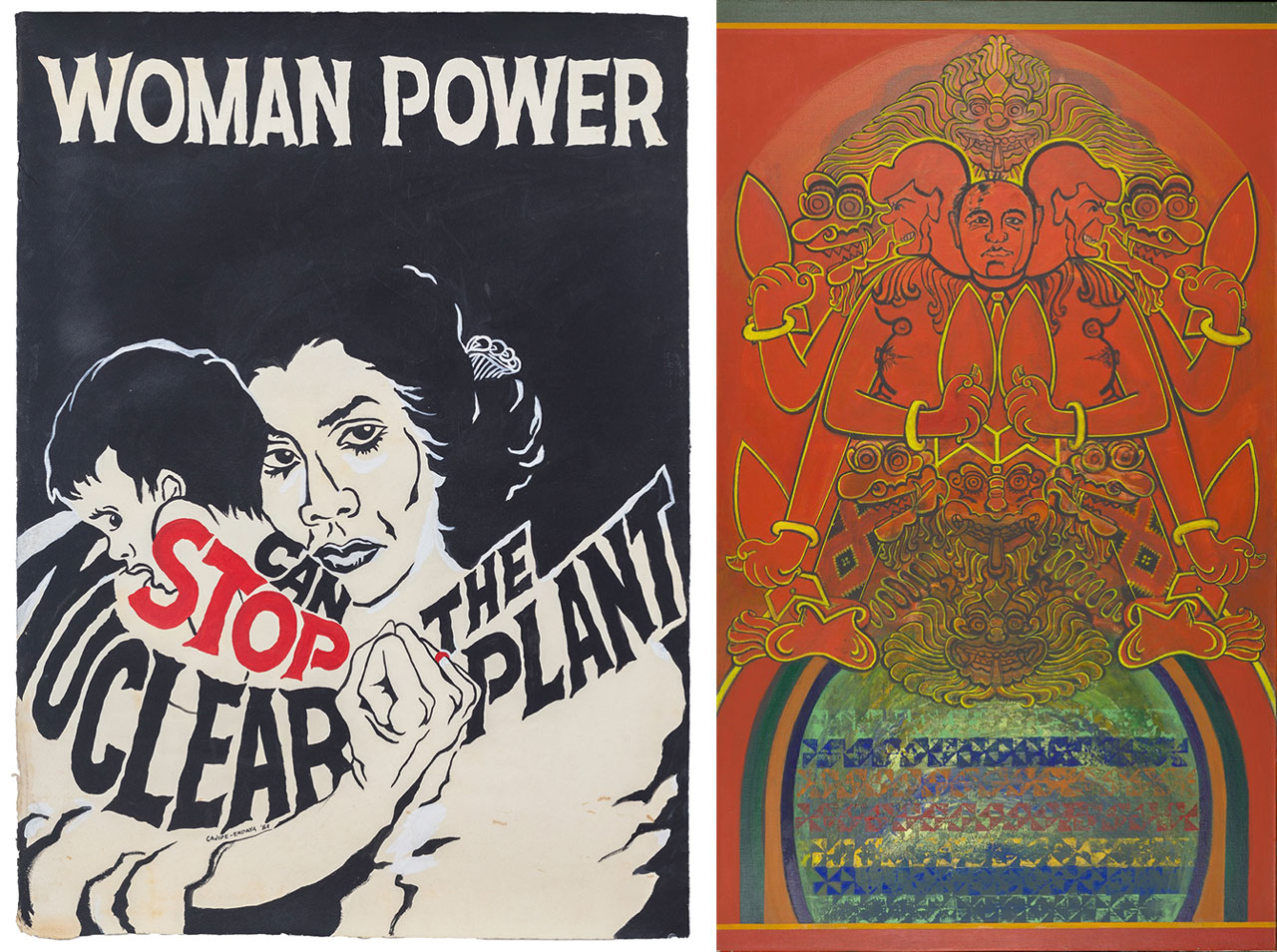
Right: Nirmala Dutt. Anti-Nuclear Piece (Commemoration of Hiroshima day). 1988. Acrylic on canvas, 205.5 × 120.8 cm. Collection of National Gallery Singapore
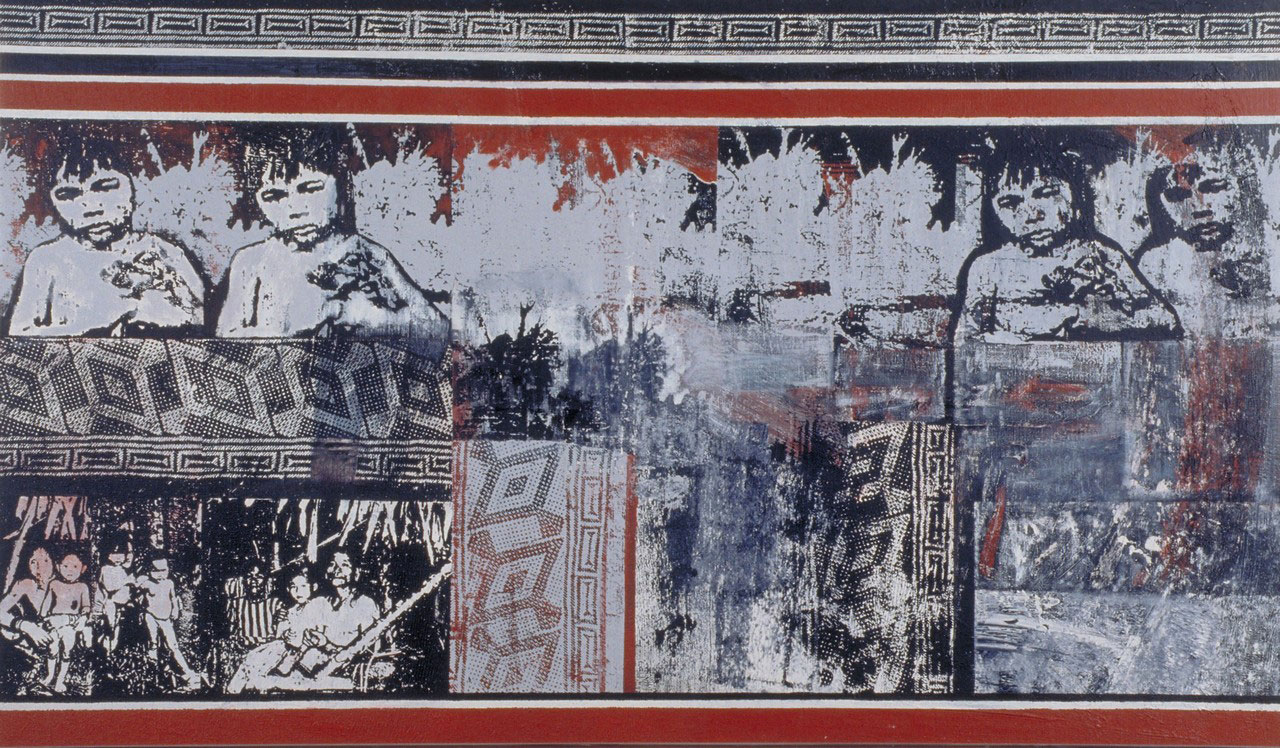
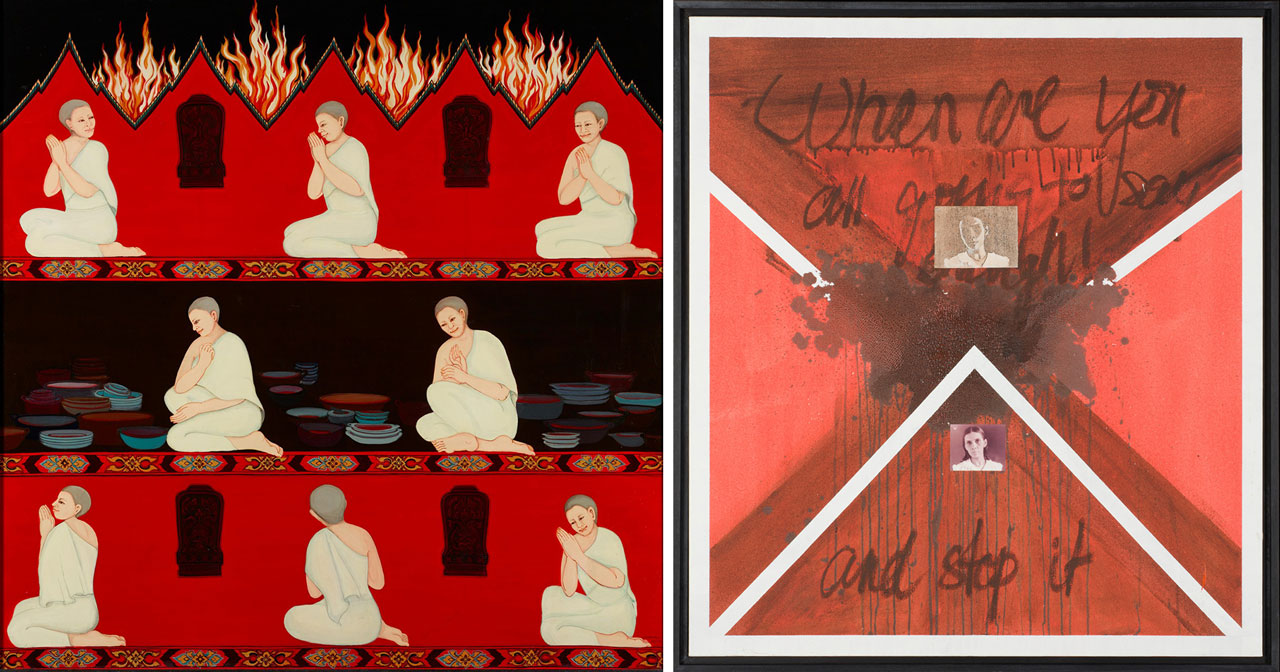
Right: Nirmala Dutt. Self-Portrait. 1999. Acrylic and collage on canvas, 101.5 × 91.5 cm. Collection of National Gallery Singapore
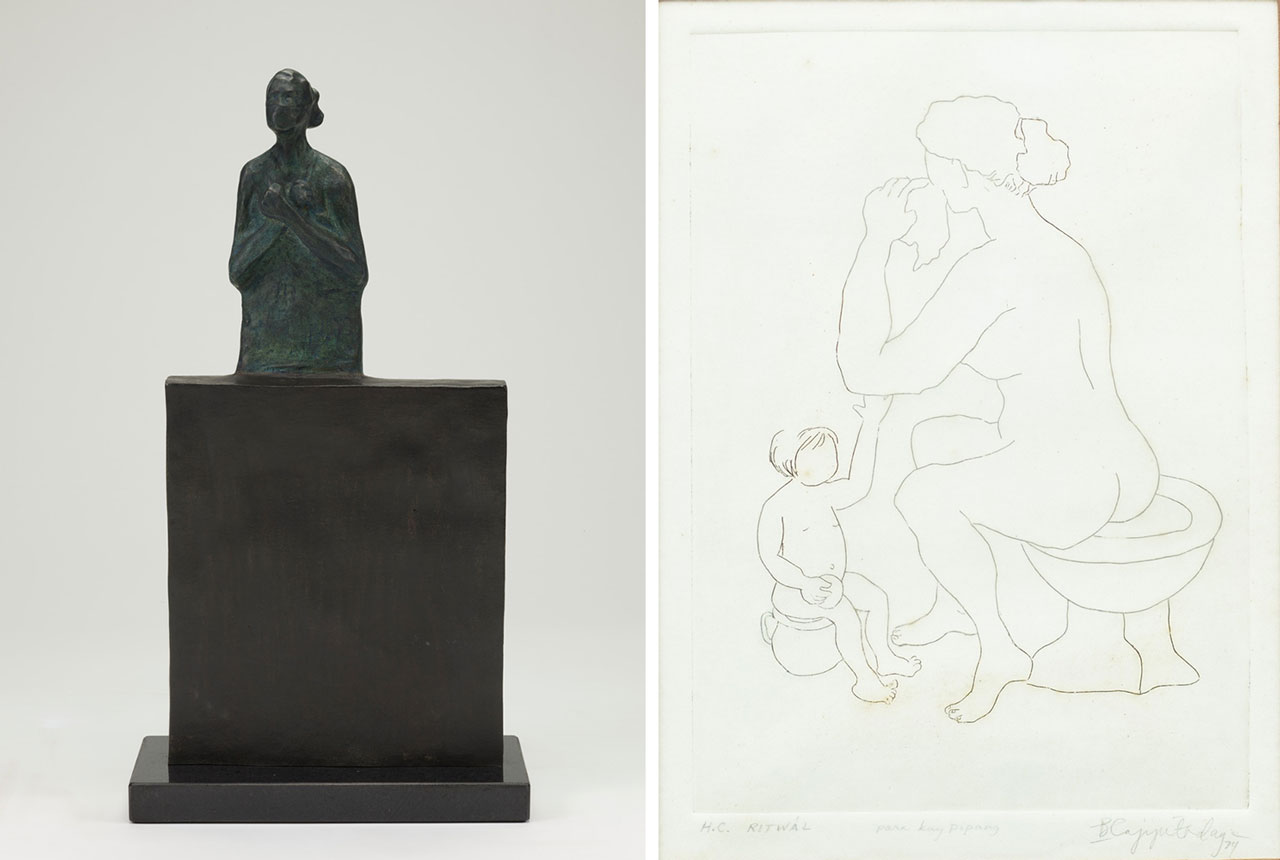
Right: Imelda Cajipe Endaya. Ritwal (Ritual). 1974. Etching, 20.2 × 14.8 cm. Private collection
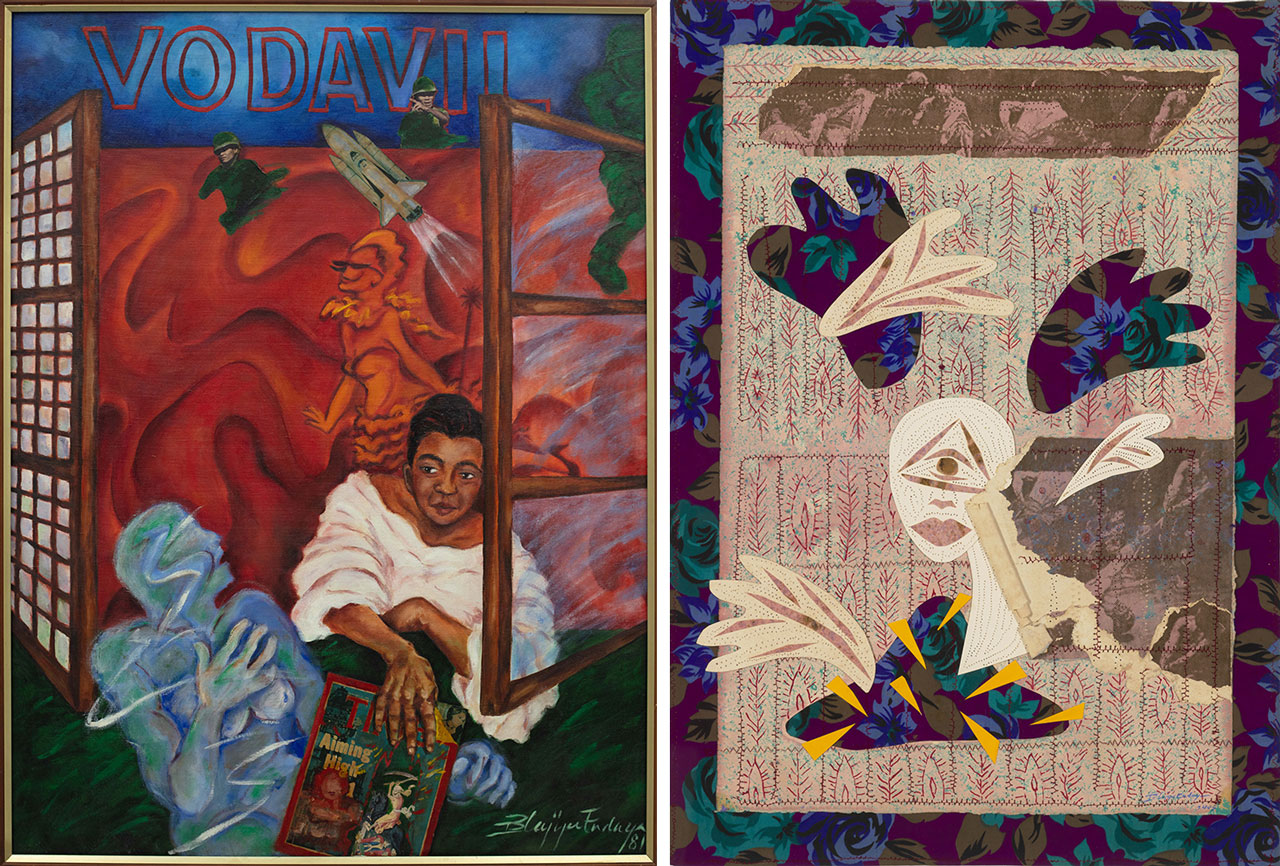
Right: Imelda Cajipe Endaya. Juan’s ‘Spoliarium’ and Alma’s ‘Lipad Suso Lipad’ (Juan’s ‘Spoliarium’ and Alma’s ‘Flying Breasts’). 2004. Oil, acrylic and collage on textile, 64 × 45 cm. © Imelda Cajipe Endaya