PRESENTATION: Hans Op de Beeck-Curiosities, Constellations and Vanishing Points

Hans Op de Beeck work is a reflection on our complex society and the universal questions of meaning and mortality that resonate within it. Op de Beeck shows the viewer non-existent, but identifiable places, moments and characters that appear to have been taken from contemporary everyday life that emphasize the tragicomic absurdity of our postmodern existence. Above all, Hans Op de Beeck is keen on stimulating the viewers’ senses and inviting them to really experience the image. He seeks to create a form of visual fiction that delivers a moment of wonder and silence.
By Dimitris Lempesis
Photo: Galerie Krinzinger Archive
Hans Op de Beeck in his newest solo exhibition “Curiosities, Constellations and Vanishing Points” presents a cohesive collection of new sculptures and an animated film. This exhibition consists of two parts: a Wunderkammer* and a projection space with Op de Beeck’s latest animation film, entirely based on black-and-white watercolor paintings.
The first part of the exhibition resembles a large Wunderkammer, in which references to the dichotomy of culture versus nature are eclectically and anachronistically intertwined, as was the tradition in old cabinets of curiosities. This body of works contains numerous references to fossilised natural elements, animals, mysticism, planetariums, astronomy, early science, oral traditions and imagery as well as allusions to contemporary digital imaging and semantics. Furthermore, through a reflection on human macro-organisms, such as the architectural grids of cities, the artist also -curiously- arrived at what looks like abstract modernist compositions. For the first time Op de Beeck uses both text and kinetic components in some of his sculptural works, such as planetariums rotating on their axis or a life-size crow flying in place. The works in the Wunderkammer section poetically question our relationship to the immensity of the universe, as well as the banal world of everyday life. They play with the classical, existential idea of the ‘memento mori’. Nevertheless, this part of the exhibition also contains light-hearted, playful and ludicrous elements in which the artist takes the liberty of making illogical and absurd leaps through free association.
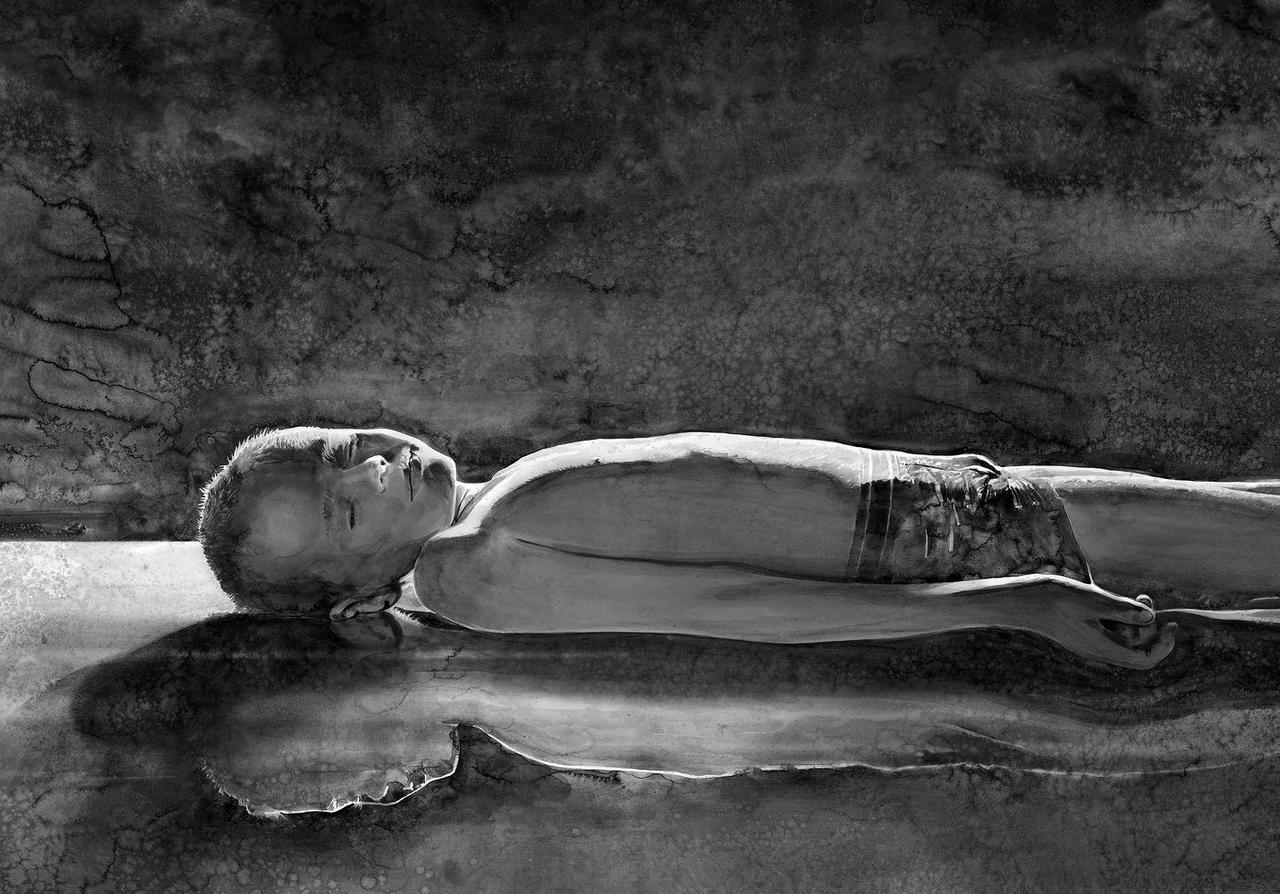
The second part of the exhibition is a film, titled “Vanishing Point”, which refers to a point in a picture plane of a perspective view where mutual parallel lines seem to converge. At the distance of a vanishing point, we can no longer perceive three-dimensional depth. Op de Beeck uses the term metaphorically, as a tipping point from which we shift from measurability and legibility into the unknown, indecipherable, and incomprehensible, or from the concrete to the abstract, mental to spiritual. The film starts with the image of a little boy resting peacefully on his back with his eyes closed. Next, we are transported to fictional landscapes, still lifes and figures, musically accompanied by a specially created composition by composer-musician Sam Vloemans, performed by the Hermes Ensemble. Together with the music, the watercolors are brought to life creating a sweeping, tranquil mood that invites one to briefly disappear into a moment of letting go.
‘Vanishing’, on its own, means ‘disappearing suddenly and completely’, or, in mathematical terms, ‘becoming zero’. Op de Beeck is fascinated by the moments when, as human beings, we briefly become nothing or nobody—when we let go of our linguistic, logical, and rational understanding of the world and slip into a state of self-loss and timelessness.
*Wunderkammers German for Cabinets of curiosities were encyclopedic collections of objects whose categorical boundaries were, in Renaissance Europe, yet to be defined. Although more rudimentary collections had preceded them, the classic cabinets of curiosities emerged in the sixteenth century. Cabinets of curiosities served not only as collections to reflect the particular interests of their curators but also as social devices to establish and uphold rank in society.
Photo: Hans Op de Beeck, Mountainscape, 2024, polyester, metal, coating, AP 1 (Ed. 3 + 2 AP), 81 x 103 x 13.5 cm, © Hans Op de Beeck, Courtesy the artist and Galerie Krinzinger
Info: Galerie Krinzinger, Seilerstätte 16, Vienna, Austria, Duration: 2/11/2025-18/2/2026, Days & Hours: Tue-Fri 12:00-18:00, Sat 11:00-16:00, https://galerie-krinzinger.at/
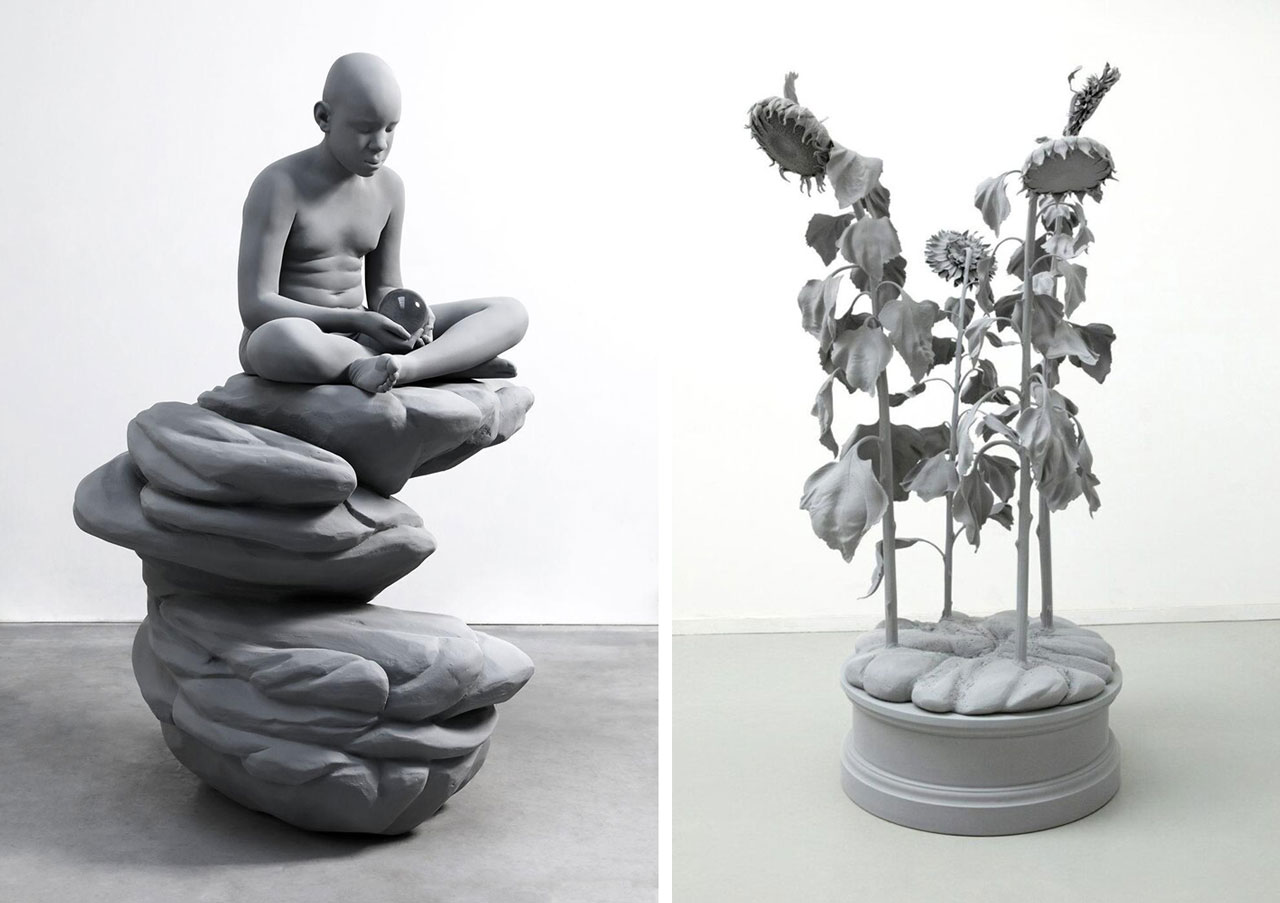
Right: Hans Op de Beeck, Sunflowers, 2025 , wood, polyester, metal, polyamide, coating , 1/3 (Ed. 3 + 2 AP), 208 x 77 x 77 cm, © Hans Op de Beeck, Courtesy the artist and Galerie Krinzinger

Right: Hans Op de Beeck, Small Constellation (Touch), 20255, polyester, metal, coating, Unique, 152 x 69 x 62 cm, © Hans Op de Beeck, Courtesy the artist and Galerie Krinzinger


Right: Hans Op de Beeck, Small Constellation (Passion), 2025, polyester, metal, coating, Unique, 185 x 84 x 51 cm, © Hans Op de Beeck, Courtesy the artist and Galerie Krinzinger
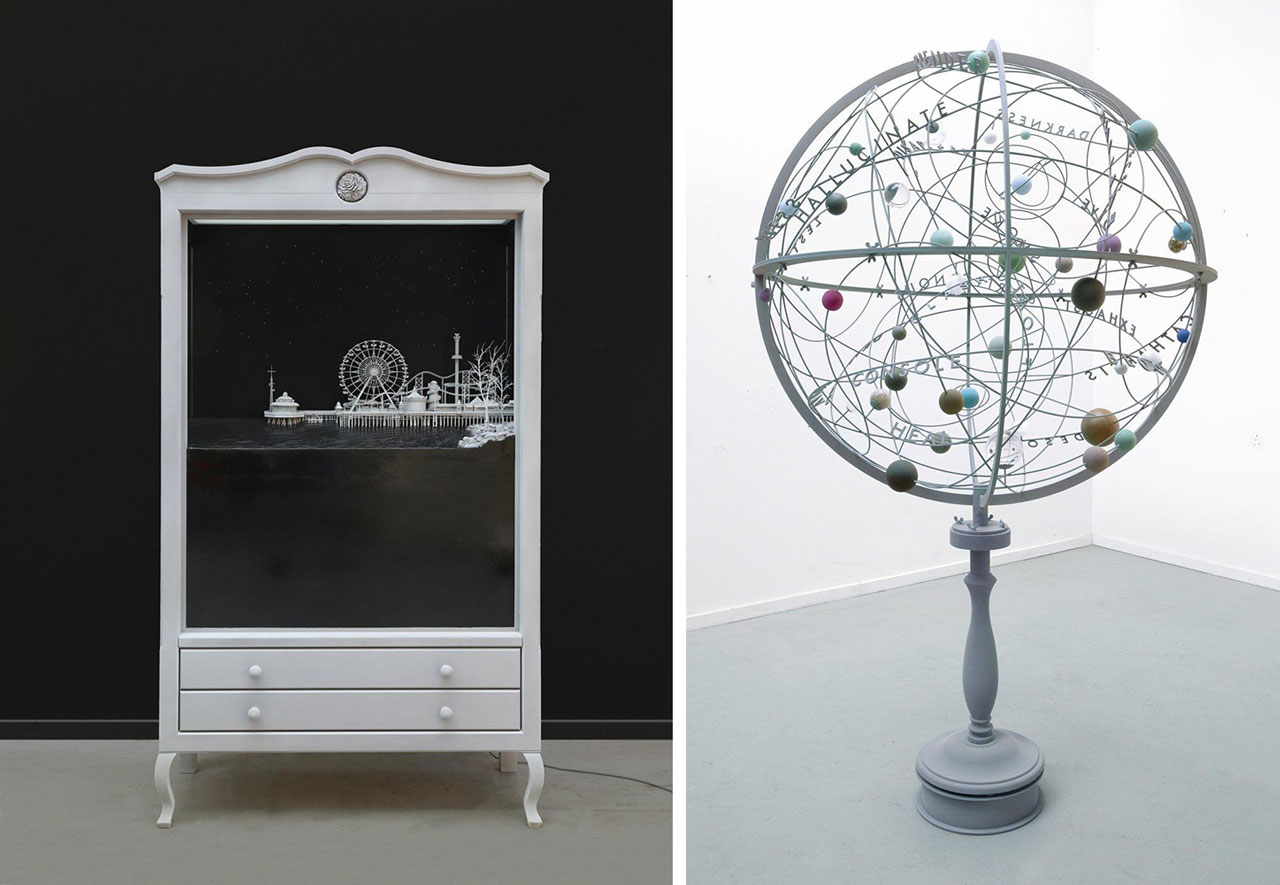
Right: Hans Op de Beeck, Orrery (Loss), 2025, metal, coating, glass, acrylic, natural stones, Unique, 232 x 130 x 130 cm, © Hans Op de Beeck, Courtesy the artist and Galerie Krinzinger