PRESENTATION: Magdalena Abakanowicz-The Fabric of Existence

Magdalena Abakanowicz is a leading figure on the 20th-century Polish art scene, Abakanowicz experienced war, censorship, and deprivation from an early age under the communist regime. She produced sculptures and immersive textile works that are poetic, sometimes unsettling, and often political. Inspired by the organic world, by seriality, and by monumentality, her work possesses undeniable power and presence, resonating with contemporary concerns—environmental, humanist, and feminist.
By Dimitris Lempesis
Photo: Bourdelle Museum Archive
With “The Fabric of Existence”, France finally hosts a major retrospective dedicated to Magdalena Abakanowicz, one of the most radical and influential sculptors of the second half of the 20th century. Presented through a chrono-thematic parcours of seventy ensembles—sculptural installations, textiles, drawings, and photographs—the exhibition restores Abakanowicz to her rightful place within the canon of modern sculpture, beyond the reductive category of textile art to which she was too often confined. The exhibition’s subtitle, “The Fabric of Existence”, borrows the artist’s own vocabulary and encapsulates her worldview. For Abakanowicz, fabric was not merely a medium but an ontology: the elemental organism of the human body, marked, stitched, wounded, and shaped by history. Born in Poland in 1930, her life and work were profoundly shaped by war, totalitarianism, material scarcity, and censorship. These experiences permeate an oeuvre that is at once organic and political, intimate and monumental.
The visitor’s journey begins outdoors, where the monumental “Great Figure” stands in the garden like a silent sentinel. Stripped of individuality yet charged with presence, it immediately announces the artist’s central concerns: the body, anonymity, and scale. Inside, the first section offers a broad overview of Abakanowicz’s practice, from early woven works to small anatomical sculptures, drawings, and proposals for public space. This introductory ensemble reveals the continuity of her thinking across media and decades.
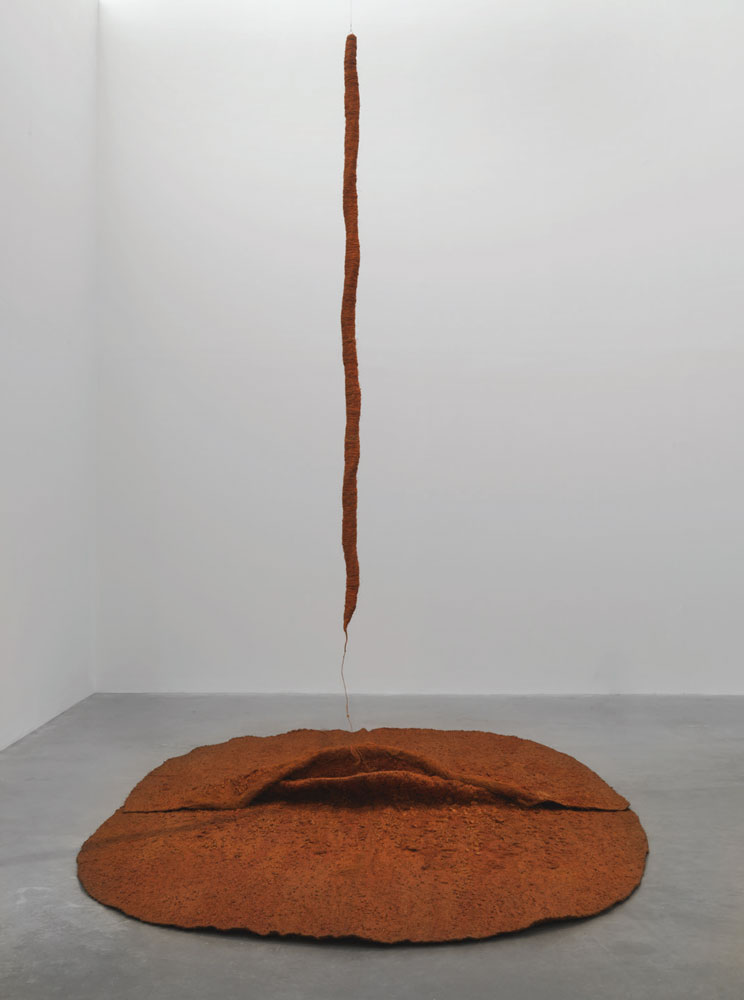
The heart of the exhibition lies in the emergence of the “Abakans”, begun in the mid-1960s. These suspended textile forms marked a decisive rupture with traditional tapestry. Freed from the wall, weaving became sculpture—expansive, immersive, and spatial. The 1969 International Tapestry Biennial in Lausanne, where the four-meter-wide “Red Abakan” unfurled in space, was a turning point not only for Abakanowicz but for the history of fiber art itself. Conceived and assembled in the cramped conditions of her studio using salvaged ropes and fabrics, the “Abakans” oscillate between concealment and revelation. Their slits, folds, and cavities evoke organic analogies—skins, bark, fur, flesh—while resisting fixed interpretation. Neither inside nor outside, neither center nor periphery, they exist as autonomous environments. Their very genesis, under a repressive regime and amid material deprivation, constitutes an act of resistance: a reclaiming of space, history, and embodied memory.
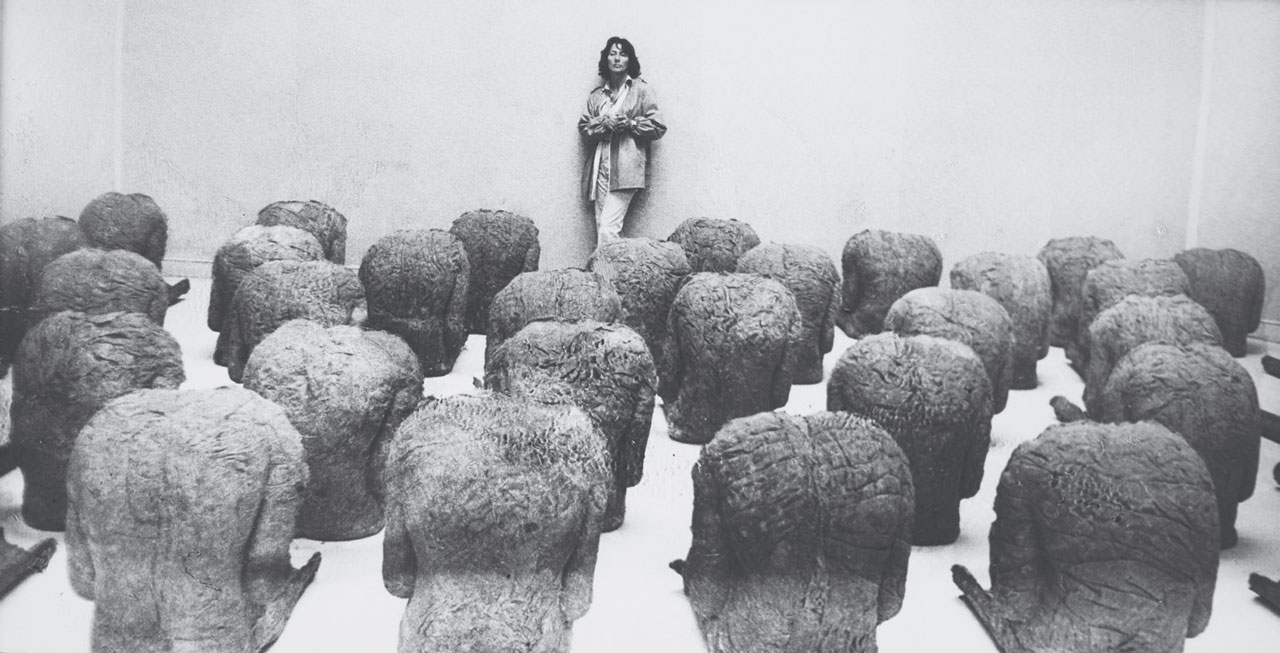
In the 1970s, Abakanowicz turned decisively toward figuration. Through casting the human body and lining molds with resin-hardened burlap, she produced hollow shells whose textures resemble skin or tree bark. Works such as “Backs” (1978–1980) confront viewers with headless, anonymous figures—bodies turned away, stripped of identity. Abakanowicz described them as expressions of the human condition itself. Arranged in semi-circular formations, these figures also suggest ritual assemblies, echoing sculptural experiences the artist encountered in Papua New Guinea. This ritual dimension resurfaces in “Dancing Figures”, inspired by the Japanese avant-garde dance form butō, whose convulsive, anguished movements emerged in the shadow of Hiroshima. The resulting sculptures capture a suspended motion—simultaneously liberating and unsettling—a “dance without a face, a dance toward nowhere.”
A decade after the invention of the “Abakans”, Abakanowicz pushed further into environmental sculpture with “Embryology”, first presented at the Polish Pavilion of the 1980 Venice Biennale. Composed of hundreds of cocoon-like forms made of hemp and linen, sutured yet open, the installation immerses the viewer in a landscape of morphogenesis. These forms hover between cell, tissue, and stone, collapsing distinctions between the human body and the natural world. The accompanying “Compositions”—ink drawings made through rotational gestures and washes—extend this investigation across media. Whether sculptural or graphic, Abakanowicz’s work insists on continuity: life as a process of self-generation, division, and transformation.
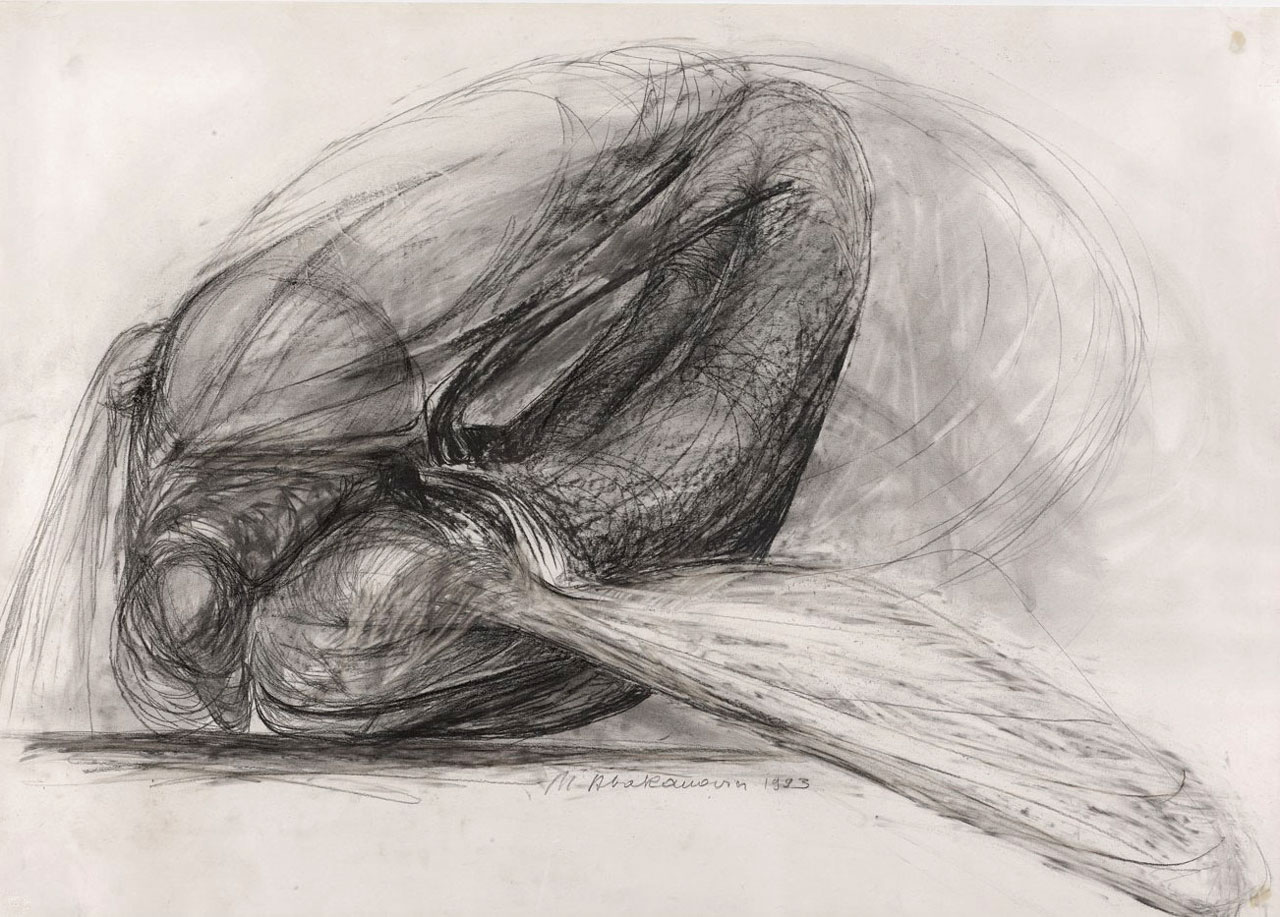
From the 1980s onward, drawing assumed a central role in her practice. The “Faces” series (1983–2004), rendered in black ink and gouache, are not portraits but spectral apparitions—faces crossed with icons, poised between abstraction and figuration. They carry the same ritual force as the anonymous burlap masks encountered earlier in the exhibition. In contrast, the monumental charcoal drawings of “Flies” (1993–1994) enlarge dead insects to microscopic scale. Far from morbid, these works reveal an almost scientific curiosity about organic structure, transforming an everyday sight into a meditation on fragility and materiality.
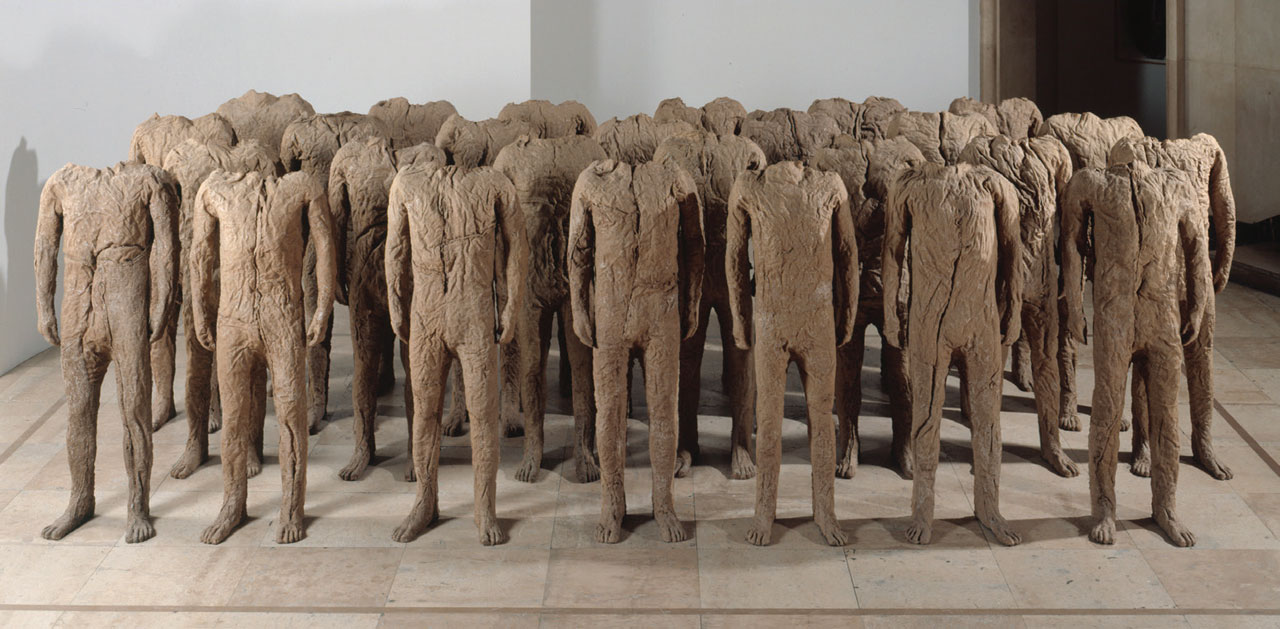
The exhibition’s later sections confront collective bodies and latent violence. The “Mutants”, hybrid creatures combining vegetal trunks and animal limbs, evoke both fascination and dread. Blind and vulnerable, they oscillate between sacrificial victims and totemic presences. The “Crowd” series (1986–1997), derived from repeated casts of a standing male figure, addresses the crushing force of mass ideologies. Through subtle variations in folds and posture, Abakanowicz insists on individuality within anonymity, even as the figures form an oppressive barrier—both shield and accusation.
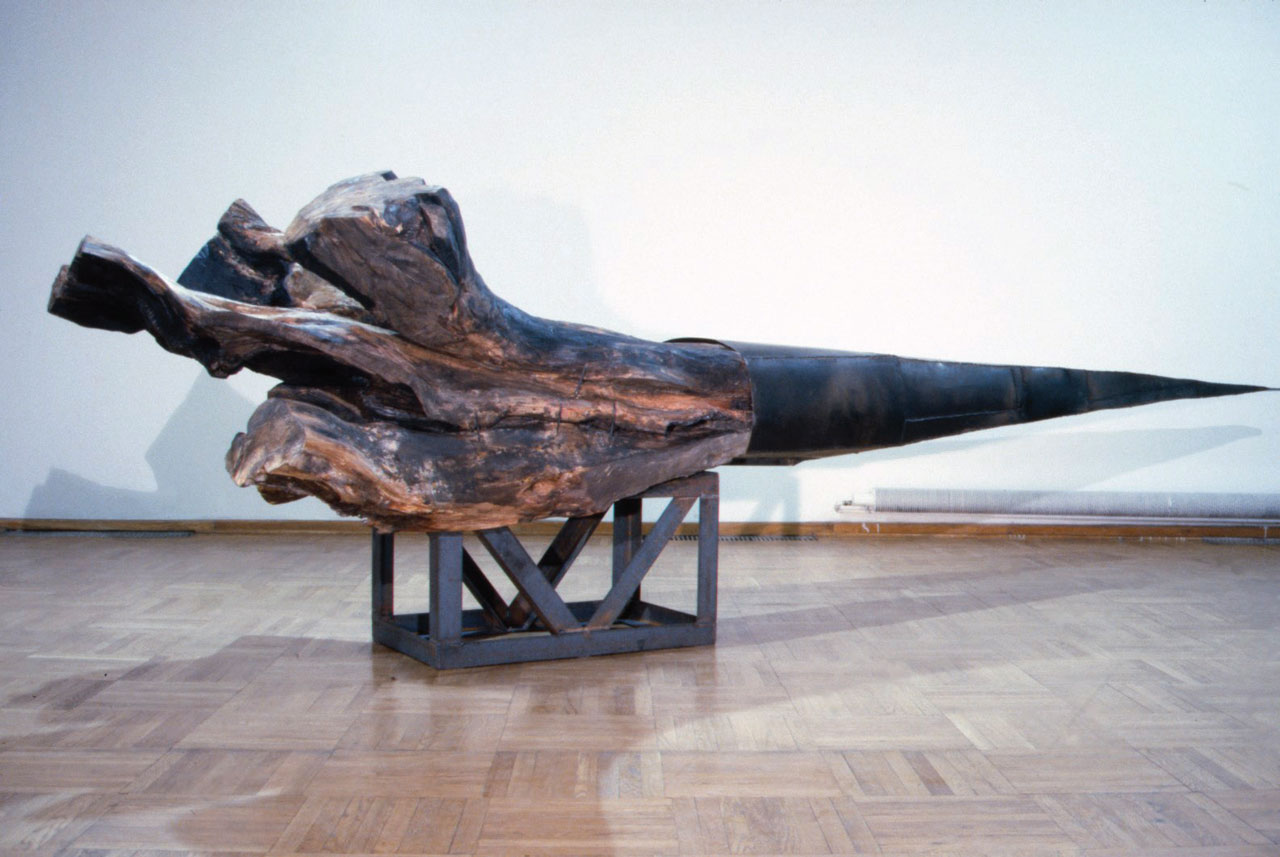
The exhibition concludes with “War Games” (1987–1995), a cycle forged during the collapse of the communist regime. Massive tree trunks from the Mazurian region are bound with steel hoops, evoking wounded bodies, weapons, and collective trauma. In works such as “The Magpie” and “The Ploughman”, organic matter confronts industrial metal, life confronts destruction. These sculptures resonate as both personal and universal allegories: of history’s violence, of humanity’s resilience, and of the artist herself grappling with resistant matter.
“The Fabric of Existence” reveals Abakanowicz as an artist of profound coherence and moral urgency. Across textiles, sculpture, and drawing, she wove a body of work that confronts the viewer with fundamental questions of existence: individuality and mass, vulnerability and power, nature and history. In doing so, the exhibition affirms her position not only as a pioneer of fiber-based sculpture but as one of the great sculptors of the 20th century—an artist whose work remains urgently resonant today.
Photo: Magdalena Abakanowicz. Abakan rouge, 1969, Tate, Présenté anonymement, 2009. Photo: © Magdalena Abakanowicz
Info: General Curator: Ophélie Ferlier Bouat, Scientific Curators: Jérôme Godeau, Colin Lemoine, Assistant Curator: Margaux Coïc, Musée Bourdelle, 18 rue Antoine-Bourdelle, Paris, France, Duration: 20/11/2025-12/4/2026, Days & Hours: Tue-Sun 10:00-18:00, www.bourdelle.paris.fr