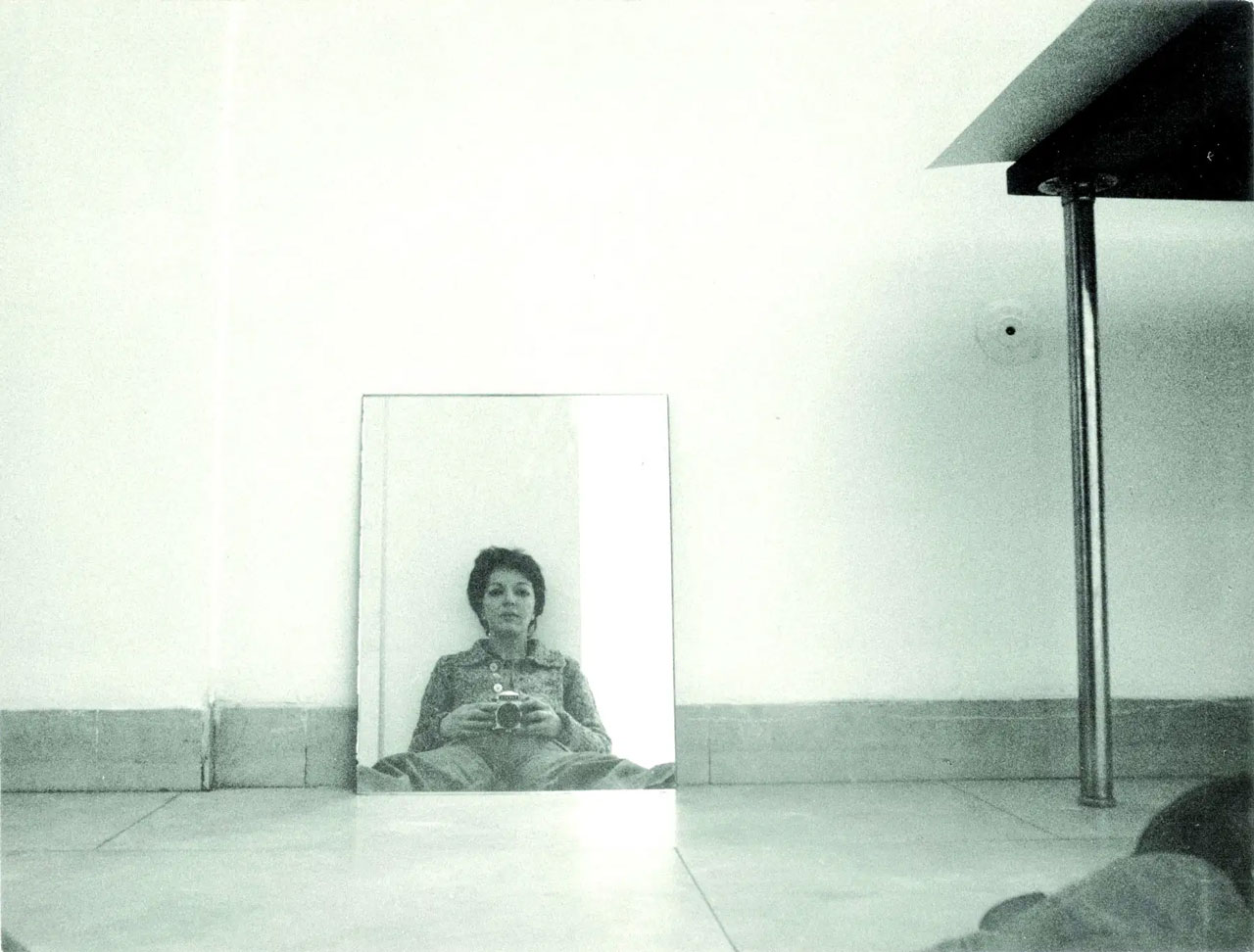
PRESENTATION: Valie Export & Ketty La Rocca-Body Sign

Valie Export and Ketty La Rocca, are two of the most visionary feminist conceptual artists to emerge in Europe during the 1960s. Both artists used their bodies as tools to challenge language’s patriarchal function and expose the dichotomy between its role in public and private space. They recognised that in order to convey their ideas an expanded field of action was required and moved beyond the constraints of a single medium.
By Efi Michalarou
Photo: Thaddaeus Ropac Gallery Archive
In an unprecedented curatorial dialogue, the exhibition “Body Sign” brings together two visionary artists of the 1960s and 1970s — Valie Export (Vienna) and Ketty La Rocca (Florence) — whose practices, though developed independently and without personal encounter, reveal profound conceptual and political affinities. Both artists articulated a radical challenge to patriarchal modes of representation, positioning the female body and non-verbal systems of meaning at the core of a reimagined artistic language.
Export and La Rocca emerged at a moment when mainstream conceptual art was dominated by dematerialization and linguistic abstraction. Yet their works insistently reinvest the body with agency, pushing back against a system of symbols and communication structures shaped by male authority. As Export insisted, the period demanded the development of “other forms of language outside of the system dominated by men.” Likewise, La Rocca asserted that women could not afford rhetorical declarations within established discourse because they “would then have to use language that is not their own, language that is both alien and hostile to them.”
Hands — the primary organ of touch — feature centrally in both artists’ investigations. For La Rocca, hands are expressive instruments that transcend verbal language. In her 1972 video “Appendice per una supplica”, male and female hands trace choreographed movements as an exploration of gesture as “a universal language beyond words.” Through this work and others, La Rocca sought to forge direct communicative forms grounded in embodied expression.
For Export, the body itself becomes a tactile medium. Her seminal “Tapp und Tastkino” (Touch Cinema, 1968) invited viewers to insert their hands into a box strapped to her torso to touch her breasts, effectively transforming her naked body into a corporeal cinema screen. Through this provocative inversion of the spectator’s gaze, Export reframed the act of looking — and touching — as a participatory, somatic encounter rather than a passive visual consumption.
Both artists extended their critique into the public sphere through interventions in urban space. La Rocca’s collaborations with the Florentine avant-garde group Gruppo 70 disrupted normative visual communication systems by distributing poetry in the streets, inserting collages into magazines, and altering traffic signs along the A1 motorway in “Engagement” (1967). These acts destabilized the authority of everyday signage and highlighted tensions between personal expression and shared codes of communication.
Export’s “Body Configurations” (1972–82) series likewise engages the city as a semiotic field. Here, the artist positions her body within architectural niches, corners and pavements of Vienna, sometimes aligning her posture with structural elements or marking the interaction with black and red lines. Her contorted forms measure and reveal the mutual shaping of identity and built environments, transforming the body into both tool and symbol.
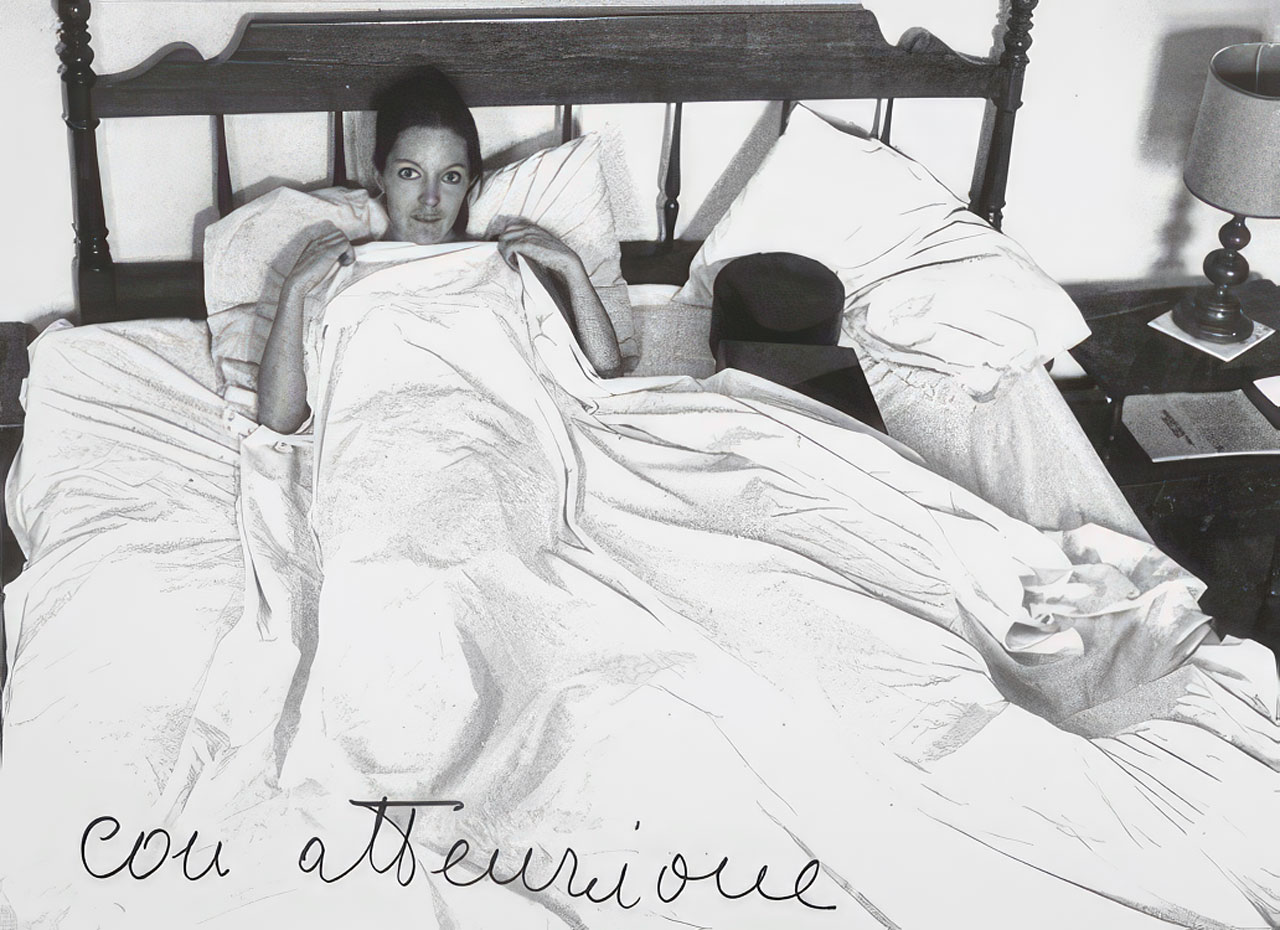
La Rocca’s sculptural works from 1970 — pieces she described as “alphabetic presences” — further articulate her critique of conventional systems of meaning. In “J with dot (three dimensions0”) (1970), a life-sized PVC letter (absent from the Italian alphabet) stands in for the French je (‘I’), embodying a linguistic identity that eludes her native tongue. In the photograph “Con attenzione” (1971), she positions herself with this character, offering a meditation on the interplay between language, self and estrangement.
Export’s 1970 photo series “BODY SIGN B” stages a different mode of semiotic disruption. In one striking image, she lifts her dress to reveal a garter tattooed on her thigh — a gesture that subverts fetishistic and patriarchal visual codes. Through this act of self-inscription, Export reclaims and reconfigures the semiotics of the female body, challenging the viewer’s gaze while foregrounding agency and autonomy.
La Rocca also explored the internal structures of meaning in her “Craniologie” series (1973), where double exposures of skull X-rays, gestural hand photographs, and repeated textual elements converge to interrogate the limitations of isolated expressive modes — mind and body, image and word.
Although their trajectories were geographically and contextually distinct, Export and La Rocca articulated parallel strategies that expanded the conceptual art canon by reinvesting it with the embodied female perspective. La Rocca’s brief but intense career, cut short by her death in 1976, has since been recognized through numerous retrospectives and institutional presentations, underscoring her enduring impact on Italian and international art.
Export, born in 1940 and active across performance, film, photography and expanded cinema, remains a pivotal figure whose influence extends into contemporary discourse on gender, media and the body. Ketty La Rocca born in1938, ranks among the most important proponents of Conceptual and Body Art in Italy in the 1960s and 70s. Based on a visual poetry, she radically dealt with the sociopolitical limits of the meaning of language and image. A central aspect is the examination of the bodily gesture as an “original means of communication” that is not precoded by society.
In their practices, Export and La Rocca negotiate language as a tool of the patriarchy. Working with and against this reality, they collude with language as sign, material and system, co-opt it for their own purposes, and circumvent its usage in conventional social contexts. Their visual experiments expand beyond the confines of the page: by inserting their bodies into the realm of language and vice-versa, they reveal the absurdity, and in turn the artistic and societal possibilities, of combining these systems of communication.
Photo left: VALIE EXPORT, SYNTAGMA, 1983 (film still) , 16 mm, 18 min, colour, © VALIE EXPORT / SIAE 2025. Courtesy of Thaddaeus Ropac Gallery, London, Paris, Salzburg, Milan, Seoul. Photo right: KETTY LA ROCCA, Le mie parole e tu (3), 1971 (detail), Photograph with handwritten text, 60 × 50 cm (23.62 × 19.69 in), ©Archive Ketty La Rocca Michelangelo Vasta. Courtesy of Thaddaeus Ropac Gallery, London, Paris, Salzburg, Milan, Seoul
Info: Curators: Andrea Maurer and Alberto Salvadori, Thaddaeus Ropac Gallery, Piazza Belgioioso 2, Milan, Italy, Duration: 16/12/2025-28/2/2026, Days & Hours: Tue-Fri 11:00-19:00, Sat 11:00-17:00, https://ropac.net/
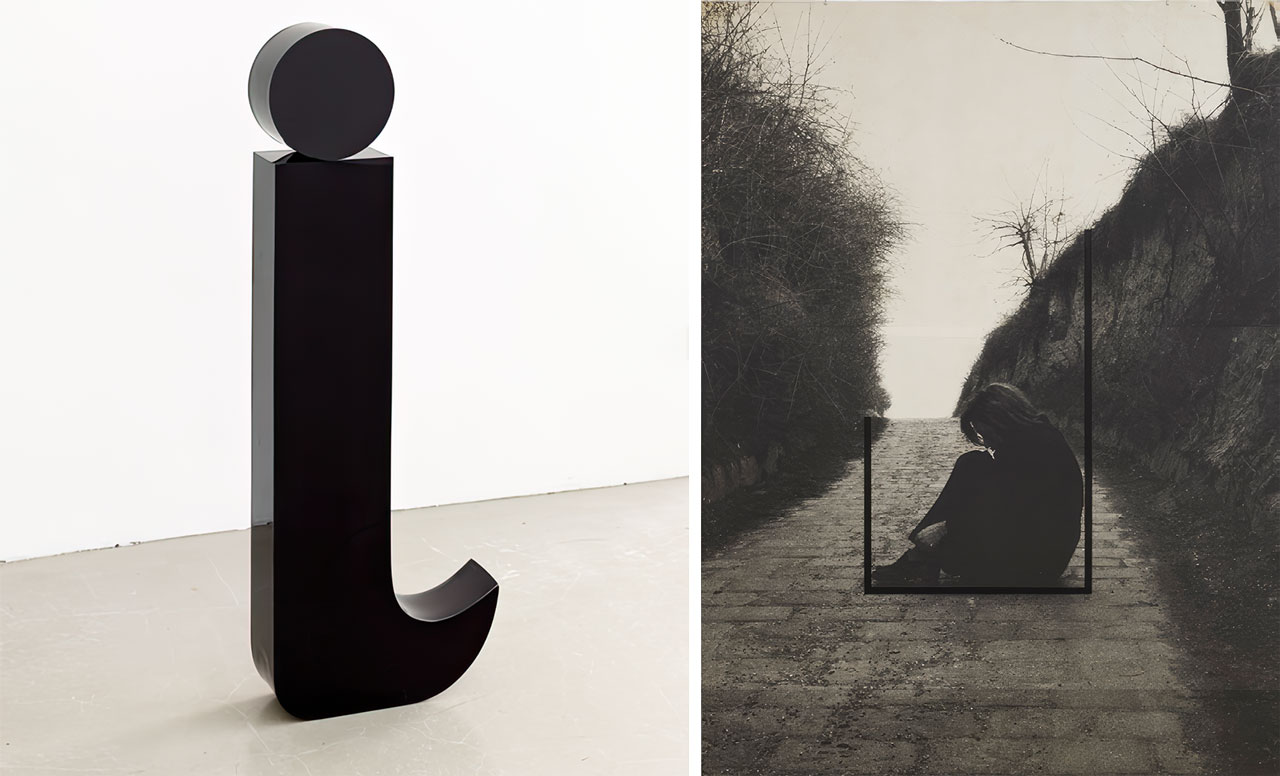
Right: VALIE EXPORT, Aufhockung, 1972/1980. , Black and white silver gelatin print on baryta paper laid on chip board, overpainted. 230.5 × 170 cm (90.75 × 66.93 in) ), © VALIE EXPORT / SIAE 2025. Courtesy of Thaddaeus Ropac Gallery, London, Paris, Salzburg, Milan, Seoul
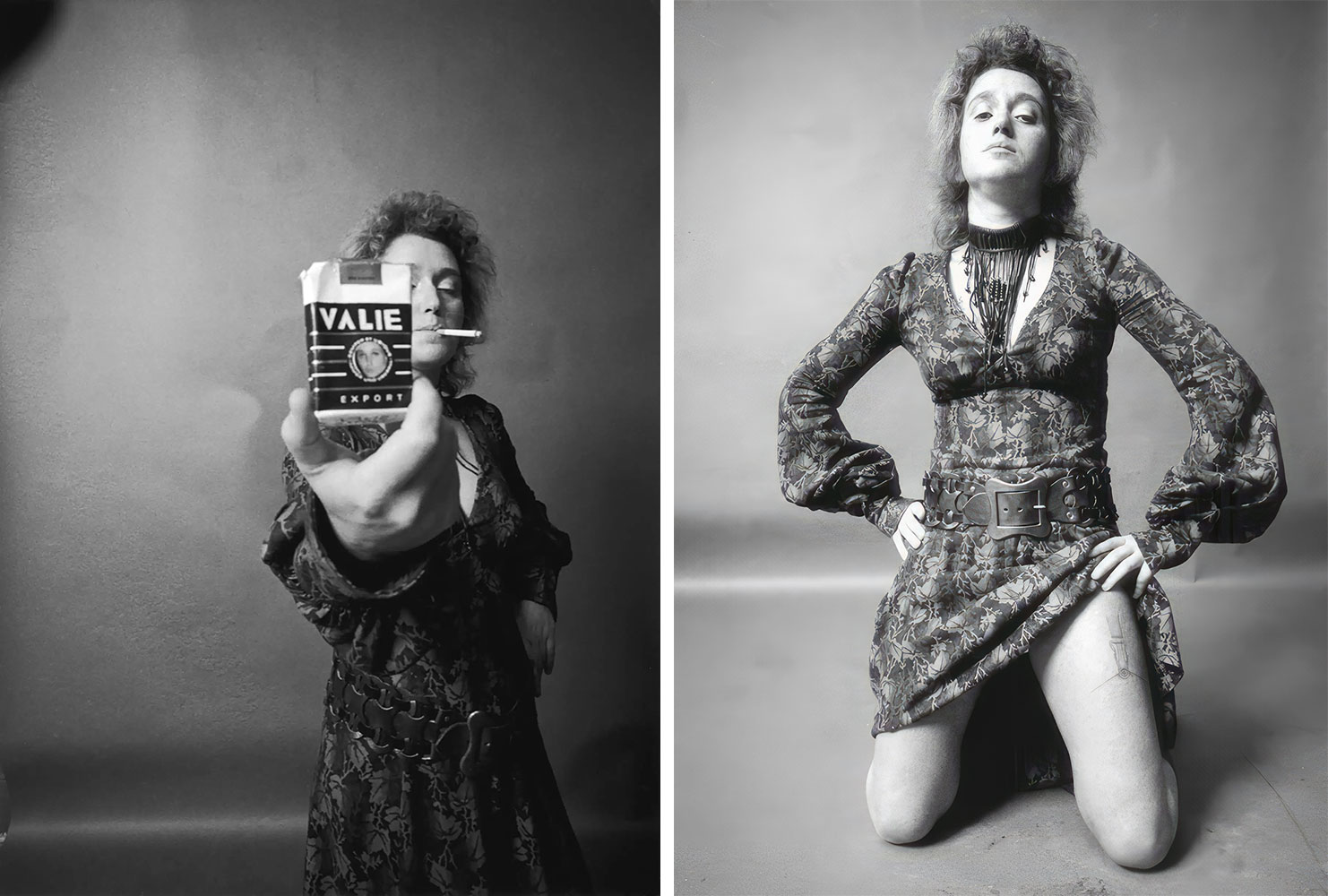
Right: VALIE EXPORT, BODY SIGN B, 1970. Black and white photograph. 44.6 × 30.4 cm (17.56 × 11.97 in), Photo: Gertraud Wolfschwenger, © VALIE EXPORT / SIAE 2025. Courtesy of Thaddaeus Ropac Gallery, London, Paris, Salzburg, Milan, Seoul