PRESENTATION: Jelena Bulajić-Untitled (after)
Jelena Bulajić’s works are both tools for exploring the mediated view of the world and speculations about the dimensions of reality. They possess an intrinsic logic of showing and revealing deriving from an intensive engagement with the pictorial, its conditions and scope. When viewed together, Bulajić’s different groups of works, her game with figuration and abstraction, posit a conception of image-making per se and challenge us to examine our own, individual perception.
By Dimitris Lempesis
Photo: Kunsthalle Münster Archive
In her recent exhibition “Untitled (after)”, Jelena Bulajić advances a sustained inquiry into the nature of mediated reality—an inquiry conducted through the appropriation of works by Gian Lorenzo Bernini, Wolfgang Tillmans, and Hiroshi Sugimoto. Rather than engaging in expressive self-portraiture or subjective invention, Bulajić adopts existing images as a form of quotation. This strategic displacement provides the conceptual distance necessary for her to concentrate on the material logic of painting itself and to uncover layers of meaning that extend beyond the visible motifs. Although her subjects initially capture the viewer’s attention, it is ultimately the physical tactility of her surfaces—the dense skins of paint composed of marble dust, granite, limestone, and kaolin—that reveals the true force of her practice. Her paintings exist as objects before they exist as images.
This interplay between the original and its translation, between the source and Bulajić’s rearticulation of it, activates the conceptual core of the exhibition. Her paintings are not mere copies; they are meditations on what is lost, gained, or transformed when an image migrates across media.
Bulajić’s “Untitled (after Bernini)” (2020) isolates the angel’s face from Bernini’s “Ecstasy of Saint Teresa” (1645–1652), a sculpture in which the Baroque master transmuted white Carrara marble into a theatre of spiritual rapture. Bernini carved passion, ecstasy, fear, and divine love into stone, demonstrating an unrivalled ability to animate inanimate material.
Bulajić brings this emotional and material register into the two-dimensional realm. Seen at close range, the painted surface reads almost as an impossibility: the sculptural detail is rendered with such depth that the viewer momentarily forgets they are looking at a painting. The work also plays with a subtle visual paradox. Given the sculpture’s elevated position in Santa Maria della Vittoria in Rome, one can never encounter the angel at such proximity in physical space. Bulajić’s painting, therefore, becomes a double mediation—a representation shaped not only by Bernini’s marble but by the photographic intermediary through which such closeness becomes possible. Light glances across the painted stone skin, condensing the temporal and spatial conditions of sculpture, photography, and painting into a single frame.
A dramatic shift in scale characterizes “Untitled (after Tillmans, Atlantique)” (2025), drawn from Wolfgang Tillmans’s photograph “Atlantique’ (2016). Where the Bernini work invites intimate contemplation, this large-format canvas immerses the viewer in the kinetic force of a breaking wave. Bulajić captures an almost sonic resonance—the roar of the surf, the wind atomizing spume, the saline imprint of sea air. The motif pulls the viewer into a sensory memory, performing the familiar seduction of photography and photorealistic painting: the promise that one can re-enter a moment through the illusion of perfect depiction.
Yet the seduction is temporary. Approaching the canvas, the viewer encounters the material evidence of its making—acrylic, coloured pencil, graphite. The wave’s power clashes with the soft, blurred surface; certain passages appear printed, gesturing directly to Tillmans’s medium. Bulajić stages a productive tension between the grand scale of natural phenomena and the fragile, delicate means of their pictorial translation. Illusion is simultaneously constructed and dismantled.
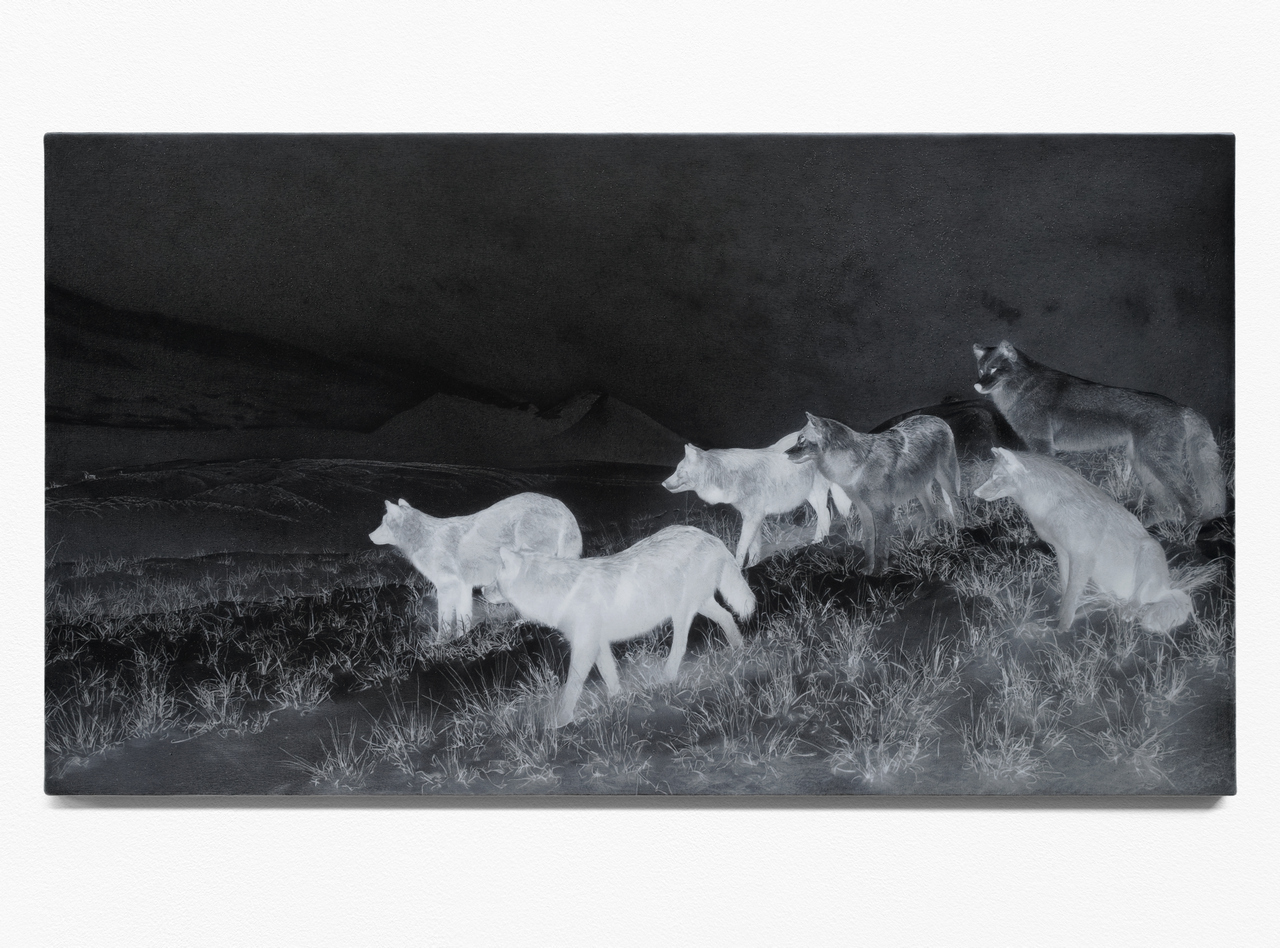
Bulajić’s ongoing series “After Sugimoto” (since 2023) draws on Hiroshi Sugimoto’s “Dioramas” (1975–1999), a photographic investigation into museum dioramas—those fabricated environments that purport to freeze a single, authoritative instant of natural history. Bulajić extends this inquiry into the painted field. Through repetition, symbolic conversion, and the aesthetic reconfiguration of Sugimoto’s images, she emphasizes the impossibility of ever fully resolving the difference between original and derivative, reality and its representation. Her paintings expose the mechanisms through which visual culture naturalizes the artificial and stabilizes the unstable.
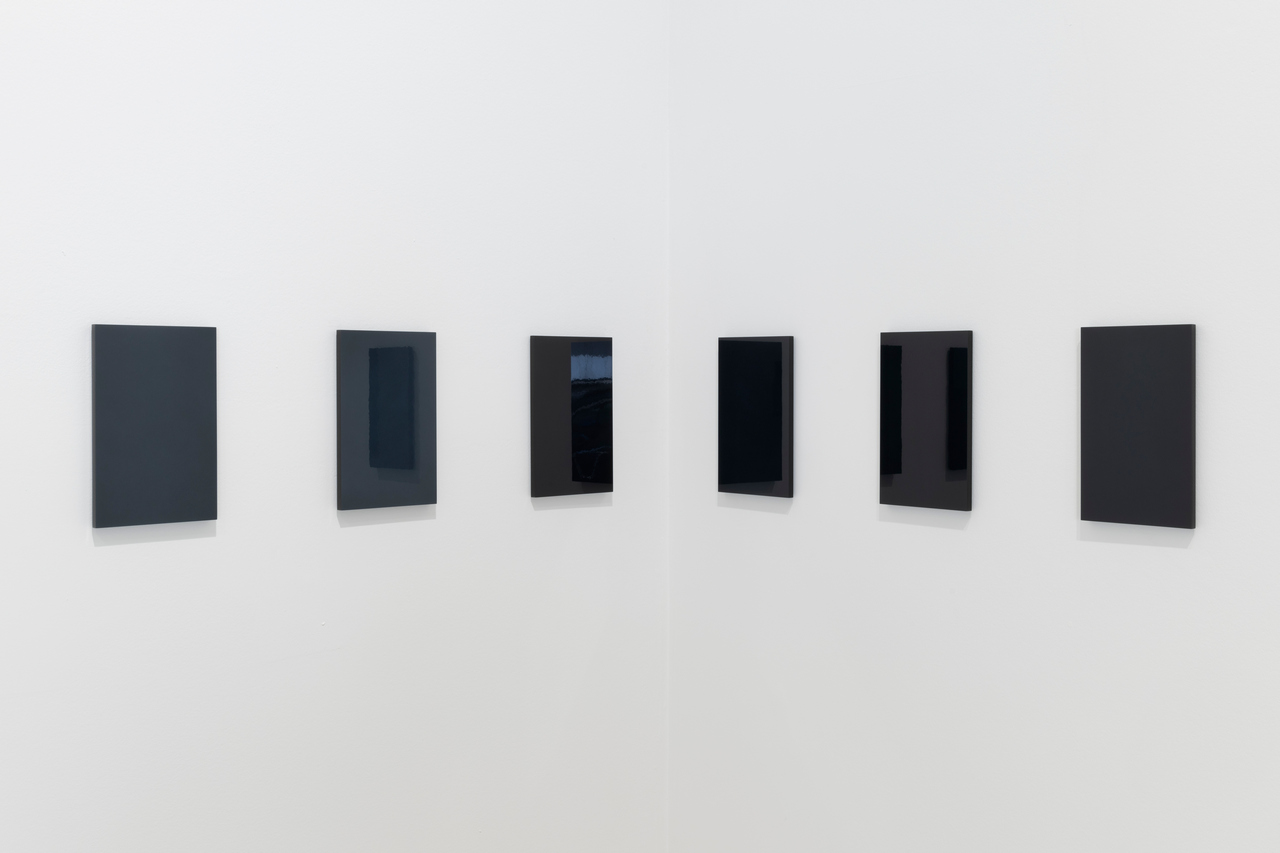
This interrogation of mediated realism reaches a heightened conceptual register in Bulajić’s “White on Black” series (2024- ), presented in an expansive installation format at Kunsthalle Münster. Restricting herself to black and white lacquer on transparent Plexiglas, she applies dozens of layered coats that, through optical interaction, generate luminous shades of blue. These chromatic effects emerge not from pigment but from reflection and refraction.
The works simultaneously absorb and mirror their surroundings. Their reflective surfaces resist a fixed image; instead, they produce a shifting constellation of contingent, ephemeral impressions that incorporate everything in their vicinity. The viewer becomes part of the picture plane, and the works oscillate among painting, photography, and living tableaux. Through this dynamic, Bulajić stages a vivid confrontation with the instability of perception in the present moment.
Across these disparate bodies of work, Bulajić articulates an enduring commitment to the medium of painting in the age of pervasive photographic mediation. Her realism is not representational but critical: a realism that examines how images construct the world rather than mirror it. Illusion fascinates her, yet it is the revelation of illusion—its deliberate unmasking—that defines her practice. Her paintings insist on their own constructedness, inviting viewers to scrutinize the fragile boundary between what appears real and what is, fundamentally, an artefact of material, technique, and perception.
In “Untitled (after)”, Bulajić demonstrates that translation across media does more than alter form; it generates new ways of seeing. Through surface, materiality, and the subtle negotiations of mediation, her work compels us to reconsider the very conditions under which images make meaning.
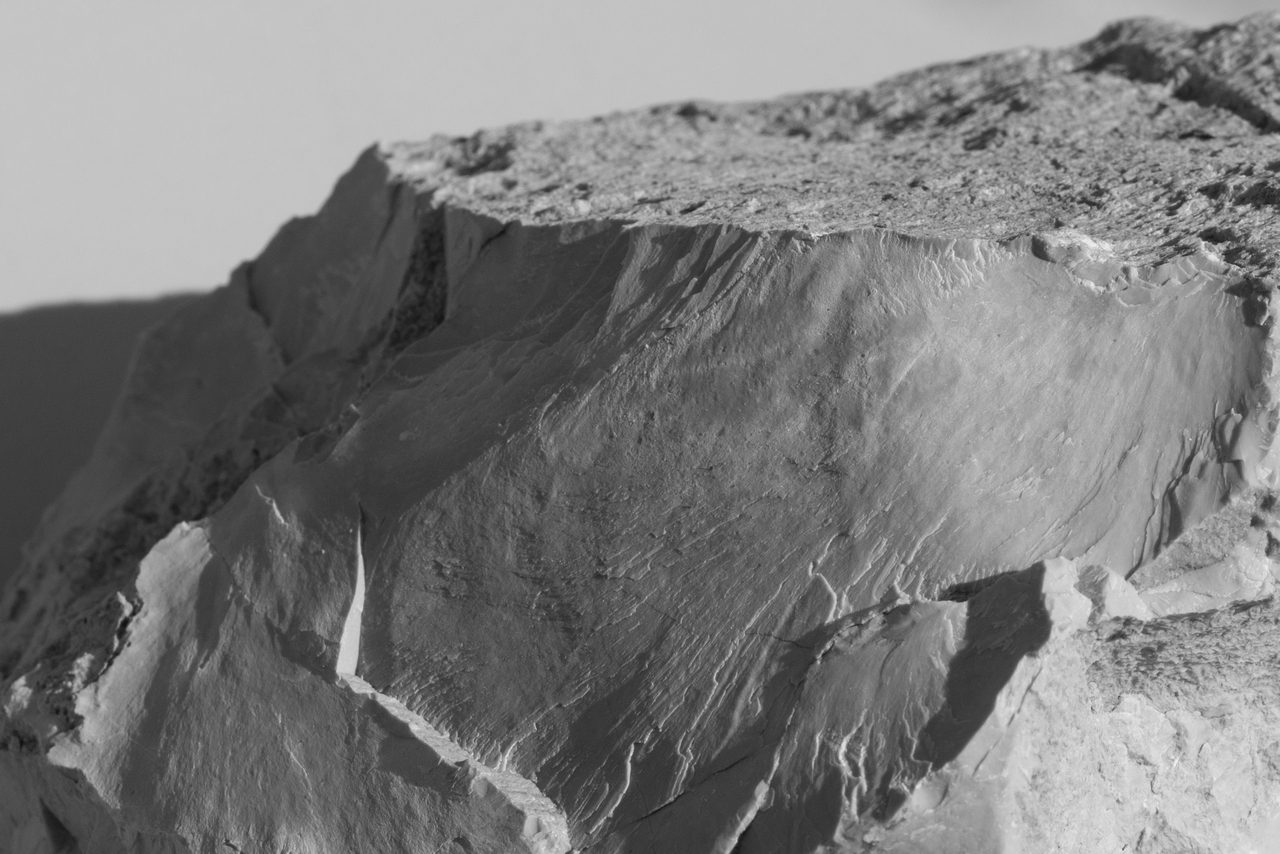
Photo: Jelena Bulajić, After stone 1-1-1 (detail), 2025, Steinmodell / stone model. Courtesy of the artist and carlier | gebauer, Berlin/Madrid. Photo: Marijana Janković
Info: Kunsthalle Münster, Hafenweg 28, Münster, Germany, Duration: 13/12/2025 – 29/03/2026, Days & Hours: Tue-Sun 12:00-18:00, www.kunsthallemuenster.de/