ART CITIES: Basel-Piero Manzoni

Piero Manzoni emerged as a powerful voice for the avant-garde in the 1950s, debuting as an artist at the “4a Fiera mercato: Mostra d’arte contemporanea: in 1956Piero Manzoni had a profound impact on the course of twentieth-century art during his brief yet prolific career, directly influencing the development of Arte Povera while paving the way for conceptual, body and performance art.
By Dimitris Lempesis
Photo: Hauser & Wirth Gallery Archive
Bringing together a carefully selected group of Piero Manzoni’s earliest works—many of them rarely seen and now displayed together for the first time—the exhibition “L’invincibile Jean and Early Works 1956–1957” provides an unprecedented opportunity to examine a pivotal yet often overlooked period in the artist’s brief but phenomenally influential career. Far from being preliminary exercises or tentative beginnings, these works reveal a young artist already deeply engaged in questioning the nature, limits, and possibilities of painting. They also illuminate the surprising conceptual and material foundations upon which Manzoni would construct the radical gestures of his later years, including the iconic white “Achromes” that cemented his place among the most significant figures of postwar avant-garde art.
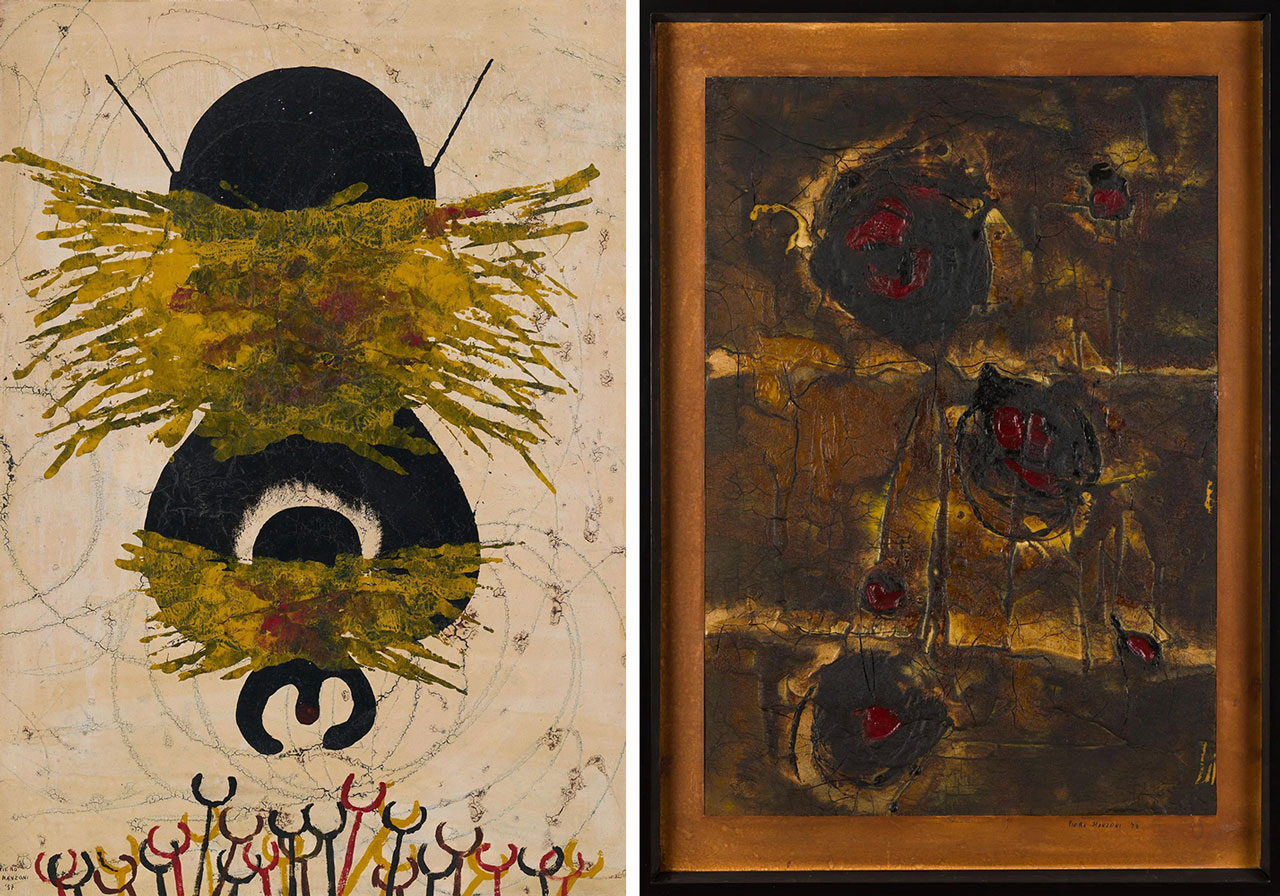
Born in the Lombardy region in 1933, Manzoni grew up in a cultural environment still grappling with the aftermath of World War II and the profound reorientation of artistic priorities that followed. He pursued no formal training in the fine arts, an absence that proved decisive: unbound by academic instruction, he felt free to dismantle and reassemble the language of painting according to his own instincts and intellectual curiosities. His artistic awakening occurred rapidly. In 1956—at just twenty-three years old—he officially launched his career by participating in the “Mostra d’Arte Contemporanea” at the Castello Sforzesco in Soncino. Organized in conjunction with the town’s annual market fair, the exhibition provided a modest platform that nonetheless marked the public debut of a remarkably original voice. Among the two works he presented was “Domani chi sa: (1956), a piece that already displays many characteristics of his early experimentation: the merging of gesture with nontraditional mark-making, the rejection of pictorial illusionism, and the impulse to disrupt inherited definitions of artistic technique. The painting’s stamped impressions—keys dipped in paint and repeatedly pressed across an animated ground—signal a young artist challenging the boundaries between tool, gesture, accident, and intention.
As Manzoni immersed himself in the dynamic Milanese art scene of the late 1950s, he encountered a constellation of artists whose work oscillated between the informel, the surreal, the lyrical, and the darkly humorous. Figures such as Enrico Baj, Roberto Crippa, Sergio Dangelo, Gianni Dova, Ettore Sordini, and Angelo Verga offered him a living laboratory of approaches to experimentation, each contributing to an environment where aesthetic conventions were constantly being questioned and overturned. Rather than adopt any single style or movement, Manzoni responded with characteristic irreverence: he absorbed influences only to bend, fracture, or discard them, combining elements of Art Informel, Surrealism, Dada, and even Futurism into a hybrid visual language that resisted classification. This period reveals an artist whose instincts were both deeply playful and intensely analytical—an artist searching for a form adequate to the complexity of modern existence.
Manzoni’s circle quickly expanded beyond Milan. He became interconnected with an international network of avant-garde thinkers and practitioners, including the groundbreaking Italian-Argentine artist Lucio Fontana. Fontana, already renowned for his “Buchi” and “tagli”—works defined by punctures and slashes that opened the pictorial plane into real space—became both mentor and intellectual companion to the younger artist. Alberto Burri, whose raw, materially charged compositions profoundly shaped postwar art, also served as an important reference point. Within this cosmopolitan environment, Manzoni briefly aligned himself with the movimento d’arte nucleare*, a group fascinated by the psychological, existential, and scientific upheavals of the atomic age. Their engagement with the theories of Carl Jung—especially the idea that myth and the unconscious provide the deepest wellsprings of human creativity—resonated strongly with Manzoni, who in this period produced an astonishing corpus of theoretical writing. Between December 1956 and December 1957 he authored nine manifestos, each revealing a mind attempting to reconcile the intuitive and the rational, the personal and the archetypal, the material and the metaphysical.
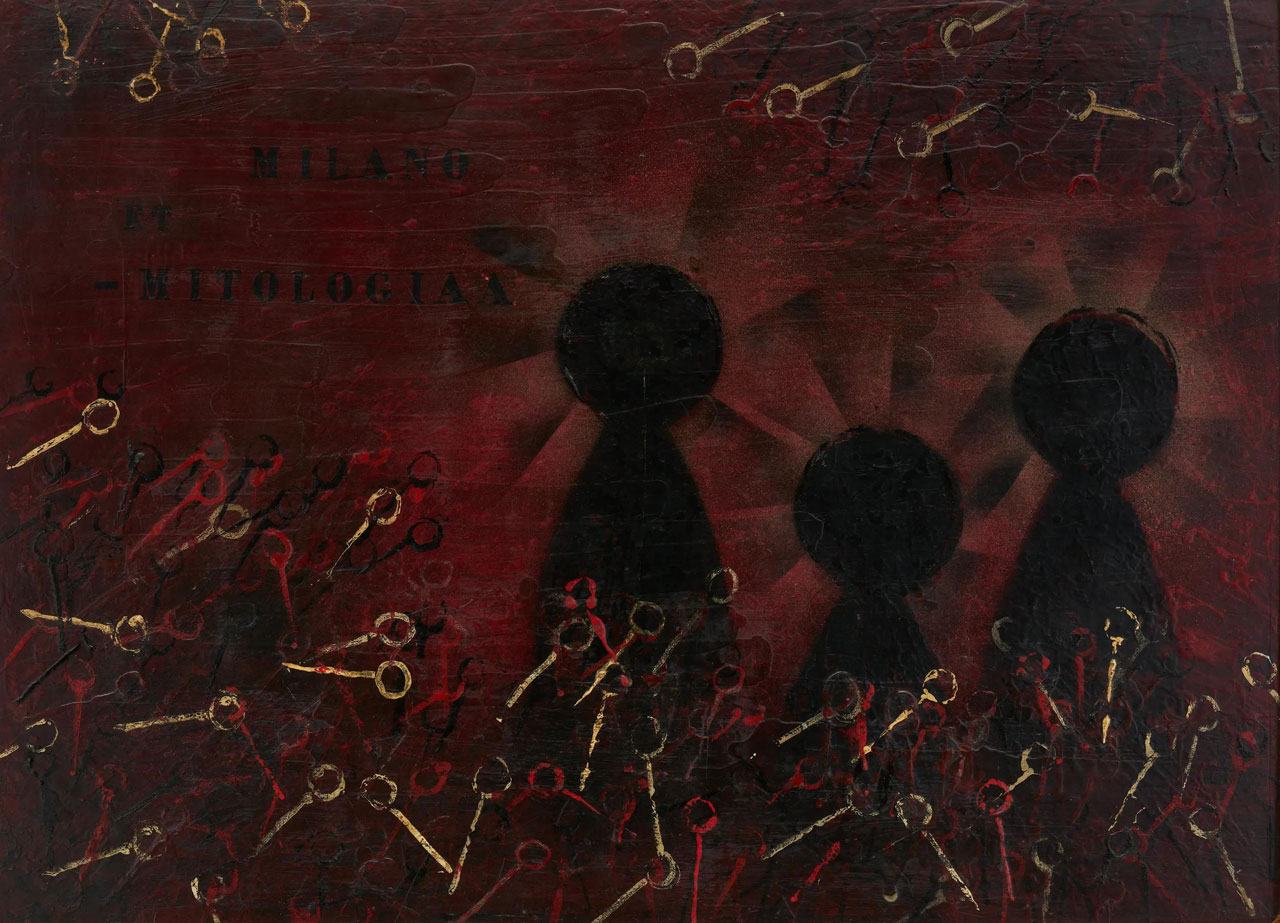
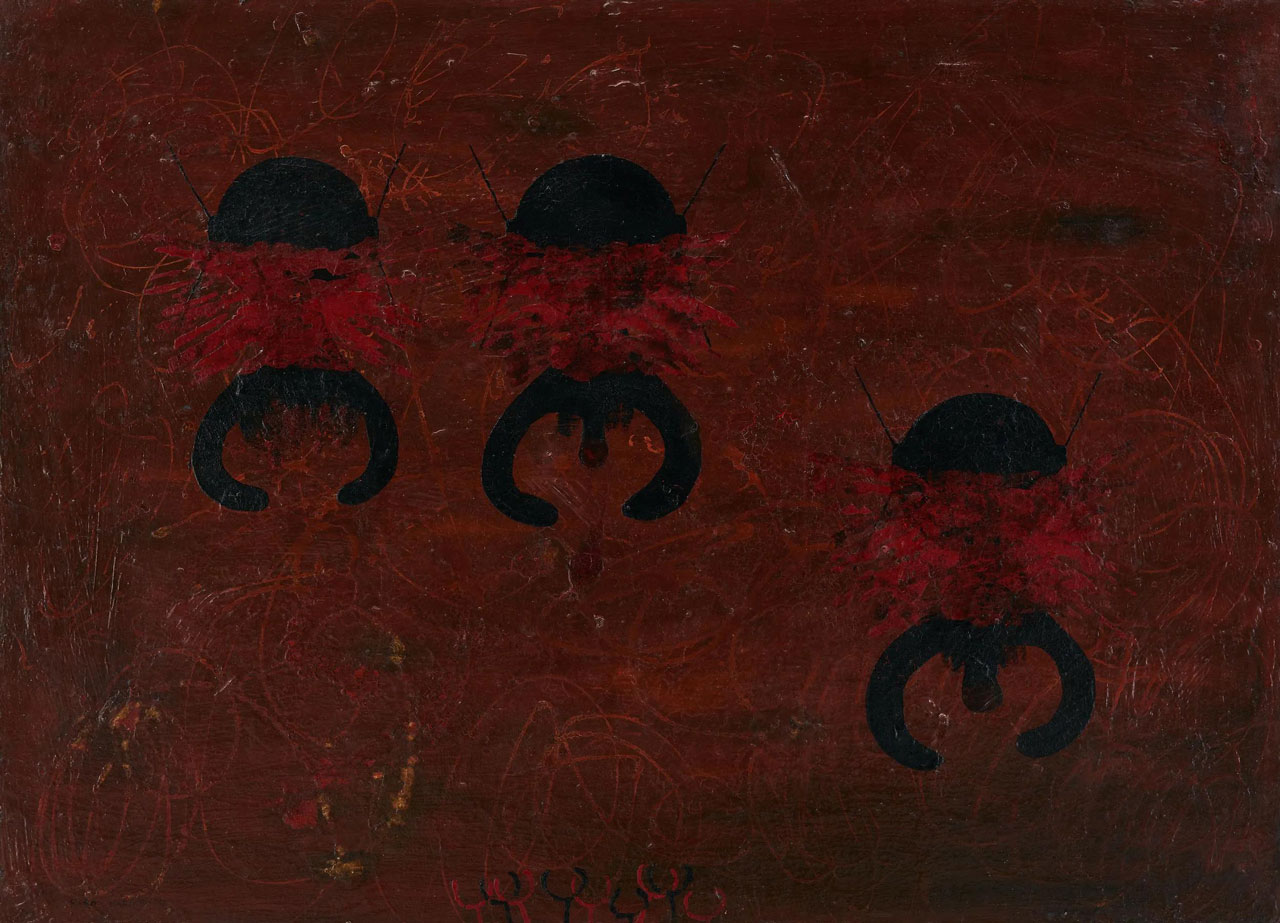
The exhibition presents several key works that exemplify these early explorations. Among them are “Milano et mitologia” (1956) and “Arrivano cantando” (1957), the latter of which is being publicly exhibited for the first time since 1971. These paintings populate their abstract, often turbulent grounds with ghostly anthropomorphic presences—figures frequently described as extraterrestrials or mythological apparitions. Hovering ambiguously between form and formlessness, these beings suggest states of metamorphosis: presences emerging, dissolving, or flickering at the threshold between consciousness and the unknown. Interspersed with splashes of enamel or partially obscured under layers of pigment, they articulate themes of alienation, repetition, and prefiguration—concepts that would echo throughout Manzoni’s future work. In these images, one senses the artist wrestling with the paradox of representation itself: how to depict a reality that feels increasingly unstable, fluid, or inaccessible.
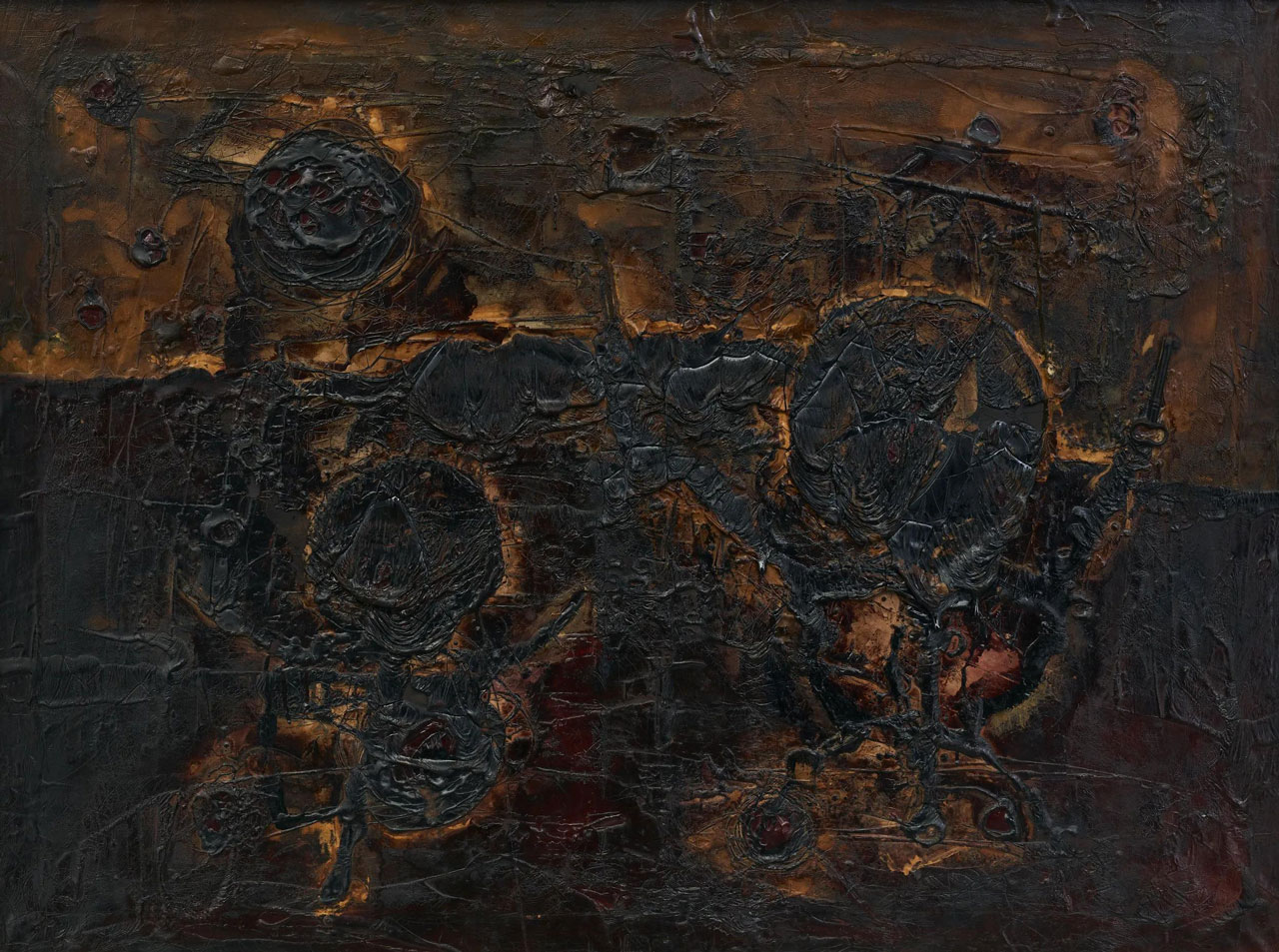
A central highlight of the exhibition is “L’invincibile Jean” (1957), a striking synthesis of Manzoni’s early iconography and his intensifying preoccupation with the materiality of the medium. Inspired partly by science fiction, the work presents a skeletal humanoid silhouette rendered not in traditional pigment but in viscous, streaked tar. The figure appears simultaneously monumental and fragile, both present and spectral, its form conjured through a substance more commonly associated with industrial surfaces than with fine art. Here, Manzoni’s interest in the primal, the archaic, and the elemental becomes unmistakably clear.
Materiality, in fact, is the binding principle that unites all the works displayed in Basel. For Manzoni, art was not merely an expressive tool or a vehicle for personal symbolism; it was a means of accessing what he considered the most primordial layers of human existence. To reach this level, he understood that he could no longer rely on inherited structures of color, composition, and narration. Instead, he sought to invent an entirely new formal language—one grounded in raw substances, tactile surfaces, and intuitively driven processes. This quest manifests powerfully in his tar paintings: pitch-black, wholly abstract landscapes that obliterate figuration in favor of an exploration of depth, opacity, and material density. In these works, Manzoni attempts to tap what he described as the “inner image”—an image not of external appearances but of fundamental psychic states.
These experiments paved the way for the “Achromes”, arguably the most defining works of Manzoni’s career. With these monochromatic, non-pigmented surfaces, he eliminated color, traditional supports, and even the notion of artistic “expression,” embracing instead a radical neutrality that challenged the very function of art. The “Achromes” mark a profound shift from the dreamy, surreal, and psychologically charged images of 1956–1957; yet, as this exhibition demonstrates, they are inconceivable without the earlier works’ relentless probing of materiality, form, and the limits of representation. What emerges in Basel is not merely a survey of Manzoni’s formative period but a narrative of transformation—a record of an artist moving swiftly and fearlessly toward an artistic vocabulary that would redefine the terms of avant-garde practice.
In presenting this constellation of early works, “L’invincibile Jean and Early Works 1956–1957” invites viewers to reconsider Manzoni not only as the creator of the Achromes but as a thinker, experimenter, and visionary whose brief life yielded a remarkably coherent and continually evolving investigation into what art could be. This exhibition reveals a young artist already in full command of his powers, compelled by an unwavering desire to reinvent painting from the ground up—an ambition that, despite his tragically short career, left an indelible imprint on the trajectory of postwar art.
*The movimento d’arte nucleare was founded by the Italian artist Enrico Baj together with Sergio Dangelo and Gianni Bertini, in Milan in 1951. Gianni Dova was a later member. Their first manifesto was issued the following year and another in 1959. The name might be translated as ‘art for the nuclear age’, since the group specifically set out to make art in relation to this. Their manifestos warned of the dangers of the misapplication of nuclear technology. They declared opposition to geometric abstract art and proposed instead the use of automatic techniques. They were thus closely aligned with art informel.
Photo Left: Piero Manzoni, Domani chi sa (Tomorrow who knows), 1956, Enamel, tempera and wax on board, 90 × 70 cm / 35 3/8 × 27 1/2 in, © Fondazione Piero Manzoni, Milano Photo: Jon Etter, Courtesy © Fondazione Piero Manzoni & Hauser & Wirth Gallery. Photo Right: Piero Manzoni, Senza titolo (Untitled), 1956, Enamel, tempera and bitumen on canvas, 90 x 70 cm / 35 3/8 x 27 1/2 in, 94.5 x 75 x 5 cm / 37 1/4 x 29 1/2 x 2 in (framed), © Fondazione Piero Manzoni, Milano, Photo: Matteo Zarbo, Courtesy © Fondazione Piero Manzoni & Hauser & Wirth Gallery
Info: Curator: Rosalia Pasqualino di Marineo, Hauser & Wirth Gallery, Luftgässlein 4, Basel, Switzerland, Duration: 27/11/2025-14/2/2026, Days & Hours: Tue-Fri 14:00-18:00, Sat 11:00-16:00, www.hauserwirth.com/
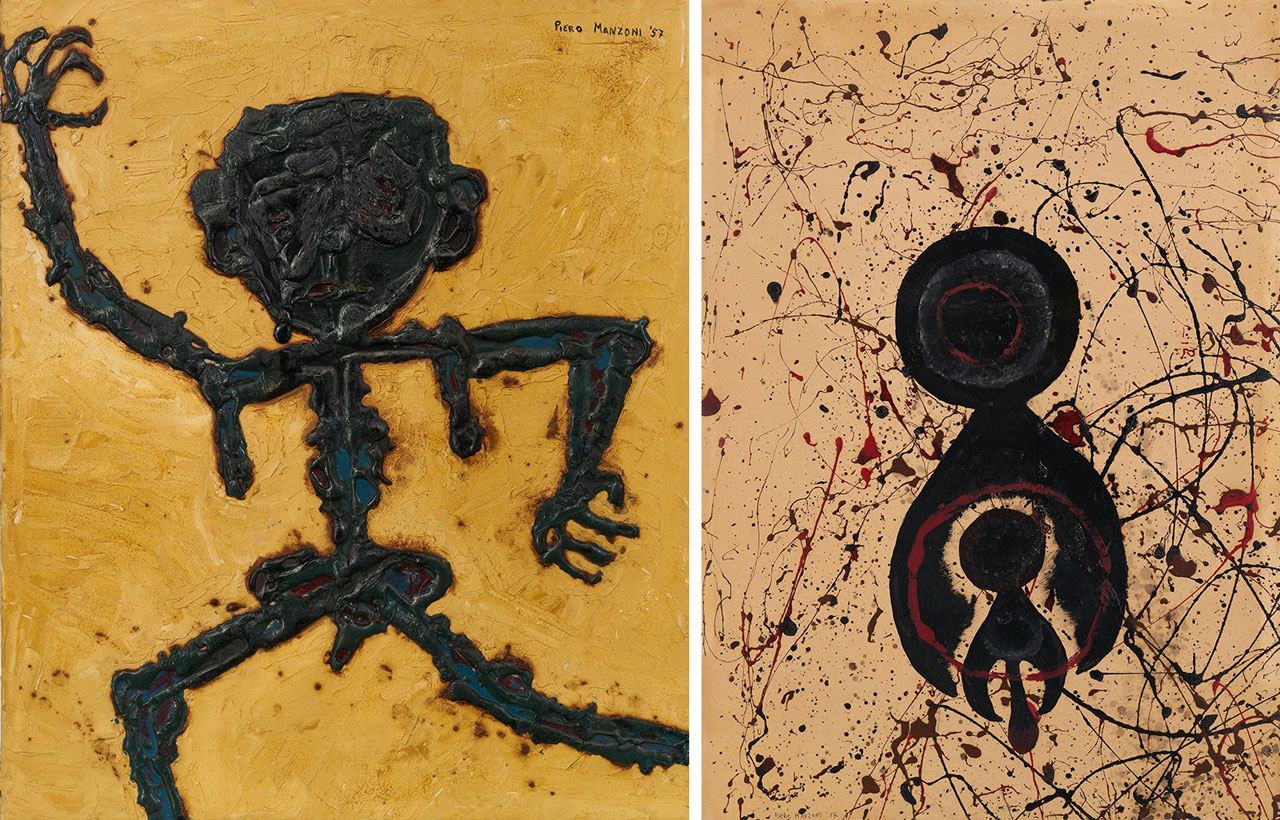
Right: Piero Manzoni, Senza titolo (Untitled), 1957, • Enamel and tempera on paper, 70 × 50 cm / 27 1/2 × 19 5/8 in, © Fondazione Piero Manzoni, Milano, Photo: Jon Etter, Courtesy © Fondazione Piero Manzoni & Hauser & Wirth Gallery
Right: Piero Manzoni, Senza titolo (Untitled), 1957, Tar on board, 70 x 50 cm / 27 1/2 x 19 5/8 in 73.7 x 53 x 5.5 cm / 29 x 20 7/8 x 2 1/8 in (framed), © Fondazione Piero Manzoni, Milano, Photo: Jon Etter, Courtesy © Fondazione Piero Manzoni & Hauser & Wirth Gallery