ART CITIES: Milan-Hito Steyerl
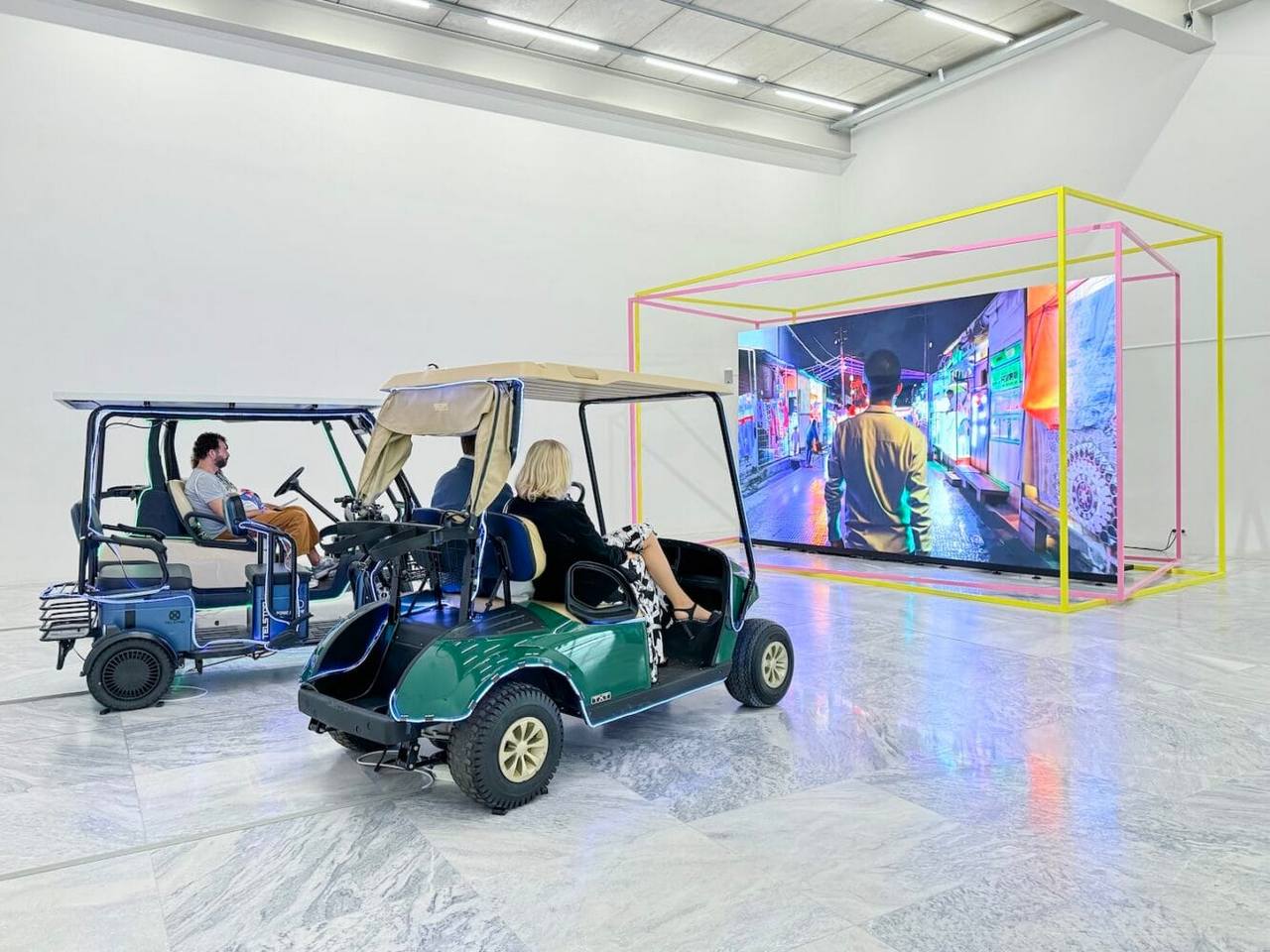
The practice of Hito Steyerl combines artistic production with theoretical analysis to investigate complex socio-political and cultural issues such as the power of media, the ambivalence of technology and science, and the global circulation of images. Developed from research and interviews, Steyerl’s works are situated at the intersection of documentary film and experimental cinema, often extending these forms into the spatial and digital dimensions.
By Efi Michalarou
Photo: Fondazione Prada Archive
With her site-specific project “The Island” Hito Steyerl delves into multiple narratives united by the recurring element of flooding, addressing urgent topics such as current authoritarian tendencies fostered by the use of AI, the climate crisis, and political pressures on scientific research. The exhibition features a new film created by Steyerl specifically for this project, which converges into a video installation and give rise to a series of objects, structures, and video interviews. Through these works, time and space are reorganized by borrowing the logic of quantum physics and science fiction to explore their aesthetic and visual dimensions.
The original idea for “The Island” comes from an anecdote told some years ago to Hito Steyerl by literary critic and academic Darko Suvin, author of the seminal 1979 book “Metamorphoses of Science Fiction”. During a bomb attack in Zagreb in 1941, Suvin reacted to this terrifying event by projecting himself into the American sci-fi serial film, “Flash Gordon’s Trip to Mars” (1938), where the comic book hero saved the Earth’s destiny. As explained by Steyerl, “This is when Suvin realized that in any situation other worlds were possible. This was the idea of science fiction, to create parallel worlds even under very adverse circumstances. So, I was super fascinated by that inventiveness that comes up with science fiction studies out of this very urgent situation. Then, later it occurred to me that we could implement this visually through quantum technology, as it deals with sudden jumps in states and the idea that several states can coexist simultaneously.”
In “The Island”, the viewer witnesses continuous leaps between different and alternative spatial and temporal dimensions. In this context, science fiction is considered a factual account of fictions that can estrange us from our usual assumptions about reality and is employed as a tool to combine contradictory or opposite worlds, blending fiction with scientific data.
“The Island” unfolds into four interrelated narratives—“The Artificial Island,” “Lucciole,” “The Birth of Science Fiction,” and “Flash!”—and it is paced by the dimensional leaps peculiar to science fiction and quantum physics: from microorganisms of animals and plants to galaxies, from the Neolithic ruins to imagined futures, from the exhibition to filmic space, from literary and poetic narrative to popular culture, from the kitsch aesthetic of comic books to current AI slop.
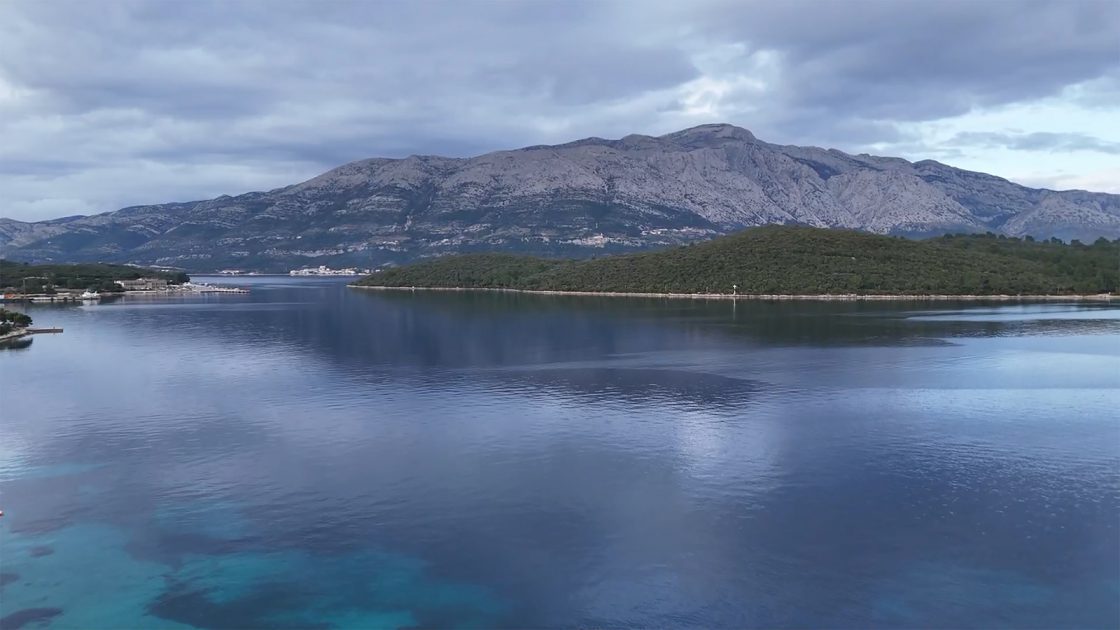
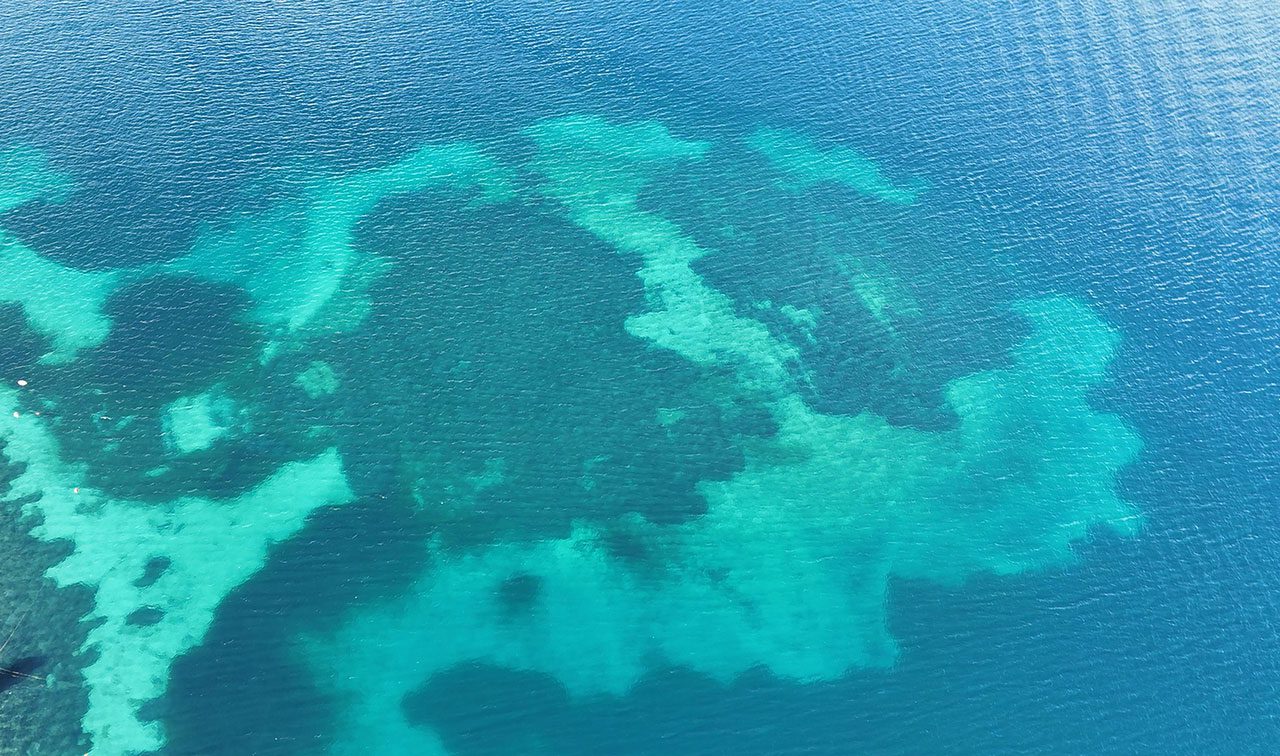
“The Artificial Island” retraces the recent discovery in Dalmatia of a submerged artificial island dating back to the Neolithic period. In 2021, archaeologist Mate Parica from the University of Zadar in Croatia discovered that the 7000-year-old site off the coast of Korčula, now located 4 to 5 meters beneath the Adriatic Sea, was originally connected to the island by an ancient road, before the water level rose substantially due to climate change.
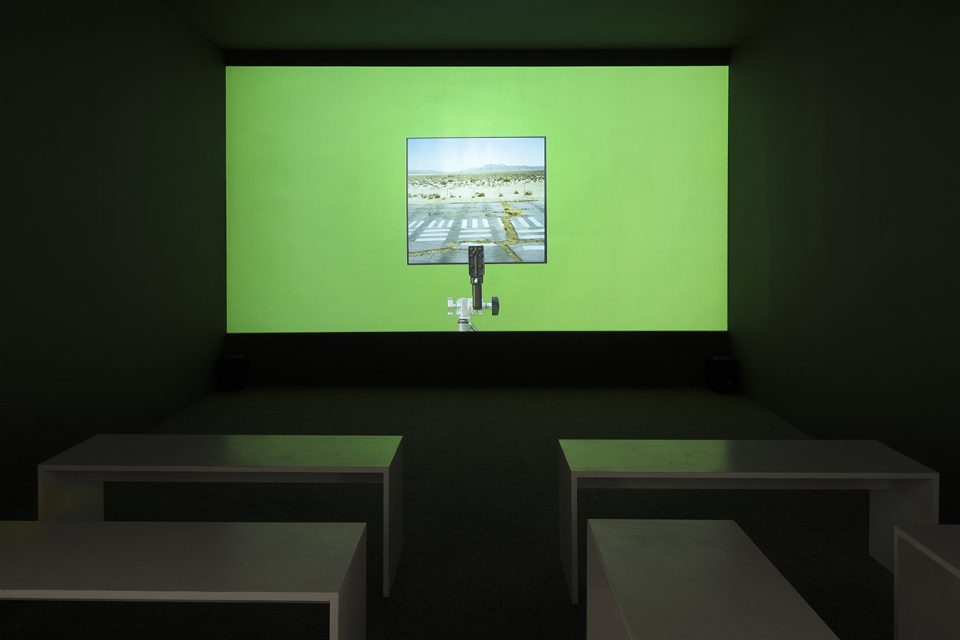
“Lucciole” introduces the visual and symbolic presence of bioluminescent plankton as a detector of wave motion. At the centre of this chapter is the organic molecule Luciferin, successfully studied by Japanese scientist Osamu Shimomura, who was awarded the Nobel Prize in Chemistry in 2008, along with Martin Chalfie and Roger Tsien, for the discovery and development of Green Fluorescent Protein (GFP). In the 1960s, he isolated GFP from jellyfish and discovered that the protein glowed green when illuminated with ultraviolet light. GFP, which emits a shimmering light, has become an essential marker in science and medicine for studying biological processes within cells.
“The Birth of Science Fiction” explores the intellectual legacy of Darko Suvin’s “Metamorphoses of Science Fiction”, a milestone in the literary and theoretical criticism of science fiction. His definition of this genre as “the literature of cognitive estrangement” was at the center of a critical debate that spanned decades, transcending literature to approach science fiction with a political and philosophical perspective.
“Flash!” evokes Suvin’s childhood fantasies and intuitions when he was a passionate reader of Flash Gordon comics. Under bombing in Zagreb during World War II, he imagined himself transported to Mars like his hero in the movie serial he saw on the big screen a few years earlier. The paradoxical coexistence of two realities so distant from each other, one dramatically real and the other imagined or utopian, experienced in this revelatory moment of his life, is the basis of how science fiction works.
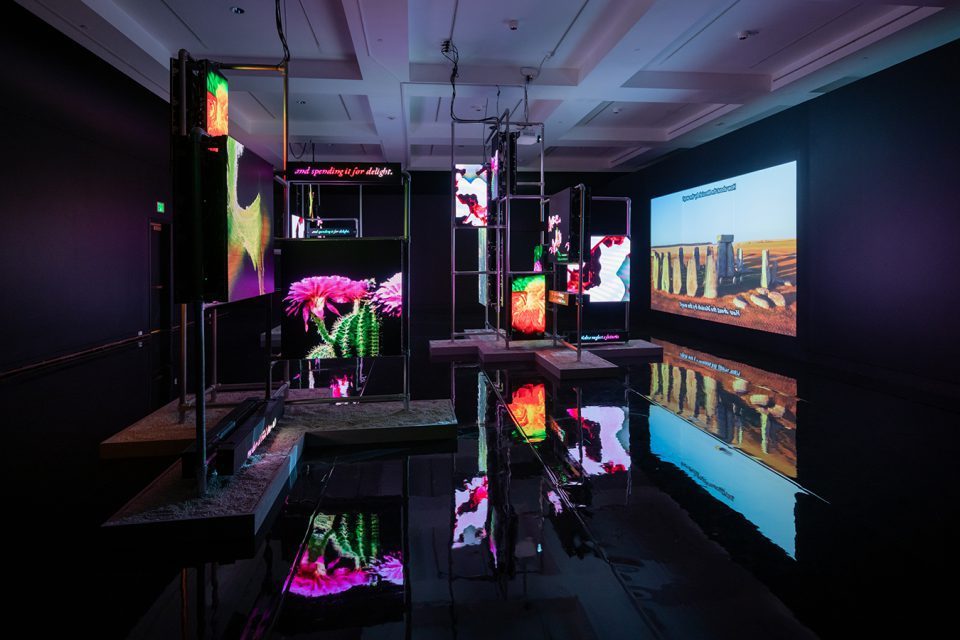
On the first floor of the Osservatorio, the themes and narratives of the project develop through a luminous spherical installation featuring a 3D documentary scan of the submerged Neolithic site, together with an installation of four LED screens projecting documentary clips that include interviews with quantum physicist Tommaso Calarco, archaeologist Mate Parica, language historian Sachi Shimomura, the daughter of the Nobel Prize-winning chemist Osamu Shimomura, and author Darko Suvin. Two poems by Suvin, presented within a driftwood installation, and a copy of his book “Metamorphoses of Science Fiction” are also exhibited.
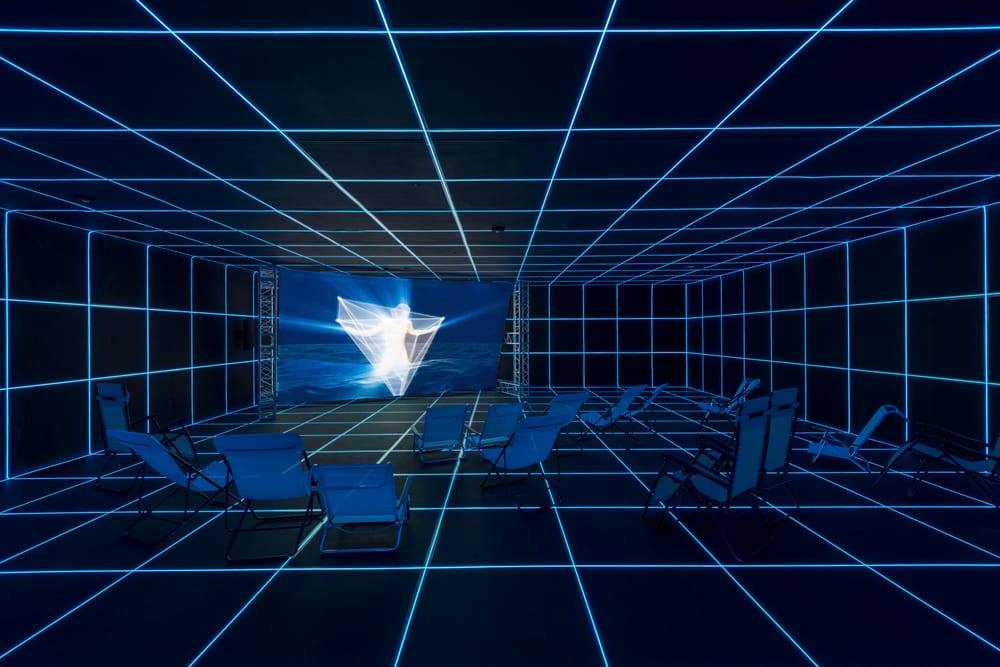
The second floor features an environment reminiscent of the movie theater where Suvin saw “Flash Gordon’s Trip to Mars” in the early 1940s. The classic red armchairs are placed on a platform that refers to the shape of the submerged island. The big screen displays Hito Steyerl’s film, which initiates the entire exhibition project, and entangles the different strands with one another using advanced traditional choir (Klapa) singing from local Klapa Ivo Lozica. The exhibition path concludes with three installations made of driftwood that support a set of hemispheres displaying projections of 3D scans of Neolithic artifacts and photogrammetries of the archaeological site.
“The Island” suggests a time beyond human comprehension, spanning from the Neolithic era to World War II, with time-space jumps to the biographical tales of Shimomura and Suvin. With her film and exhibition project, Hito Steyerl intentionally provokes a productive clash between two different notions of time: the junk time of technology and capitalism that disrupts time with continuous jumps and loops that interrupt and exhaust us, and the deep time—not human time, Neolithic time, underwater time—times that are outside of the human artificially created spectrum.
Photo: Hito Steyerl, Image CC 4.0. Courtesy of the artist, Andrew Kreps Gallery, New York and Esther Schipper, Berlin/Paris/Seoul
Info: Osservatorio Fondazione Prada, Galleria Vittorio Emanuele II, Milan, Italy, Duration: 3/10/2025-30/10/2026, Days & Hours: Mon & Wed-Fri 14:00-20:00, Sat-Sun 11:00-20:00, www.fondazioneprada.org/