ART CITIES: Berlin-Neriman Polat
Neriman Polat focuses on socio-political issues in her works. Critically analyzes phenomena such as gender, public space, urban transformation, and forms of power from a feminist perspective. In her productions, which explore personal and collective memory, she creates works that span the fields of photography, video, installation, text, and, more recently, ready-made textile materials with interventions.
By Efi Michalarou
Photo: Zilberman Gallery Archive
Following “Merciless” (2018) and “Roofless” (2023), “Groundless” by Neriman Polat” is the final chapter of an exhibition trilogy, Through this trilogy, Polat threads a conceptual and material meditation on absence — “merciless,” “roofless,” “groundless” — using the suffix –less to signal what is lost or stripped away: protection, shelter, land.
Polat’s trilogy charts a progressive deterioration of shelter and stability — from the emotional and physical insecurity in “Merciless”, through the material and domestic precarity of “Roofless”, culminating in the existential and social void of “Groundless.”
In “Merciless: (2018), Polat confronted the fragility of children’s lives and the breakdown of protective domestic spaces, using domestic objects (e.g. children’s blankets) and architectural metaphors (brick walls, collapsed houses) to expose systemic violence and abandonment.
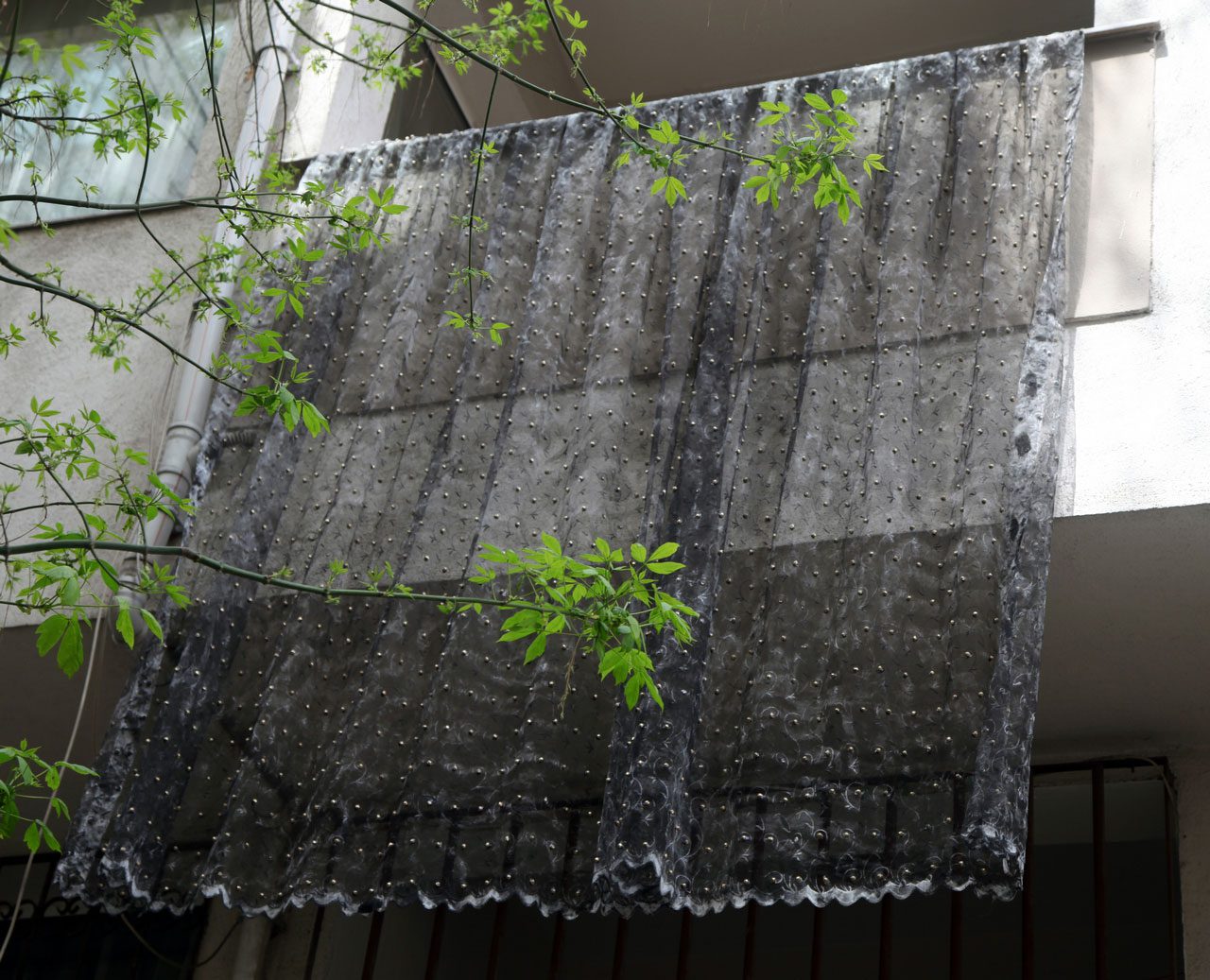
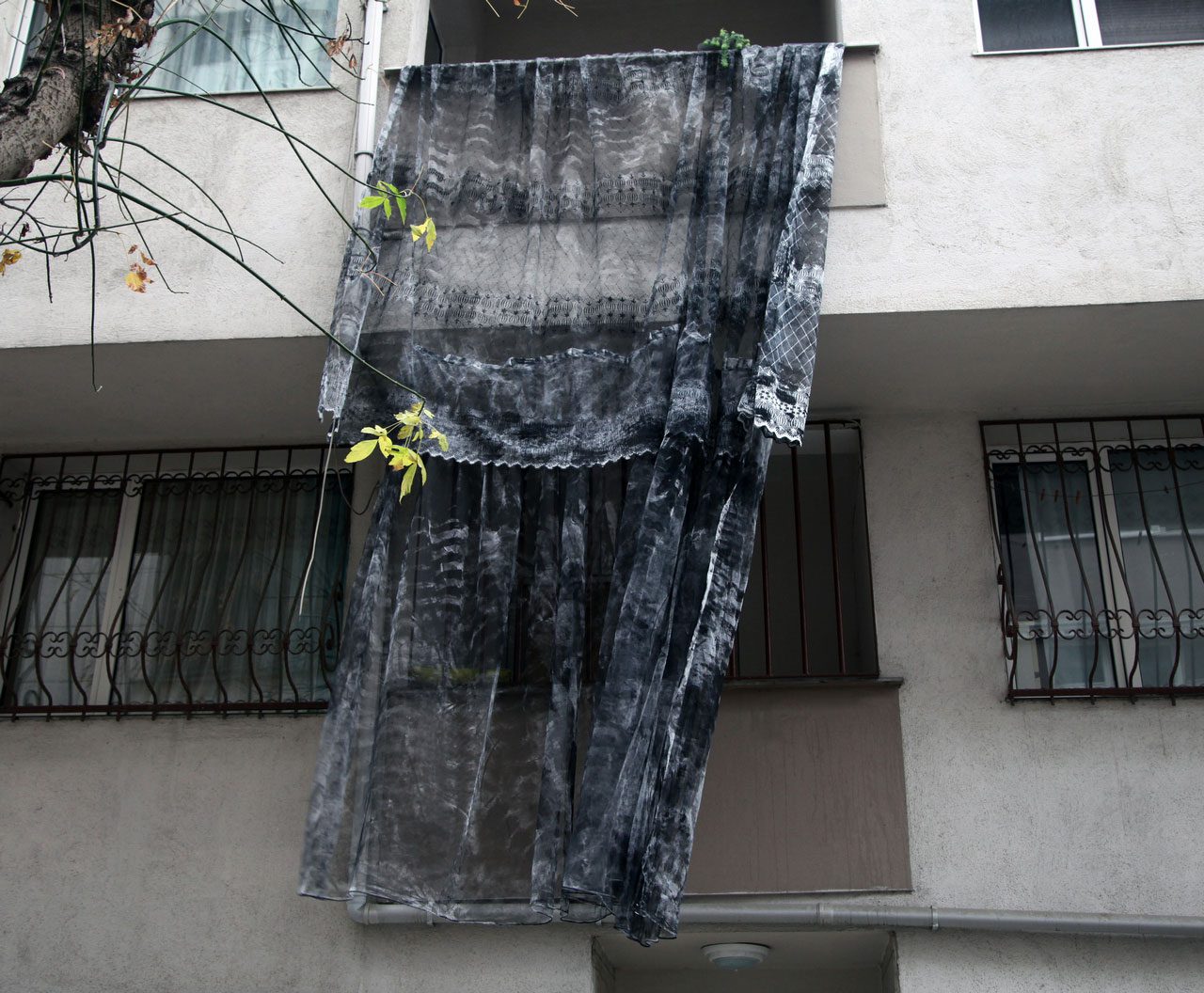
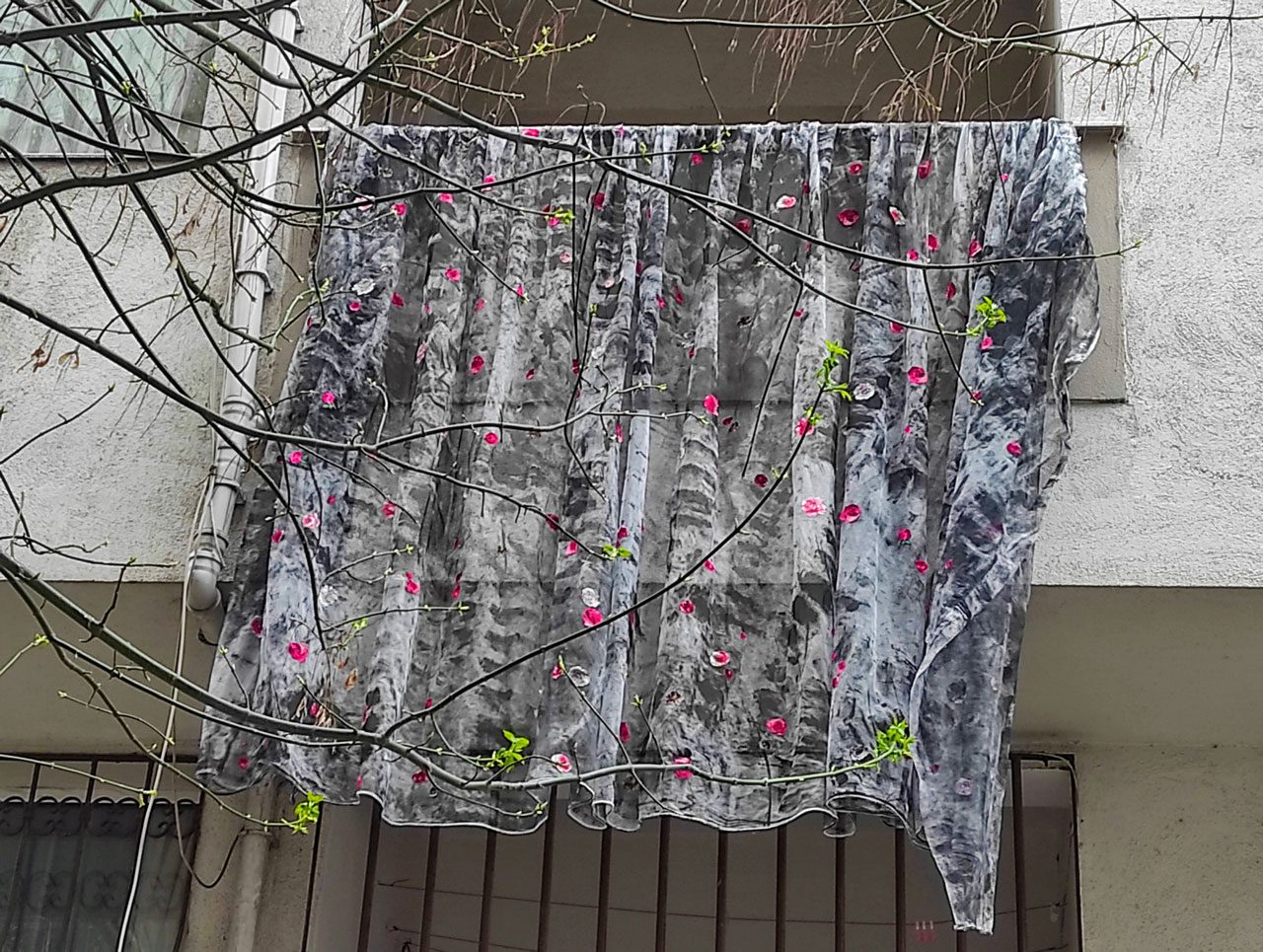
“Roofless” (2023) responded to the crises of housing, displacement, and economic hardship. Through installations that reduced a house to its “bare skeleton,” tulle curtains as fragile domestic membranes, and photographic — even video — works, Polat visualized how shelter becomes a hollow shell under structural pressures.
With “Groundless” (2025), Polat extends the critique deeper: not only is physical shelter gone, but the very ground — material, social, political — has shifted or eroded. The exhibition examines what happens when foundations crack — literally and metaphorically — and common ground disappears.
This arc reflects a shift from individual/domestic vulnerability to collective and existential instability — from home and shelter to land, belonging, and memory.
Polat’s strength lies in her deft use of materials and domestic signifiers — textiles, tulle, global-market fabrics, everyday objects — to evoke memory, loss, and resistance. In “Groundless”
The gallery walls painted concrete-grey suggest that the exterior world — harsh, urban, uncertain — has invaded the interior, blurring the boundary between private and public space. A balcony protrudes on one wall — a liminal threshold between inside and outside, privacy and the collective, intimacy and exposure. From its railing drapes a rose-patterned fabric — historically romanticized, here repainted in black and gray — transforming a decorative motif into a symbol of mourning, loss, violence and memory.
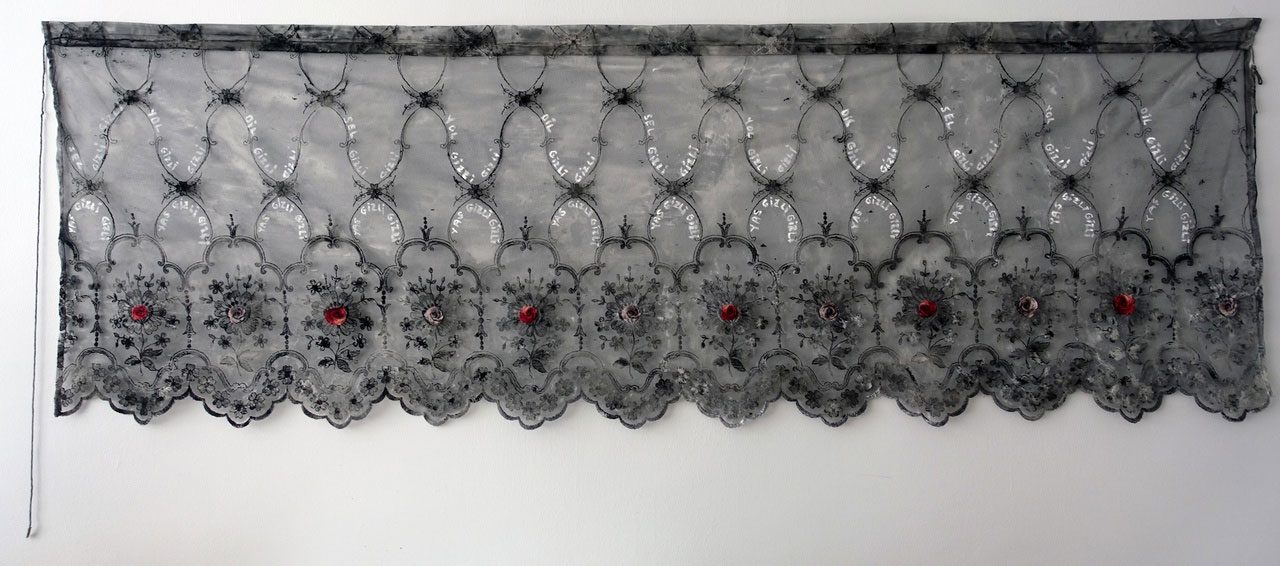
On tulle fabric, the words “sel gizli gizli, yol gizli gizli, dil gizli gizli…” (from a folk song) are presented alongside Polat’s addition “yas gizli gizli” (“secret is the lamentation”). The repetition of “gizli” (“secret”) evokes what is hidden — pain, grief, memory — not forcibly revealed but allowed to resonate quietly.
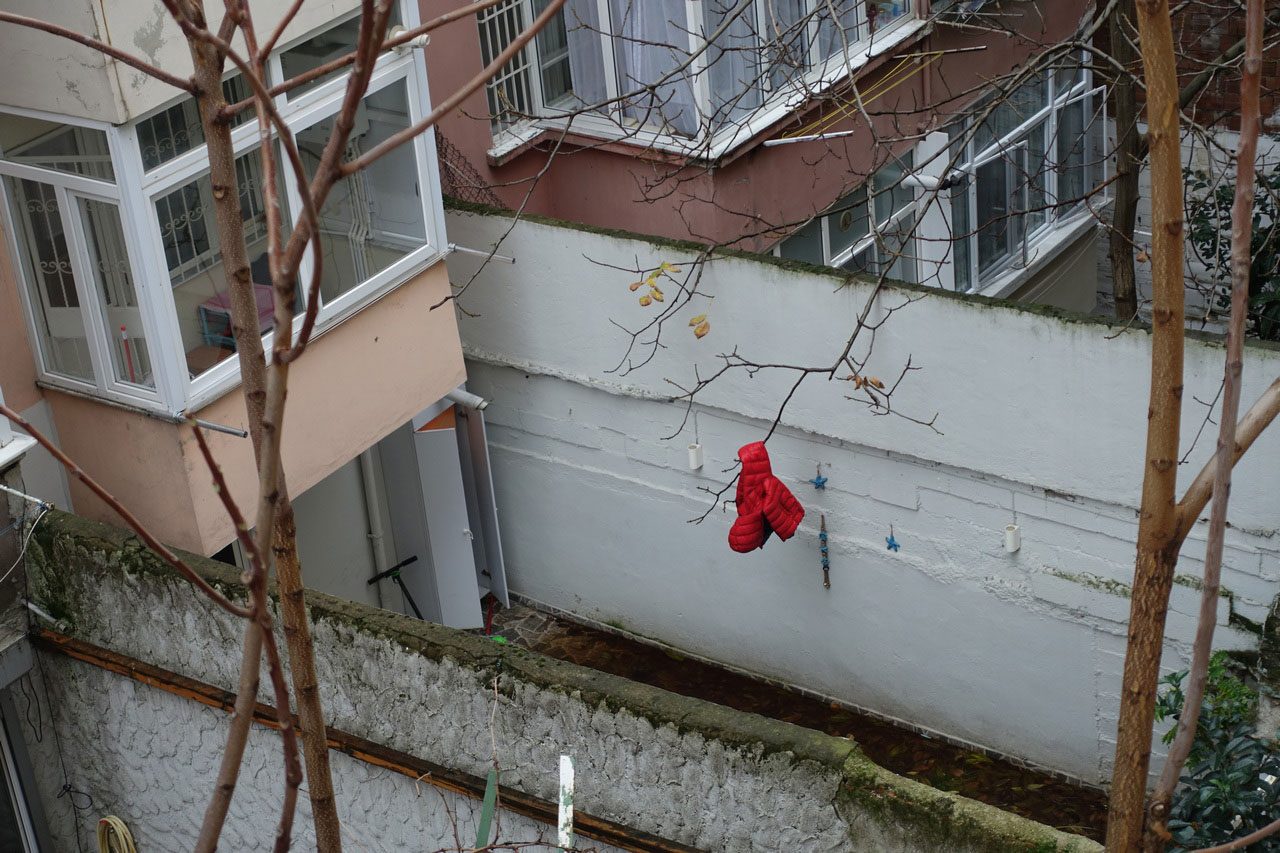
In photographic works like “Kayıp” (Lost), a child’s red jacket hangs from a branch reaching over an enclosing wall — a fragile attempt to cling to warmth, intimacy, and protection in a space defined by separation and boundary.
In installations such as “Döşemelik” (Upholstery), a long black ribbon of fabric cascades from wall to floor, metaphorically evoking ground sinking — the loss of stability, of livelihood.
Works like “Kırık” (Cracked) render the patterns on marbled fabric as fissures, metaphors for aridity, cracking earth, environmental crisis — drought, fires, earthquakes. Everyday objects — shopping nets, handkerchiefs — become silent carriers of economic inequality, lack, and societal precarity.
Through these gestures, Polat reveals the traces of trauma, displacement, marginalization — the lived consequences of wider socio-economic and ecological crises — while also inscribing a politics of memory, visibility, and resistance into the mundane.
Polat’s artistic journey is rooted in collectivity. Since the 1990s she has collaborated with the group Sanat Tanımı Topluluğu (STT), and later co-founded the feminist artist group Arada (“In Between”), alongside other women artists. She also belonged to the collective Hafriyat — a name referencing “excavation,” symbolic of uncovering hidden layers, histories, and voices.
In “Groundless,” Polat channels this collective history: the exhibition does not merely depict personal loss or individual trauma, but the erosion of shared grounds — social, political, communal. The title points not only to physical “groundlessness,” but to the dissolution of communal bonds, shared memory, solidarity.
Moreover — as scholarship on Polat notes — her work engages feminist concerns and critiques of social structures, class, gender, urban transformation, and modernity. Her poetic deployment of textiles, domestic forms, personal objects, and memory-laden metaphors becomes a feminist strategy: to reveal what is often unseen, to give visibility to vulnerability, and to transform silence into collective witnessing.
In an era marked by displacement, economic instability, climate disasters, rising inequality and social fragmentation, “Groundless” resonates as a powerful allegory. Polat’s cracked fabrics, sinking grounds, empty walls, threshold-balconies, silent laments — they echo the anxieties of a world where homes are lost, political security falters, ecological balance collapses, and common ground becomes elusive.
But the exhibition is not solely elegy. Through careful material interventions, Polat makes visible the rubble — urging reflection on memory, loss, solidarity, resistance. The red jacket on a branch, the darkened rose-patterned fabric, the word “gizli” conjure not only absence but longing, mourning, hope.
In this sense, “Groundless” stands as both critique and elegy — a landscape of loss, but also a call for new foundations: ethical, collective, grounded in memory and responsibility.
With “Groundless,” Neriman Polat completes a trilogy that is much more than a formal or aesthetic experiment — it is an excavation of what disappears when protection, shelter, and common ground erode: human dignity, stability, solidarity, memory.
In revisiting the “–less” states — merciless, roofless, groundless — she prompts a reckoning with contemporary vulnerabilities while insisting on the power of art to bear witness, to transform absence into presence, to make visible the invisible.
Photo: Neriman Polat, ‘Gönül Dağı’, 2024, Intervened tulle, 62 x 87 cm, © Neriman Polat, Courtesy the artist and Zilberman Gallery Belin-Istanbul
Info: Zilberman Gallery, Goethestr. 82, 2nd floor, Berlin, Germany, Duration: 2/12/2025-7/2/2026, Days & Hours: Tue-Sat 11:00-18:00, www.zilbermangallery.com/
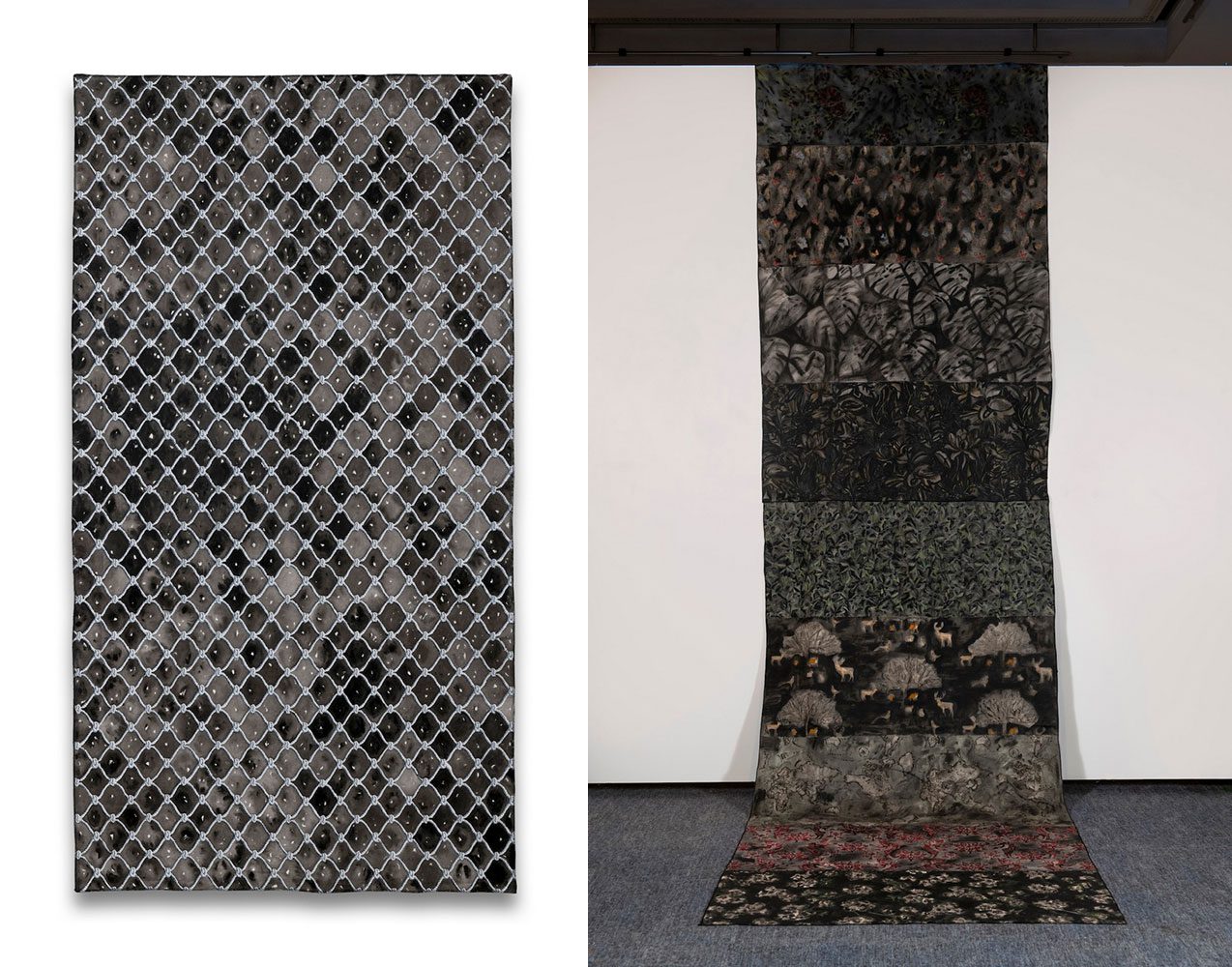
Right: Neriman Polat, ‘Döşemelik’, 2024, Acrylic paint on patterned fabric, 494 x 138 cm, © Neriman Polat, Courtesy the artist and Zilberman Gallery Belin-Istanbul