PRESENTATION: Beatriz Milhazes-Além do Horizonte

Coming to prominence in the 1980s as part of Brazil’s Geração Oitenta, Beatriz Milhazes was among a generation that reclaimed painting’s sensual and expressive potential after years of conceptual austerity under the military dictatorship of 1964–85. The optimism of that era, and its renewed confidence in painting as a space of imaginative freedom and vitality, endures throughout her work. Her reconciliation of dissonant patterns and sources sustains this impulse, allowing heterogeneity to unfold as formal invention.
By Efi Michalarou
Photo: White Cube Gallery Archive
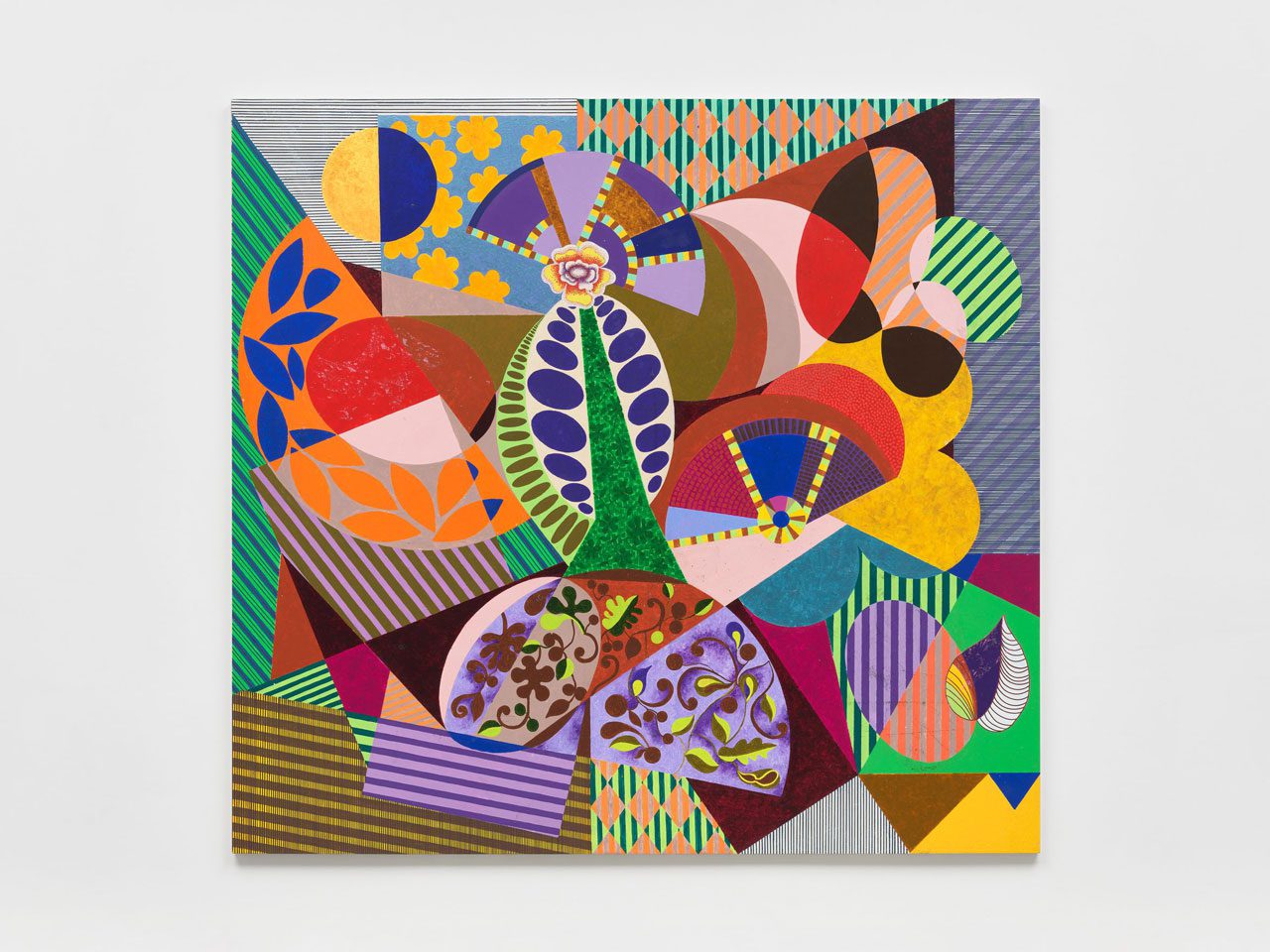
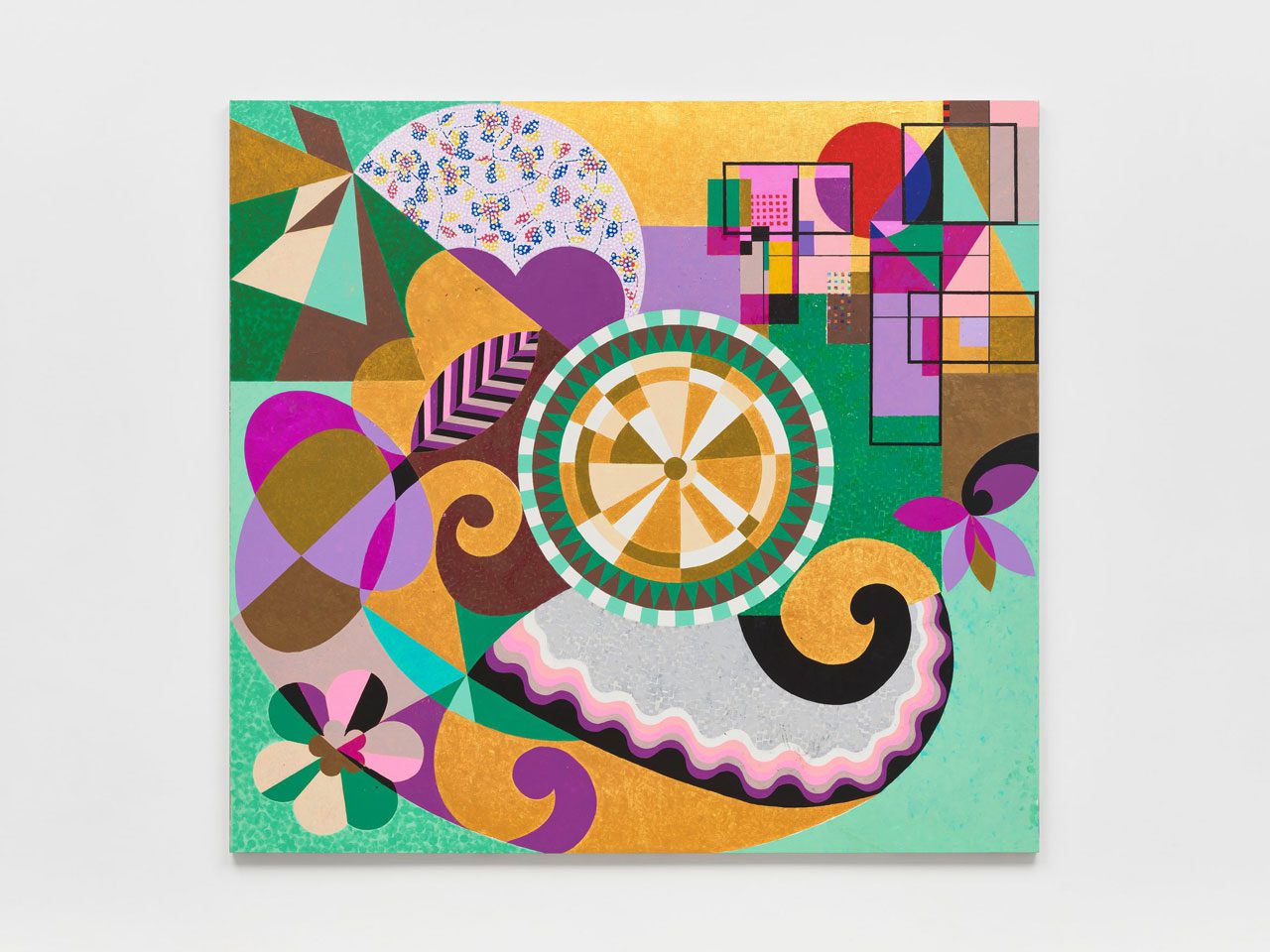
In her latest solo exhibition “Além do Horizonte” (Beyond the Horizon), Beatriz Milhazes reaffirms her position as one of the most distinctive voices in contemporary painting. Known for her kaleidoscopic orchestrations of color, pattern, and ornament, Milhazes has long pursued an aesthetic that resists easy categorization. Her work is simultaneously exuberant and ordered, rooted in Brazilian cultural traditions yet open to global dialogues. This exhibition, presented in London following her acclaimed contribution to the 2024 Venice Biennale, gathers new paintings, collages, and a site-specific installation that together chart the artist’s evolving enquiry into the affective and conceptual potential of ornament.
Milhazes’s practice has always been about more than decoration. Her chromatic architectures are not simply dazzling surfaces but complex negotiations of cultural memory, personal history, and formal experimentation. In “Além do Horizonte”, she deepens this enquiry, drawing upon an expanded archive of textile and decorative sources—from mid-20th-century psychedelia to indigenous Brazilian craft, European folk traditions, and the accumulated materials of her own studio. The result is a body of work that sustains a sense of simultaneity and interconnectedness, where order and exuberance ignite a productive tension.
A striking development in Milhazes’s recent paintings is her engagement with the woodblock portraits of the Edo-period printmaker Hokusai. In these prints, the patterned volumes of kimonos both conceal and articulate the human form, suggesting presence without direct figuration. Milhazes adapts this strategy in works such as “Pictures of the Floating World” (2025) and “Olokun – Goddess of the Sea” (2025). Here, violet-blue and white grounds frame silhouettes composed of overlapping geometries—ovoid forms, concentric circles, undulating lines.
Executed through her distinctive mono-transfer process, in which motifs are painted onto transparent plastic sheets and then transferred in reverse onto canvas, these works mark a new inflection in her mediation of figure and ground. Pattern becomes a means of evoking presence, a way of conjuring bodies without depicting them. The ornamental plane is no longer a backdrop but a site of embodiment, where geometry assumes agency.
Milhazes’s canvases are often described as “abundant,” their surfaces teeming with floral motifs, stripes, and spirals. Yet in IN THE EXHIBITION, she introduces tonal contrasts of black and white that generate shadow and depth. Works such as “The Botanical Mind” (2025) describe dense, aggregated fields that nonetheless cohere around a central animating presence. Veils of bicolored stripes traverse the canvas, suggesting transparency and rhythm, situating the work within the legacies of Op Art.
This interplay of order and exuberance is central to Milhazes’s practice. Her paintings are not chaotic explosions of color but carefully structured architectures. Beneath their chromatic exuberance runs a mathematical logic, an ordering impulse through which repetition and accumulation give rise to form. Geometry here is generative, recalling the natural rhythms of growth and movement. Flowers, foliage, horizon lines, and orbs evoke organic processes, while the repetition of circles and stripes suggests the infinite permutations of pattern.
Milhazes’s archive of sources is expansive, encompassing the psychedelia of mid-20th-century print culture, indigenous Brazilian design, European folk ornament, and the everyday materials of her studio. Her collages, in particular, translate processes of accumulation and exchange into material form. Mining the histories of textile and decorative design, she synthesizes bold florals from the 1960s and ’70s with embroidered motifs of traditional European dress.
Yet these collages also introduce a more personal register. Papers painted by the artist herself, her mother, and her studio assistant, alongside ribbons preserved from gifts and celebrations, provide a diaristic quality. Ornament here is not only cultural but personal, a record of relationships and lived experience. The collages thus extend Milhazes’s practice of collection and reuse, situating her work within broader conversations about sustainability, memory, and the politics of material culture.
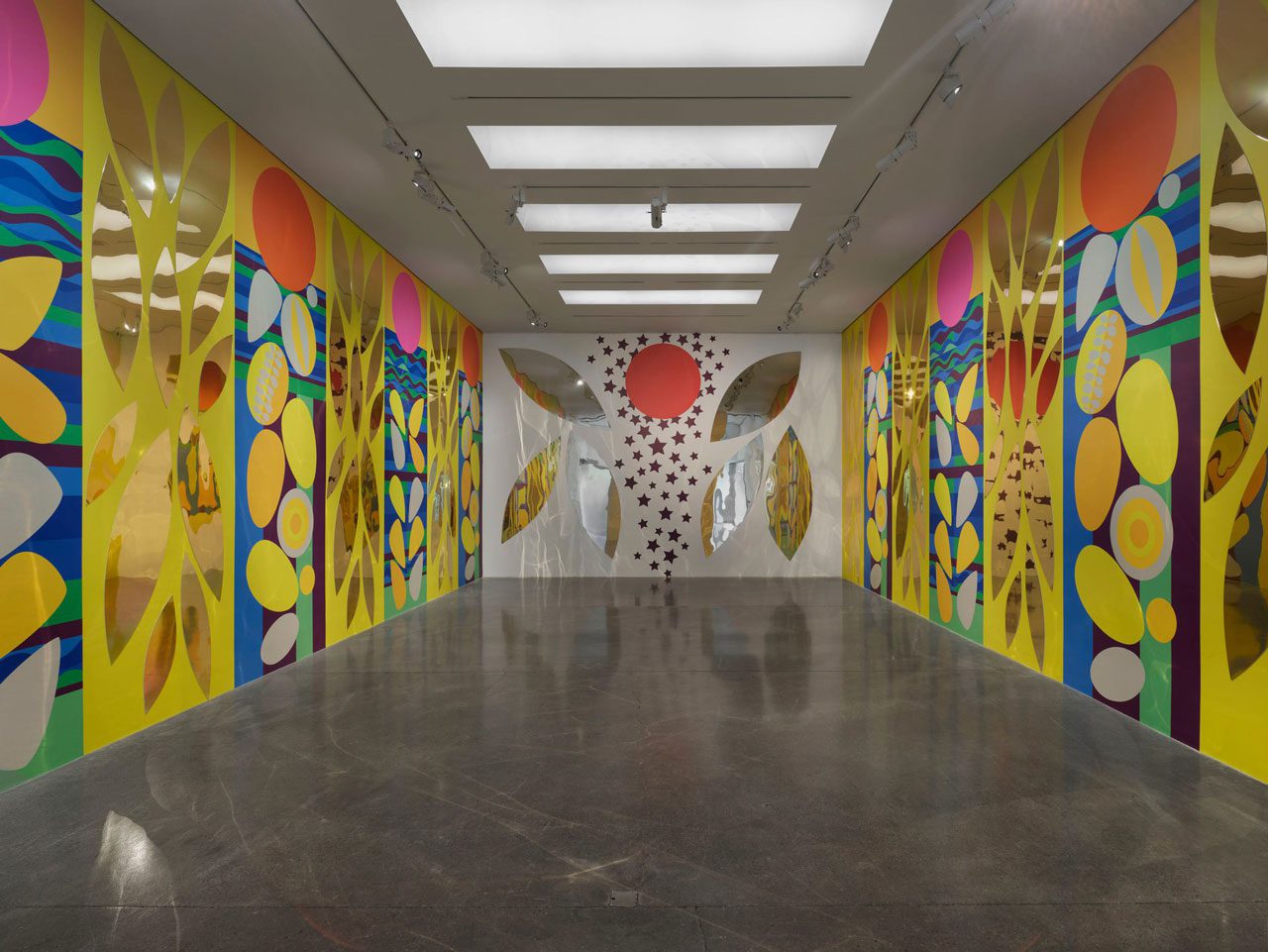
The exhibition culminates in a site-specific installation that lends its title to the show. “Além do Horizonte” (2025) transforms the ground-floor gallery into an immersive field of shifting color and pattern. A panoramic vinyl mural unfurls across the walls, organizing rippling bands of blue and green beneath pink-orange suns, mirrored golden leaves, and constellations of stars.
This installation transposes the coastal atmosphere of Rio de Janeiro into dialogue with London’s urban setting. It is not a static image but a responsive environment, shifting with the viewer’s movement. Casting glimmers of golden, liturgical light across the gallery, the work advances Milhazes’s vision of art as an ongoing negotiation of difference—an ever-shifting horizon of convergence and return. The horizon here is not a boundary but a site of possibility, intimating harmony within multiplicity.
What emerges from “Além do Horizonte” is a philosophy of ornament. For Milhazes, ornament is not superficial embellishment but a mode of thought, a way of structuring experience. Her chromatic architectures sustain a sense of simultaneity, where disparate idioms coexist without hierarchy. Indigenous motifs, psychedelic florals, European folk patterns, and personal materials are orchestrated into a syncretic whole.
This philosophy resonates with broader debates in art history. Ornament has often been dismissed as secondary to form, associated with the decorative rather than the conceptual. Yet Milhazes reclaims ornament as a site of meaning, aligning her practice with figures such as Gustav Klimt, Sonia Delaunay, and the Op Art pioneers, while also situating it within Brazilian modernist traditions. Her work demonstrates that ornament can be both affective and intellectual, both exuberant and ordered.
“Além do Horizonte” is more than an exhibition; it is a proposition about how art can negotiate difference. Milhazes’s paintings, collages, and installation sustain a sense of interconnectedness, where order and exuberance, tradition and innovation, personal and cultural registers coexist. Her engagement with Hokusai, Op Art, psychedelia, and folk ornament situates her practice within a global dialogue, while her use of personal materials grounds it in lived experience.
The horizon, in Milhazes’s vision, is not a limit but a site of convergence. It is where sea meets sky, where cultures intersect, where ornament becomes philosophy. In a world often fractured by difference, Milhazes offers a vision of harmony within multiplicity—an art that is at once dazzling and profound, exuberant and ordered, personal and universal.
Photo: Beatriz Milhazes, Histórias Tropicais I, 2024, Collage of various and printed papers and acrylic markers on paper, 55 x 93 cm | 21 5/8 x 36 5/8 in., 68 x 106 x 5 cm | 26 3/4 x 41 3/4 x 1 15/16 in. (framed), © Beatriz Milhazes, Courtesy the artist and White Cube Gallery
Info: White Cube Gallery, 25–26 Mason’s Yard, London, United Kingdom, Duration: 19/112025-17/1/2026, Days & Hours: Tue-Sat 10:00-18:00, www.whitecube.com/
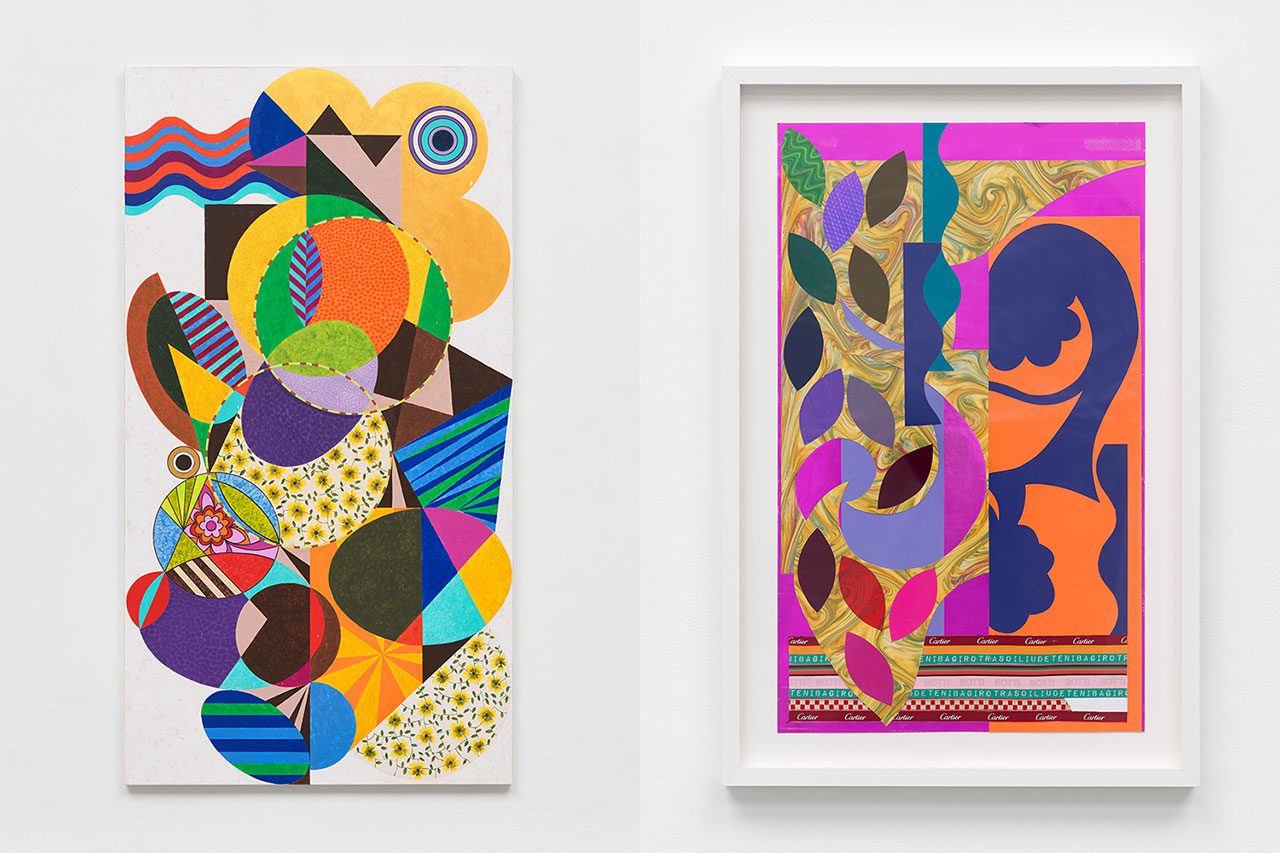
Right: Beatriz Milhazes, A Valsa das Folhas IV 2024, Collage of various and printed papers and fabric ribbon on paper, 73.5 x 44.5 cm | 28 15/16 x 17 1/2 in. , 86.5 x 57.5 x 5 cm | 34 1/16 x 22 5/8 x 1 15/16 in. (framed), © Beatriz Milhazes, Courtesy the artist and White Cube Gallery