ART CITIES: Berlin-Pakui Hardware
Pakui Hardware is the name chosen by collaborative artist duo Neringa Černiauskaité and Ugnius Gelguda. Pakui Hardware refers to Pakui – special attendant of Hawaiian Goddess, a runner who could circle an island six times in a day, thus embodying velocity and mythology, and Hardware which stands for materiality, bodies, and resources. The duo’s work explores plasticity of bodies, their yet undiscovered potentials. They trace how diverse technologies expand, test and control these bodily promises.
By Dimitris Lempesis
Photo: Carlier|Gebauer Gallery Archive
Since 2023, the Lithuanian duo Pakui Hardware (Neringa Černiauskaitė and Ugnius Gelguda) have extended their long-standing enquiry into the biological body by turning to the genetic, nervous, and immune systems as frameworks for thinking about management, governance, and social dynamics. Their earlier projects, which centred on illness, treatment, and technological mediation, already reflected on issues such as the climate crisis, drought, and migration. For Pakui Hardware, the body—whether human or planetary—remembers. It stores history in molecules, scars, and forms.
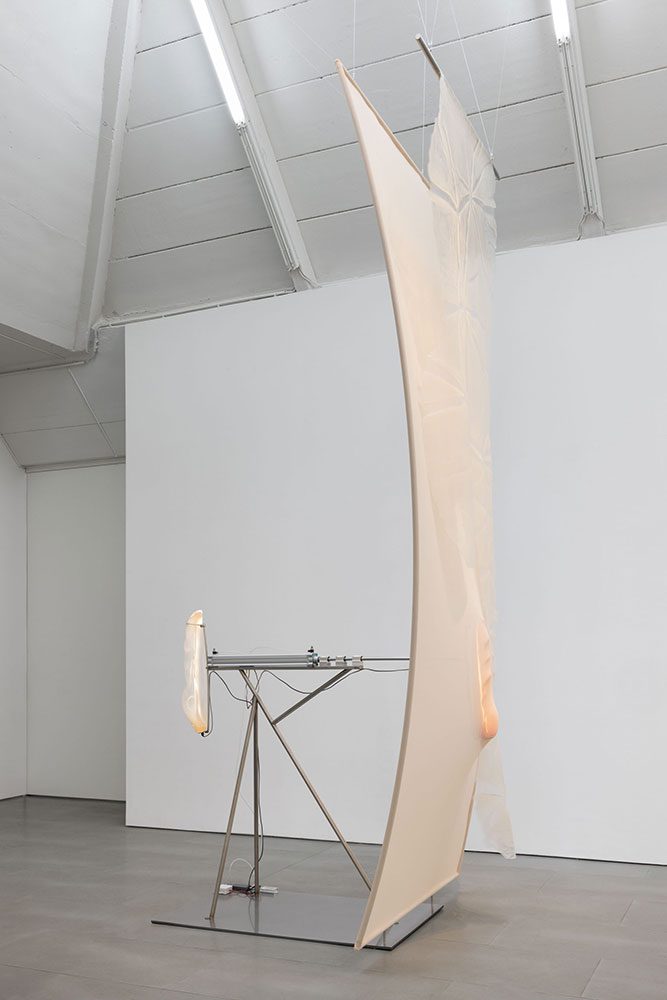
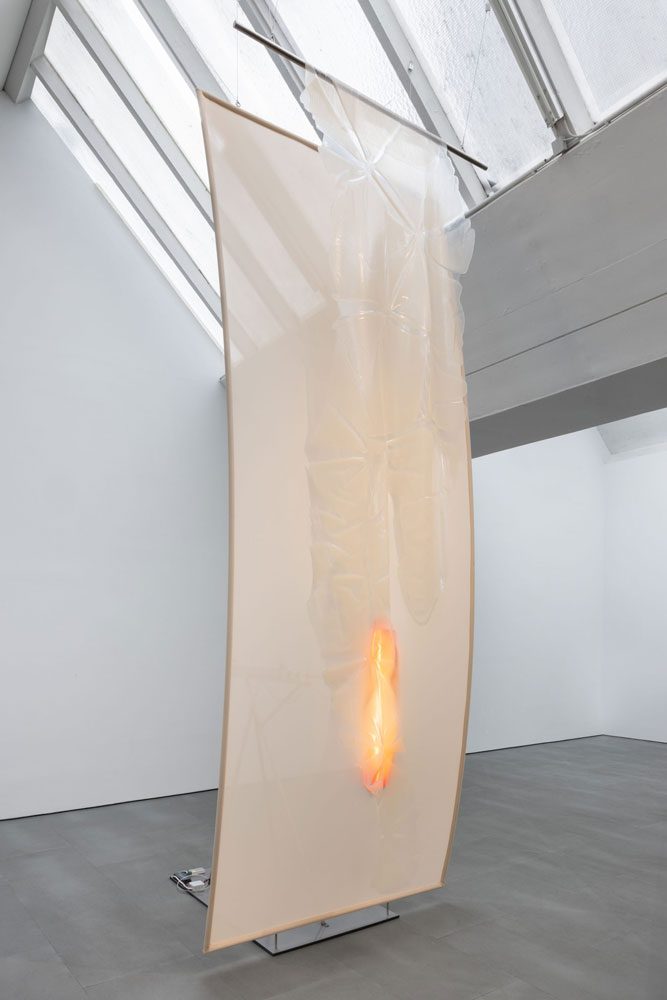
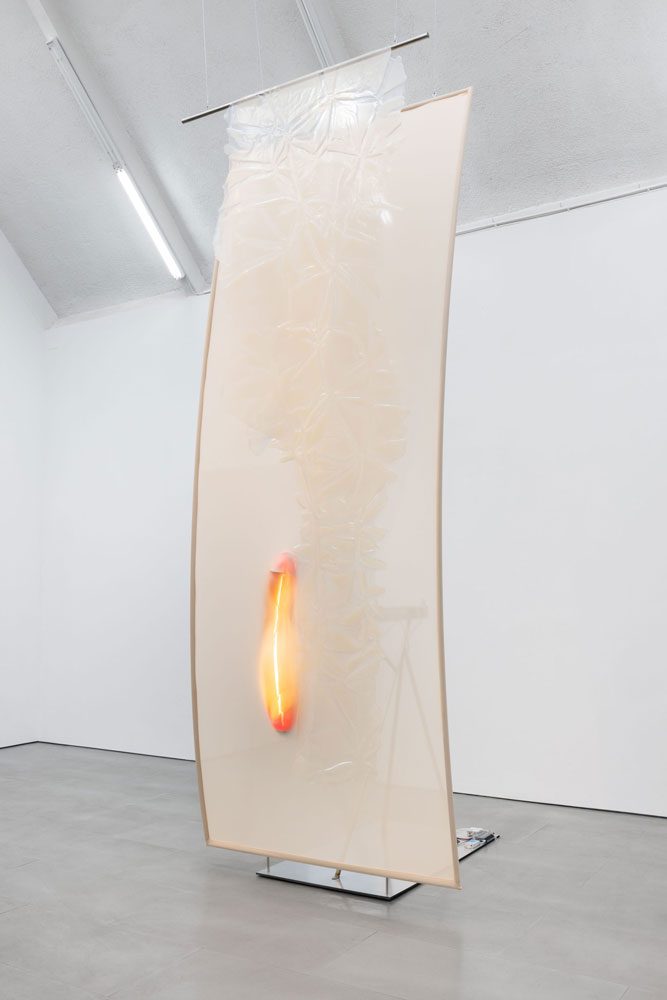
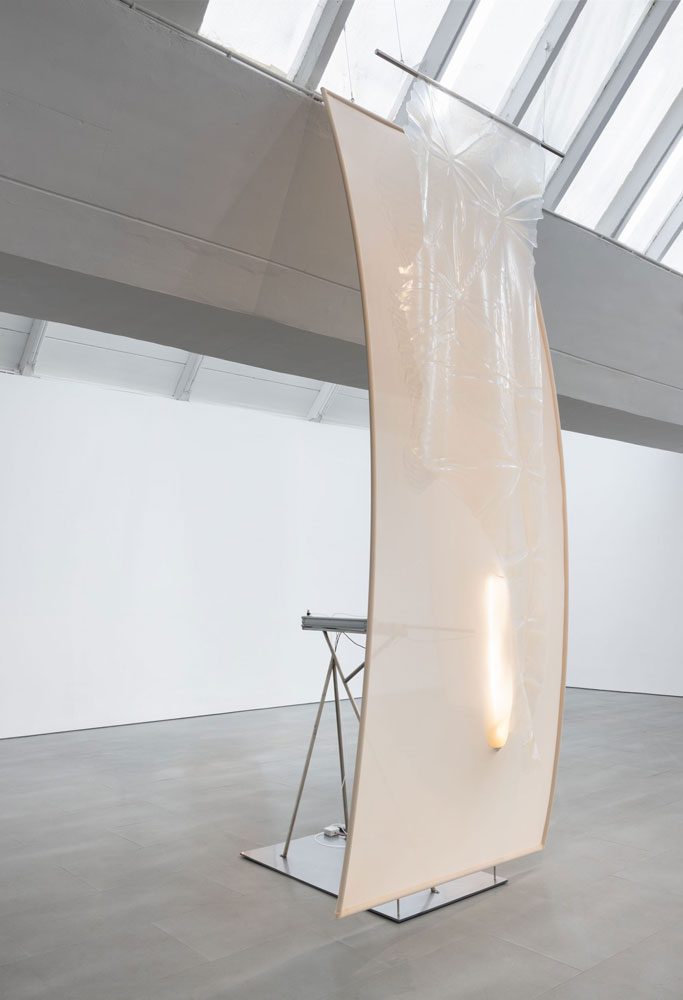
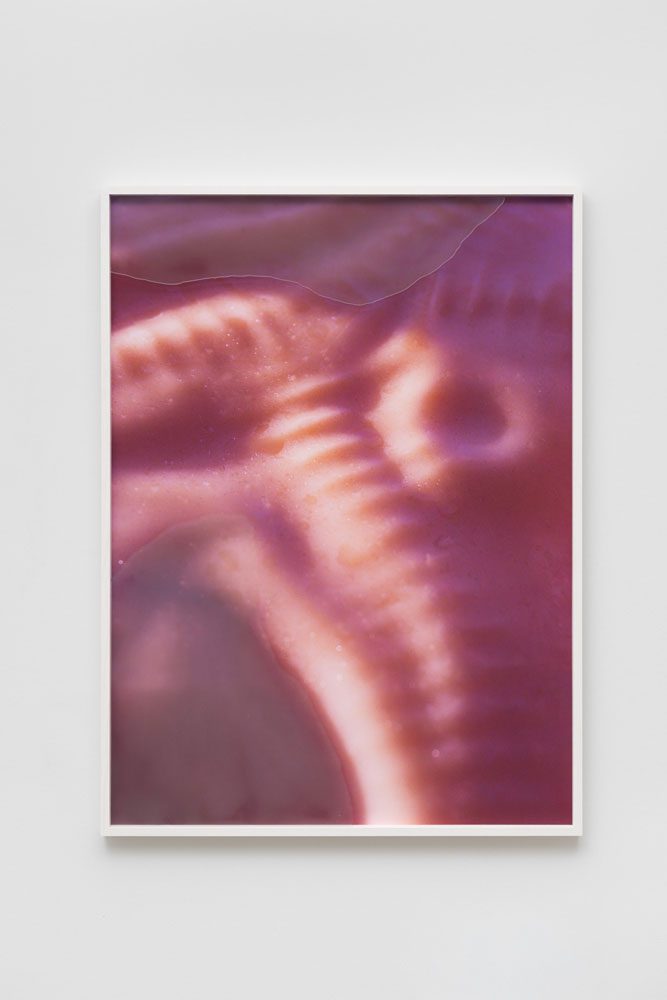
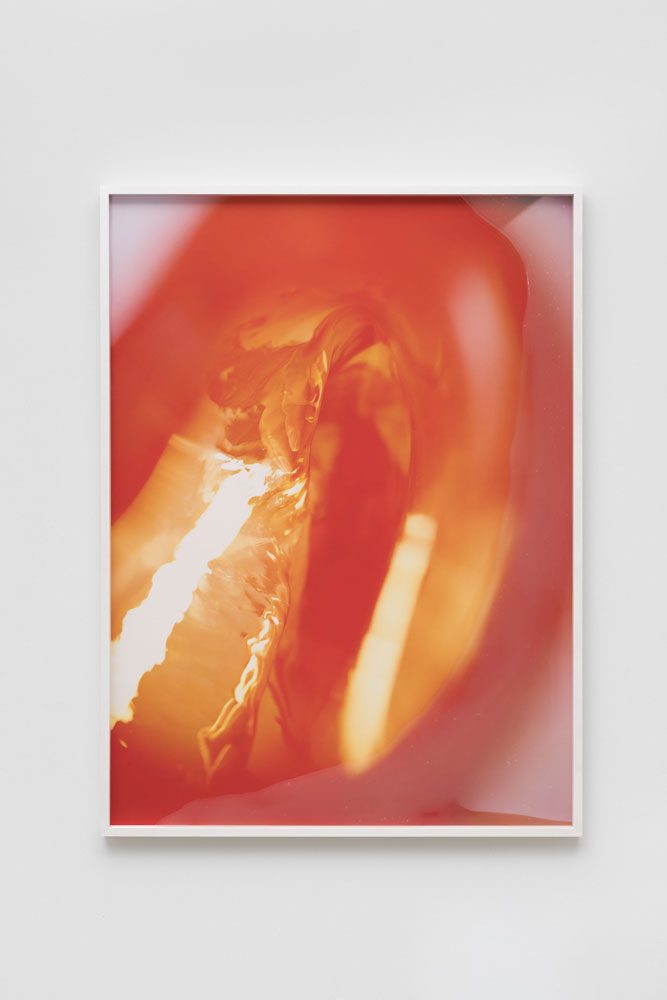
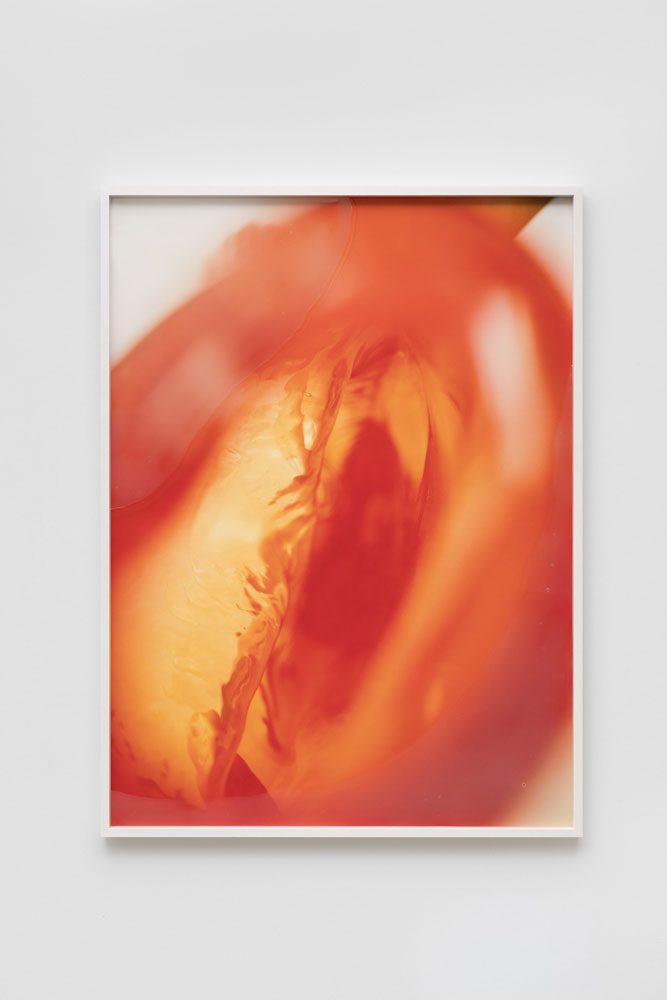
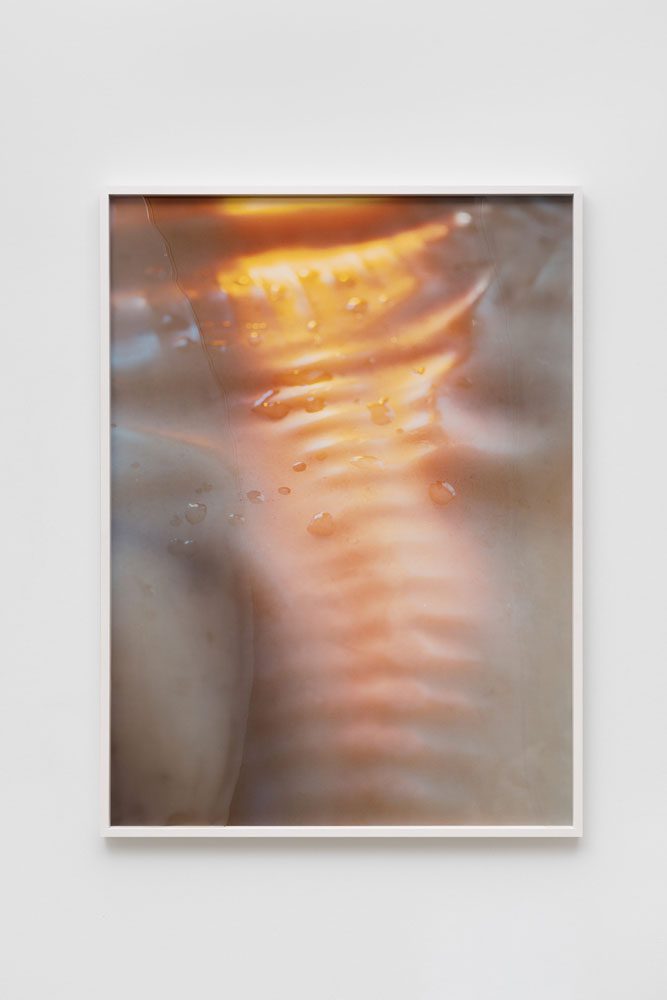
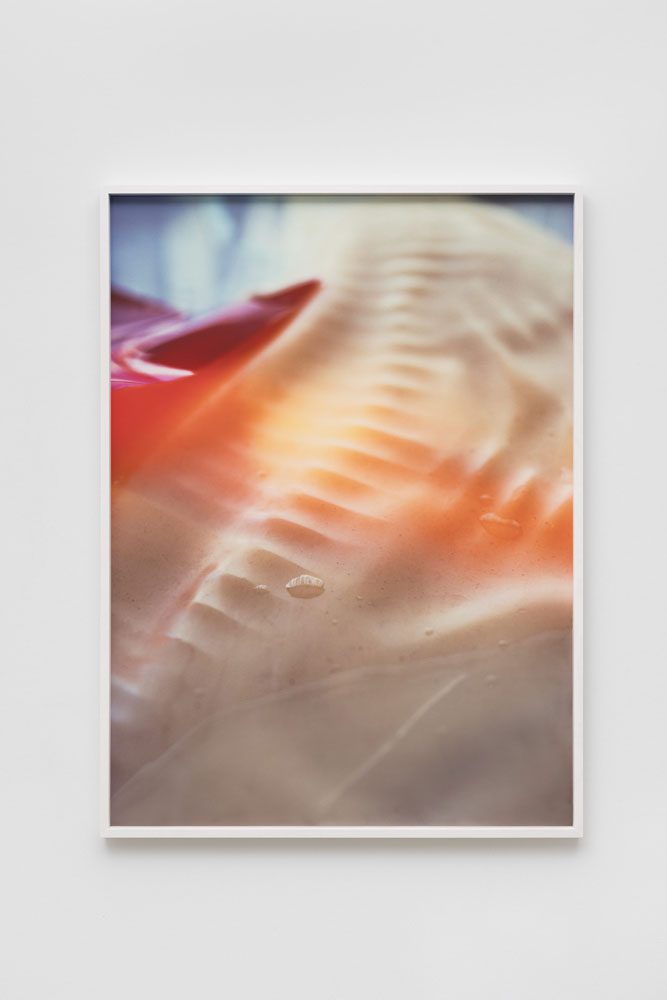
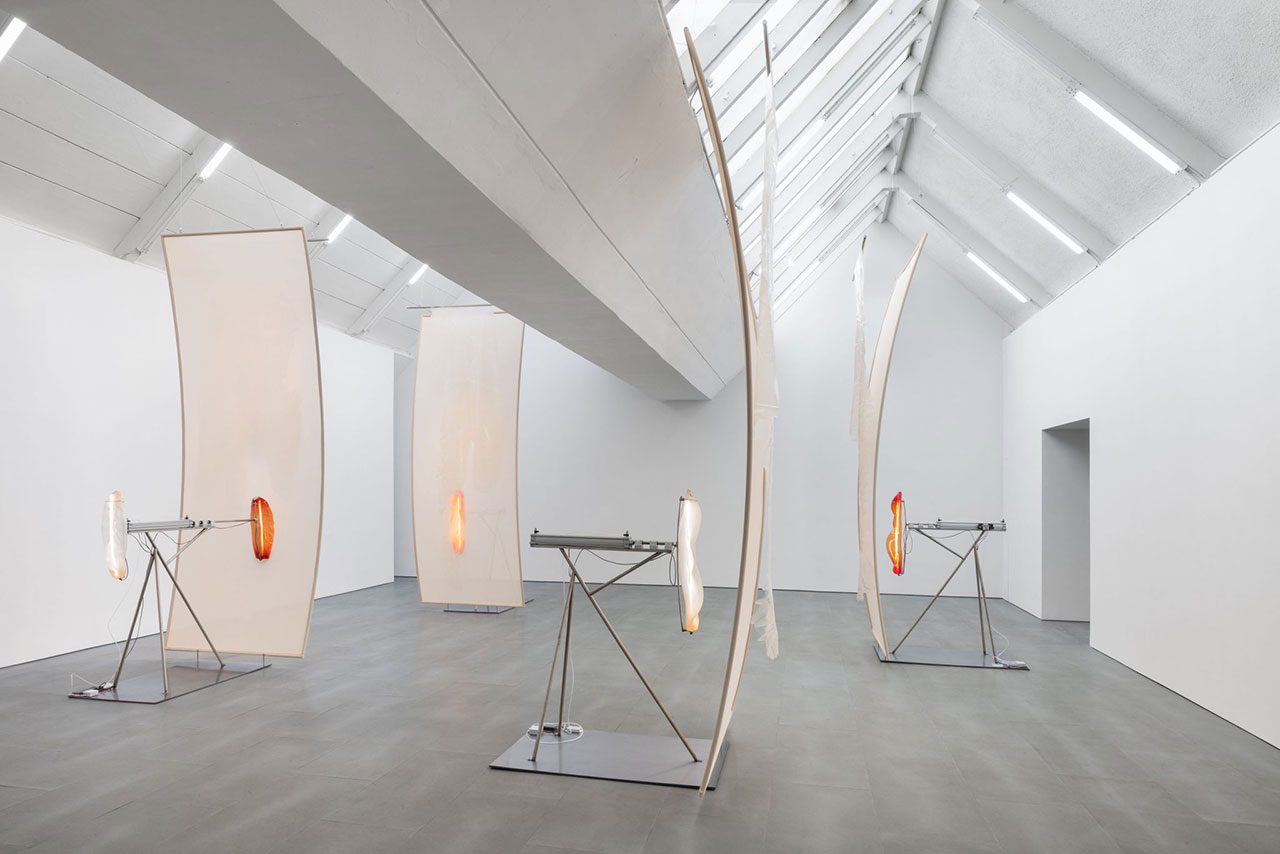
Their exhibition “Thresholds”, first shown at Zachęta – National Gallery of Art in Warsaw, deepens this inquiry by focusing on the filtering membrane as a central metaphor. Biological immunity becomes both a literal and conceptual foundation: the delicate process by which organisms distinguish the self from the other. Drawing on medical imaging, biological processes, and the materiality of flesh, the artists explore the body’s ever-shifting boundaries—its points of vulnerability, permeability, and resistance.
Pakui Hardware works with a distinctive material lexicon: hand-blown glass, thin silicone films, latex, flexible membranes. These materials function almost as a pictographic script, each one carrying its own conceptual weight. In “Thresholds”, these forms are animated by compressed air, causing them to expand and contract in rhythmic pulses.
As the artistic duo says “With these materials, we can bring together themes that otherwise would require straightforward explanation: stainless steel is associated with medicine, silicone – with skin-like prostheses, and laboratory glassware – with scientific experiments. This is how we construct our own visual language.”
The movement is mechanical and externally dictated—an artificial breath—that pushes repeatedly against soft boundaries without rupturing them. This cyclical motion evokes biological processes but also economic and political dynamics: systems stretched to their limits, expanding and recoiling under pressure.
The membrane, in this context, becomes more than a biological interface. It stands in for borders, thresholds, and psychological or social limits—spaces where forces meet, collide, and transform.
As in much of Pakui Hardware’s practice, the exhibition’s title is intentionally multi-layered. In economics, a threshold marks the point at which an entire system changes its behaviour. In traditional Lithuanian culture, the threshold (slenkstis) is sacred and dangerous—a liminal boundary crossed with care.
In education, “threshold concepts” refer to transformative ideas that fundamentally reshape perception and understanding.
The membrane, therefore, is not an object but a conceptual hinge. Across these various meanings, Pakui Hardware uses material forms to articulate arguments—propositions constructed through glass, latex, steel, and air rather than academic language. Their works do not illustrate theories; they embody them.
Pakui Hardware often return to the body as a repository of collective and ecological memory. Just as DNA encodes ancestral narratives, the body of the planet retains the imprints of extraction, warming, and collapse. Their earlier project “Inflammation “linked biological inflammation with geopolitical tension and environmental trauma.
The body—human or planetary—becomes a living archive in which history is inscribed not in books but in tissues and terrains. This echoes ancient traditions such as hepatoscopy, the reading of omens in animal livers. The German art historian Aby Warburg collected images of clay organs used as teaching tools for apprentice diviners, their surfaces marked with inscriptions indicating where knowledge could be “read.” Pakui Hardware’s work, too, proposes new forms of reading—of membranes, surfaces, internal landscapes.
As part of “Inflammation” the artists integrated works by Marija Terese Rožanskaitė, recognising her depictions of medical and radiological environments as a lineage they inherit. They also stand in a broader constellation with artists such as Helen Chadwick, whose “Viral Landscapes” (1988–89) merged microscopic images of her own cells with coastal topographies, examining the body’s porous relationship to its surroundings.
When viewed through a political lens, the bodies in works by Rožanskaitė, Chadwick, or Alina Szapocznikow are not purely anatomical. They are sites of struggle, agency, and resistance. The body becomes a contested terrain where power, identity, and autonomy are negotiated. Pakui Hardware’s membranes can similarly be read as biopolitical surfaces—screens on which control, permeability, and vulnerability are played out.
In an era shaped by ecological collapse, pandemics, mass migration, and fragile political orders, the question of thresholds—of what divides or connects, protects or exposes—feels urgent. Pakui Hardware’s work offers a meditation on these shifting boundaries.
The membranes in “Thresholds” invite viewers to reflect on the permeability of systems we once assumed were stable: borders, markets, bodies, ecosystems. These works suggest that transformation often happens not at the centre but at the edge, where contact and exchange occur.
In the slow, rhythmic movements of their kinetic sculptures, the boundary is not fixed. It is a living, negotiable zone—fragile yet resilient. A place where vulnerability becomes a form of knowledge, and where memory continues to pulse beneath the surface.
Photo: Pakui Hardware, Thresholdsm, Exhibition view carlier|Gebauer Gallery-Berlin 2025, Courtesy the artists and Carlier|Gebauer Gallery
Info: Carlier|Gebauer Gallery, Markgrafenstraße 67, Berlin, Germany, Duration: 1/11-20/12/2025, Days & Hours: Tue-Sat 11:00-18:00, www.carliergebauer.com/