PRESENTATION: Howardena Pindell-Off the Grid
Howardena Pindell’s profoundly personal and politically charged work delivers a dynamic materiality to the canons of painting – serving as much as a diaristic account of her own biography as a means to interrogate broader issues of social justice. With a practice spanning over five decades and encompassing a diverse range of mediums – including painting, collage, drawing and film – Pindell lends visceral form to a rigorous intellectual inquiry of the given subject.
By Efi Michalarou
Photo: White Cube Gallery Archive
In her sweeping six-decade survey “Off the Grid”, Howardena Pindell cements her place among the titans of postwar abstraction—yet her work always transcends formal geometry, folding in layers of memory, activism, and identity. This major exhibition brings together paintings, sculpture, works on paper, and video to chart Pindell’s persistent refusal of the grid as merely a compositional device.
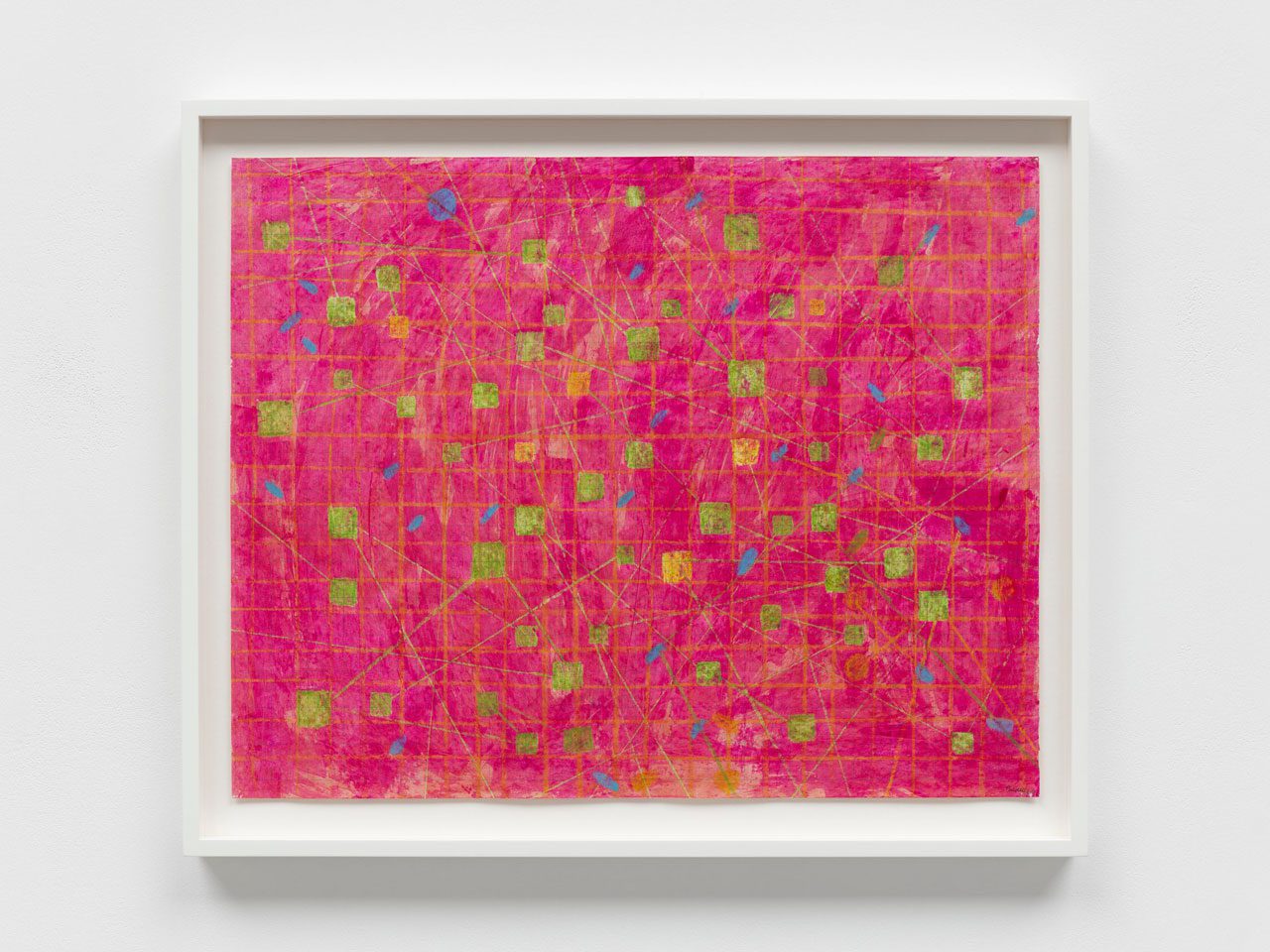
The exhibition’s title, “Off the Grid”, signals more than aesthetic play: it captures Pindell’s lifelong subversion of a structure deeply rooted in modernist tradition — and in American social history. The grid, long heralded in modernist art for its mathematical purity, also carries the weight of systemic division, from Jefferson’s 1785 Land Ordinance to the zoning of racially segregated neighborhoods. In Pindell’s hands, the grid becomes a battleground.
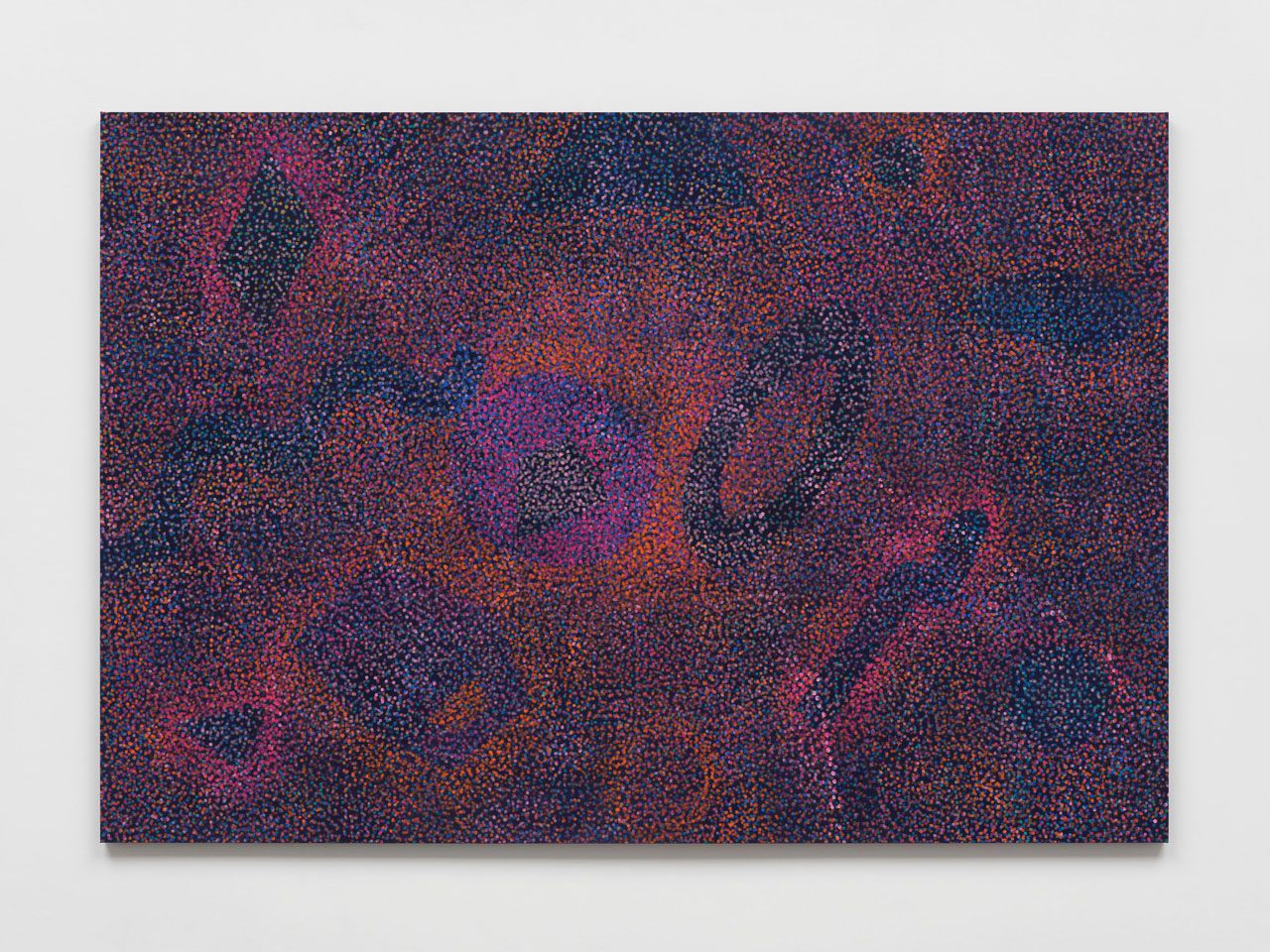
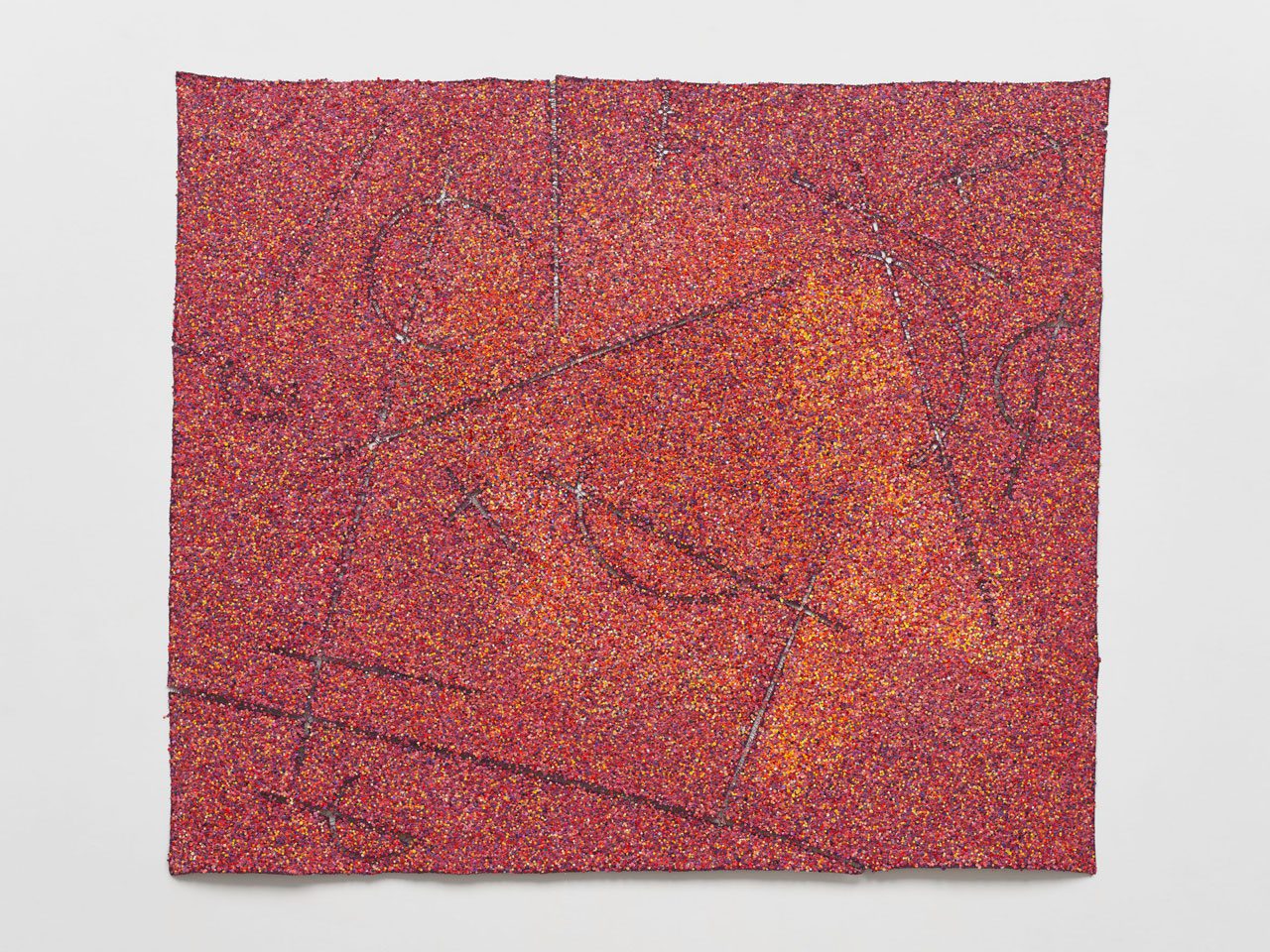
Her work disrupts and deconstructs this organizing principle — the lines weaken, the symmetry fractures, and her beloved circular motifs burst through. These circles, whether in sprayed dots, punched holes, or dense tapestries, are more than decorative: they trace histories — of space, of memory, of racial politics.
Born in 1943 in Philadelphia, Pindell’s personal journey is inseparable from her art. As a child, she visited the Philadelphia Museum of Art and encountered Marcel Duchamp’s “Why Not Sneeze, Rose Sélavy?”, a formative experience in her understanding of structure and chance. She later studied at Yale in the 1960s, where Josef Albers’s color theories (via Si Sillman) reshaped how she thought about light and hue.
Pindell also worked at MoMA — first as a curator — and there she absorbed ideas about African textiles and layered craftsmanship, which would later feed into her own practice. A near-fatal car crash in 1979 left her with partial memory loss. This trauma marked a turning point: her work became more explicitly political and autobiographical, integrating personal history with collective struggle.
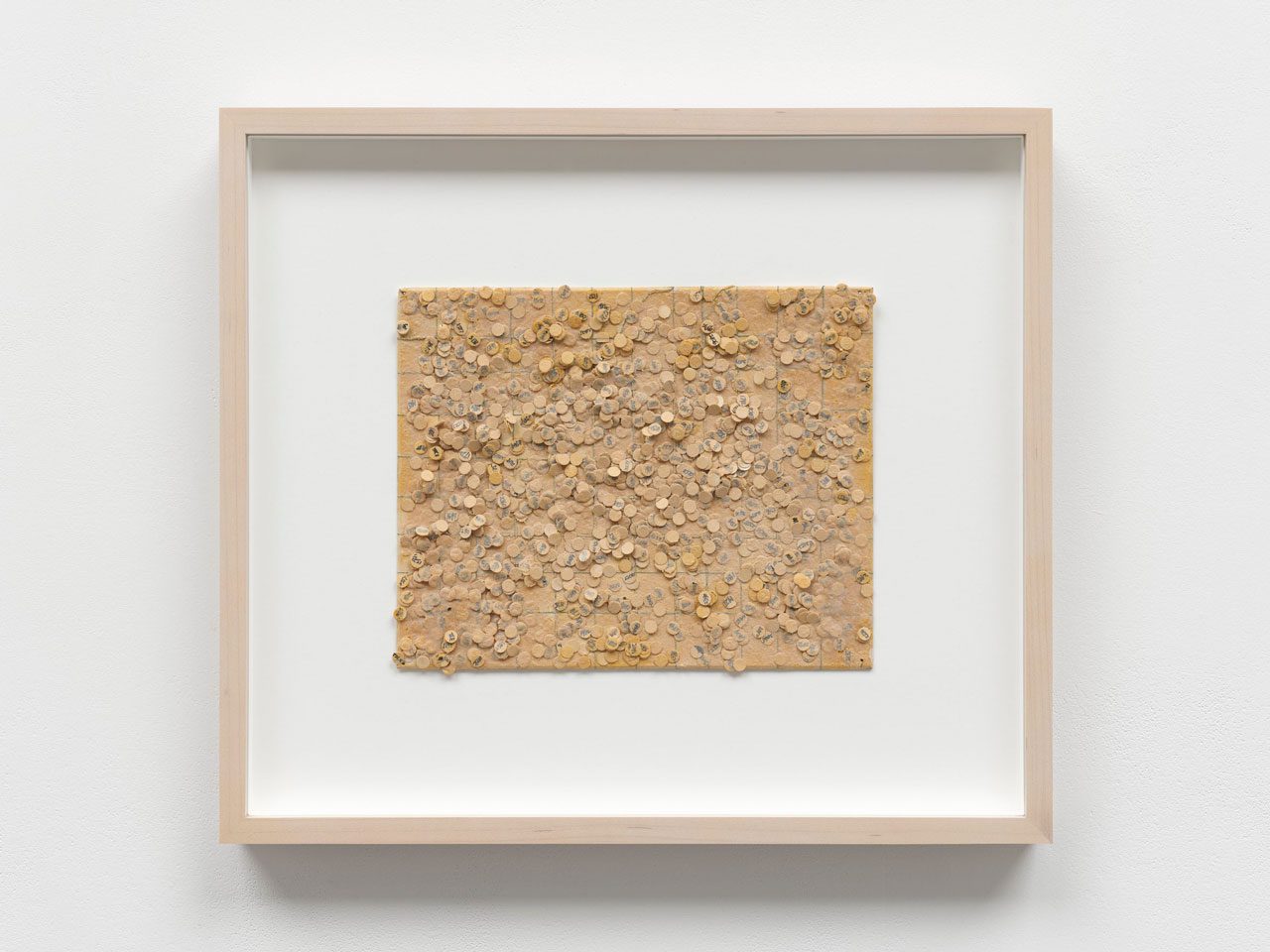
One of Pindell’s signature innovations arose in her MoMA days: the spray-dot technique. She fabricated stencils from office materials — punching holes in manila folders, envelopes, cardstock — and then sprayed layers of paint through them. The residue, or “chads,” became the raw material for her “Hole Punch” works.
These chads aren’t random but deliberately numbered. In works like “Letter Series”, “Mildred Pindell to Howardena Pindell” (1974), Pindell piles up these tiny paper disks in seemingly chaotic mass, spilling beyond the strictures of the grid. The numbering gives structure, but their accumulation feels uncontrollable — echoing how personal grief, memory, or history defy neat containment.
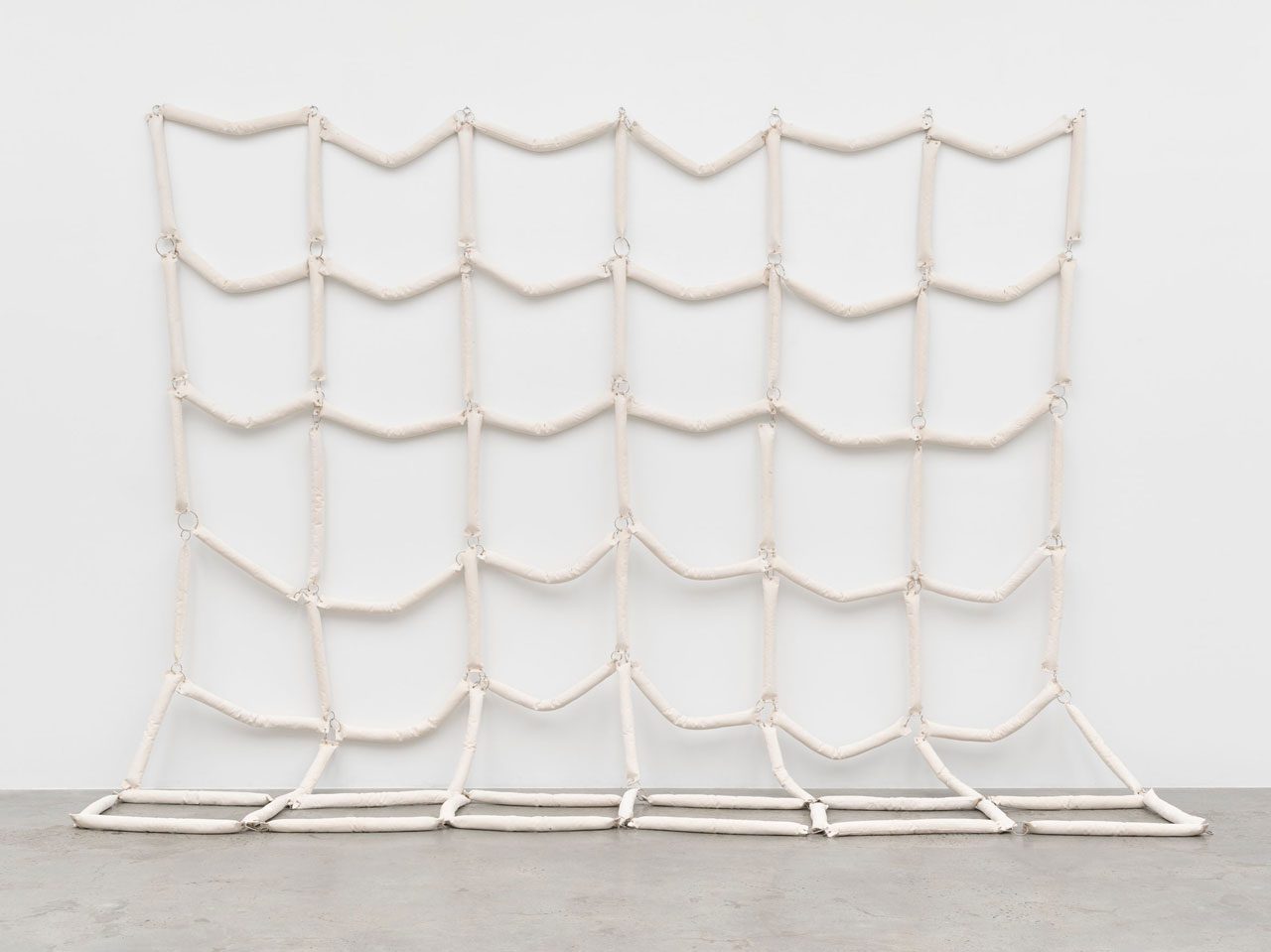
In sculptural works such as her grid of rolled canvas in “Untitled” (1971/2025), she literalizes the grid only to unravel its rigidity — a mocking gesture, she has said, that renders the scientific into the soft, the flexible.
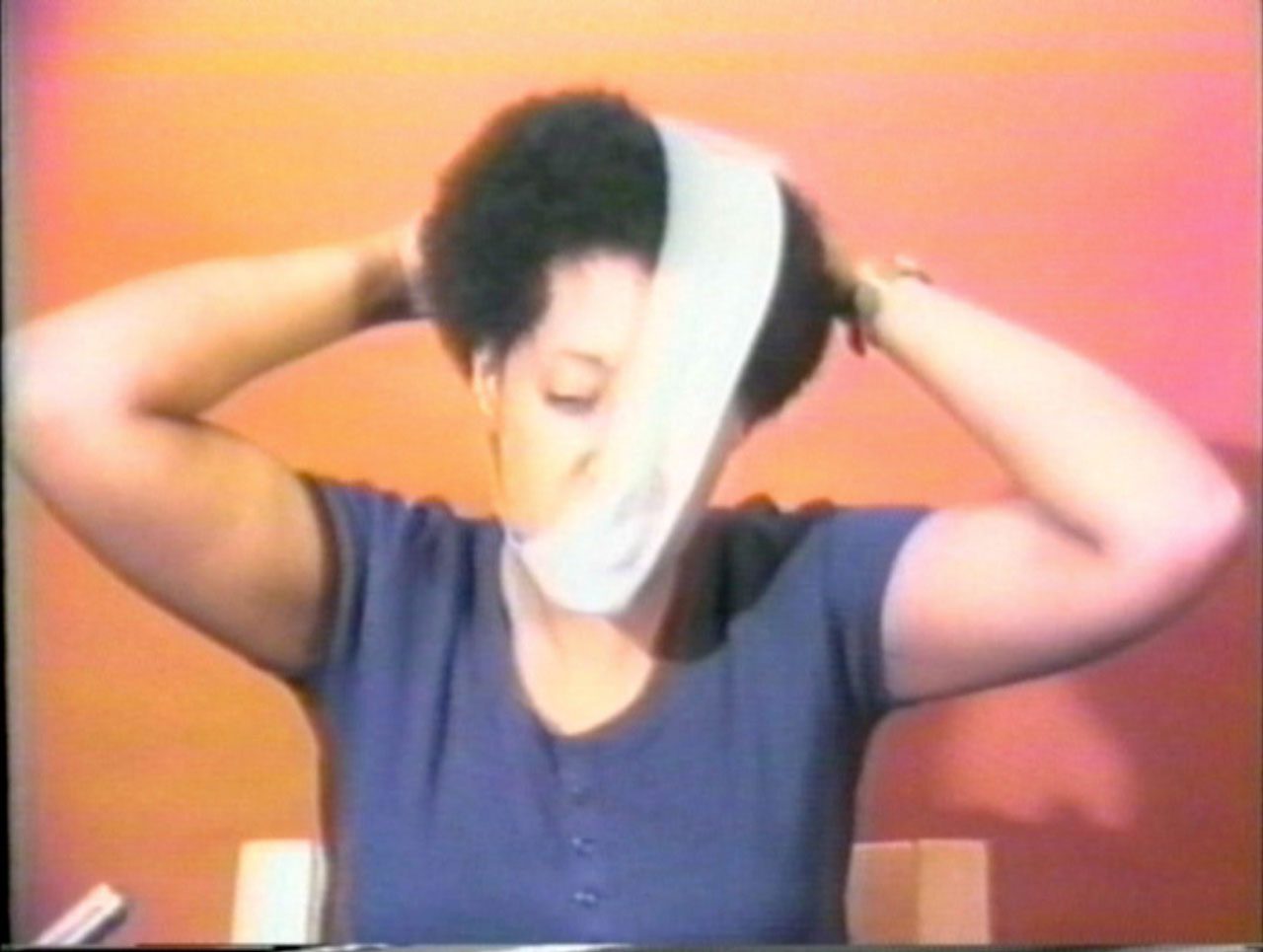
From the 1980s onward, Pindell’s practice took on a more political edge. Her landmark video “Free, White and 21” (1980) features her speaking candidly about racism and sexism — even playing a white woman in a wig and whiteface to perform a caricature of racist indifference. (Wikipedia)
Later, she returned to film with “Doubling” (1995) and “Rope/Fire/Water” (2020), works built from archival imagery that interrogate violence against Black bodies over centuries. Her video works, shown in the exhibition, are acts of reckoning — deeply personal, uncomfortably direct, and politically urgent.
In her recent “Tesseract” series, Pindell abandons visible grids altogether. Instead, multicolored spray-painted dots hint at four-dimensional hypercubes, evoking cells, bacteria, or galaxies. Her work often hovers between micro and macro, between the ocean’s depths and the vastness of space.
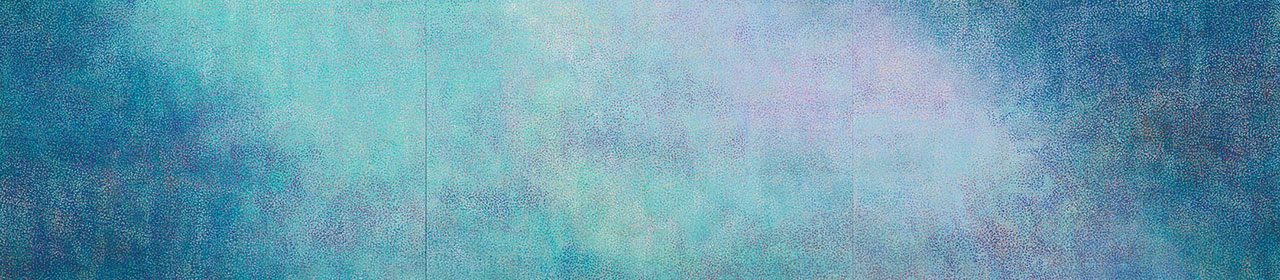
At the heart of “Off the Grid” is “Oceanic Underwater” (2025), a monumental three-panel canvas in translucent blues, lilacs, purples, and crystalline whites — Pindell’s response to Monet’s Water Lilies and a meditation on beauty born from trauma. In her own words, she wanted to move “from this traumatic, violent thing, to something beautiful and joyful.”
Pindell’s peers — Jack Whitten, Sam Gilliam, Lorraine O’Grady, Adrian Piper, Ana Mendieta — all helped reshape abstraction in the latter half of the 20th century. But Pindell’s work stands out not just for formal innovation, but for its moral weight. Her abstraction is not a retreat, but a call to witness.
“Off the Grid” is more than a retrospective: it’s a reminder that formal rigor and political urgency can cohabit in the same space — that abstraction can be deeply rooted in the fight for justice.
Photo: Howardena Pindell, Oceanic Underwater, 2025, Acrylic on canvas, Overall: 182.9 x 823 cm | 72 x 324 in, 3 panels, each: 182.9 x 274.3 cm | 72 x 108 in, © Howardena Pindell, Courtesy the artist and White Cube Gallery
Info: White Cube Gallery, 144–152 Bermondsey Street, London, United Kingdom, Duration: 21/11/2025-18/1/2026, Days & Hours: Tue-Sat 10:00-18:00, Sun 12:00-18:00, www.whitecube.com/