
PREVIEW: Wifredo Lam-When I Don’t Sleep, I Dream

Wifredo Lam’s paintings expanded the horizons of modernism by creating a meaningful space for the beauty and depth of Black diasporic culture. Born in Cuba at the start of the twentieth century, Lam forged his political convictions and commitment to modern painting in war-torn Europe in the 1930s. His exile and return to the Caribbean after eighteen years abroad drove him to radically reimagine his artistic project through Afro-Caribbean histories.
By Dimitris Lempesis
Photo: MoMA Archive
The MoMa’s latest retrospective, “When I Don’t Sleep, I Dream,” stands as the most comprehensive exhibition of Wifredo Lam’s work ever presented in the United States. With more than 130 artworks spanning six transformative decades—from the 1920s through the 1970s—the exhibition is not merely a celebration of Lam’s extraordinary artistic range, but a meditation on exile, identity, and the restless imagination of a truly global artist.
Born in Cuba in 1902 to parents of Chinese, African, and Spanish descent, Lam’s life unfolded as a continuous migration across geographies and artistic vocabularies. His journey from Havana to Madrid, Paris, Marseille, and ultimately to the Italian town of Albissola Marina mirrors the movement of modernism itself: a circulation of ideas, aesthetics, and spiritual inquiries that defied national boundaries.
Lam’s early education in Havana offered the foundations of academic technique, but it was in Spain—where he studied at Madrid’s Real Academia de Bellas Artes de San Fernando beginning in 1923—that he encountered the modern world. Immersed in the intellectual fervor of interwar Europe, Lam began to merge the traditions of Western painting with his own search for identity. His experiments with flattened perspective, bold outlines, and rhythmic patterning hinted at a visual language that would later come to full bloom.
The Spanish Civil War marked a crucible for both his art and his political consciousness. Fighting with the Republican army, Lam’s “La Guerra Civil” (1937) declared his alignment with the avant-garde’s commitment to social struggle and transformation. This experience also marked the beginning of a lifelong reckoning with violence, displacement, and the persistence of spirit under oppression—motifs that would animate his later work.
In 1938, Lam relocated to Paris, where his path converged with the luminaries of the European avant-garde. His friendship with Pablo Picasso and his engagement with André Breton and the Surrealists catalyzed a profound evolution. In their circle, Lam found an artistic kinship grounded in the liberation of the unconscious and the poetic power of metamorphosis.
Yet history intervened once more. The Nazi invasion of France in 1940 forced Lam into exile for a second time, joining a community of displaced artists in Marseille’s Villa Air-Bel. There, amid uncertainty and fear, Lam participated in collective Surrealist drawings—an act of both resistance and psychic survival. His hybrid creatures of animal, plant, and human form were born in this crucible, heralding a new synthesis that would define his art.
When Lam returned to Cuba in 1941 after nearly two decades abroad, he encountered his homeland as both native and stranger. The lush vegetation and the rhythms of Afro-Cuban spirituality reawakened memories long submerged beneath European modernism. The result was a radical reconfiguration of his pictorial universe.
In works such as “La jungle” (1942–43), Lam conjured a dense, dreamlike landscape where sugarcane and spirit, history and myth, body and cosmos, intertwined. The painting is a cornerstone of modern art, both an indictment of colonial exploitation and a visionary affirmation of cultural renewal. Through imagery inspired by Lucumí and Vodou cosmologies—horned deities, birds in flight, half-human hybrids—Lam redefined the modernist canvas as a site of diasporic memory and ritual power.
Lam’s postwar return to Europe in 1946 ushered in a new austerity. The devastation of the continent and the lingering specter of colonialism deepened his resolve to forge an art of clarity and force. He pared back the lush chromatic excess of his Caribbean period, focusing instead on monumental forms rendered in a dark, resonant palette. The femme-cheval (horse-woman) series epitomizes this shift—images of transformation and possession that bridge the sacred and the political, the ancestral and the contemporary.
In the following decades, Lam became a tireless collaborator. He worked alongside poets such as René Char and Édouard Glissant, translating the rhythms of language into the visual domain. His move to Albissola Marina in 1962 expanded his experimentation into ceramics and printmaking, translating his cosmology into new materials and dimensions. The Brousse (Bush) paintings of the late 1950s, with their intricate thickets of sugarcane and birdlike forms, testify to his lifelong dialogue between abstraction and nature—a poetics of entanglement rooted in the Cuban landscape yet universally resonant.
By the time of his death in 1982, Wifredo Lam had become one of the defining figures of 20th-century art—a bridge between the European avant-garde and the spiritual and cultural worlds of the Caribbean and Africa. When I Don’t Sleep, I Dream captures not only the breadth of his achievement but also the profound coherence of his vision: an art born from displacement, committed to liberation, and animated by the dream of synthesis.
In Lam’s world, sleep and waking, myth and history, Africa and Europe, flesh and spirit, are not opposites but continuums. His work reminds us that to dream—especially when we cannot sleep—is to imagine new worlds into being.
Photo: Wifredo Lam. La Guerra Civil (The Spanish Civil War), 1937. Gouache on paper mounted on canvas, 6’11 ¼” x 7’9 ¼” (211.5 x 236.9 cm). Capriles Cannizzaro Family Collection © Wifredo Lam Estate, Adagp, Paris / ARS, New York 2025
Info: Curators: Christophe Cherix, Beverly Adams, Damasia Lacroze, Eva Caston, MoMA (Museum of Modern Art, 11 West 53 Street, Manhattan, New York, NY, USA, Duration: 10/11/2025-11/4/2026, Days & Hours: Mon-Thu & Sat-Sun 10:00-17:30, Fri 10:30-20:30, www.moma.org/
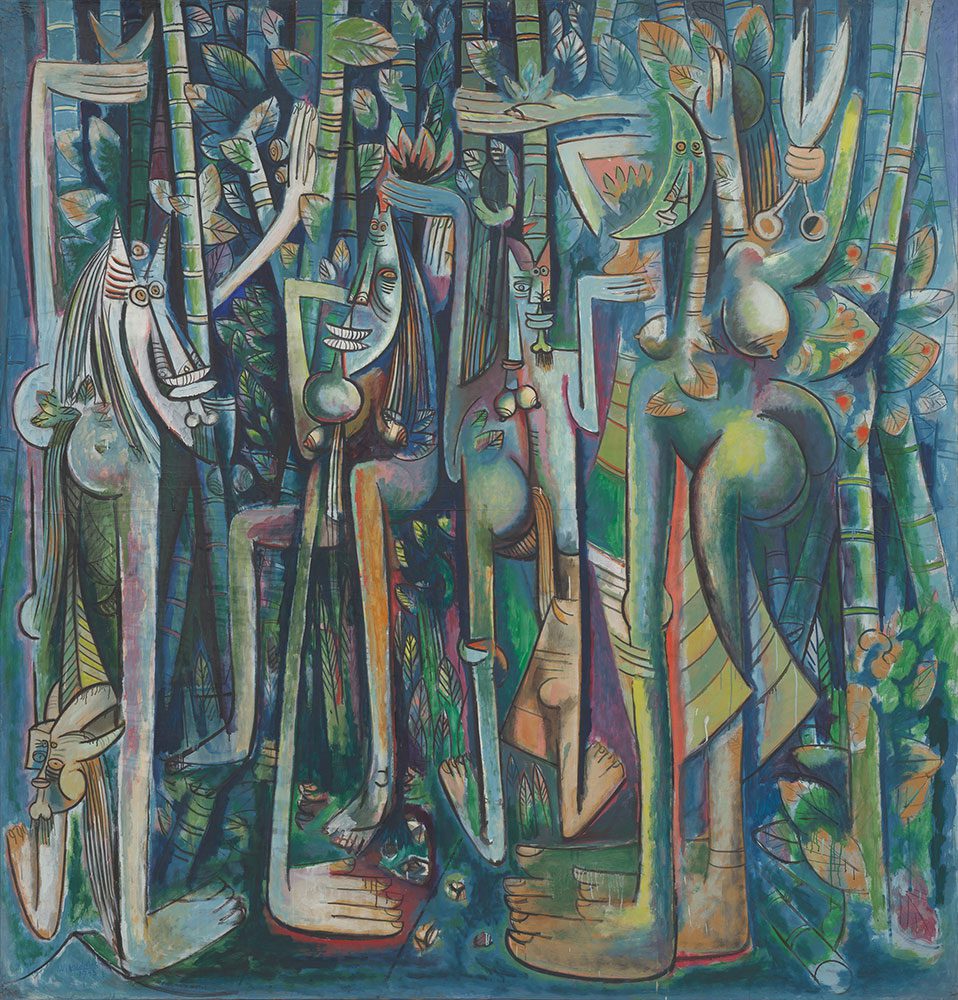
Wifredo Lam. La jungla (The Jungle), 1942-43. Oil and charcoal on paper mounted on canvas, 7’10 ¼” × 7’6 ½” (239.4 × 229.9 cm). The Museum of Modern Art, New York © Wifredo Lam Estate, Adagp, Paris / ARS, New York 2025
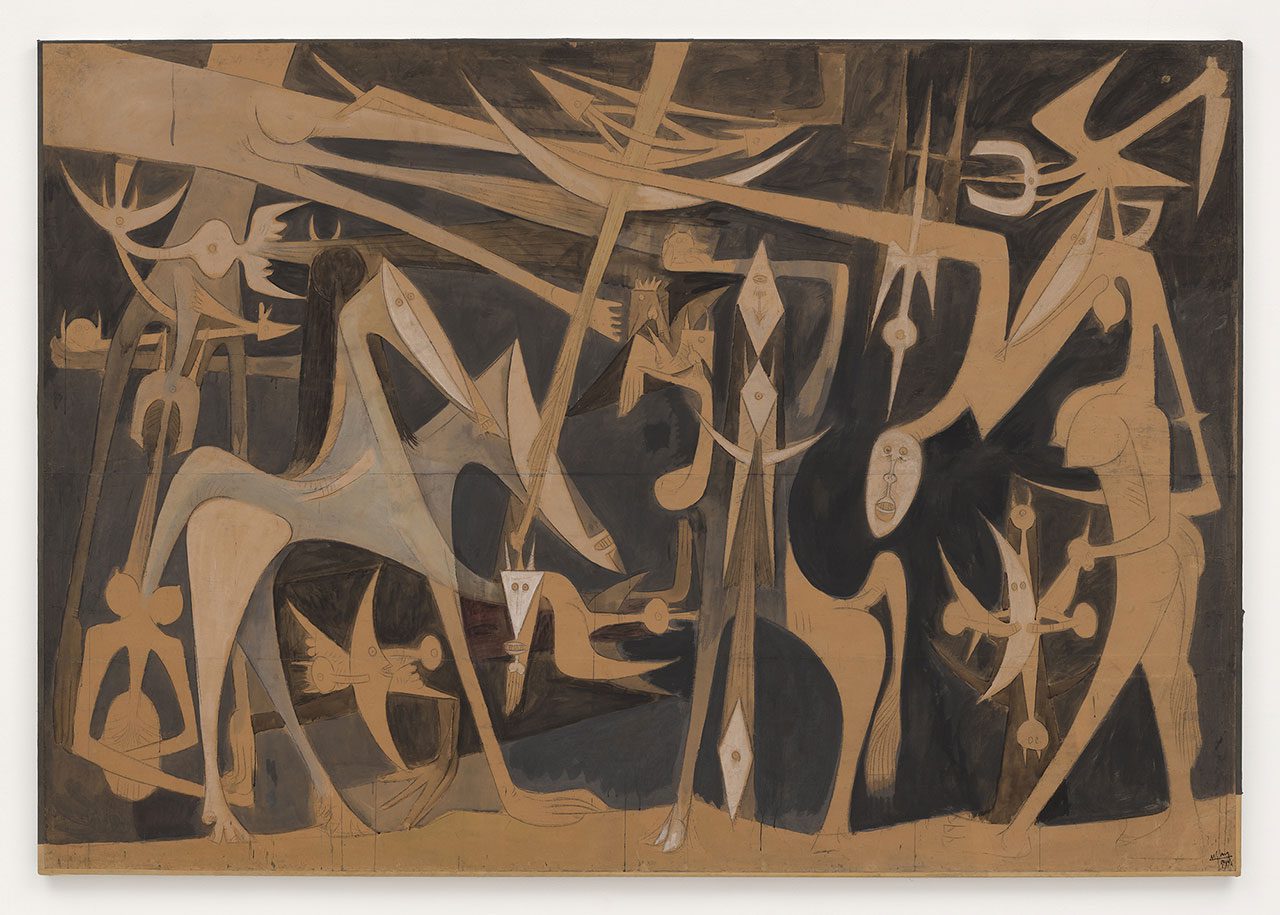
Wifredo Lam. Grande Composition (Large Composition), 1949. Oil and charcoal on paper mounted on canvas, 9’6 ½” × 13’9 ¾” (291 × 421 cm). The Museum of Modern Art, New York. Acquired in memory of Gustavo Cisneros through the generosity of the Sue and Edgar Wachenheim III Endowment Fund, Mimi Haas, Marlene Hess and James D. Zirin, The Judith Rothschild Foundation Contemporary Drawings Collection Gift (by exchange), Committee on Drawings and Prints Fund, The Werner H. Kramarsky Endowment Fund for Drawings, Marie-Josée and Henry R. Kravis, Sue and Edgar Wachenheim III, Emilio Ambasz, Anne Dias Griffin, Agnes Gund, Richard Roth, Tony Tamer, Candace King Weir, The Dian Woodner Acquisition Endowment Fund, the Frances Keech Fund, Joshua and Filipa Fink, Ann and Graham Gund, Alice and Tom Tisch, the Richard S. Zeisler Fund, Adriana Cisneros de Griffin, Glenn D. and Susan Lowry, and Marnie S. Pillsbury (as of September 2025) © Wifredo Lam Estate, Adagp, Paris / ARS, New York 2025
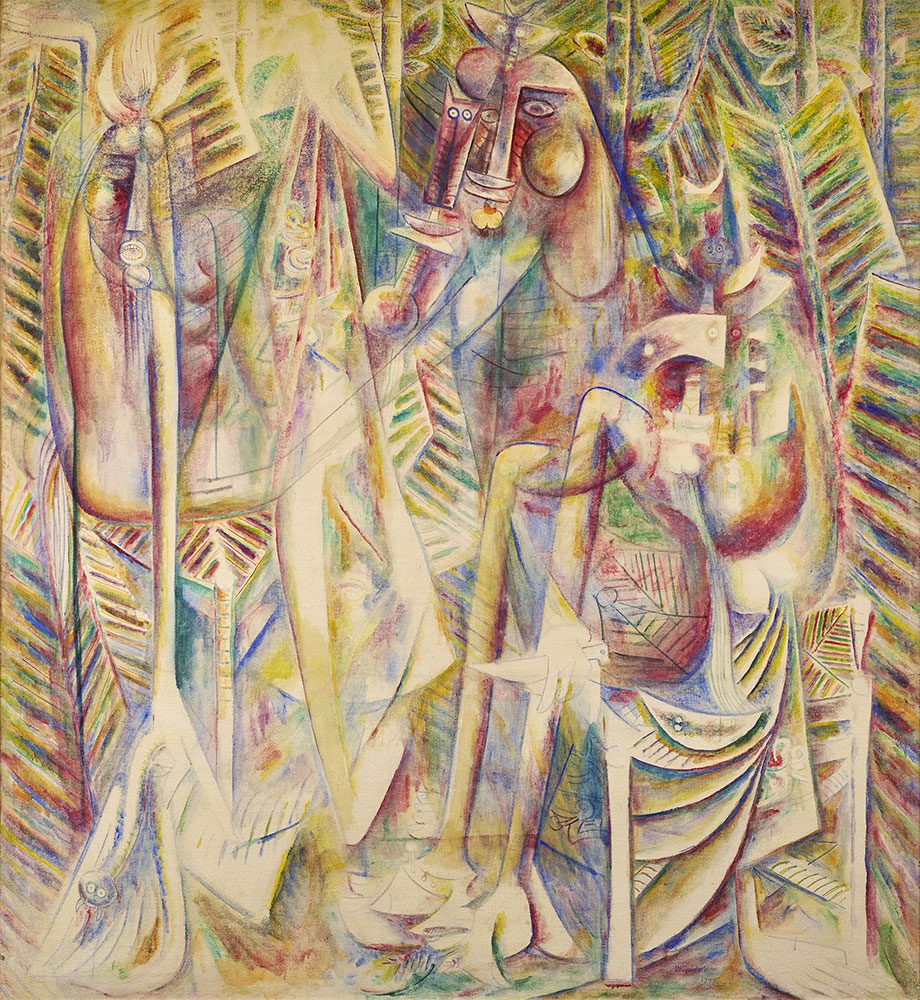
Wifredo Lam. Harpe astrale (Astral Harp), 1944. Oil on canvas, 6’10 ⅝” × 6’2 ¾” (210 × 190 cm). Private collection. © Wifredo Lam Estate, Adagp, Paris / ARS, New York 2025
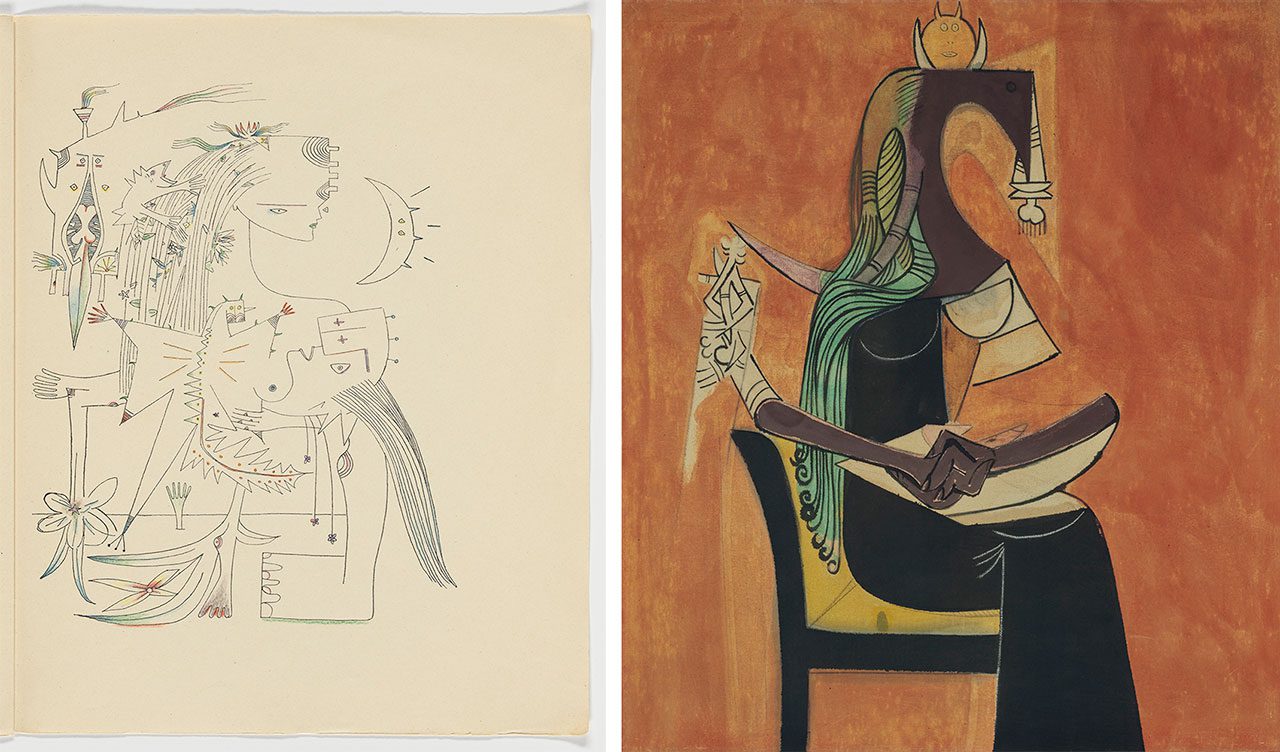
Right: Wifredo Lam. Je Suis (I Am), 1949. Oil on canvas, 49 × 42 15/16″ (124.5 x 109 cm). Private collection © Wifredo Lam Estate, Adagp, Paris / ARS, New York 2025
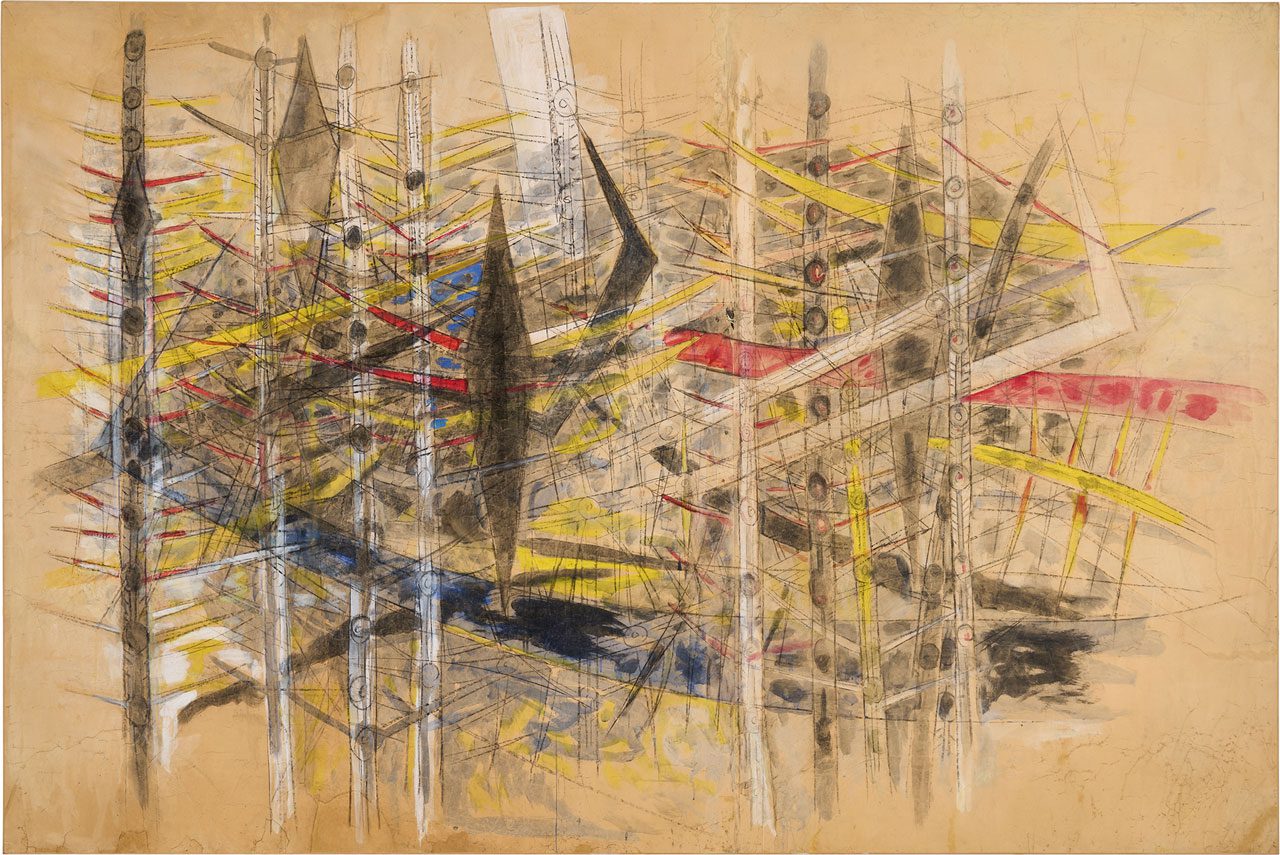
Wifredo Lam. Untitled, 1958. Oil and charcoal on paper mounted on canvas, 8′ × 11’3 ⅞” (244 × 345 cm). Private collection © Wifredo Lam Estate, Adagp, Paris / ARS, New York 2025
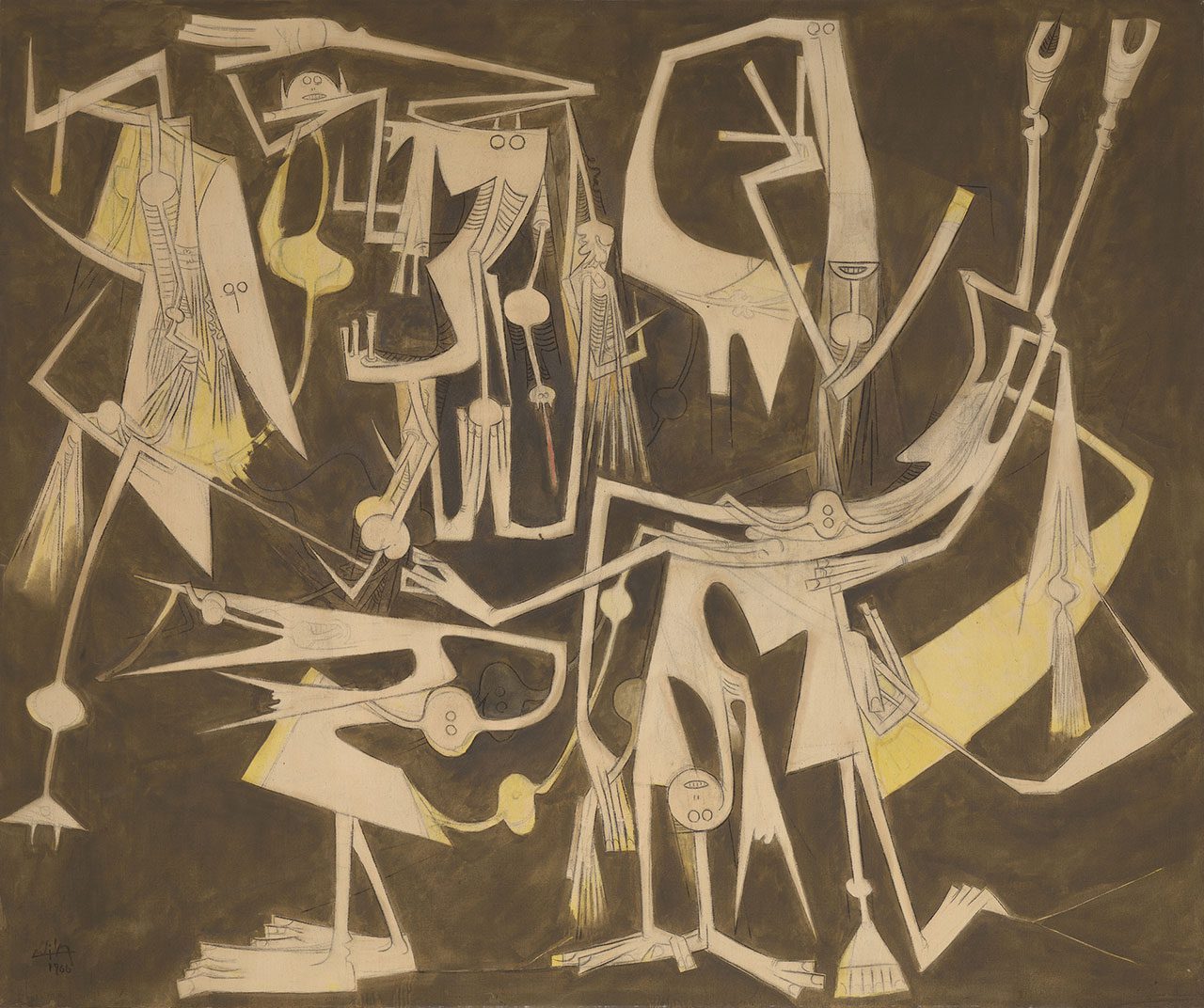
Wifredo Lam. Les Invités (The Guests), 1966. Oil and charcoal on canvas, 6’10 11/16″ x 8’2 7/16″ (210 x 250 cm). Colección Patricia Phelps de Cisneros © Wifredo Lam Estate, Adagp, Paris / ARS, New York 2025
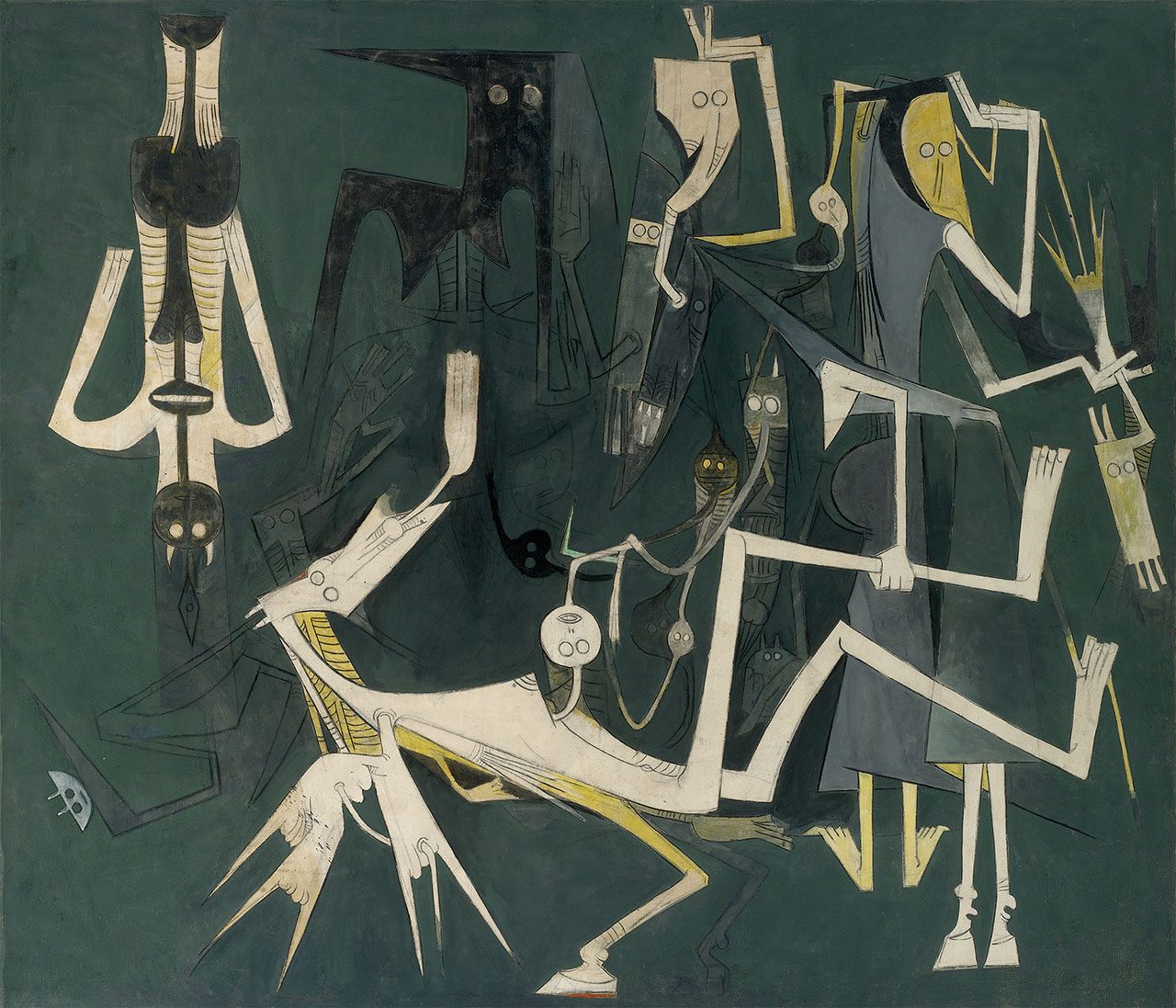
Wifredo Lam. Les Abalochas dansent pour Dhambala, dieu de l’unité (The Abalochas Dance for Dhambala, the God of Unity), 1970. Oil on canvas, 6’11 ⅞” × 8′ (213 × 244 cm). Private collection. Courtesy McClain Gallery © Wifredo Lam Estate, Adagp, Paris / ARS, New York 2025