ART CITIES: N.York-Kiki Smith
Kiki Smith is recognized for her multidisciplinary practice through which she explores embodiment and the natural world. The body, mortality, regeneration, gender, as well as the interconnection of spirituality and the natural world are observed through her own personal lens. Her expansive work manifests as sculpture, glassmaking, printmaking, watercolor, photography, and textile, among other art-making forms. Drawn to the cogency of repetition in narratives and symbolic representations, much of Smith’s work is inspired by contemporary and historical visual culture.
By Efi Michalarou
Photo: 125 Newbury Gallery Archive
Kiki Smith’s long-awaited return to New York City marks a moment of both reflection and renewal. “The Moon Watches the Earth”, her first solo exhibition in the city in six years—brings together more than three decades of work, threading together the artist’s early sculptural investigations from the late 1980s and early 1990s with a new body of bronzes, drawings, and prints. The exhibition unfolds as a constellation of gestures, materials, and symbols, revealing Smith’s enduring dialogue with the natural world, mythology, and the fragile architecture of the human body. At 125 Newbury, the show’s title immediately conjures a celestial intimacy: the moon, a silent observer, gazes upon the living earth below. This relationship—between the distant and the embodied, the enduring and the ephemeral—mirrors the fundamental concerns of Smith’s art. Across her career, she has navigated the porous boundaries between life and death, nature and culture, body and spirit. The exhibition, in bringing together work from different eras, illuminates not only Smith’s aesthetic evolution but also the continuity of her vision: a meditation on transience and the bittersweet joy of embodiment.
Since emerging in the downtown New York art scene of the 1980s, Kiki Smith has drawn deeply from sources as diverse as folklore, Catholic iconography, anatomy, and natural history. Her work, often simultaneously tender and visceral, foregrounds the material processes of making as an essential element of meaning. Even as she has experimented widely with mediums—from glass and textiles to bronze and print—drawing has remained the heartbeat of her practice. It is through drawing that she first articulates her encounters with the living world: birds, insects, trees, and celestial bodies all appear as metaphors for transformation and renewal. In “The Moon Watches the Earth”, Smith debuts a series of new bronze bird reliefs that mark a striking development in her sculptural language. Eschewing the refined patinas for which she is known, she presents raw, unfinished metal surfaces where the marks of casting remain visible like open wounds. These imperfections—scratches, scars, and traces of touch—embody the tension between creation and decay, form and dissolution. The birds, at once delicate and defiant, become vessels of resilience and fragility alike.
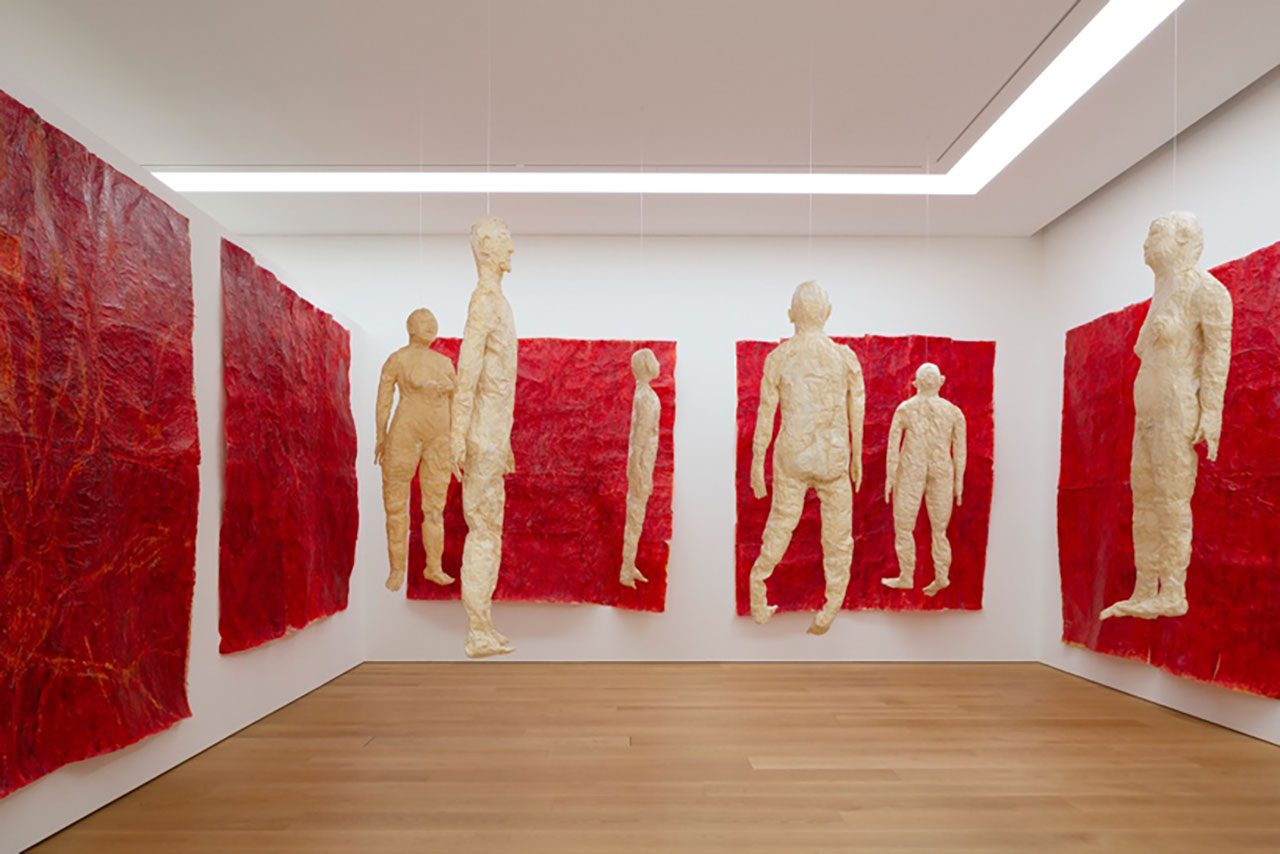
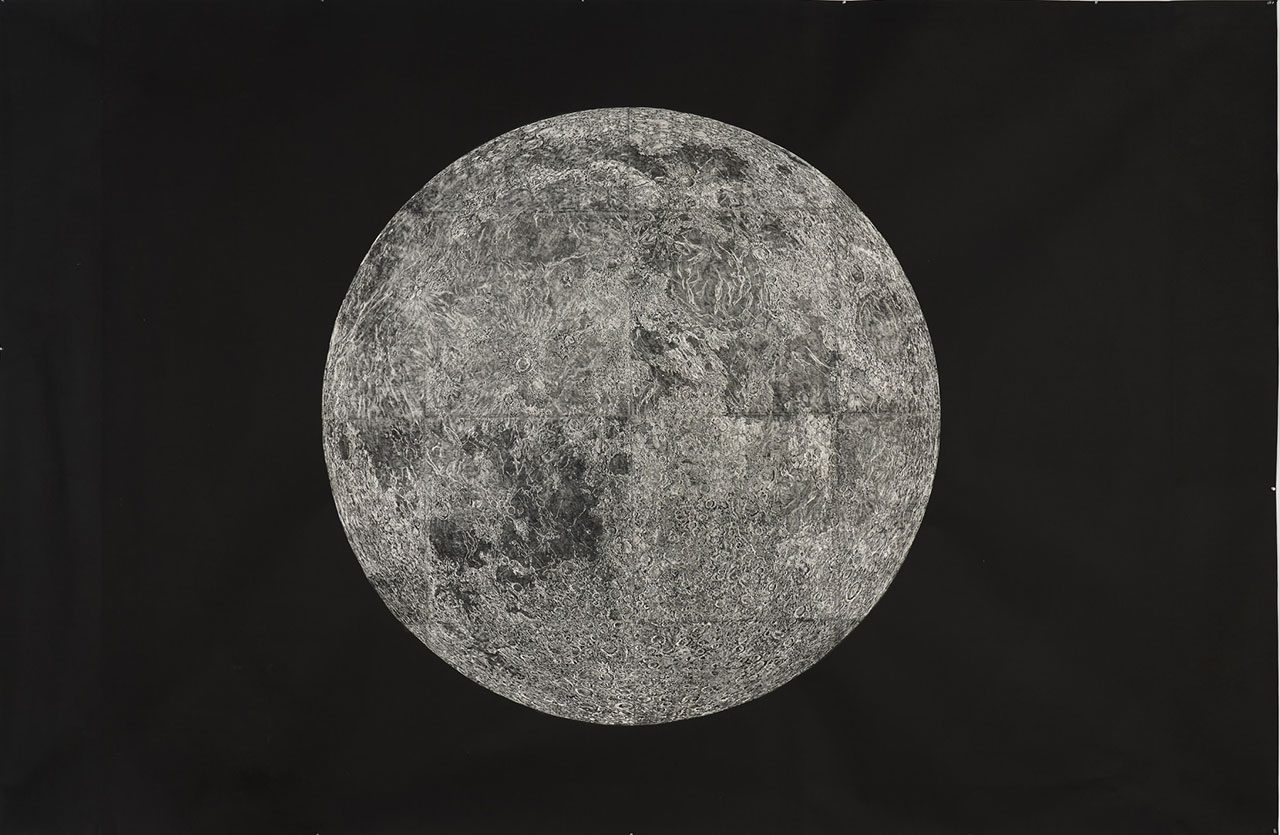
These new bronzes are installed in conversation with “Wooden Moon” (2022), a monumental ink-and-watercolor woodcut that dominates one wall of the gallery. Its scale envelops the viewer, suggesting not only the moon’s physical vastness but also its symbolic role as an eternal witness to earthly life. The dialogue between bronze and print—between metal and paper—underscores the central paradox of Smith’s practice: her ability to find transcendence through matter. Interspersed among these new works are key historical pieces that anchor the exhibition in the formative years of Smith’s career. Several sculptures from the early 1990s—when the artist was solidifying her distinctive visual vocabulary—reveal her early preoccupation with corporeality, mortality, and spiritual duality. One of the exhibition’s emotional cores is a rarely seen installation from this period, composed of papier-mâché figures suspended from the gallery ceiling. Against large monochromatic panels of painted red paper, the pale, shell-like figures hover as spectral presences. Their fragile, empty forms recall bodily envelopes—skins without substance—evoking the separation of matter and form that St. Thomas Aquinas once described.
The installation’s history lends it additional poignancy: it was created during the height of the AIDS crisis, a moment of profound collective loss that shaped Smith’s artistic and ethical sensibilities. Its reappearance after more than 30 years—its first showing in New York since its debut—resonates as both a memorial and a renewal. Nearby, “Untitled (Meat Arm)” (1992) reminds viewers of the corporeal vulnerability that has always haunted Smith’s art. The sculpture’s visceral immediacy contrasts sharply with the ethereal suspension of the papier-mâché figures, situating the body between suffering and transcendence. Printmaking, a medium central to Smith’s oeuvre, operates as both metaphor and method. Like casting in bronze, printing is a process of transfer—an act of translating touch, gesture, and memory from one surface to another. In both disciplines, Smith begins with drawing: she incises her graphic marks into clay or etches them onto plates, preserving the physical trace of her hand. This transference—of line, of texture, of energy—embodies the way Smith understands creation itself: as a process of continual metamorphosis.
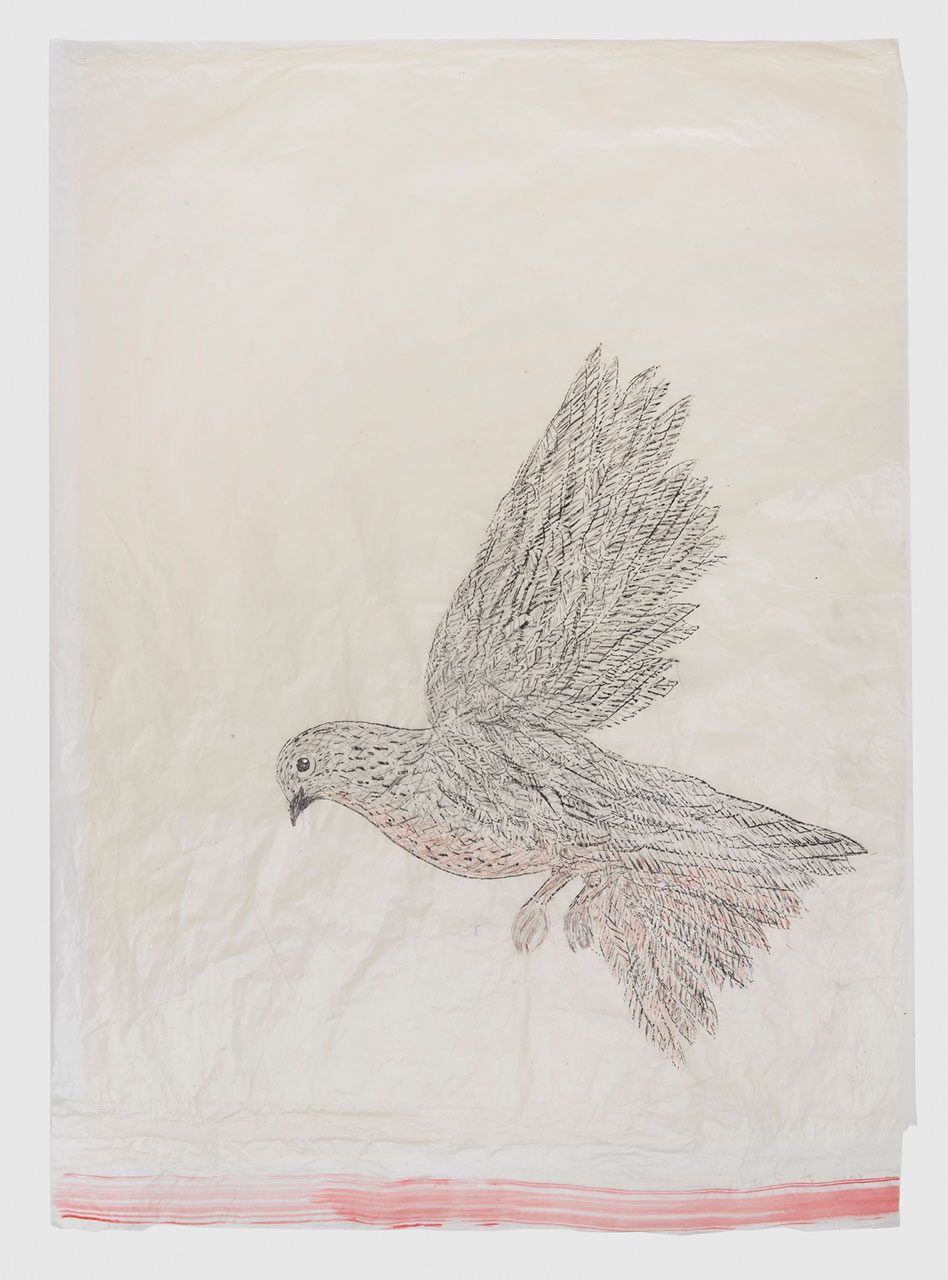
Among the new works on view, a series of bird drawings rendered on silk tissue paper stands out for its exquisite delicacy. The creatures seem to hover on the verge of flight, their outlines barely tethered to the page. The choice of material—thin, translucent, and easily torn—reinforces Smith’s fascination with fragility as a site of revelation. These works do not simply depict birds; they become them, evanescent and luminous. In “The Moon Watches the Earth”, Kiki Smith orchestrates a conversation between temporalities, materials, and sensibilities. The exhibition’s temporal scope—spanning more than thirty years—highlights the persistence of certain themes: the body’s vulnerability, the mystery of nature, the reciprocity between the earthly and the celestial. Yet within that continuity lies transformation. The bronzes’ rawness, the watercolors’ fluidity, and the ghosts of paper all point to an artist who, even after decades of exploration, remains deeply attuned to the tactile and spiritual possibilities of her craft.
Ultimately, the show is less a retrospective than a constellation—a living dialogue across time. Just as the moon’s light is but a reflection of the sun’s, Smith’s newest works reflect the luminosity of her past, refracted through the sensibility of the present. In their convergence, we find a portrait of an artist who continues to watch the world—its fragility, its ferocity, its fleeting beauty—with unflinching tenderness.
Photo: Kiki Smith, Wooden Moon, 2022, © Kiki Smith, Courtesy the artist and 125 Newbury Gallery
Info: Curator: Arne Glimcher, 125 Newbury Gallery, 395 Broadway, New York, NY, USA, Duration: 7/11/2025-10/1/2026, Days & Hours: Tue-Sat 10:00-18:00, www.125newbury.com/