
PRESENTATION: Louise Bourgeois-Gathering Wool
Born in France in 1911, and working in America from 1938 until her death in 2010, Louise Bourgeois is recognized as one of the most important and influential artists of our time. For over seven decades, Bourgeois’s creative process was fueled by an introspective reality, often rooted in cathartic re-visitations of early childhood trauma and frank examinations of female sexuality. Articulated by recurrent motifs, personal symbolism and psychological release, the conceptual and stylistic complexity of Bourgeois’s oeuvre—employing a variety of genres, media and materials—plays upon the powers of association, memory, fantasy and fear.
By Dimitris Lempesis
Photo: Houser & Wirth Gallery Archive
The exhibition “Gathering Wool” delves into the intricate relationship between Louise Bourgeois and abstraction, presenting a series of late sculptures, reliefs, and works on paper—many of which have never before been exhibited. Installed alongside select early pieces, these works trace the evolution of Bourgeois’s distinctive symbolic language and highlight the remarkable consistency of her lifelong preoccupations: memory, trauma, repair, and the psychological textures of intimacy and isolation.
The exhibition’s title, “Gathering Wool”, comes from an enigmatic work created by Bourgeois in 1990. The phrase “gathering wool” traditionally denotes daydreaming or letting one’s thoughts drift freely—a state of mental wandering that mirrors the artist’s approach to her creative process. Bourgeois often worked in this state of suspended consciousness, allowing forms to emerge through intuition rather than intention. For her, making art was a way of accessing subconscious material—what she called “the return of the repressed”—through a process that was both meditative and deeply personal.
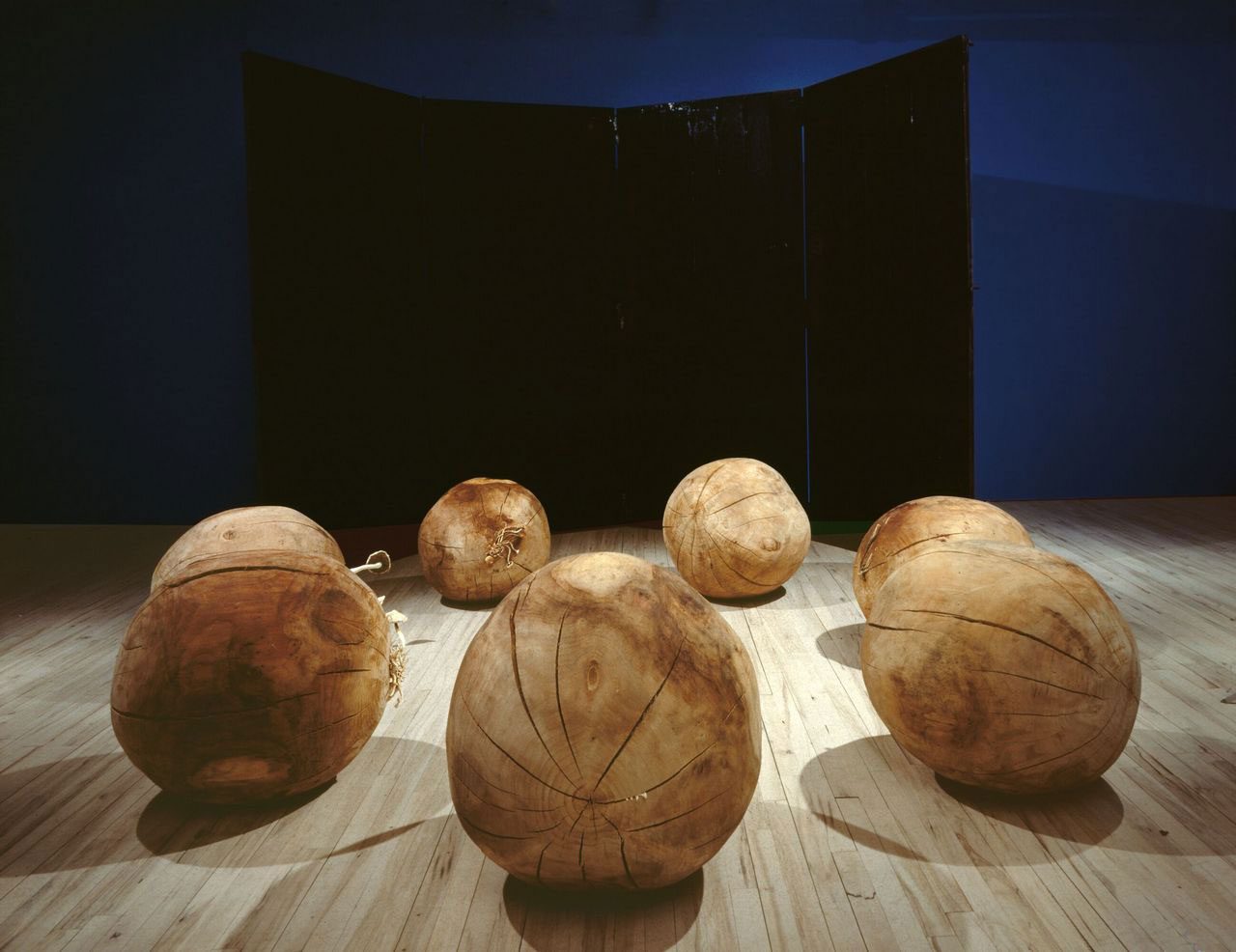
The titular work, “Gathering Wool” (1990), consists of seven wooden spheres arranged in a circle before a tall, semicircular screen of four panels. The installation’s geometry and stillness evoke ritual and introspection. Mushrooms sprouting from the cracks of the spheres introduce a sense of organic growth and decay, reflecting Bourgeois’s enduring interest in the body as a living, changing structure. As a precursor to her celebrated Cells, the piece exists somewhere between sculpture and environment, creating a space that is both inward and enclosing. Within this circular configuration, Bourgeois invites the viewer to experience the psychological terrain that shaped her creative world—an arena of containment, repetition, and renewal.
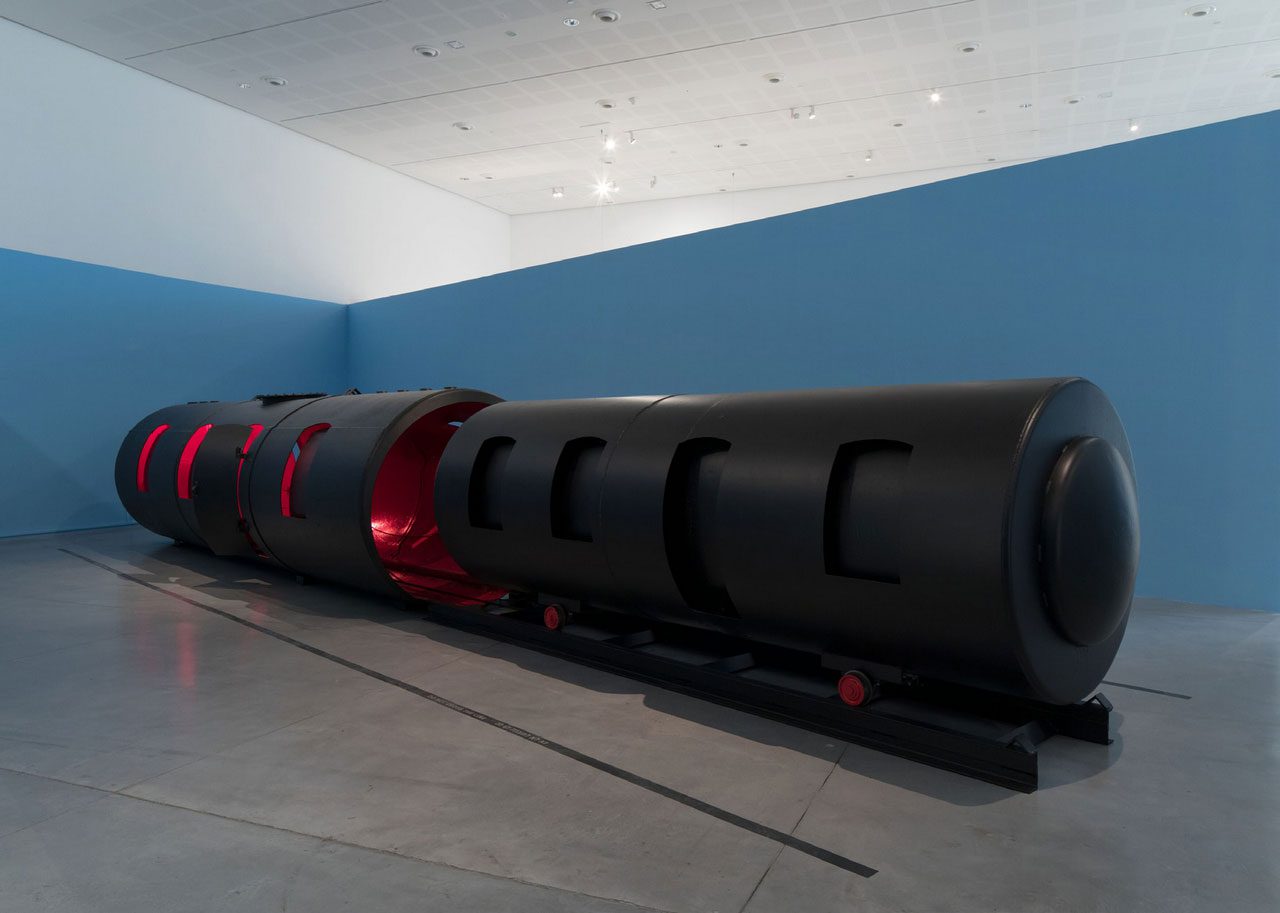
The exhibition opens on the first floor with “Twosome” (1991), a monumental installation in which a small tank moves in and out of a larger one along a mechanical track. This rhythmic motion—endless, cyclical, and slightly ominous—embodies Bourgeois’s recurring meditation on the mother-child relationship. The work’s mechanical repetition transforms a deeply human bond into a hypnotic choreography of separation and return.
Nearby, a video clip from Bourgeois’s 1978 performance “A Fashion Show of Body Parts” features the actress Suzan Cooper singing “She Abandoned Me”, a lament of maternal loss and longing. The juxtaposition of the kinetic Twosome with this haunting performance underscores Bourgeois’s conviction that the emotional intensity of her figurative works also fuels her abstract ones. Both emerge from the same psychic core—what Bourgeois described as “a need to express and to exorcise.” Her abstractions, though stripped of literal imagery, are no less visceral in their exploration of dependency, fear, and desire.
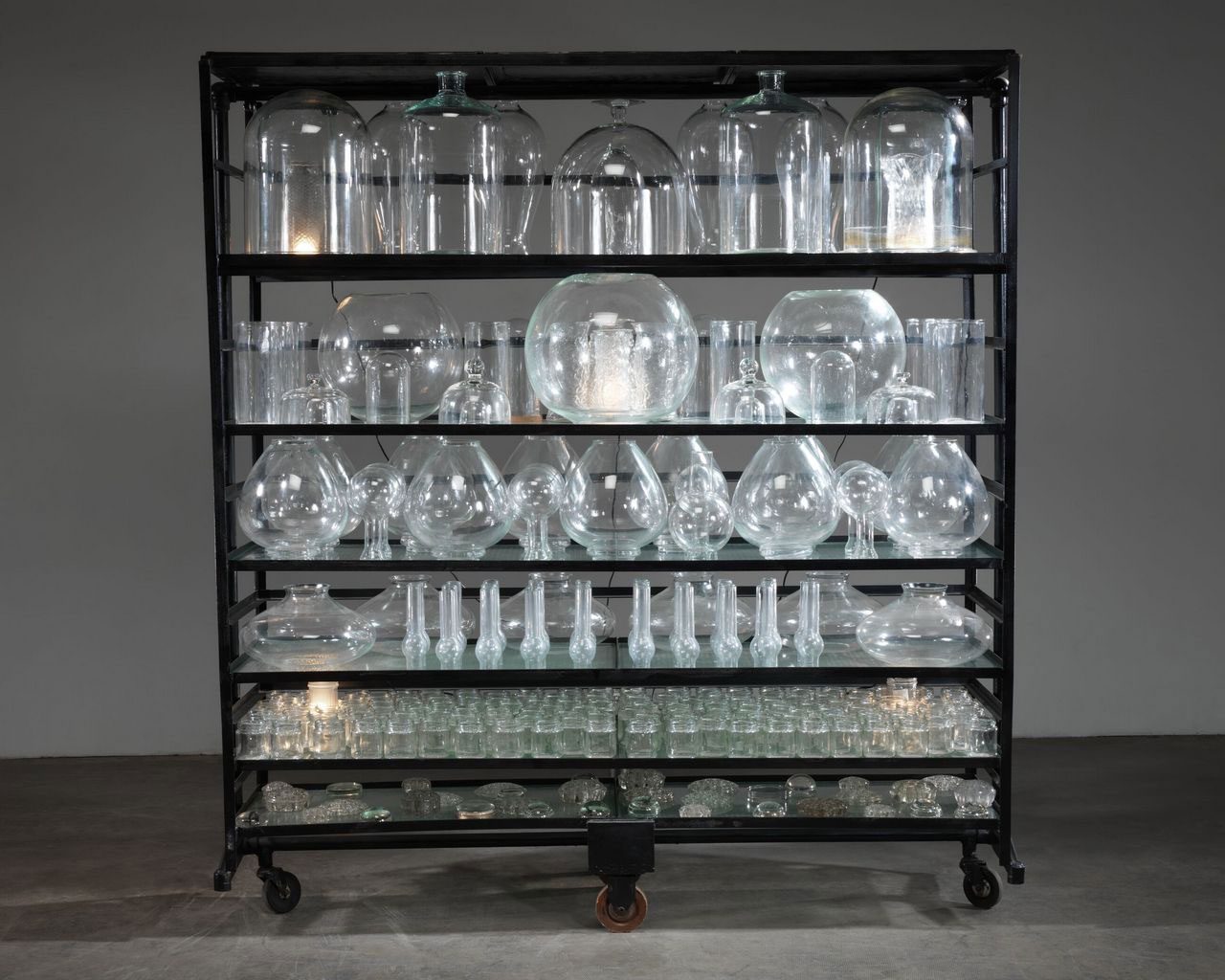
On the ground floor, an iconography of protrusion and emergence unites several works. In “Untitled (With Hand)” (1989), a childlike arm juts out from a smooth sphere, suggesting both birth and entrapment. “Mamelles” (1991) takes the form of a bronze frieze from which water spills from rows of breasts—at once nurturing and unsettling. In “Gathering Wool” (1990), mushrooms sprout from the wooden spheres’ crevices, while in “Le Défi II” (1992), glass elements arranged within a metal cabinet emit a faint, spectral light.
Each of these works explores the porous boundary between container and contained, the seen and the hidden. Bourgeois’s fascination with thresholds—between body and space, memory and material, consciousness and dream—translates into physical forms that feel both intimate and monumental. The works seem to breathe, to secrete, to overflow; they blur the distinction between the organic and the mechanical, the animate and the inert. Through these hybrid objects, Bourgeois stages the conflict between control and surrender, between the need to hold and the urge to release.
Ascending to the fifth floor, visitors encounter Bourgeois’s more purely abstract compositions, defined by vertical progressions and stacked elements. For the artist, stacking was not merely a formal choice but a psychological act—an attempt to impose structure upon the chaos of emotion. “Order brings me peace,” she once remarked, yet the precarious balance of these sculptures betrays the fragility of that peace.
In these works, repetition becomes a visual manifestation of obsession and compulsion. The unstable equilibrium of top-heavy structures conveys vulnerability; interlocking components suggest interdependence and the desperate attempt to stave off abandonment. Bourgeois’s formal language thus becomes a mirror of her inner architecture: repetition as defense, symmetry as therapy, imbalance as truth. Triangular motifs, recurring throughout her oeuvre, embody jealousy—a sharp, unresolved emotion that she translated into form with startling clarity.
What emerges across these floors is a vocabulary of abstract symbols rooted in Bourgeois’s emotional life. Her art, while modernist in appearance, remains deeply autobiographical in origin. It transforms personal pathology into universal metaphor, revealing how pain, fear, and longing can generate a visual language of extraordinary beauty and depth.
“Gathering Wool” invites viewers not only to witness Bourgeois’s evolution but to enter the mental landscape that made it possible. The exhibition reveals an artist who embraced abstraction not as escape from emotion but as its most refined articulation. Her forms—stacked, protruding, enclosing—speak to the complexity of being human: the need for connection, the inevitability of loss, and the restless search for equilibrium.
To “gather wool,” in Bourgeois’s world, is not idleness but inquiry. It is the artist’s act of dreaming while awake—of letting the hand follow the unconscious mind through the material, until form itself becomes a vessel for thought and feeling. In this way, Gathering Wool stands as both a meditation on Bourgeois’s creative process and a testament to the enduring power of abstraction to reveal the unspoken depths of the self.
Photo: Louise Bourgeois, Gathering Wool, 1990, Metal, wood and mixed media, 243.8 x 396.2 x 457.2 cm / 96 x 156 x 180 in, Photo: Peter Bellamy, © The Easton Foundation/VAGA at ARS, NY, Courtesy the Foundation and Hauser & Wirth
Info: Houser & Wirth Gallery, 542 West 22nd Street, New York, NY, USA, Duration: 6/11/2025-24/1/2026, Days & Hours: Tue-Sat 10:00-18:00, www.hauserwirth.com/
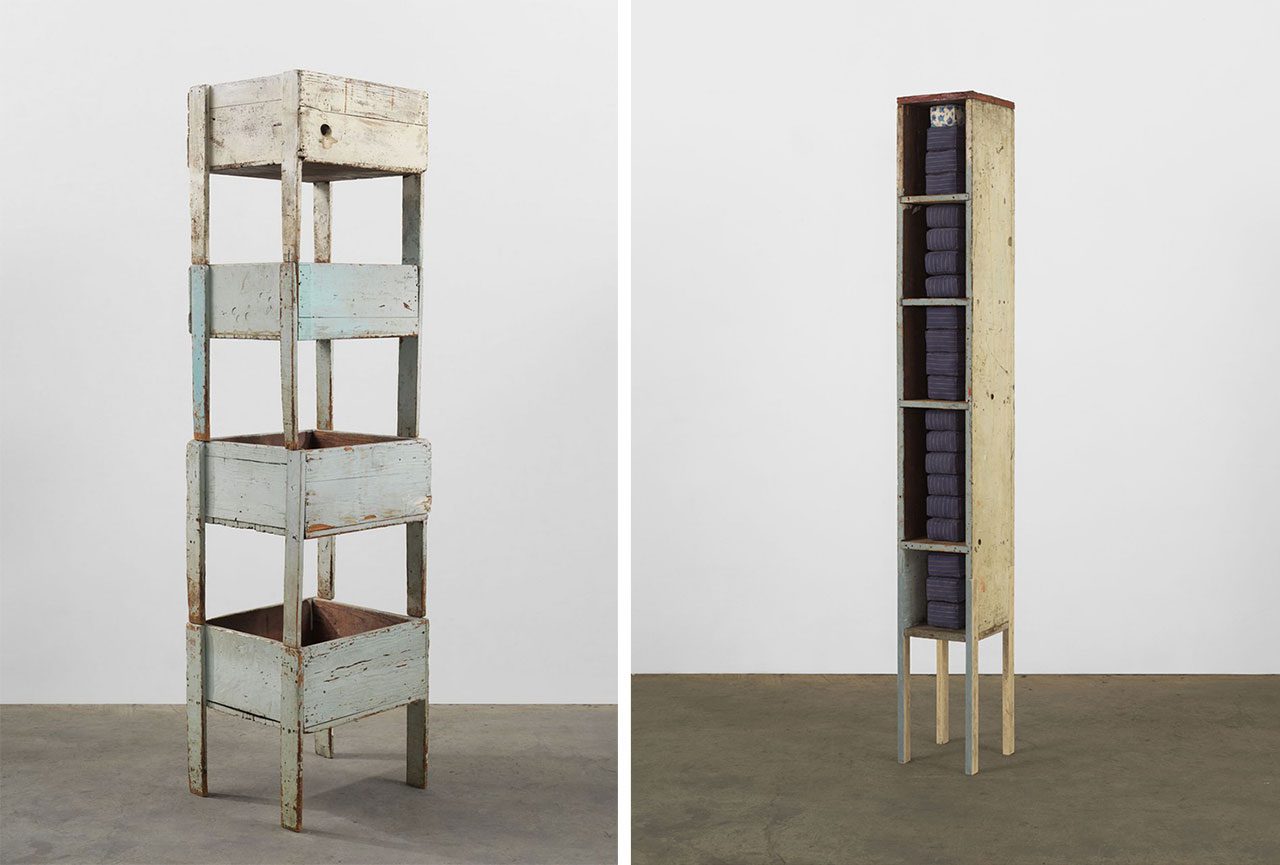
Right: Louise Bourgeois, Untitled, 2000, Painted wood and fabric, 179.1 x 22.9 x 24.8 cm / 70 1/2 x 9 x 9 3/4 in, Photo: Christopher Burke, © The Easton Foundation/VAGA at ARS, NY, Courtesy the Foundation and Hauser & Wirth