PRESENTATION: Gerhard Richter

Fondation Louis Vuitton presents a landmark retrospective of Gerhard Richter, one of the most influential and enduring figures in contemporary art. Featuring 275 works spanning from 1962 to 2024, the exhibition traces more than six decades of ceaseless innovation. It brings together oil paintings, glass and steel sculptures, pencil and ink drawings, watercolors, and overpainted photographs—offering, for the first time, a comprehensive view of Richter’s entire artistic journey.
By Efi Michalarou
Photo: Fondation Louis Vuitton Archive
Bringing together many of the artist’s most significant works, the exhibition unfolds across successive decades, from the early 1960s to the present. It charts Richter’s evolution as a painter until his decision in 2017 to lay down the brush and continue instead with drawing and conceptual work. Each gallery section reflects a distinct moment in his development, culminating in the monumental series of abstract paintings from 2000 to 2016—works conceived as complete visual ensembles. Richter has long described himself as a “classical painter,” one whose greatest joy lies in the solitude of the studio. Throughout his career, he has returned deliberately to painting’s traditional genres—portrait, still life, landscape, and history painting—while continually questioning their meaning in the modern age. Unlike most artists who work directly from observation, Richter never paints from life. His images are mediated through photographs, sketches, or memory—each painting an autonomous, self-sufficient world. The exhibition is divided in the following sectors:
1962–1970: Painting After Photographs. Born in Dresden in 1932, Richter studied at the Academy of Fine Arts before fleeing East Germany for Düsseldorf in 1961, just before the Berlin Wall was built. There, he began painting images derived from photographs—his now-iconic “photo paintings.” Drawn from magazines and family albums alike, these blurred, enigmatic works questioned the nature of perception and truth in painting. By 1964, Richter had opened his own studio and was exhibiting with prominent galleries across Germany.
1971–1975: Questioning Representation. In the early 1970s, Richter turned his inquiry inward, creating opposing bodies of work—figurative and abstract—that reflected his ambivalence toward representation itself. For the 1972 Venice Biennale, he produced “48 Portrait”s, a stark series of male intellectuals rendered in grayscale. Around the same time, his fascination with Titian led to a cycle of dissolving “Annunciations”. He also introduced his first gray paintings—deliberate negations of color and image—and began to incorporate chance as a compositional force.
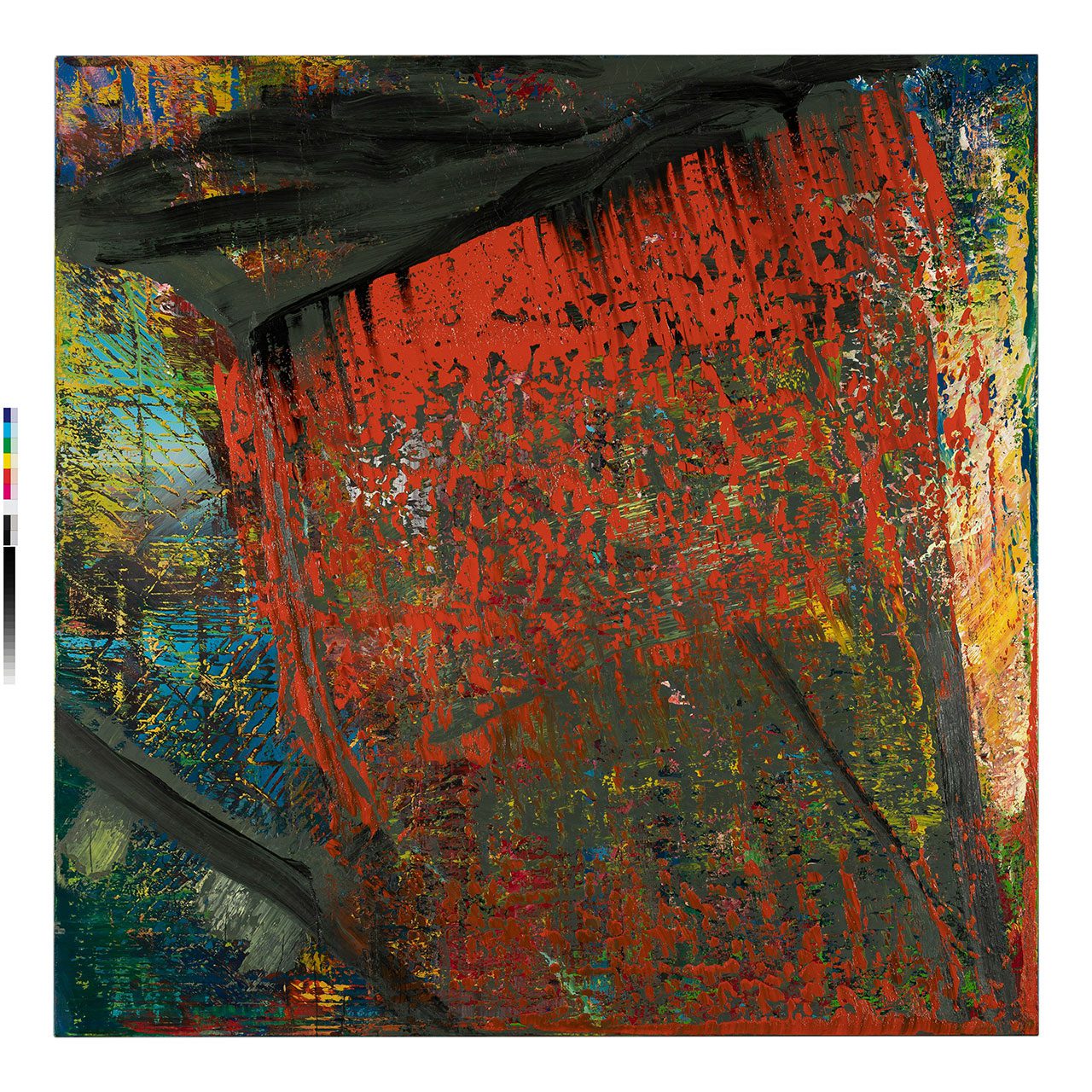
1976–1986: Exploring Abstraction. Richter’s first major abstract painting, “Konstruktion” (1976), marked a decisive turn. Over the next decade, abstraction became his primary language. International recognition followed, with retrospectives in Europe and North America, and a solo exhibition at the Centre Pompidou in 1977. During this period, he also embraced watercolor and developed intimate still lifes—candles, skulls, and landscapes—alongside his vast, gestural abstractions.
1987–1995: Somber Reflection. The cycle “18 October 1977” (1988), depicting the deaths of the Baader-Meinhof group, stands as one of Richter’s most powerful engagements with German history. These paintings, haunting and austere, sparked intense debate. Around this time, he also painted serene landscapes and intimate portraits, including his daughter Betty. His work of this era reveals a profound meditation on memory, trauma, and representation. In 1995, he married the artist Sabine Moritz; their son, Moritz, was born the same year.
1983–2008: On Paper. Richter’s drawing practice—spontaneous, improvised, and intuitive—served as a counterpoint to his methodical approach to painting. From the 1980s onward, he explored delicate graphite lines, frottage, and washes of color in small-format sheets. His overpainted photographs, begun in the 1990s, blurred the boundary between documentation and abstraction, merging photographic truth with painterly gesture.
1992–1999: Moments of Reflection, By the 1990s, Richter was working simultaneously on multiple bodies of work: vast abstractions, intimate portraits, and conceptual experiments. Honors accumulated, including the Golden Lion at the 1997 Venice Biennale and Japan’s Praemium Imperiale. His monumental “Black, Red and Gold” (1999) for the Reichstag cemented his place as Germany’s leading painter. The retrospective “Forty Years of Painting” at MoMA (2002) celebrated his 70th birthday and international stature.
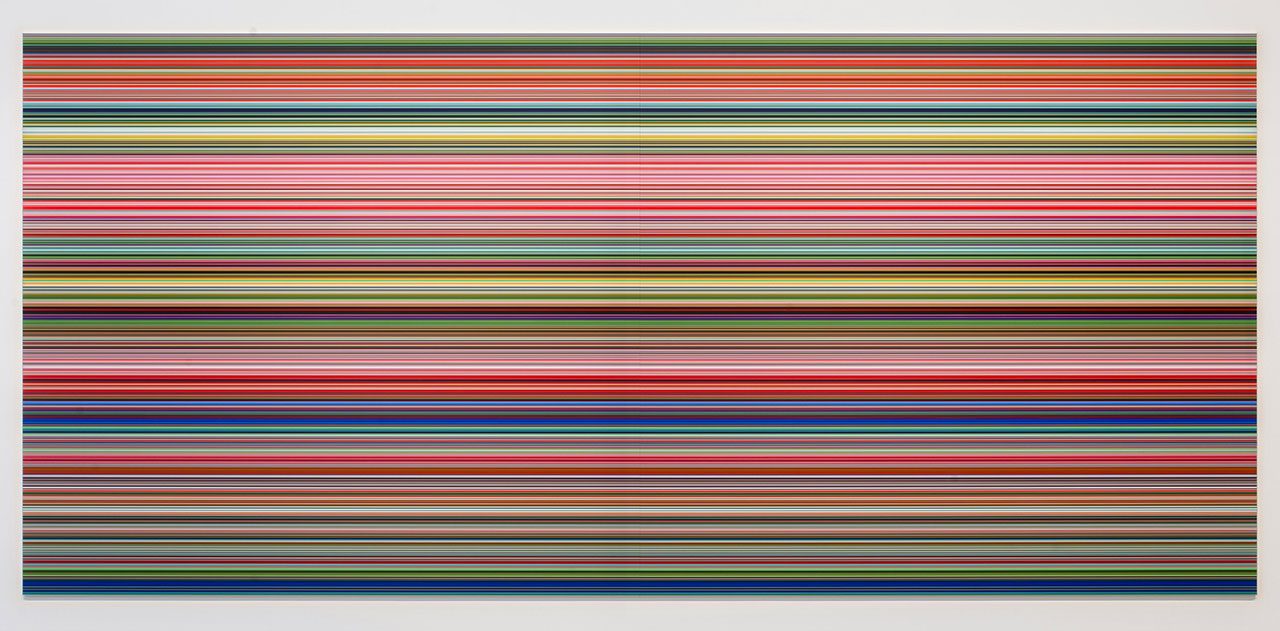
2001–2013: New Perspectives in Painting. Richter’s commission for the stained-glass window of Cologne Cathedral (2007) opened a new chapter. Using digital randomness to arrange 4,900 colored panes, he merged chance and order in a work of luminous abstraction. Around this time, he began creating works in glass and digital prints, including the Strips series. His later paintings—white, restrained, and nearly silent—approach a meditative minimalism.
2014–2017: Pictorial Elegies. Returning to painting after a pause, Richter confronted the unrepresentable. The “Birkenau” cycle (2014), based on photographs from Auschwitz, evolved into four monumental abstractions—a profound meditation on history and memory. Exhibited internationally, they stand among his most haunting works. In these years, Richter also established the Gerhard Richter Art Foundation to preserve and present his legacy.
2017–2025: Continuing to Work. After declaring his painterly oeuvre complete, Richter turned to drawing and architectural collaborations. In 2016, he unveiled 14 Panes of Glass on the Japanese island of Toyoshima, followed by a mirror-and-pendulum installation in Münster (2018). In 2025, two large reliefs were completed for a building designed by Norman Foster in New York. Now working from his desk rather than the easel, Richter produces dated series of drawings—intimate explorations of gesture, chance, and structure. Lines, tonal washes, and colored inks combine in spontaneous configurations that he refines using rulers and compasses. In these works, the unconscious movement of the hand assumes primacy. The artist, still restless in inquiry, continues to test the boundaries of what an image can be.
Photo: Gerhard Richter, S.D., 1985 (CR 575-2), Oil on canvas, 200 x 200 cm, Private collection, Paris © Gerhard Richter 2025 (18102025)
Info: Curatorial Team: Artistic Director: Suzanne Pagé, Guest Curators: Dieter Schwarz and Nicholas Serota, Coordination: Ludovic Delalande with Magdalena Gemra, Fondation Louis Vuitton, 8 avenue du Mahatma Gandhi, Bois de Boulogne, Paris, France, Duration: 17/10/2025-2/3/2026, Days & Hours: Mon, Wed-Thu 11:00-20:00, Fri 11:00-21:00 (on the first Friday of every month, closes at 23:00), Sat-Sun10:00-20:00, www.fondationlouisvuitton.fr
![Left: Gerhard Richter, Onkel Rudi [Uncle Rudi], 1965 (CR 85) Oil on canvas, 87 x 50 cm, Collection Lidice Memorial, Czech Republic Photo credit : Richard Schmidt, © Gerhard Richter 2025 (18102025)Right: Gerhard Richter, Ema (Akt auf einer Treppe) Ema [Nude on a Staircase], 1966 (CR 134) Oil on canvas, 200 x 130 cm, Museum Ludwig, Cologne / Donation Ludwig Collection 1976, © Gerhard Richter 2025 (18102025)](http://www.dreamideamachine.com/web/wp-content/uploads/2025/10/01a-1.jpg)
Right: Gerhard Richter, Ema (Akt auf einer Treppe) Ema [Nude on a Staircase], 1966 (CR 134) Oil on canvas, 200 x 130 cm, Museum Ludwig, Cologne / Donation Ludwig Collection 1976, © Gerhard Richter 2025 (18102025)
![Gerhard Richter, Apfelbäume [Apple Trees], 1987 (CR 650-1), Oil on canvas, 67 x 92 cm, Private collection, © Gerhard Richter 2025 (18102025)](http://www.dreamideamachine.com/web/wp-content/uploads/2025/10/02-5.jpg)
![Gerhard Richter, Tisch [Table], 1962 (CR 1) Oil on canvas, 90 x 113 cm, Private Collection, Photo credit: Jennifer Bornstein © Gerhard Richter 2025 (18102025)](http://www.dreamideamachine.com/web/wp-content/uploads/2025/10/03-4.jpg)
![Gerhard Richter, Hirsch [Cerf], 1963 (CR 7) Oil on canvas, 150 x 200 cm, Fondation Louis Vuitton, Paris Photo credit: Primae / Louis Bourjac © Gerhard Richter 2025 (18102025)](http://www.dreamideamachine.com/web/wp-content/uploads/2025/10/04-4.jpg)
![Gerhard Richter, Kerze [Candle], 1982 (CR 511-1) Oil on canvas 95 x 90 cm, Collection Institut d’art contemporain, Villeurbanne/Rhône-Alpes Hirshhorn Purchase Fund, 1994 © Gerhard Richter 2025 (18102025)](http://www.dreamideamachine.com/web/wp-content/uploads/2025/10/05-1.jpg)
![Left: Gerhard Richter, S.D., 1985 (CR 575-2) Oil on canvas, 200 x 200 cm, Private collection, Paris © Gerhard Richter 2025 (18102025)Right: Gerhard Richter, Wald (3) [Forest (3)], 1990 (CR 733) Oil on canvas, 340 x 260 cm, Fondation Louis Vuitton, Paris Photo credit: Primae / Louis Bourjac © Gerhard Richter 2025 (18102025)](http://www.dreamideamachine.com/web/wp-content/uploads/2025/10/06a-2.jpg)
Right: Gerhard Richter, Wald (3) [Forest (3)], 1990 (CR 733) Oil on canvas, 340 x 260 cm, Fondation Louis Vuitton, Paris Photo credit: Primae / Louis Bourjac © Gerhard Richter 2025 (18102025)
![Gerhard Richter, Lesende [Reader], 1994 (CR 804), Oil on canvas, 72 x 102 cm, Collection San Francisco Museum of Modern Art Purchase through the gifts of Mimi and Peter Haas and Helen and Charles Schwab, and theAccessions Committee Fund: Barbara and Gerson Bakar, Collec- tors Forum, Evelyn D. Haas, Elaine McKeon, Byron R. Meyer, Modern Art Council, Christine and Michael Murray, Nancy and Steven Oliver, Leanne B. Roberts, Madeleine H. Russell, Danielle and Brooks Walker, Jr., Phyllis C. Wattis, and Pat and Bill Wilson, © Gerhard Richter 2025 (18102025)](http://www.dreamideamachine.com/web/wp-content/uploads/2025/10/7-1.jpg)
![Gerhard Richter, Verkündigung nach Tizian [Annunciation after Titian], 1973 (CR 343-1), Oil on canvas, 125 x 200 cm, Hirshhorn Museum and Sculpture Garden, Smithsonian Institution, Washington, DC, Joseph H. Hirshhorn Purchase Fund, 1994, © Gerhard Richter 2025 (18102025)](http://www.dreamideamachine.com/web/wp-content/uploads/2025/10/8-1.jpg)
![Gerhard Richter, Gegenüberstellung 2 [Confrontation 2], 1988 (CR 671-2), Oil on canvas, 112 x 102 cm, The Museum of Modern Art, New York. The Sidney and Harriet Janis Collection, gift of Philip Johnson, and acquired through the Lillie P. Bliss Bequest (all by exchange); Enid A. Haupt Fund; Nina and Gordon Bunshaft Bequest Fund; and gift of Emily Rauh Pulitzer, 1995 © Gerhard Richter 2025 (18102025)](http://www.dreamideamachine.com/web/wp-content/uploads/2025/10/09.jpg)
![Gerhard Richter, Selbstportrait [Self-Portrait], 1996 (CR 836-1), Oil on linen, 51 x 46 cm, The Museum of Modern Art, New York. Gift of Jo Carole and Ronald S. Lauder and Committee on Painting and Sculpture Funds, 1996 © Gerhard Richter 2025 (18102025)](http://www.dreamideamachine.com/web/wp-content/uploads/2025/10/09a.jpg)
![Gerhard Richter, Venedig (Treppe) [Venice (Staircase)], 1985 (CR 586-3), Oil on canvas, 51.4 x 71.8 cm, The Art Institute of Chicago. Gift of Edlis Neeson Collection © Gerhard Richter 2025 (18102025)](http://www.dreamideamachine.com/web/wp-content/uploads/2025/10/11.jpg)