PRESENTATION: Carsten Höller-Stockholm Slides

Carsten Höller is known for creating participatory artworks that blur the boundary between scientific experiment and sensory play. For almost four decades, he has created site-specific, experimental sculptures in which the viewer becomes active in the exploration of consciousness. By disrupting habitual approaches to the body, space and consciousness, the artworks create new ways for the participant to experience both the work and themselves.
By Dimitris Lempesis
Photo: Moderna Museet Archive
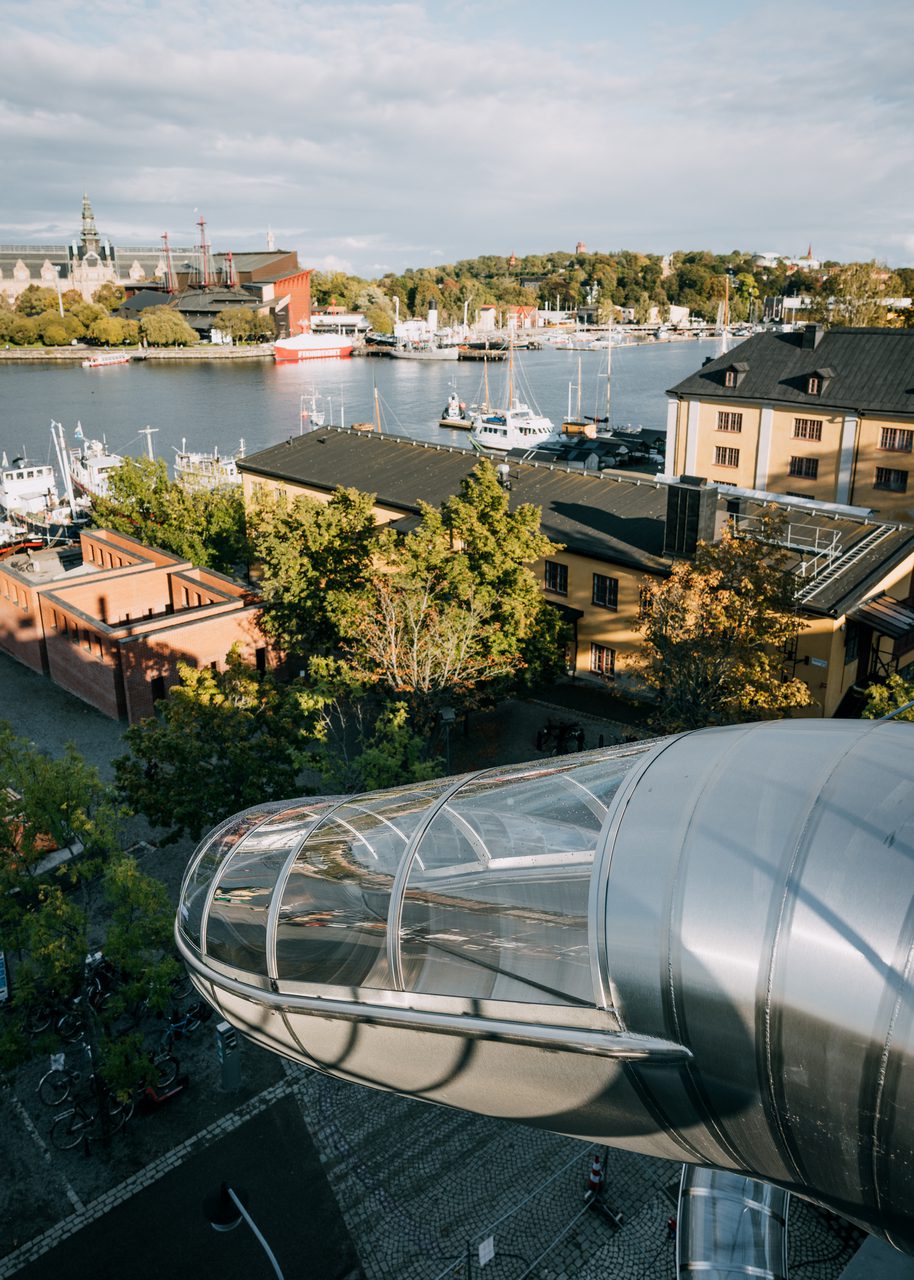
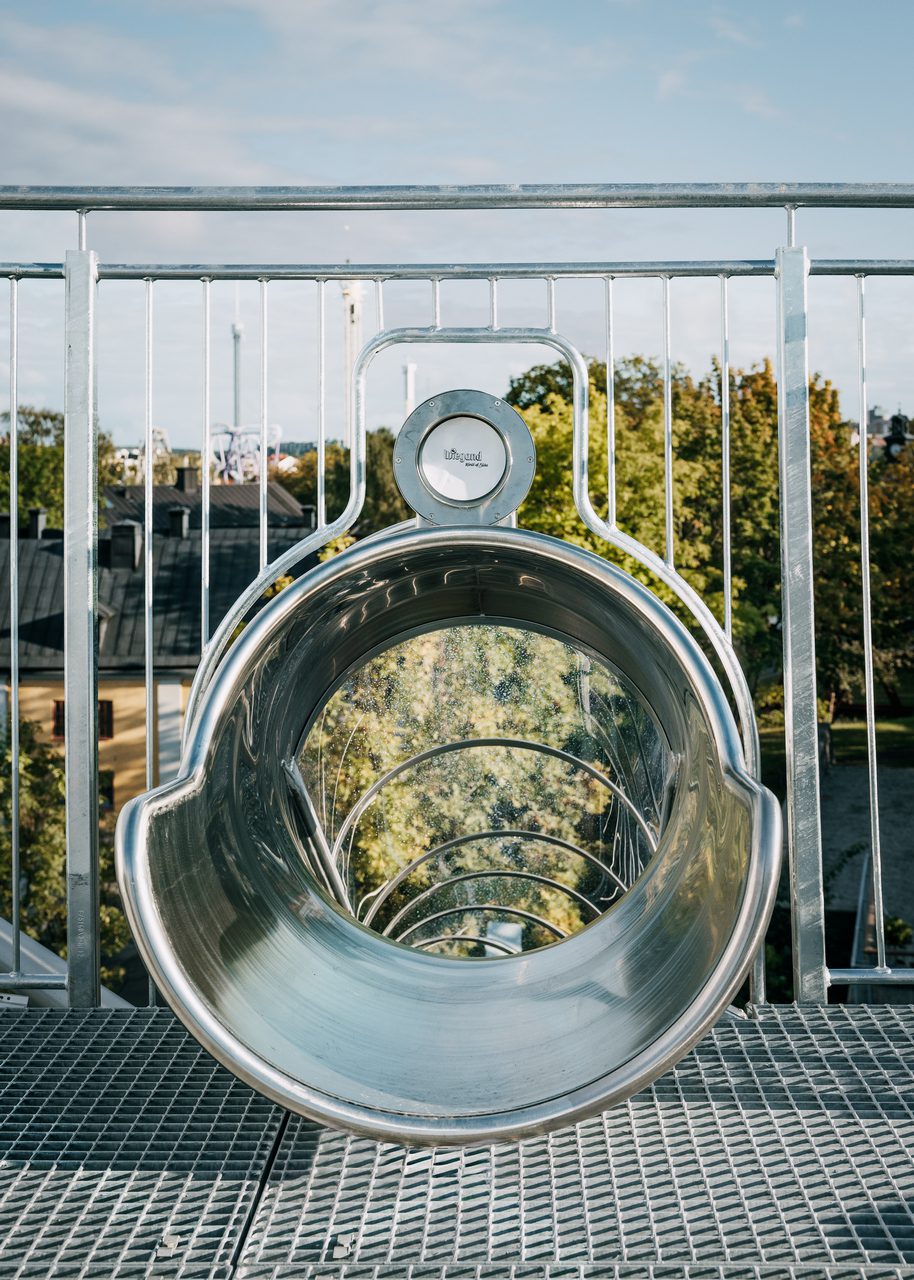
Carsten Höller refers to his artistic practice as the creation of “influential environments” – immersive installations that are designed not only to be seen, but to be felt, experienced, and inhabited. His works are not passive objects of contemplation, but situations that actively provoke states of exhilaration, disorientation, doubt, joy, and fear. With his art, Höller invites us to step out of the ordinary and into carefully staged experiences that challenge both body and mind. One of his most ambitious projects to date, “Stockholm Slides”, has now been installed on the façade of Moderna Museet. This monumental work consists of two parallel spiral slides that begin on the museum’s rooftop and extend dramatically down to Slupskjulsvägen, on the building’s waterfront side. The slides officially open to the public today, offering a new way to encounter both art and the museum itself. The slides are each about 39 metres long and share the same design, but in mirrored form. One curves clockwise, the other counterclockwise, creating a visual and experiential symmetry. With a drop height of 15 metres, riders begin at the roof and descend toward the ground in a thrilling, spiraling movement. Two people can ride simultaneously, their mirrored trajectories forming a kind of choreography in motion—a duet shaped by gravity, speed, and chance. For Höller, the act of sliding is never just play. It is a deeply psychological and bodily experience. The downward movement engages the body in ways that are at once childlike and profound, triggering a complex interplay of emotion and thought. The rider gives themselves over to gravity, entering a controlled state of free fall that produces what Höller describes as a “regulated loss of control”. In this space of surrender, sensations of fear, delight, anticipation, and exhilaration coexist, often inseparably. As the sociologist Roger Caillois once phrased it—a formulation that Höller embraces—the slide produces a state of “voluptuous panic upon an otherwise lucid mind.” Although the slides can only accommodate two riders at a time, their impact reaches far beyond those who take the plunge. Passersby on Slupskjulsvägen, visitors entering the museum, and diners at the restaurant whose windows face the slides all become part of the artwork. Watching the sudden rush of bodies spiraling downward, the laughter, the brief shrieks, and the unpredictable emotions on riders’ faces can be just as affecting as the act of sliding itself. In this way, “Stockholm Slides” functions as both a personal and a collective experience, reshaping the social dynamics of the museum space.
Carsten Höller was born in 1961 in Belgium, to German parents, and has lived an unusually transnational life. For the past 25 years, he has called Sweden home, while more recently dividing his time between Ghana and Italy. His artistic career was preceded by a rigorous scientific background: he earned a doctorate in biology, with a dissertation focusing on the ways insects communicate through scent. This early research into systems of perception, behavior, and interaction laid the groundwork for his later artistic explorations. In the early 1990s, Höller transitioned fully into art, bringing with him a scientific precision and curiosity that continue to inform his work today. Since 1998, slides of various forms have become a central motif in Höller’s practice. They have appeared as both temporary interventions and permanent installations across Europe and the United States—from museum exhibitions to urban public spaces. Each time, they have provoked a unique combination of wonder, playfulness, and philosophical reflection. “Stockholm Slides” is the latest and perhaps most striking manifestation of this ongoing exploration. Importantly, the work is not a temporary experiment but a lasting addition to the Moderna Museet environment. As part of the museum’s permanent collection, the slides have been granted a building permit valid for five years at a time, underscoring their role as a long-term intervention in the cityscape. From the outset, the museum envisioned this piece as something more than an exhibition object. It is an artwork that activates the audience in a concrete, physical way, while simultaneously redefining what a museum experience can be. For those who ride, it is a visceral journey through space, gravity, and emotion. For those who watch, it is a spectacle that transforms the museum into a stage of collective play and shared reactions. With “Stockholm Slides,” Carsten Höller once again demonstrates his ability to blur the boundaries between art, science, play, and lived experience. The work is not only a striking architectural intervention but also an invitation: to let go, to give in to movement, and to rediscover the exhilaration of uncertainty. In doing so, it offers a powerful reminder that contemporary art can be more than an object—it can be an event, an encounter, and an experiment in perception.
Photo: Carsten Höller, Stockholm Slides, 2025 Photo: My Matson/Moderna Museet
Info: Moderna Museet, Skeppsholmen, Stockholm, Sweeden, Duration: 4/10/2025-31/12/2030, Days & Hours: Tue & Fri 10:00-20:00, Wed-Thu & Sat-Sun 10:00-18:00, www.modernamuseet.se/stockholm/