
PRESENTATION: Guan Xiao-Teenager
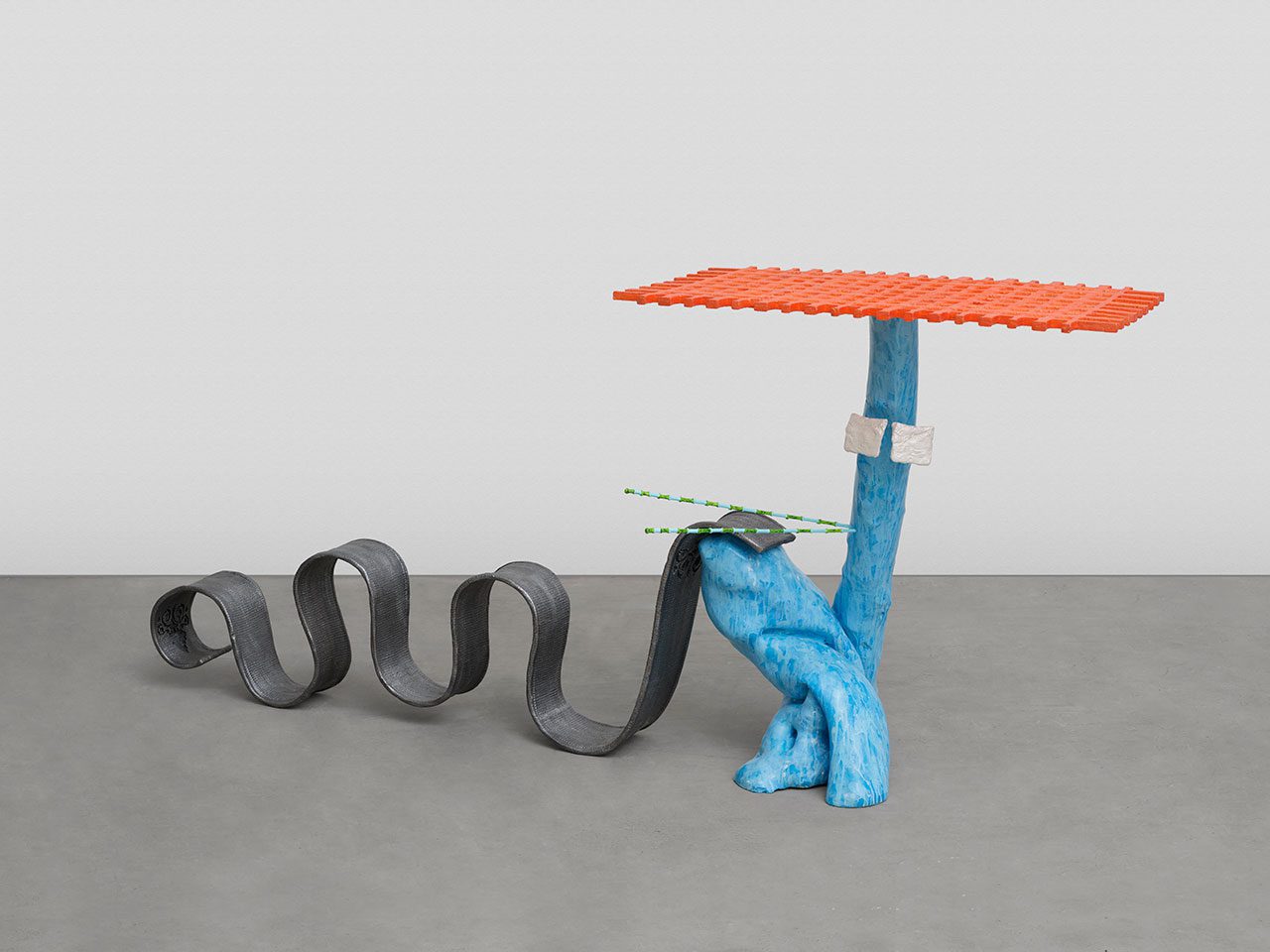
Guan Xiao takes a playful approach to her sculpture, video, and installation artworks. She creates a visual language that breaks through historical and cultural boundaries by establishing diverse relationships between a variety of rich materials, and using collage to blend classical art with industrial manufacturing to build a unique form of contemporary art. She often juxtaposes physical objects—such as industrial products and cultural artifacts—alongside images amassed from scrolling through the infinite universe of desktop and laptop screens.
By Efi Michalarou
Photo: Kunsthalle Wien Archive
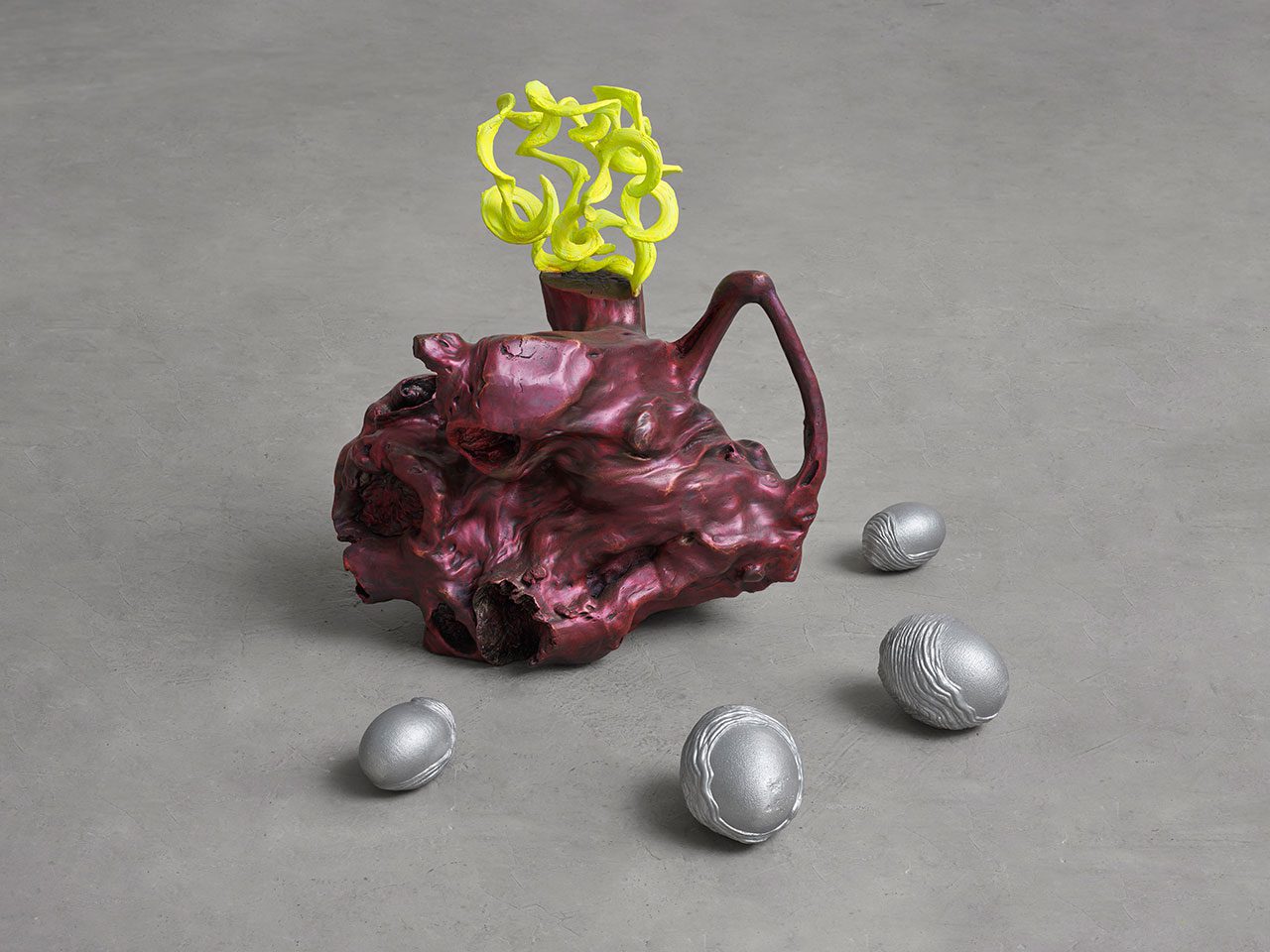
In “Teenager”, her first solo exhibition in Austria, Guan Xiao presents an entirely new body of sculptures and paintings that explore the liminal, uncertain, and often turbulent state of adolescence. Described by the artist as an “ambiguous life stage,” the teenager becomes both a subject and a metaphor — a psychological condition that mirrors the contradictions of our contemporary world. Through her hybrid forms and surreal environments, Guan examines how societies shaped by capitalism and liberalism navigate the uneasy balance between desire and discipline, tradition and transformation, individuality and conformity. At the centre of the exhibition, a large, furry A-frame structure bisects the gallery, forming a tunnel that acts as both passage and threshold. Animated by light and smoke, the structure contains a constellation of cast aluminium objects — enlarged items of domestic familiarity: a moka pot, cutlery, and a cluster of magnified eggs. This curious environment, hovering between the dreamlike and the absurd, suggests a theatre of transformation where everyday forms are reimagined at an unfamiliar scale. Surrounding this core installation, a series of gnarled, brass-cast tree roots are meticulously painted and fused with motorcycle parts and cartoon-like clouds of scribble. These hybrid beings — part machine, part myth — populate the exhibition like a cast of eccentric figures. Some are equipped with mesh plates and antennae-like extensions, as if attuned to invisible frequencies or signals. Two modular columns extend pink and blue aluminium arms from claw-like bases resembling oversized bunches of bananas, further complicating distinctions between the organic and the artificial, the technological and the sensual. On the surrounding walls, a triptych of palette-shaped panels, thickly layered with paint, evokes windows that are at once reflective and opaque — a gesture that suspends the viewer between looking and being looked at. Trained initially as a filmmaker, Guan Xiao’s sculptural practice retains a cinematic sensibility — one attentive to framing, rhythm, and the construction of meaning through juxtaposition. Her works often encourage the viewer to weave their own stories, activating a narrative impulse that is neither linear nor literal. Earlier installations resembled museological displays or improvised photography studios: assemblages of disparate objects and images that conjured new relationships through proximity and contradiction.
This strategy of associative thinking — of creating meaning through unexpected conjunctions — situates Guan within a lineage of artists who challenge fixed categories of perception and value. Yet her work remains distinctly her own, marked by an interest in how images, technologies, and cultural artefacts circulate globally and become detached from their original contexts. In more recent years, Guan Xiao has turned her attention to the Chinese custom of displaying polished tree roots in domestic interiors — a practice with a long and complex history. Originating in the Warring States Period (474–221 BCE), root carving preserves the natural form of the wood, celebrating its organic beauty. Over centuries, however, this practice became both a marker of prosperity and a sign of aesthetic stagnation: a symbol of wealth that, through repetition, lost its vitality. In Guan’s hands, the tree root becomes a site of transformation. She reanimates it as a hybrid entity — part vegetal, part animal, part mechanical — that resists easy classification. These roots no longer serve as mere decoration; they mutate into sentient forms, suggesting growth, mutation, and metamorphosis. By combining handcrafted elements with mass-produced materials, Guan constructs a dialogue between the artisanal and the industrial, between inherited craft traditions and the relentless circulation of global commodities. “Teenager” returns to fundamental subjects — food, clothing, shelter — to meditate on questions of civilisation, progress, and spirituality. These universal necessities, reframed through Guan’s surreal vocabulary, become symbolic of the perpetual negotiations that define both adolescence and modern society. The teenager, poised between childhood and adulthood, is a figure of instability and potential — an emblem of becoming. For Guan, this “conflicted state” embodies the tension of a world suspended between devotion and restraint, ancient wisdom and contemporary desire. Her adolescent metaphor extends beyond the individual, reflecting a collective condition: a civilisation caught in perpetual adolescence, striving toward growth yet resistant to maturity, driven by consumption yet haunted by memory. The exhibition thus stages a philosophical inquiry into what it means to evolve — materially, culturally, and spiritually — in a time when progress itself feels uncertain. Through her richly imaginative sculptural language, Guan Xiao constructs a world that is at once playful and profound, humorous and melancholic. “Teenager”is not merely an exploration of youth, but a meditation on transformation — of bodies, materials, and societies. In confronting the contradictions of the present, Guan’s work offers a poetic vision of change: a space where the boundaries between object and subject, the human and the nonhuman, are continuously renegotiated. In this suspended state — between innocence and experience, myth and modernity — Guan invites us to dwell in uncertainty, to inhabit the ambiguous, and to rediscover the potential of not yet being fully formed.
Photo: Guan Xiao, Midnight Pancake, 2025, Courtesy the artist and Kraupa-Tuskany Zeidler Gallery, Berlin/Munich
Info: Kunsthalle Wien, Museumsquartier, Museumsplatz 1, Vienna, Austria, Duration: 8/10/2025-11/1/2026, Days & Hours: Tue-Wed & Fri-Sun 10:00-18:00, Thu 10:00-20:00, https://kunsthallewien.at/en
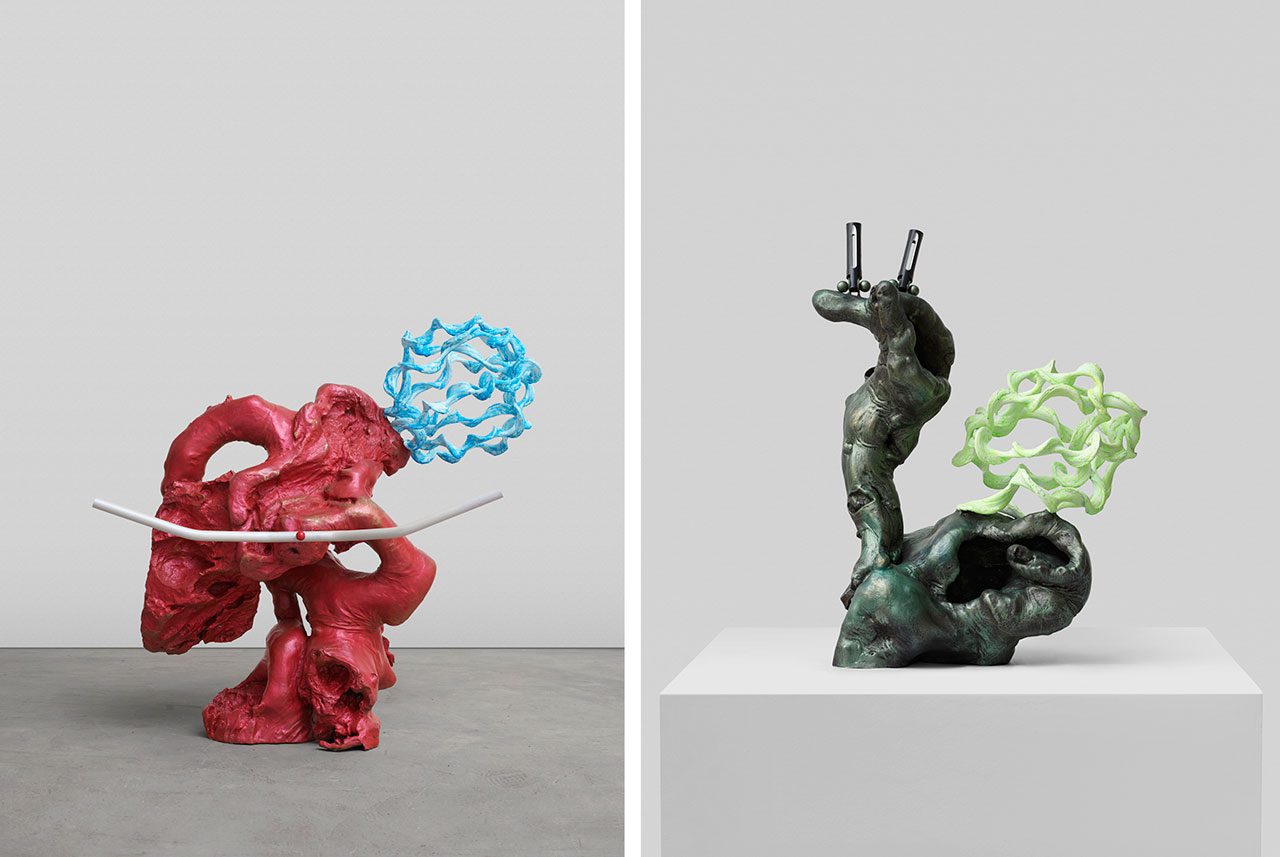
Right: Guan Xiao, Jeanake, 2025, Courtesy the artist and David Kordansky Gallery, Los Angeles/New York
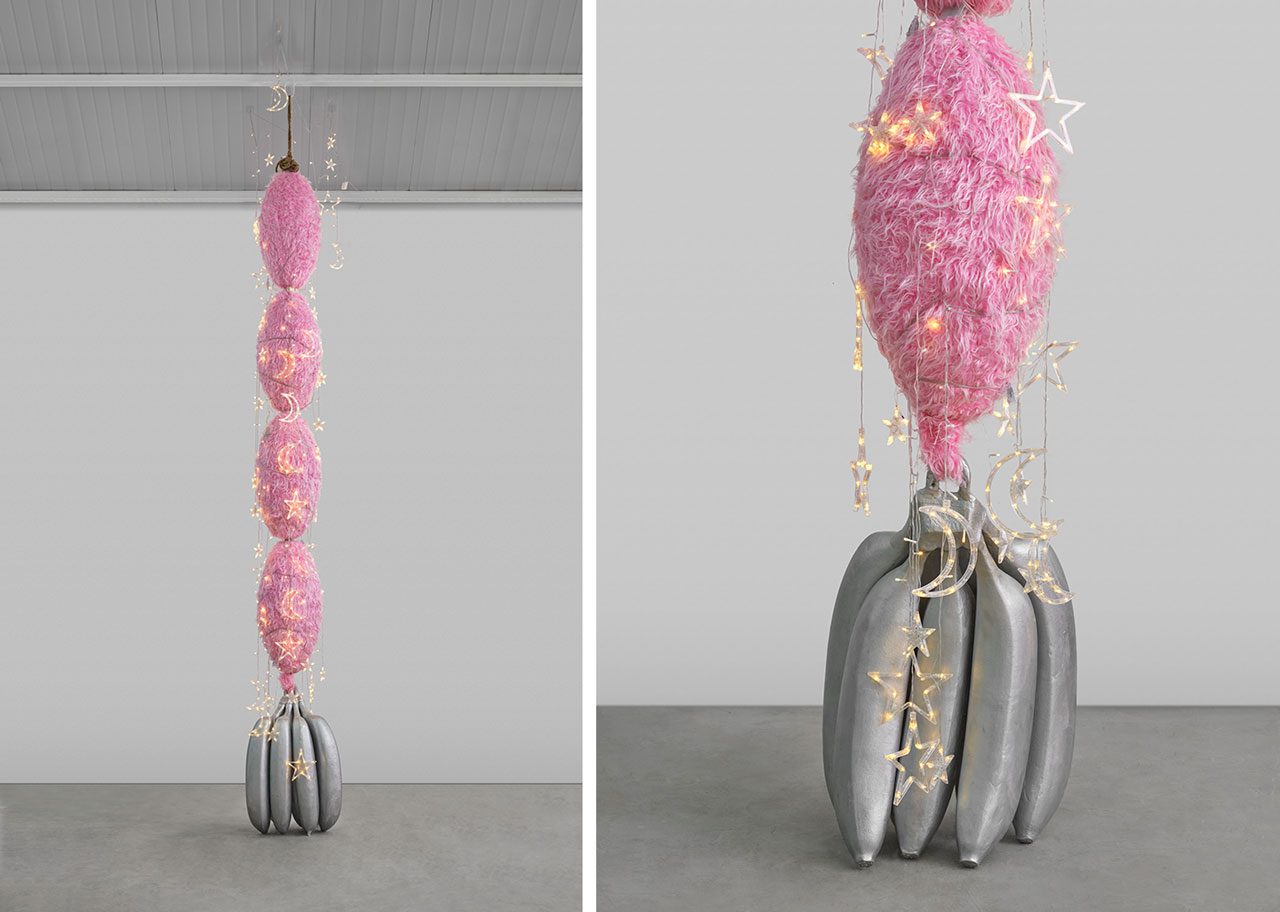
Right: Guan Xiao, Raining (detail), 2025, Courtesy the artist and David Kordansky Gallery, Los Angeles/New York