
ART CITIES: Athens-The Winged Bull of Nineveh Returns: The Second Phase of the Michael Rakowitz Trilogy
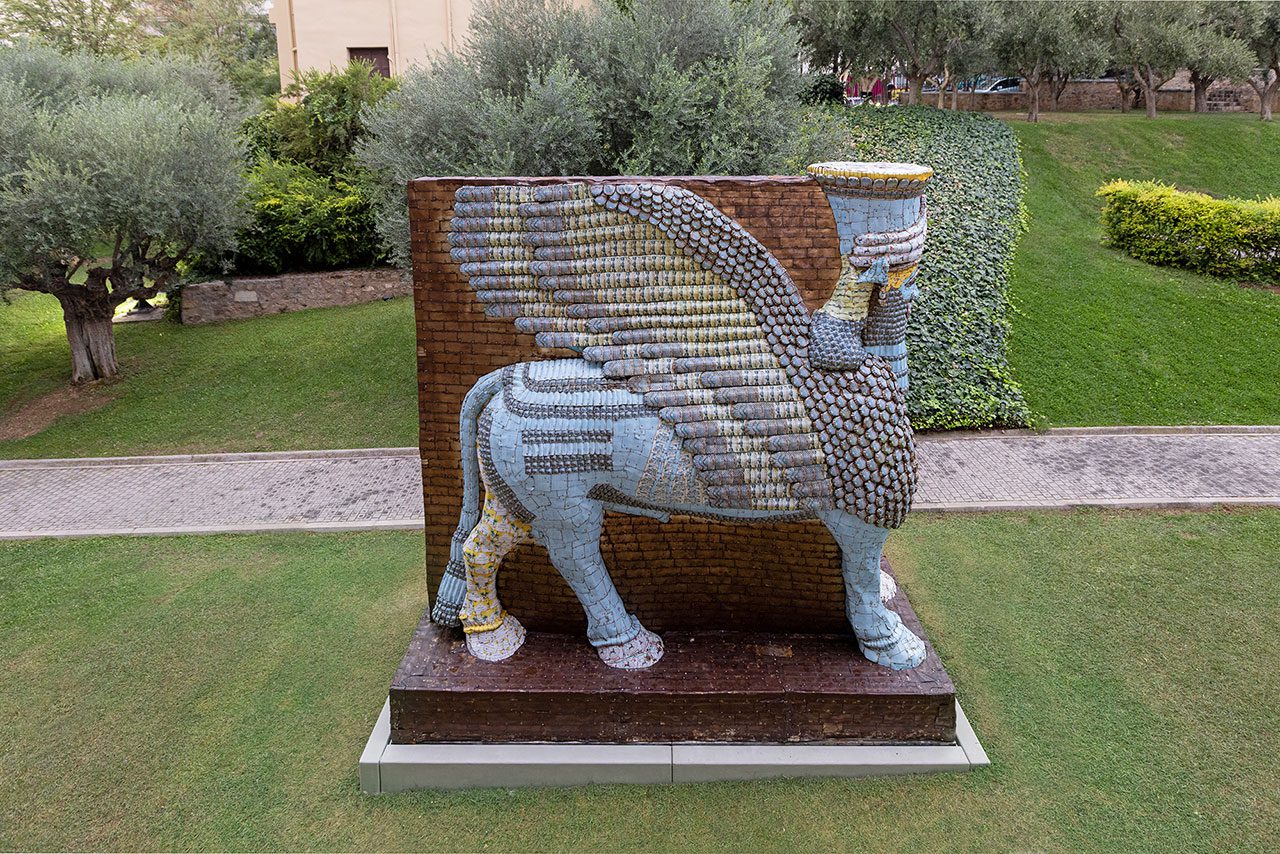
On Monday, October 6th, the second phase of the exhibition trilogy “Michael Rakowitz & Ancient Cultures” was inaugurated in the exterior space of the Acropolis Museum, on the western side facing Mitsaion Street. The monumental Winged Bull of Nineveh, the “Lamassu of Nineveh,” establishes for the first time its imposing presence in the Greek capital, creating a dialogue with the sacred Rock of the Acropolis and the monuments that crown it.
By Mimika Christodoulopoulou
Photo: NEON Archive
The work by internationally renowned contemporary artist Michael Rakowitz, measuring approximately 4.3 meters in length, constitutes an extension of his acclaimed series “The Invisible Enemy Should Not Exist” and represents the protective Assyrian deity that guarded the entrance of the Nergal Gate of Nineveh from 700 BCE. The original deity was brutally destroyed in February 2015 by ISIS, along with other invaluable exhibits from the Mosul Museum—an act of cultural annihilation that shocked the international community. Rakowitz’s choice of materials is particularly symbolic and poignant: The sculpture is constructed from metal cans of date syrup originating from Iraq. The date, a product deeply connected to Mesopotamian soil, is transformed into a structural material for the reconstitution of a lost symbol. The empty cans, stacked and assembled, create a structure that is simultaneously fragile and resilient, temporary and monumental. The placement of the lamassu in the exterior space of the Acropolis Museum is not coincidental. It creates a multilayered conversation: with the archaeological excavation at the Museum’s base, with the sacred Rock of the Acropolis dominating above, with the Museum’s contemporary building, and with the urban landscape surrounding it. The Winged Bull, a symbol of protection and power in ancient Assyria, encounters the Parthenon, symbol of Western Civilization, in a dialogue that transcends millennia and borders. The work, originally created as a commission for the Fourth Plinth in Trafalgar Square, London, will remain in this location until December 2026, inviting passersby to contemplate the fate of cultural heritage in times of war and to reflect upon questions of cultural inheritance, loss, and memory.
The installation of the Winged Bull represents the natural continuation of an ambitious trilogy that began in May 2025 and extends through December 2026, through the collaboration of the Acropolis Museum, the Ephorate of Antiquities of the City of Athens, and NEON organization. This is an audacious undertaking that attempts to challenge static archaeological narratives by placing ancient objects in dialogue with contemporary artworks. The first part of the trilogy, aptly titled “Allspice / Michael Rakowitz & Ancient Cultures,” is presented in the Temporary Exhibitions Hall of the Acropolis Museum from May 13 through October 31, 2025. The exhibition, curated by Professor Nikolaos Stampolidis and Elina Kountouri, constitutes a multilayered meditation on identity, exile, and the preservation of cultural memory. The title “Allspice” acquires symbolic character: The handwritten recipes of the artist’s Iraqi-Jewish mother, reproduced on the hall’s columns, function as a metaphor for the preservation of cultural identity in diaspora. Just as allspice combines many flavors into one, the memories of migrants interweave multiple cultural identities. This spice, a basic ingredient in the Iraqi mixture “baharat,” functions as a substitute when other spices are unavailable—a concept central to Rakowitz’s work, as he creates “substitute” sculptures of objects that have been lost or destroyed.
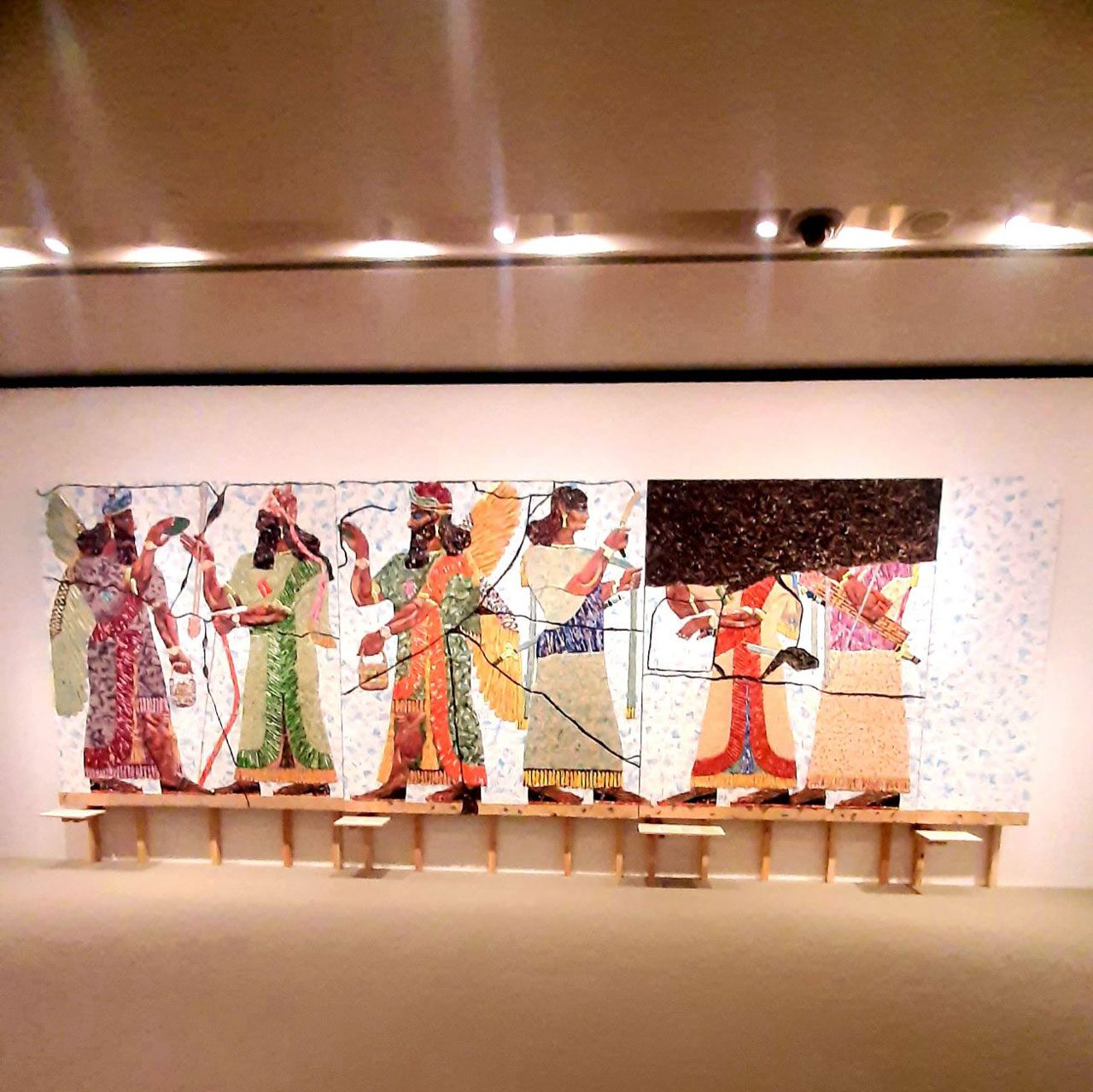
A central role in the exhibition is played by the series “The Invisible Enemy Should Not Exist,” an ongoing project by Rakowitz concerning the “reappearance” of looted and destroyed antiquities from Mesopotamia. These works represent relief sculptures from the Northwest Palace of Nimrud-Kalḫu that once adorned the walls of the ancient Assyrian palace. Rakowitz’s technique is as significant as its content: The sculptures are constructed from compressed paper, contemporary Middle Eastern newspapers, and boxes from food packaging from Northern Iraq. The use of consumable materials is not accidental—it underscores the absence of the originals, the perishability of memory, and the ephemeral nature of history when it is not protected. The reliefs are deliberately presented with gaps between them, revealing the fractures caused by wars, looting, and the passage of time. These gaps are not concealed—rather, they become an integral part of the narrative, bearing witness to the history of cultural trauma.
The exhibition opens with the video “The Ballad of Special Ops Cody,” filmed at the Institute for the Study of Ancient Cultures at the University of Chicago. The protagonist is a miniature U.S. Marine toy figure, crafted with exceptional detail, that “enters” the museum vitrines housing Mesopotamian votive statues and attempts to “liberate” them. This work poses incisive questions: Who exactly is the liberator and who is the plunderer? Which “liberation” truly constitutes salvation and which constitutes new imprisonment? Rakowitz ironically undermines the rhetoric of “salvation” often employed to justify the displaced existence of antiquities in Western museums.
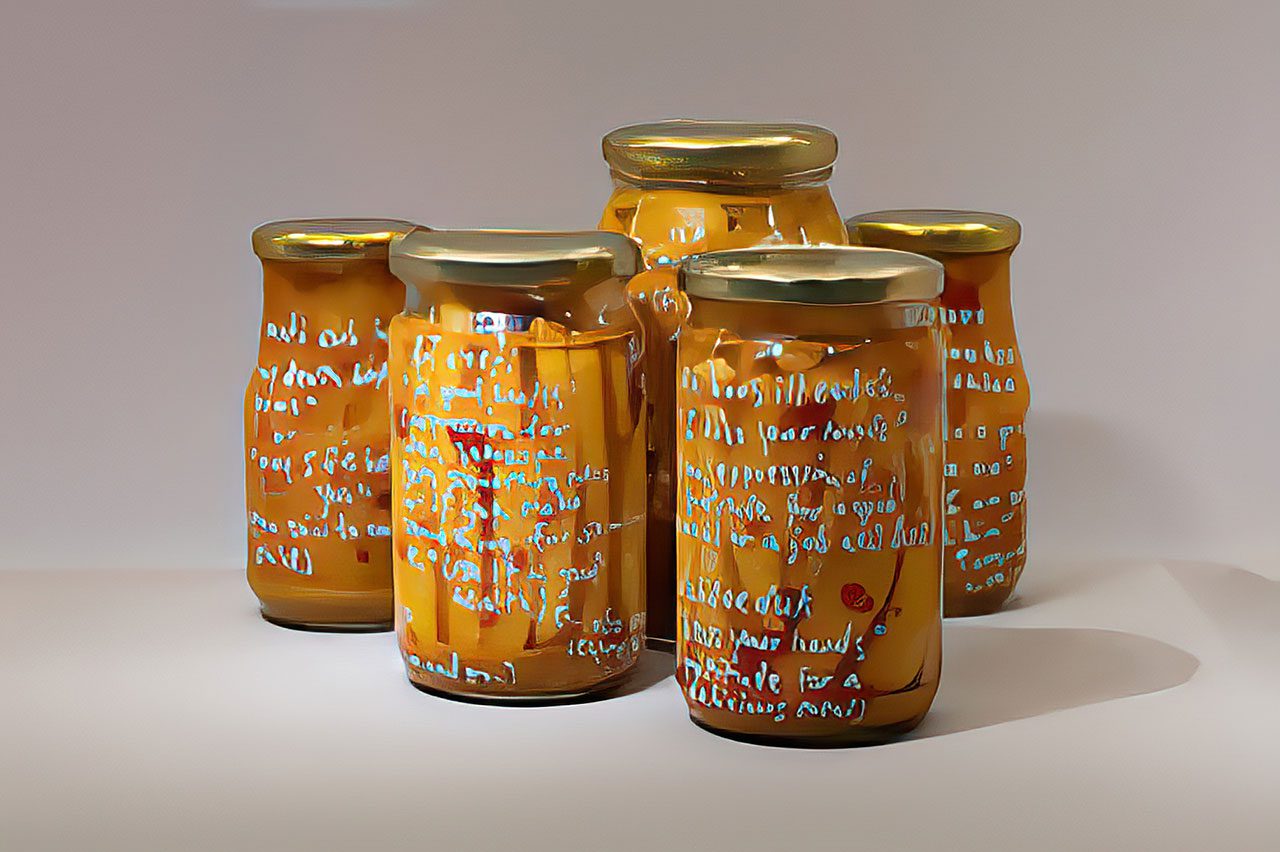
The book vitrine presents a new commission titled “A Baghdadi Amba Dictionary.” The work dialogues with the monumental “Chicago Assyrian Dictionary” (CAD) of the University of Chicago, an encyclopedic 21-volume study of a language that has not been spoken for two millennia. Rakowitz creates handcrafted jars containing “amba,” a traditional mango-based pickle that holds an important place in Iraqi cuisine. On the external glass surface of the jars, he has etched a glossary of dialectical terms and expressions taught to him by his mother, Yvonne. These jars will be offered to the public at the exhibition’s conclusion, transforming memory into gift. This work underscores the fragile nature of both ancient relics and the oral traditions of diasporas. What happens when a language, a recipe, a spice is forgotten? The artist parallels the work of the scholar who documents a forgotten language, the conservator who repairs an old book, and the migrant who attempts to preserve their cultural identity.
Also a new commission, “Study for a Lamassu in spolia” constitutes a conceptual collage connecting different cultures through the ancient technique of “spolia”—the reuse of architectural elements from earlier buildings. Rakowitz paints the body of an Assyrian Winged Bull (lamassu) directly onto the vitrine glass housing a stone male head from Cyprus, from the Th. Zintilis Collection. This composition proposes a fantastical “completion” of two fragments from different cultures, emphasizing the shared fates of antiquities that have been fragmented, displaced, and reconstituted far from their place of origin.
The exhibition is enriched with significant loaned objects: thirteen from the Institute for the Study of Ancient Cultures at the University of Chicago and one from the Cypriot Collection housed at the Museum of Cycladic Art. These ancient exhibits from the Middle East and southeastern Mediterranean do not function merely as historical backdrop but as active interlocutors with the contemporary works. Their placement in the Temporary Exhibitions Hall of the Acropolis Museum is not coincidental: The visible gap among the Parthenon sculptures functions as a silent yet powerful interlocutor, recalling the history of the marbles’ seizure by Lord Elgin.
The trilogy is expected to conclude with an exhibition at the Old Acropolis Museum, from May through December 2026, in collaboration between the Ephorate of Antiquities of the City of Athens and NEON. This exhibition will focus on the ancient brick as both structural material and metaphor for the construction of histories and memories. Clay, from which bricks are made, constitutes the primary material of both Mesopotamian architecture and writing—the cuneiform tablets that recorded human history were made from the same clay. The concept explores how objects from different historical and geographical contexts shape narratives that transcend borders and epochs.
A central question posed by the trilogy concerns the very nature of antiquities located far from their place of origin. Are they refugees who were expatriated for reasons of salvation and should return when conditions permit? Or are they captives, victims of theft, seizure, and illegal trafficking, who must be returned immediately? Rakowitz’s works, whether complete or fragmentary objects, function as shadows and phantoms—”reappearances” bearing a trace of memory and humanity. They do not attempt to replace the originals but to keep alive the consciousness of loss. They move from exhibition to exhibition, from country to country, raising awareness until the desired restoration of justice is achieved.
Collaboration between archaeological museums and contemporary creators is not new, but Rakowitz’s trilogy in Athens distinguishes itself through its organic and deeply meaningful approach. This is not a simple juxtaposition of old and new but a fertile conversation that highlights the complexity and continuity of cultural heritage. Ancient exhibits cease to be products of a frozen past and acquire new dimensions through contemporary artistic interventions. Various lived experiences, identities, and memories become implicated, reminding us that history is not static but continually renegotiable. Rakowitz’s trilogy is manifestly political without being didactic, conceptual without being distanced, moving without being sentimental. His works remind us of the repetition of painful historical events: wars, looting, colonialism, displacements, while bringing to the foreground the fate of war-torn regions. Simultaneously, they underscore the futile journeys of persecuted peoples and cultural heritage. Refugees crossing seas, looted antiquities, exiled memories—all converge in Rakowitz’s work, creating a powerful narrative about the urgent need to reclaim humanity’s shared cultural history.
With the inauguration of the Winged Bull, the trilogy “Michael Rakowitz & Ancient Cultures” enters a new phase. The monumental sculpture in the exterior space of the Acropolis Museum provides an opportunity for the Greek public to engage with one of the most significant contemporary artists addressing issues of cultural heritage. Rakowitz does not merely create beautiful objects; he creates narratives, opens dialogues, poses questions. At the Acropolis Museum, beneath the Rock of the Acropolis and the Parthenon—symbol of Western Civilization—the trilogy unites the classical and contemporary cultures of this corner of the planet. It recalls the fertile contact with the civilizations that marked the ancient world and continue to influence our present.
Photo: Michael Rakowitz, The Invisible Enemy Should Not Exist (Lamassu of Nineveh), 2018, 10,500 Iraqi date syrup cans, metal framem 4.69 x 1.70 x 4.48 m, Commissioned for the Mayor of London’s Fourth Plinth Programme, Courtesy Mayor of London and the Artist
Installation view Lamassu of Nineveh (2018) | Michael Rakowitz & Ancient Cultures, 2025 | A collaboration between NEON + the Acropolis Museum | Photography © Natalia Tsoukala | Courtesy ΝΕΟΝ, the Acropolis Museum and the artist
Info: “Lamassu of Nineveh”: Acropolis Museum, Exterior space, western side facing Mitsaion Street, Dionysiou Areopagitou 15, Athens, Greece, Duration: 6-31/10/2025, Days & Hours: Summer season (1/4-31/10) Mon 9:00-17:00, Tue-Thu & Sat-Sun 9:00-19:30, Fri 9:00-22:00, Winter season (1/11-31/3) Mon-Thu 9:00-17:00, Fri 9:00-22:00, Sat=Sun 9:00-20:00, Free access & “Allspice / Michael Rakowitz & Ancient Cultures”: Curators: Professor Nikolaos Chr. Stampolidismand Elina Kountouri, Acropolis Museum, Temporary Exhibitions Hall, Dionysiou Areopagitou 15, Athens, Greece, Duration: 13/5-31/10/2025, Days & Hours: Summer season (1/4-31/10) Mon 9:00-17:00, Tue-Thu & Sat-Sun 9:00-19:30, Fri 9:00-22:00, Winter season (1/11-31/3) Mon-Thu 9:00-17:00, Fri 9:00-22:00, Sat=Sun 9:00-20:00, Free access, www.theacropolismuseum.gr/

Installation view Lamassu of Nineveh (2018) | Michael Rakowitz & Ancient Cultures, 2025 | A collaboration between NEON + the Acropolis Museum | Photography © Natalia Tsoukala | Courtesy ΝΕΟΝ, the Acropolis Museum and the artist
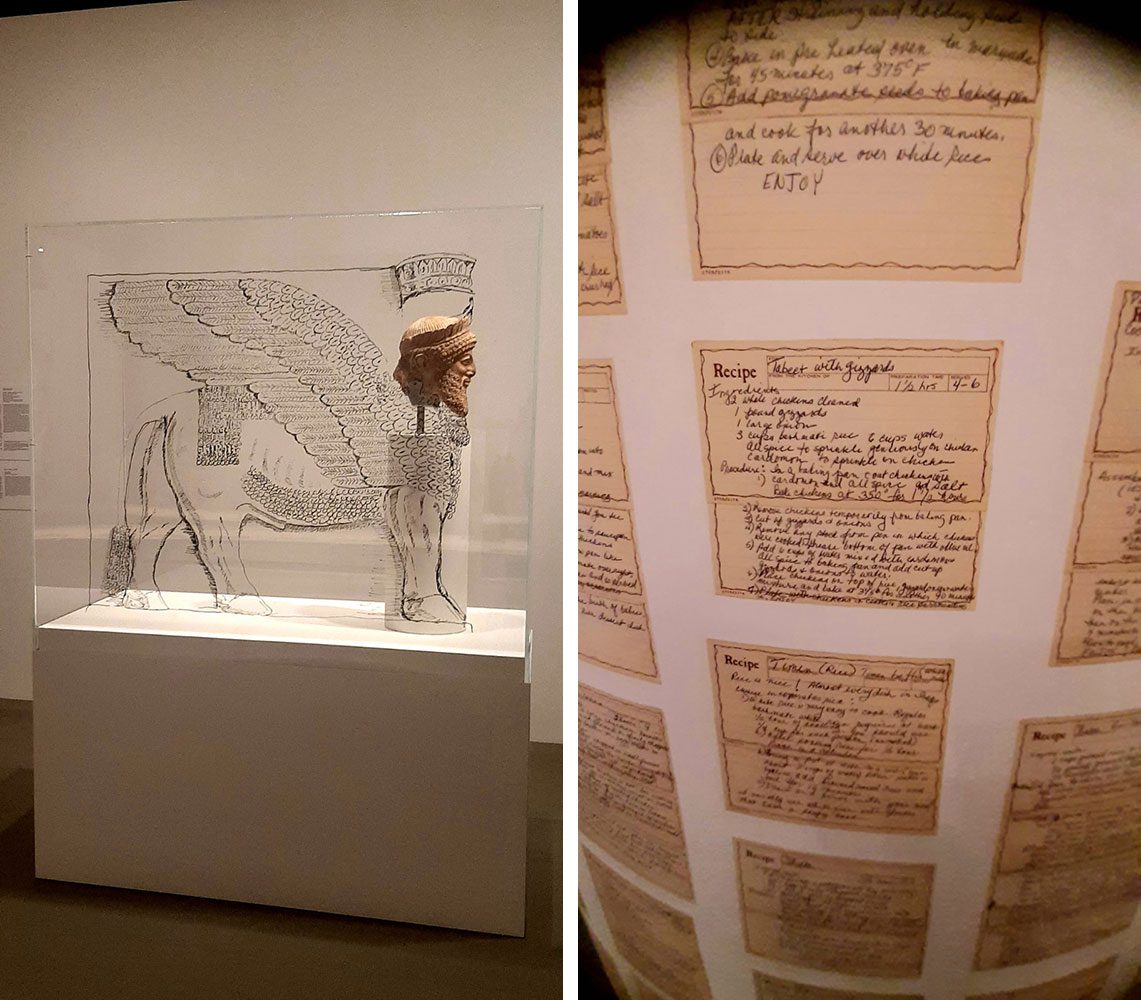
Right: Michael Rakowitz, Handwritten recipes from the artist’s Iraqi-Jewish mother reproduced on the exhibition hall columns body, Photo NEON, Courtesy ΝΕΟΝ, the Acropolis Museum and the artist
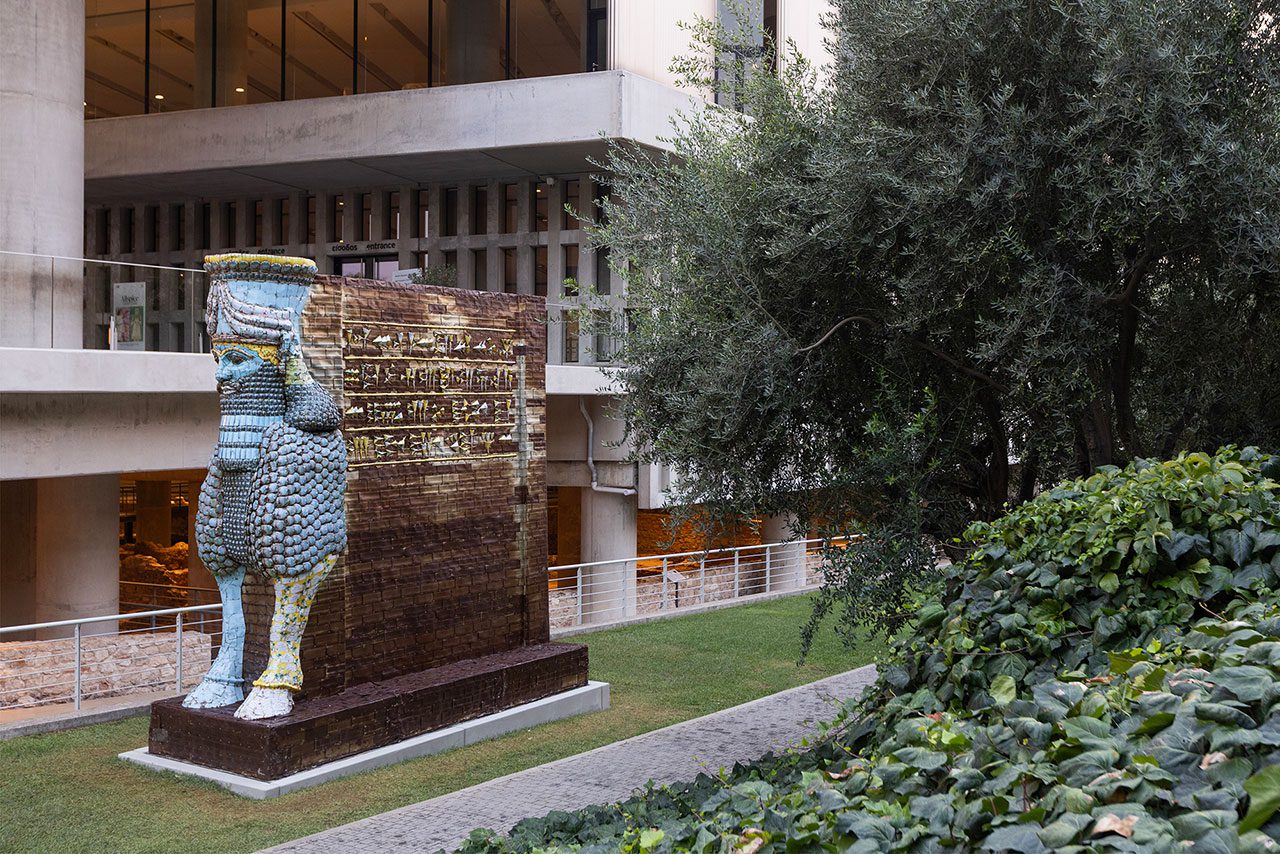
Installation view Lamassu of Nineveh (2018) | Michael Rakowitz & Ancient Cultures, 2025 | A collaboration between NEON + the Acropolis Museum | Photography © Natalia Tsoukala | Courtesy ΝΕΟΝ, the Acropolis Museum and the artist