
ART CITIES: Rome-Urs Fischer
Urs Fischer has always treated art as a grand experiment, a place where the ordinary and the extraordinary can collide without warning. His studio resembles a hybrid of kitchen, laboratory, and theater: a site where clay and steel mingle with bread dough, fruit, and fistfuls of dust. The Swiss-born artist delights in materials that most would overlook or discard, coaxing out their hidden potential through a heady mix of technical precision and irreverent wit.
By Efi Michalarou
Photo: Gagosian Archive
By turns mischievous and philosophical, Urs Fischer builds sculptures, paintings, photographs, and immersive installations that question how we perceive reality—and how quickly those perceptions can unravel. From the beginning of his career, Fischer has reveled in contradiction. He chooses materials that invite decay even as he applies meticulous craftsmanship. A loaf of bread might harden into sculpture; a block of steel might be carved with the delicacy of fruit. This tension between permanence and impermanence fuels his practice. He manipulates scale to startling effect—magnifying a common object until it becomes monumental, or miniaturizing the seemingly grand until it feels fragile. Illusion and humor are never far away. His works disorient precisely because they are so familiar, forcing viewers to reconsider the most basic acts of looking. The solo exhibition “After Nature” crystallizes these long-standing concerns while opening new pathways. Here Fischer marshals a dazzling range of methods—screenprinting, soft sculpture, interactive video—yet the works remain bound by a shared fascination with perception, memory, and the subtle erosion of time. Technology and handwork, order and entropy, all coexist in a delicate, shifting balance. At the heart of the show is a suite of eight new aluminum paintings derived from the humblest of sources: dust collected from the artist’s studio floor. Fischer began exploring this unlikely medium more than a decade ago, but these latest panels possess a richer, more tactile presence. Their partly screen-printed surfaces are burnished to a mirror-like sheen, catching fleeting reflections of the gallery interior and even fragments of Roman sky. Across this polished ground, tiny specks of dust scatter like desert sandstorms or distant constellations. Viewers find themselves oscillating between micro and macro, as if peering through a microscope one moment and a telescope the next. These images recall, almost irresistibly, Man Ray’s 1920 photograph “Dust Breeding”, which documented the gradual buildup of grime on Marcel Duchamp’s “The Bride Stripped Bare by Her Bachelors, Even (The Large Glass)” (1915–23) Fischer’s dust paintings, like their historical forebears, elevate residue to revelation. They suggest that the overlooked particles beneath our feet can contain an entire cosmos, bridging the immeasurable gap between the infinitesimal and the infinite.
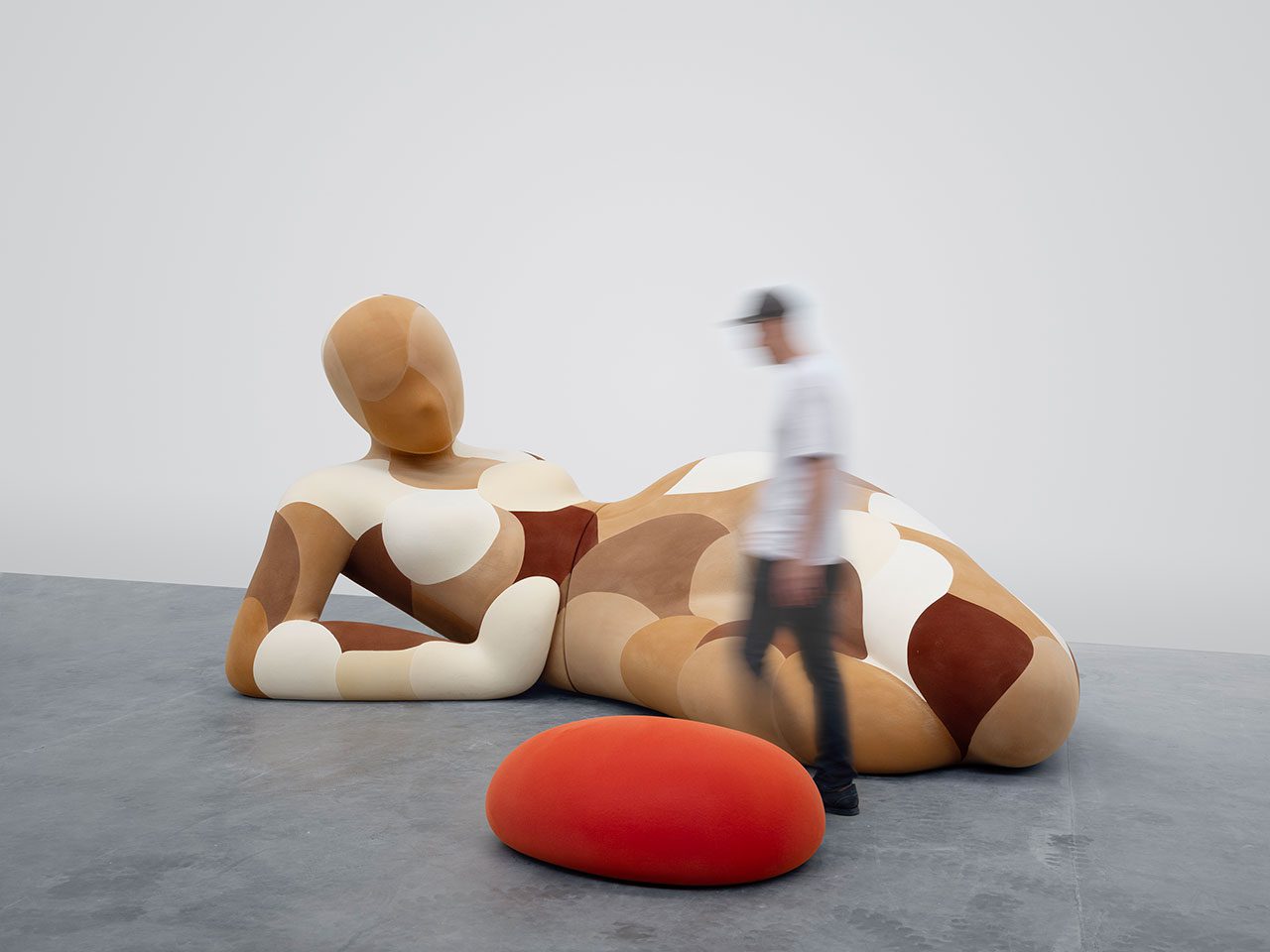
Equally striking is a monumental soft sculpture of a reclining female figure, its surface cloaked in a camouflage-like pattern of brown flocking. Two smaller, amoebic ottomans in a fiery orange-red accompany her like loyal satellites. Visitors are encouraged to recline on the figure itself, transforming the artwork into a couch, a resting place, a gravitational anchor within the gallery. Fischer speaks of the piece as a visceral embodiment of gravity’s pull—a reminder that no matter how lofty our thoughts, we remain bound to the earth. The work also carries historical resonance. It echoes “She—A Cathedral” (1966), the legendary installation by Niki de Saint Phalle, Jean Tinguely, P.O. Ultvedt, and Pontus Hultén, in which visitors entered the cavernous body of a reclining, pregnant woman to encounter a world of surprises. Fischer’s version, however, favors intimacy over spectacle. Rather than a walk-in cathedral, his sculpture offers a quiet pause, a site of rest and contemplation amid the surrounding visual tumult. The exhibition culminates in an interactive video installation that updates Dan Graham’s seminal “Time Delay Room” (1974). Fischer deploys a closed-circuit system of cameras and monitors that records visitors and plays back their images with a five-second lag. The effect is disarmingly immediate: you watch yourself almost in real time, yet not quite. This slight delay collapses the distinction between past and present, mirroring a digital culture in which memory and live experience blur into a continuous, looping “now.” By inviting audiences to witness their own gestures in near-real time, Fischer underscores how contemporary life is increasingly defined by perpetual self-observation. The piece is both playful and quietly unsettling, a meditation on how technology reframes identity and the act of looking. Taken together, the works in “After Nature” reveal an artist who is equal parts prankster and philosopher. Fischer elevates dust to stardust, turns a reclining body into communal furniture, and folds time back upon itself. He asks us to look harder at what we normally overlook: the residue on a studio floor, the weight of gravity on our own bodies, the brief delay between action and memory. Urs Fischer reminds us that perception is never fixed. Matter transforms, images deceive, and even the most banal substance can open onto a universe of wonder. By collapsing boundaries—between micro and macro, art and life, humor and gravity—he offers a vivid, ever-changing portrait of the world we inhabit, one in which nothing is too small, too fleeting, or too humble to become the stuff of art.
Photo: Urs Fischer, Body, 2025, Polyurethane foam and flocking, in 3 parts, Overall dimensions variable, © Urs Fischer, Courtesy the artist and Gagosian
Info: Gagosian, Via Francesco Crispi 16, Rome, Italy, Duration: 17/9-22/11/2025, Days & Hours: Tue-Sat 10:00-18:30, https://gagosian.com/