PRESENTATION: Dan Flavin-untitled (for Ksenija)
Beginning in 1963 with “the diagonal of May 25, 1963 (to Constantin Brancusi)”—a single gold fluorescent tube placed diagonally on a wall—Dan Flavin developed, until his death in 1996, a remarkably consistent and prolific body of work using commercially available fluorescent lamps. He created immersive installations, or “situations” as he preferred to call them, that explored light and color as a means of shaping and redefining space. Ranging from intimate wall-mounted or corner pieces to expansive environments that transformed entire rooms and corridors, Flavin’s work reflects his enduring engagement with architecture.
By Efi Michalarou
Photo: Kunstbau Lenbachhaus Archive
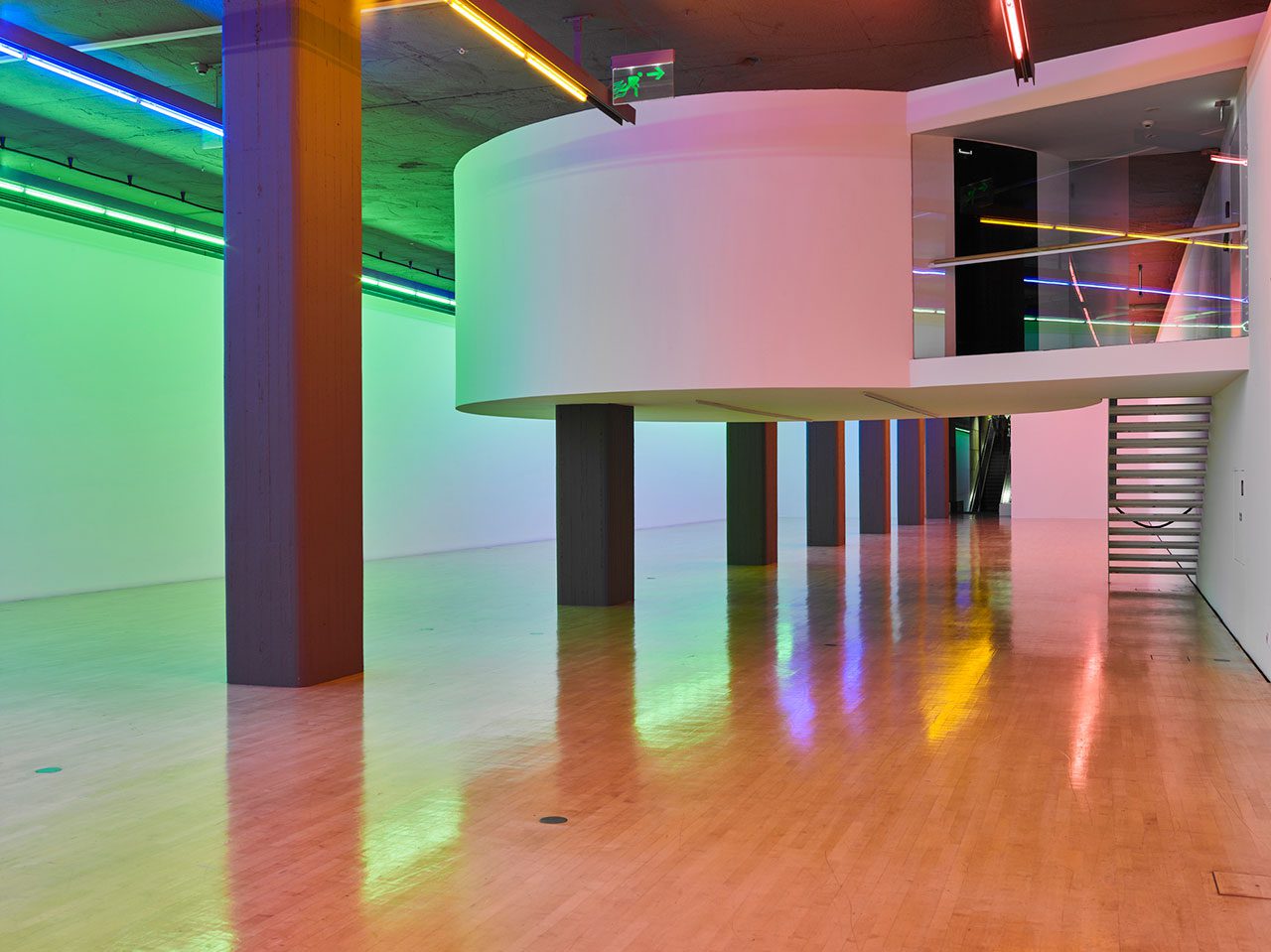
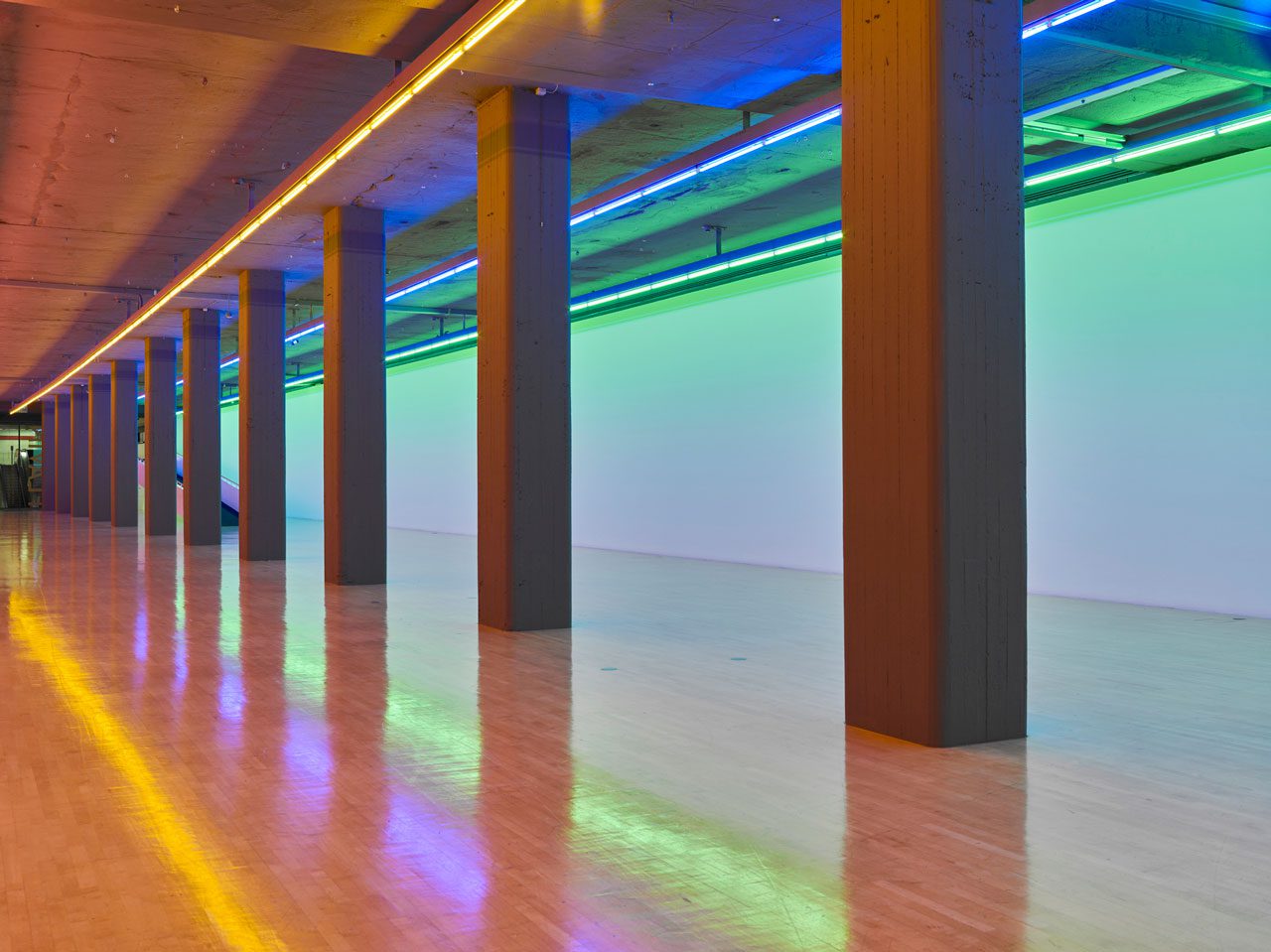
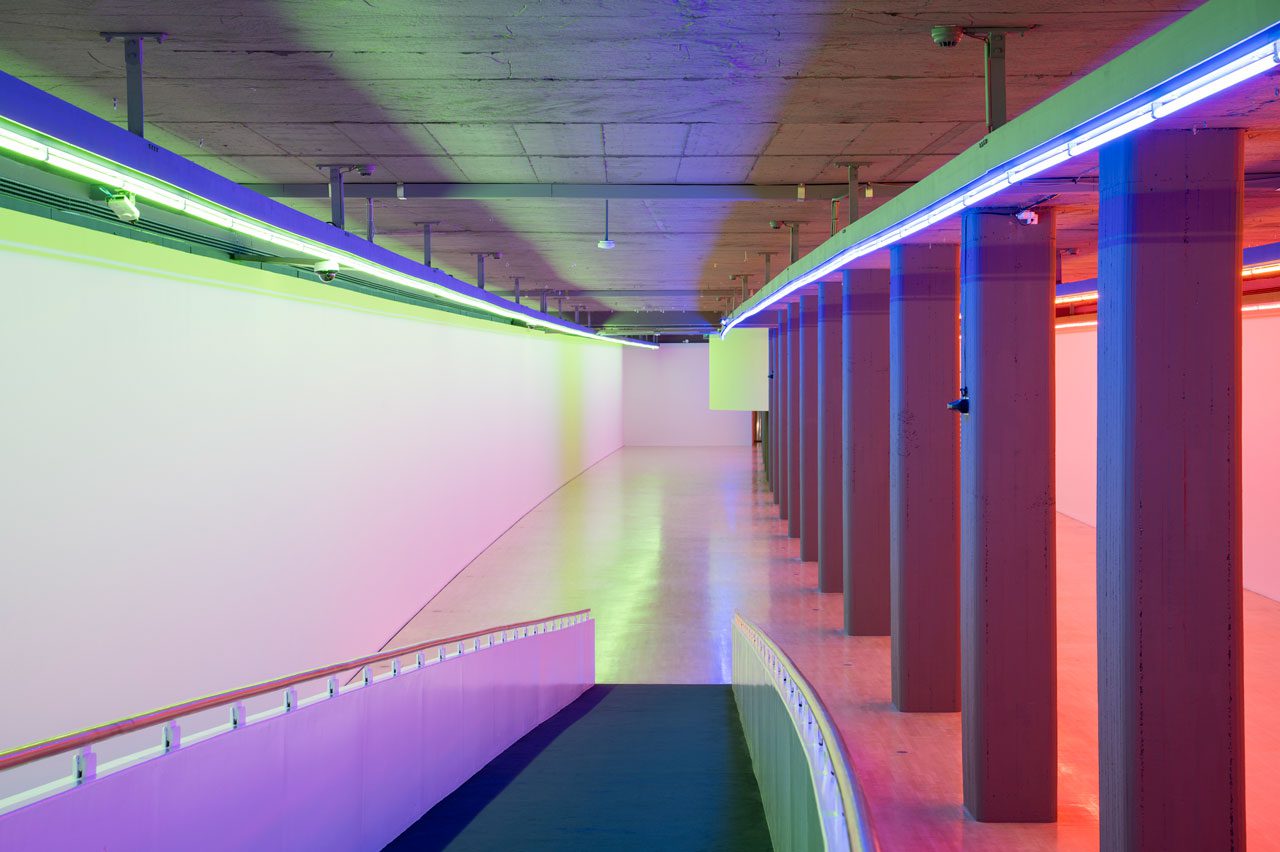
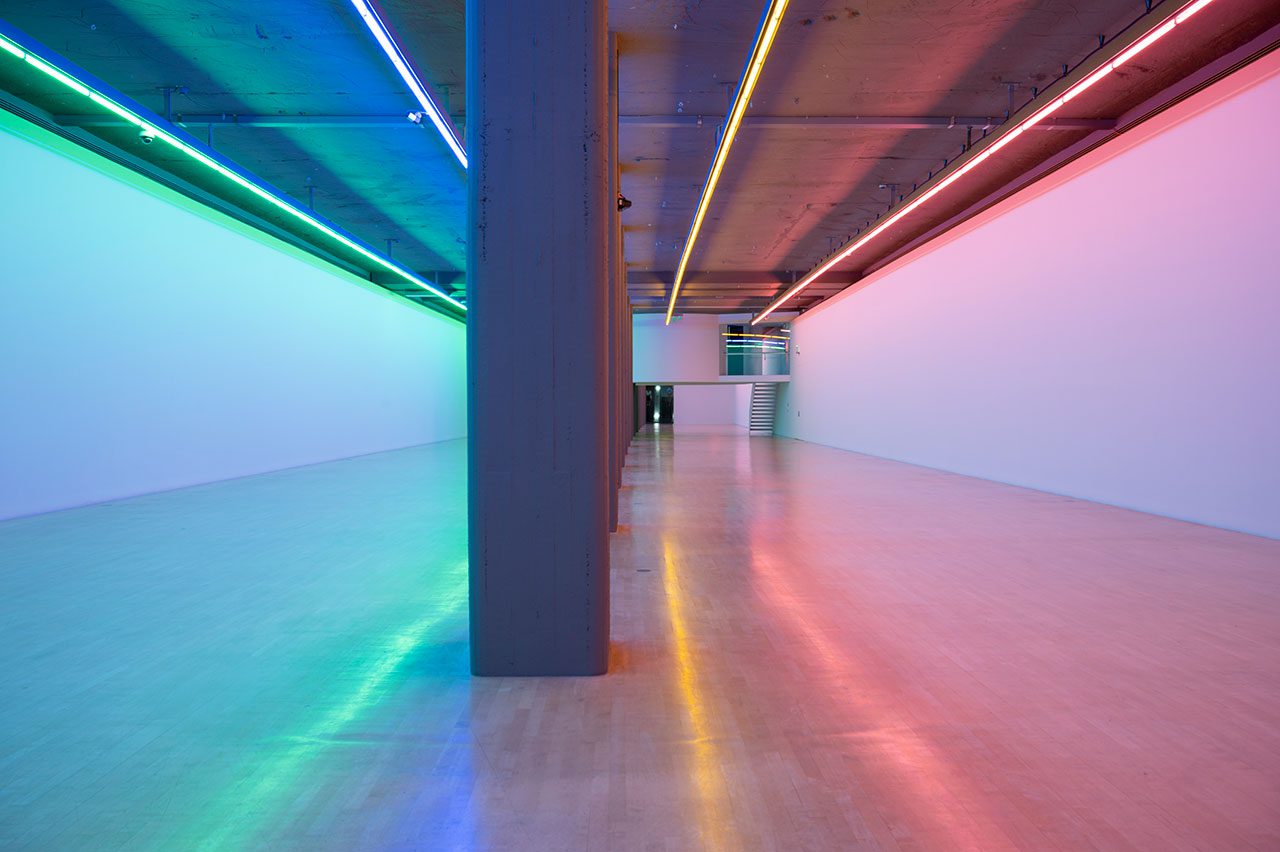
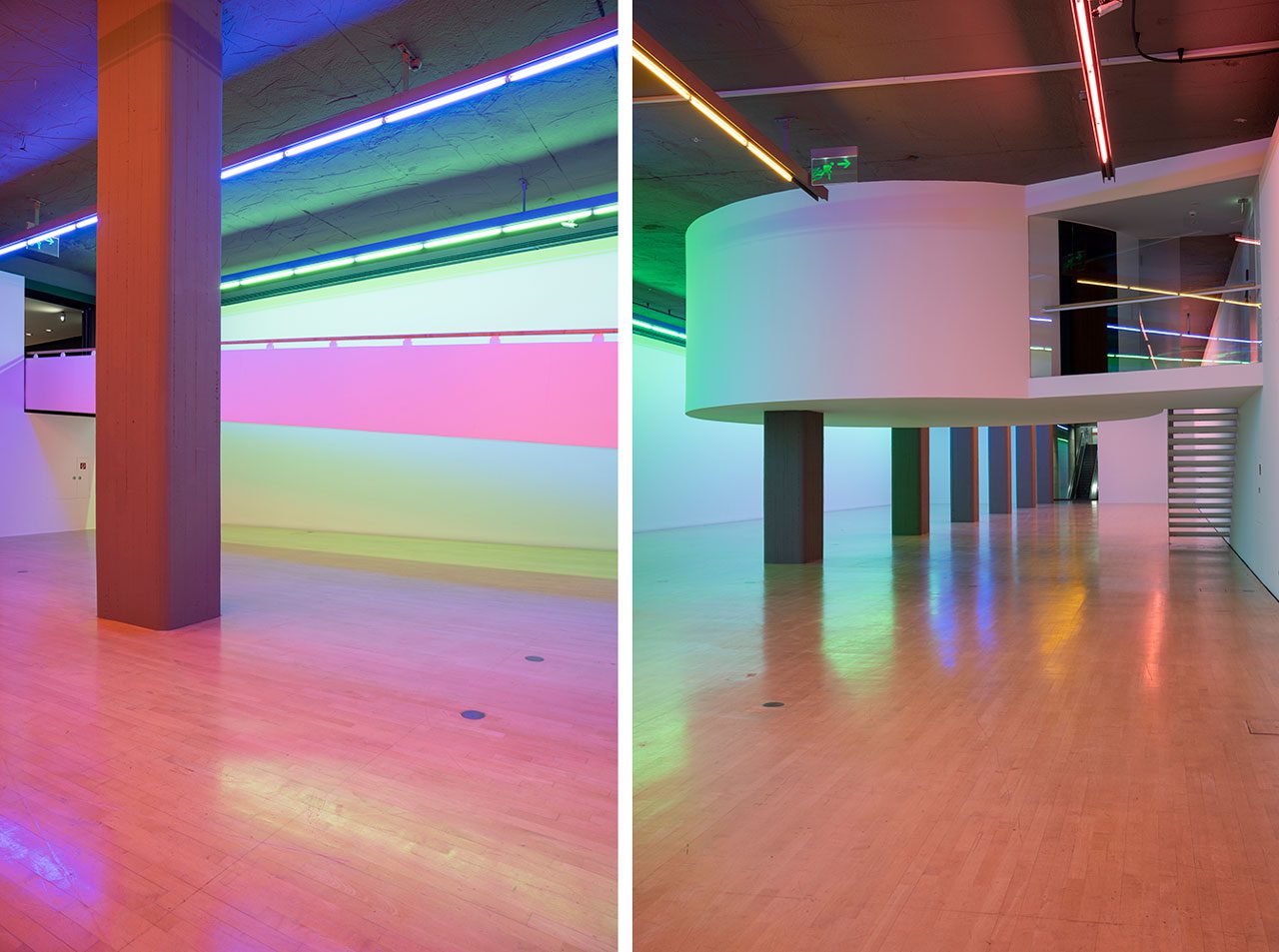
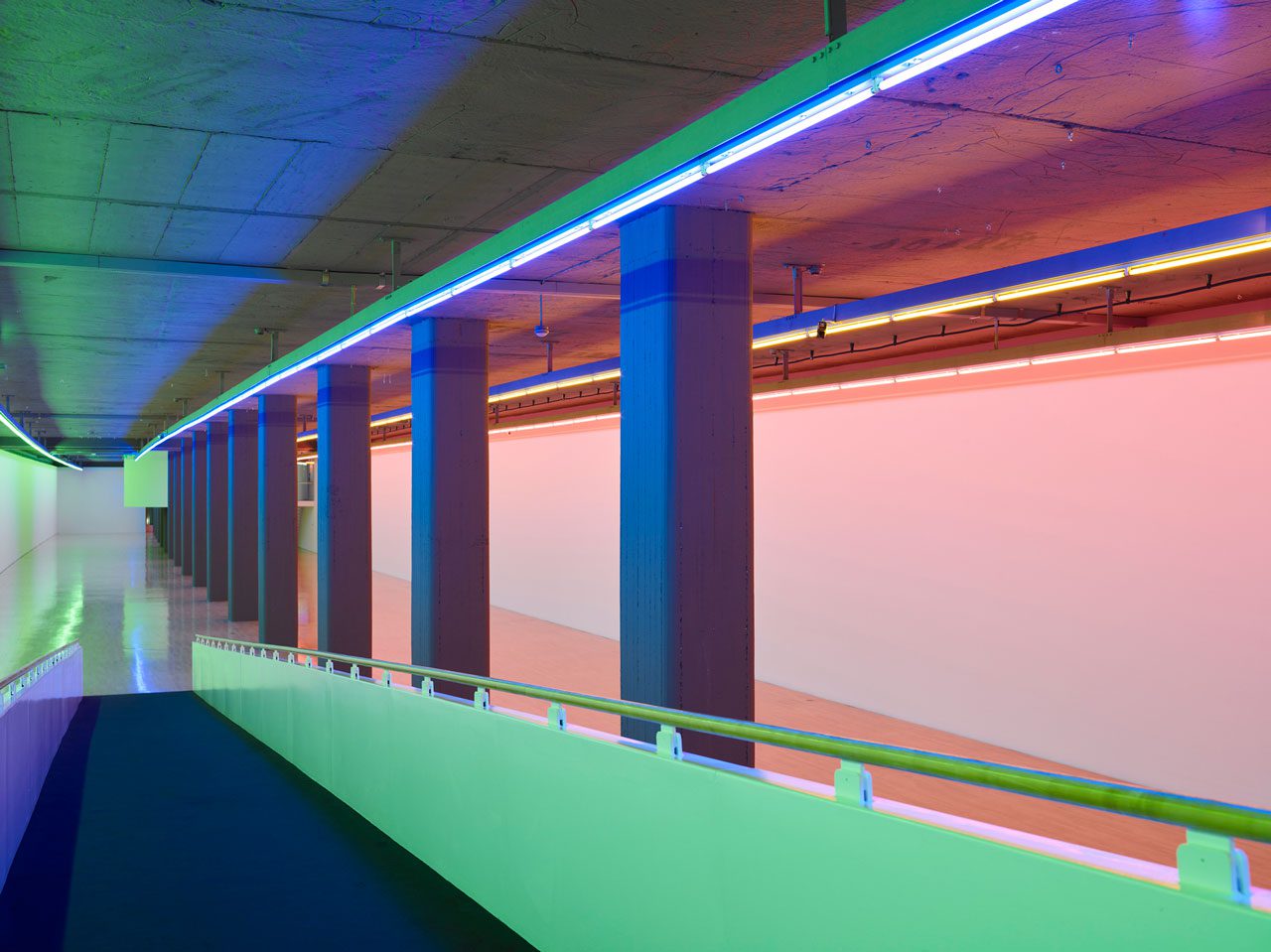
When the Kunstbau of the Lenbachhaus Munich opened its doors in 1994, it was more than an architectural expansion—it was the unveiling of a new dimension for experiencing art. Conceived by the architectural firm Uwe Kiessler + Partner, the subterranean hall echoes the proportions of the subway station that lies beneath it. This unusual parallel between transit space and exhibition space underscores the Kunstbau’s distinctive character: a place where art unfolds within, and in response to, its architecture. To inaugurate this unique site, the Lenbachhaus invited Dan Flavin—one of the most influential figures of Minimal Art—to conceive a new work. The result, “untitled (for Ksenija)”, belongs among his final “situations,” the artist’s term for installations in which light, color, and perception transform the experience of space. No work is more closely identified with the Kunstbau than this piece, which remains a touchstone of its identity three decades on. Flavin’s fluorescent installations never merely illuminate a room; they reconfigure it. In “untitled (for Ksenija)”, colored fluorescent tubes trace the Kunstbau’s four architectural lighting tracks, dissolving the boundaries between material and immaterial, presence and perception. Light floods the subterranean expanse, recasting its architecture as an experiential field where body, vision, and movement converge. Visitors find themselves drawn into an atmosphere where the simplest elements—light, color, space—become inseparable and alive. This transformation is consistent with Flavin’s lifelong project. As a pioneer of Minimal Art, he turned away from the painterly illusions of earlier generations—eschewing Abstract Expressionism’s gestural drama, Pop Art’s figuration, and painting’s pictorial illusion. Instead, he embraced industrially manufactured fluorescent lamps, beginning in the mid-1960s, as his sole artistic medium. With them, he created environments where the viewer’s perception, rather than the artist’s hand, became central. His minimal pencil sketches—at once austere and precise—served as conceptual and technical blueprints for these luminous “situations.” One such drawing, faxed from Flavin’s New York studio to the Lenbachhaus on March 8, 1994, laid out the instructions for the installation in Munich. It offered both a conceptual framework and the practical directives necessary to realize the piece. From the humblest of means—a diagram of lamps, wires, and placement—emerged an installation that redefined an entire space. The significance of “untitled (for Ksenija)” lies not only in its artistic radicalism but also in its resonance with memory and dedication. Donated to the Lenbachhaus by Heiner and Philippa Friedrich, the work honors their parents Erika and Harald Friedrich, as well as Dominique and John de Menil—figures deeply engaged in advancing contemporary art. Their gift ensures that Flavin’s luminous architecture remains permanently integrated into the life of the museum, reinstalled regularly in accordance with their wishes. Today, the installation is being shown for the tenth time, a reactivation that reminds us how inexhaustible Flavin’s light can be. Each encounter renews the questions at the heart of his art: How do light and color shape our perception of space? Where does architecture end and atmosphere begin? And how might something as utilitarian as an industrial lamp become a vessel for transcendence? Further insights into “untitled (for Ksenija)” and its exhibition history can be discovered in the Kunstbau’s rotunda—an invitation to linger not only with the work but with its enduring dialogue between light, architecture, and human perception.
Photo: Dan Flavin, untitled (for Ksenija), 1994, Lenbachhaus Munich, Donated by Heiner and Philippa Friedrich in memory of their parents Erika and Harald Friedrich and Dominique and John de Menil © Estate of Dan Flavin / VG Bild-Kunst, Bonn 2018. Photo: Simone Gänsheimer, Lenbachhaus
Info: Curator: Johannes Michael Stanislaus, Lenbachhaus und Kunstbau Munich (Lenbachhaus Munich), Luisenstraße 33, Munich, Germany, Duration: 15/8-30/11/2025, Days & Hours: Tue-Wed & Fri-Sun 10:00-18:00, Thu10:00-20:00, www.lenbachhaus.de/