ART CITIES: Istanbul-Young Fresh Different 2025
For the past 14 years, Zilberman Gallery has positioned the series of the exhibition “Young Fresh Different” not merely as a space of display, but as a dynamic platform for emerging voices. By increasing the visibility of diverse practices and cultivating spaces where new voices can sustain their work, the initiative fosters long-term artistic de- velopment beyond the exhibition itself.
By Efi Michalarou
Photo: Zilberman Gallery Archive
The exhibition “Young Fresh Different 25” aims to remind us of the collective possibilities of thought in the face of various forms of censorship in Turkey. The selected works span a broad spectrum from personal memory to public space, from identity to site, from the everyday to the political. Rather than orbiting a singular theme, YFD’25 unfolds around the possibilities of being together. Concepts such as the body, memory, and belonging are explored through a wide range of mediums and approaches: from video installations to AI-generated narratives, from biological remnants to traditional objects. These works come together across personal and collective thresholds, engaging in layered dialogues. This year’s selection was made from over 400 applications by the jury composed of Burcu Çimen (Director and Curator at Yapı Kredi Museum), Ulya Soley (Curator at Hamburger Bahnhof), Sena Başöz (Artist), Lotte Laub (Director of Zilberman | Berlin), and Ece Ateş (Program Manager of Zilberman | Berlin). Bringing together a diversity of production motives, modes of thought, and narrative strategies, YFD’25 reflects the contemporary potential of emerging artists, and offers an invitation to think together, to create together, and to imagine new possibilities.
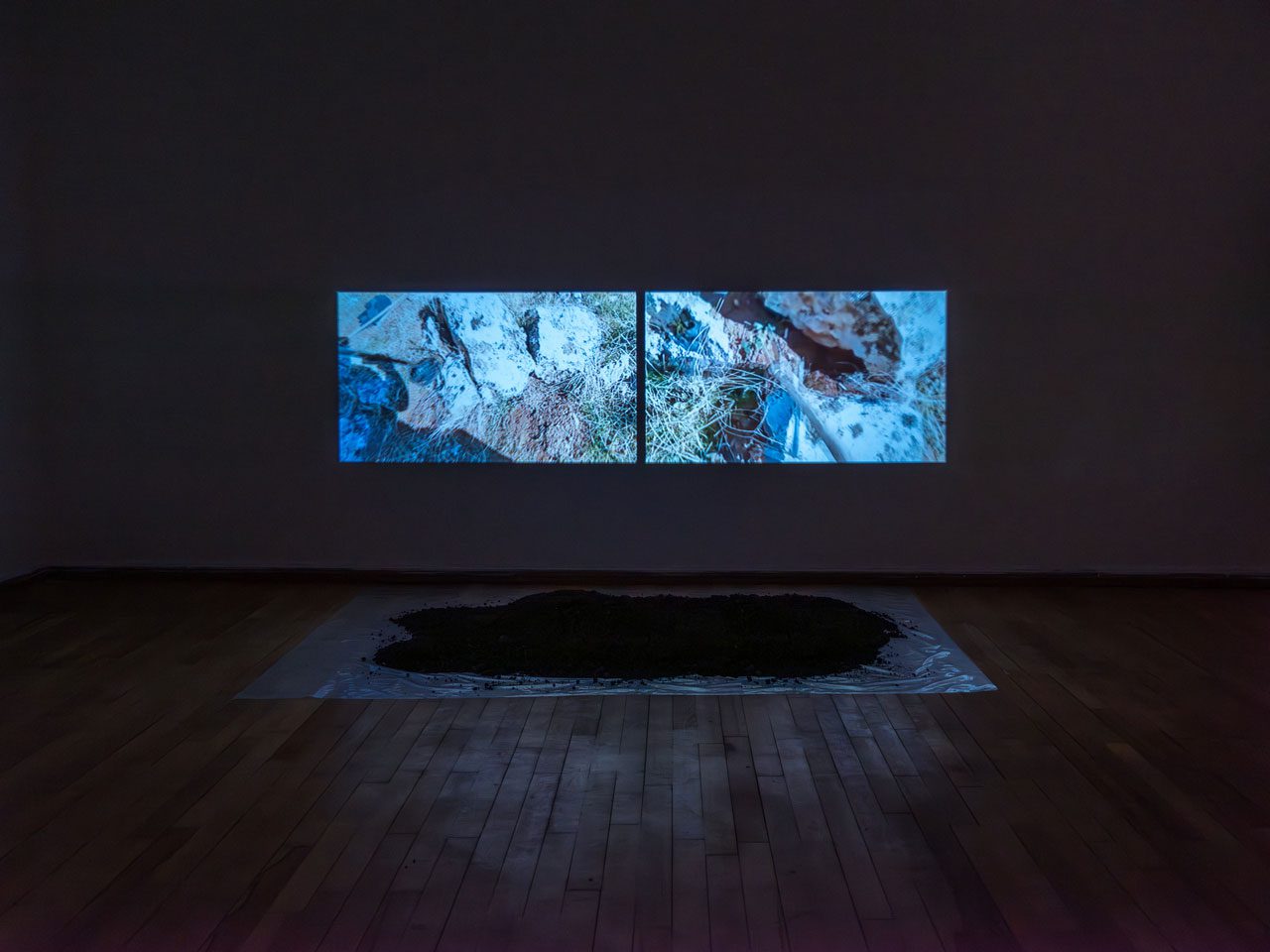
Anet Sandra Açıkgöz’s practice revolves around concepts such as collective memory and power relations, which she explores through an interdisciplinary inquiry. She re- visits disrupted, lost, or distorted connections within official historical narratives and investigates the blurred boundaries of dominant discourses that sustain their own forms of authority.The video “Finders Keepers” questions the legality of illegal treasure hunting activities carried out in certain regions of Turkey. It criticizes the suspension of the law, which varies depending on the individual, institution, or organization in Turkey, and examines the conditions under which treasure hunting is considered legal or disregarded within certain rules. The video, which was stolen/obtained from YouTube, has been edited and presented to the audience in a way that assumes it is free of copyright claims. The parallelism between the ease with which treasure hunters acquire their loot while excavating in an old Armenian village and the “readiness” of the video aims to re- spond to the actions of treasure hunters who seize the treasures they find in a manner that could be considered legal, while reestablishing the positions of perpetrator and victim. A similarity is established between the objects the treasure hunters reach by digging into the ground and the images the artist has extracted from the archive and re-constructed. Thus, the artist’s position in the production invites the viewer out of passive spectatorship and into an ethical responsibility. In art, the dynamics of taking and giving, and the balance between “value” and ownership, are re-examined, placing the tension between hunter and prey on slippery ground. It invites us to rethink and discuss property rights not only through loot but also through works of art.
Focusing on the impact of digital technologies on our perception of memory, time, and space, Şahsenem Altıparmak explores the temporal continuity of both personal and collective memory. Working across video and interactive media, she brings together archival objects, digital data, and technological devices to construct alternative con- texts around the themes of resistance and transformation between past and future. “Memory of Network” is an installation composed of mobile phones, probing the mem- ory of the digital age. Once-functional devices from different periods are presented as carriers of personal memory, witnesses of technological evolution, and overlooked archival artifacts on the verge of disappearance. Positioned as objects that carry material and temporal tension, these phones also hold potential traces of deleted messages and unrecorded images. Rather than being randomly placed, the devices are dispersed throughout the space with a deliberate rhythm and structure. The viewer is not merely encountering a graveyard of obsolete hardware, but step- ping into a space that reflects collective forgetting, digital residue, and the shifting nature of communication itself. By quietly inhabiting the exhibition space, Memory of Network renders visible the personal pasts held within devices rapidly consumed by digitization.
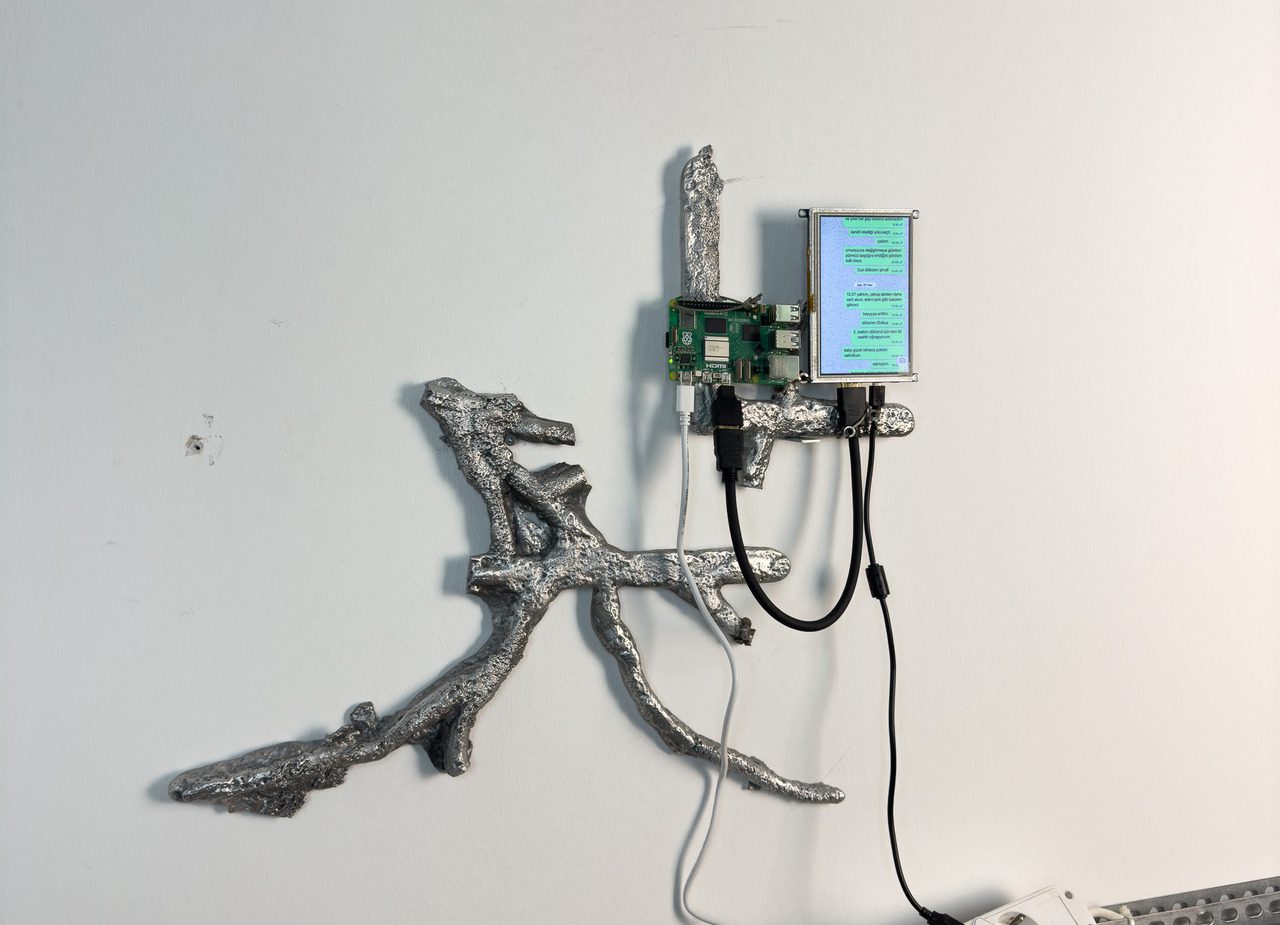
Ahmet Dündar investigates the fluidity of identity, the transformation of material, and the instability of fixed categories. His works, situated between the organic and the artificial, the personal and the systemic, do more than question boundaries; they also expose the very moments those boundaries begin to dissolve. Informed by his back- ground in industrial production, his practice critically reconsiders the assumed pas- sivity of material and objects. By tracing the relationships between subject and object, he explores textures that evoke life, movements shaped by robotic systems, and how these evoke specific responses in the viewer. “Texts I Received” examines the impact of material on the human psyche through the visual and affective traces of the metal casting process. Engaging directly with the resistance of molten aluminum, the artist documents not only the transformation of matter but also the emotional and physical responses it generates. The process be- comes a mirror of human resilience and adaptation in the face of material tension. By archiving his own interactions with this material through messages he sent to him- self during the process Dündar makes visible how so-called passive materials can assert agency. The work destabilizes conventional subject-object hierarchies and prompts viewers to consider how even the most industrial of materials might shape thought, feeling, and form.
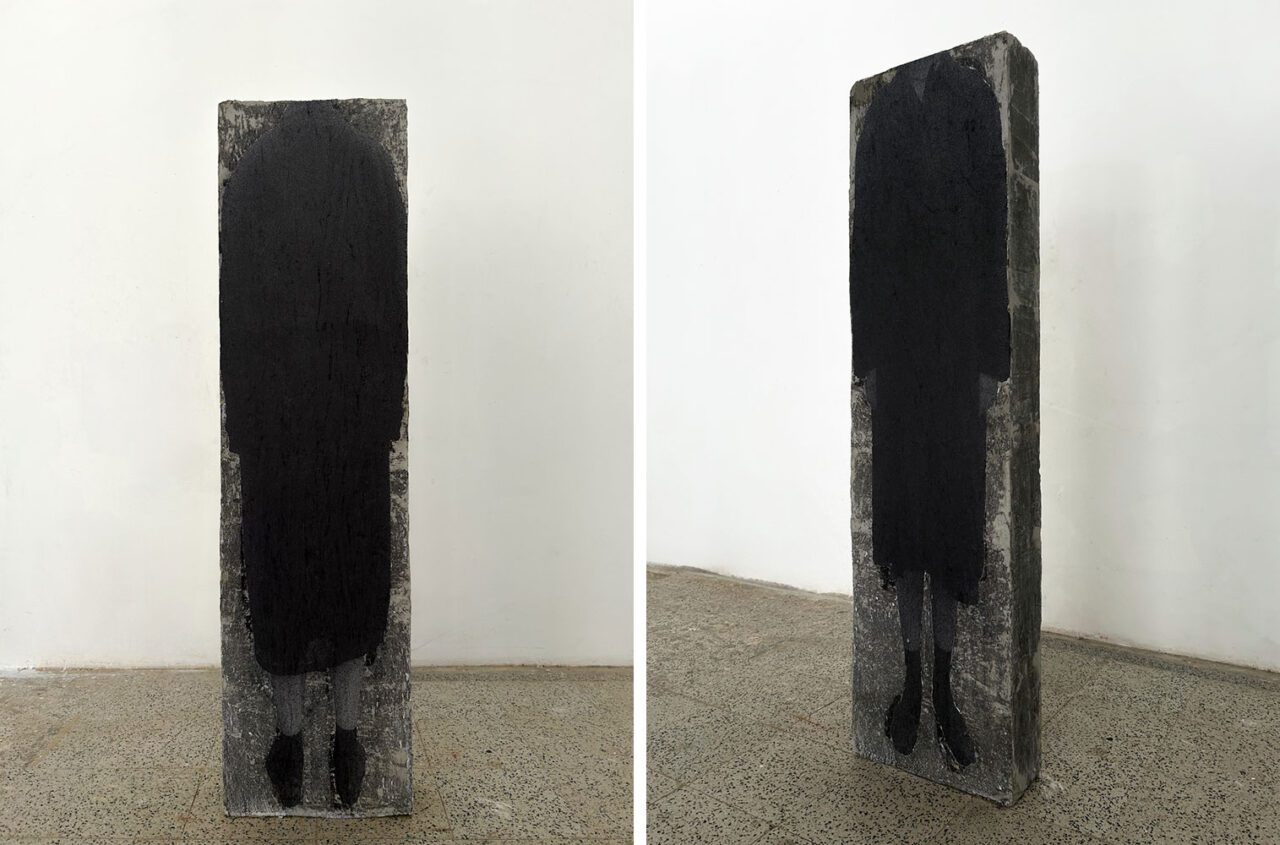
Yasemin Erturan’s practice is shaped by the relationship she builds between the wit- nessing capacity of the visual and the perception of space. In her archive-based re- search, visual recordings, written notes, surface details, and fleeting encounters often evolve into central elements of her works. Moving across sculpture, photography, video, and installation, her productions investigate how personal and collective data can be re-visualized and spatially re-contextualized. In “Passing by the house of my first arrival”, Erturan takes an imprint of a surface be- longing to a different architectural space and reworks it onto a concrete block. The image and its ground are displaced, detached from their context, and repositioned. The anonymized body transferred onto the surface represents a physically and con- textually reduced image. The absence of a head emphasizes the incompleteness of the figure and underscores the limitations of representation. The concrete surface becomes more than a mere carrier—it transforms into a layered structure that holds the physical traces of the place it once belonged to.
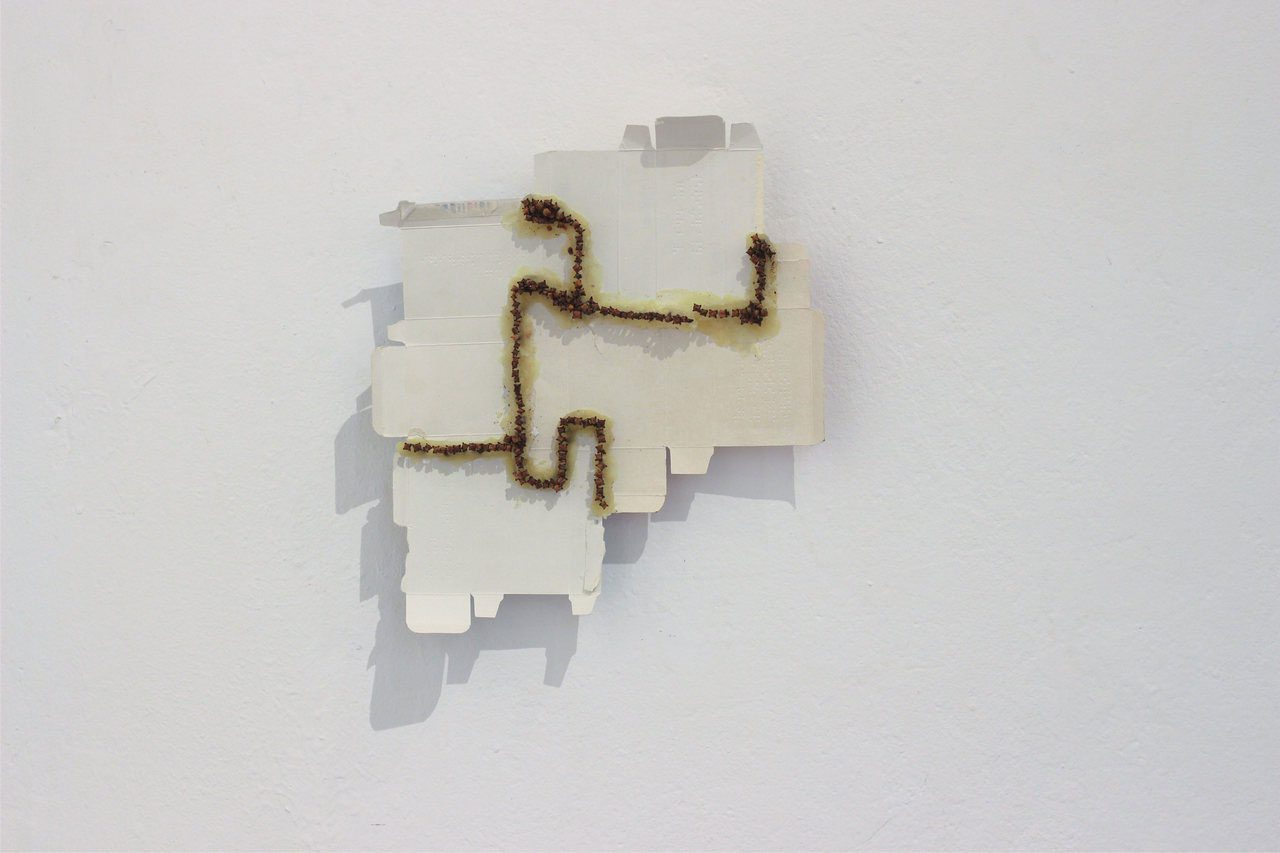
Merve Karakoç explores the relationship between body and self through biological materials. Drawing from personal experiences, she investigates medical waste and the body’s responses to these discarded elements. By using bodily substances such as blood and saliva, she transforms the spaces where these remnants are encountered. “Dissection” is an installation composed of a wax-preserved tumor extracted from Karakoç’s own body, and a metal structure that carries the tissue. The use of biological material – present in her earlier works – here turns toward a more intimate and invisible layer. This tissue, which had grown spontaneously within the body and was classified as unwanted and harmful, becomes an object once removed. With “Dissection”, Karakoç questions the condition of being expelled from the body and the processes of meaning, control, and intervention that such a removal sets into motion. In contrast to institutional procedures that archive pathological materials as damaged, ill, or deviant parts under standardized and anonymizing systems, she recalls a deeply personal experience –reinstating the individual within what is often treated as clinical residue.
Deniz Zaide Korkmaz focuses on the sense of insufficiency within the constraints im- posed by material or form, as well as the meanings attributed to these structures. In her practice, she explores the intersection of the physical and the digital, proposing encounters that challenge bodily and spatial perception. Through various media such as sculpture, painting, sound, and artificial intelligence, she constructs a narrative shaped by ambiguity – producing images that revolve around unsettling and conflict- ing emotions, often embodied in formless structures. “Falsehoods Meet” unfolds inside an artificial family home surrounded by conflicting feelings, suppressed desires, and fragility. It depicts a space where trust is continually reconstructed yet never fully established, progressing within a fabricated order that offers an illusion of continuity. With fragmented figures, artificial color gradients, and distorted images, this work pushes the limits of representation and reveals how fragile emotional connections can be. The constant shifts, dissolutions, and fake repetitions at visual and auditory levels trap the viewer within moments that break just as they are about to form. Falsehoods Meet reminds us of the instability and constructed nature of what we call home, alongside themes of belonging, vulnerability, and repressed fears.
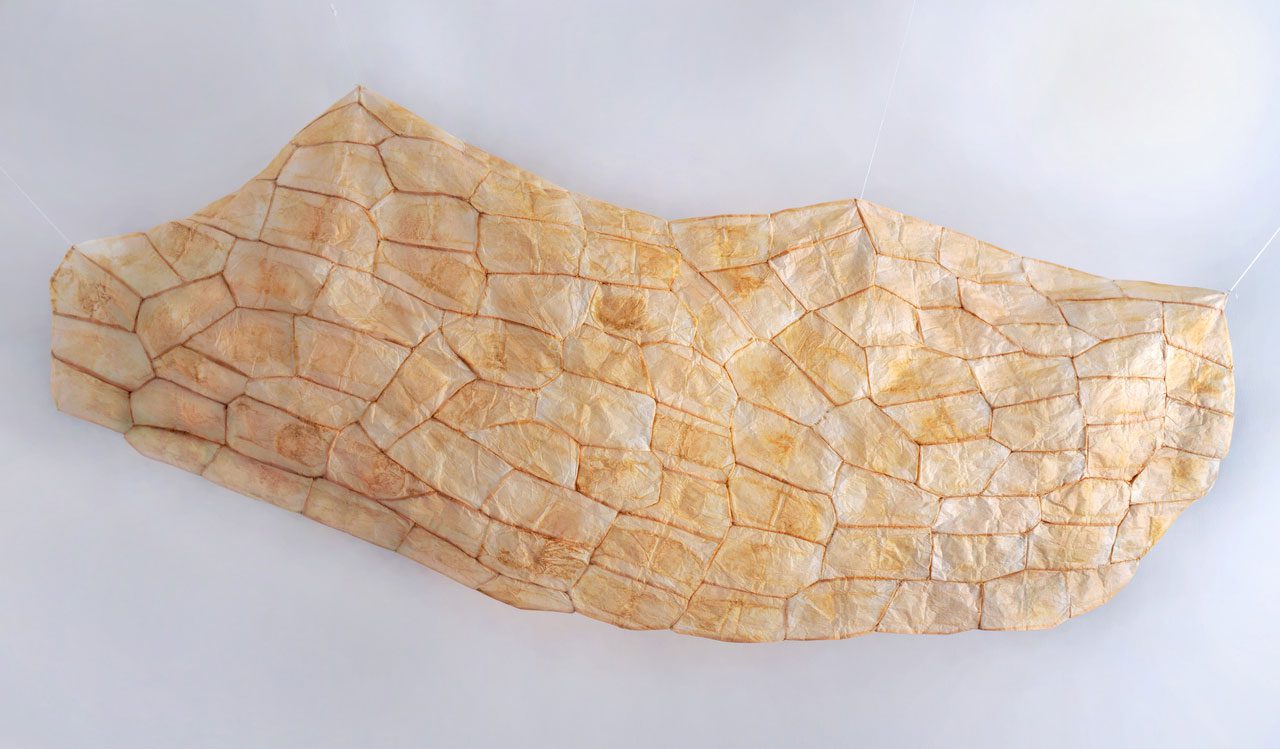
Ezgi Lemur centers her practice on the concept of the body through various disciplines such as photography, video, collage, and sculpture. Positioned at the intersection of visual arts and movement-based research, she examines the body as a dynamic field of perception. Challenging perceptual hierarchies and traditional dichotomies that separate mind from body, spirit from matter, and appearance from essence, she proposes a return to the material itself. Seeking new wholes and meanings emerging from the interaction of images and objects, Lemur aims to create fresh dialogic spaces on body representations and perception. Framing the body as a living site continuously woven by memory and senses, Lemur’s “Untitled” installation centers on tea – a beverage symbolically consumed across diverse cultures to gather and connect. Associated with respect and ritual during its preparation, she treats tea as a representation of skin. Through the disposable ma- terial of used tea bags, the work critically reflects on modern consumer culture. In a contemporary world where experience is reduced to consumption and comfort and convenience prevail, it points to an individualistic and isolated culture. With a fabric sewn from tea bag waste and its fragments, Lemur constructs a sustainable whole. The skin, linked to themes of identity and fragility, records history through its marks, and each piece of the fabric becomes a remnant of personal experience, joining a collective memory.
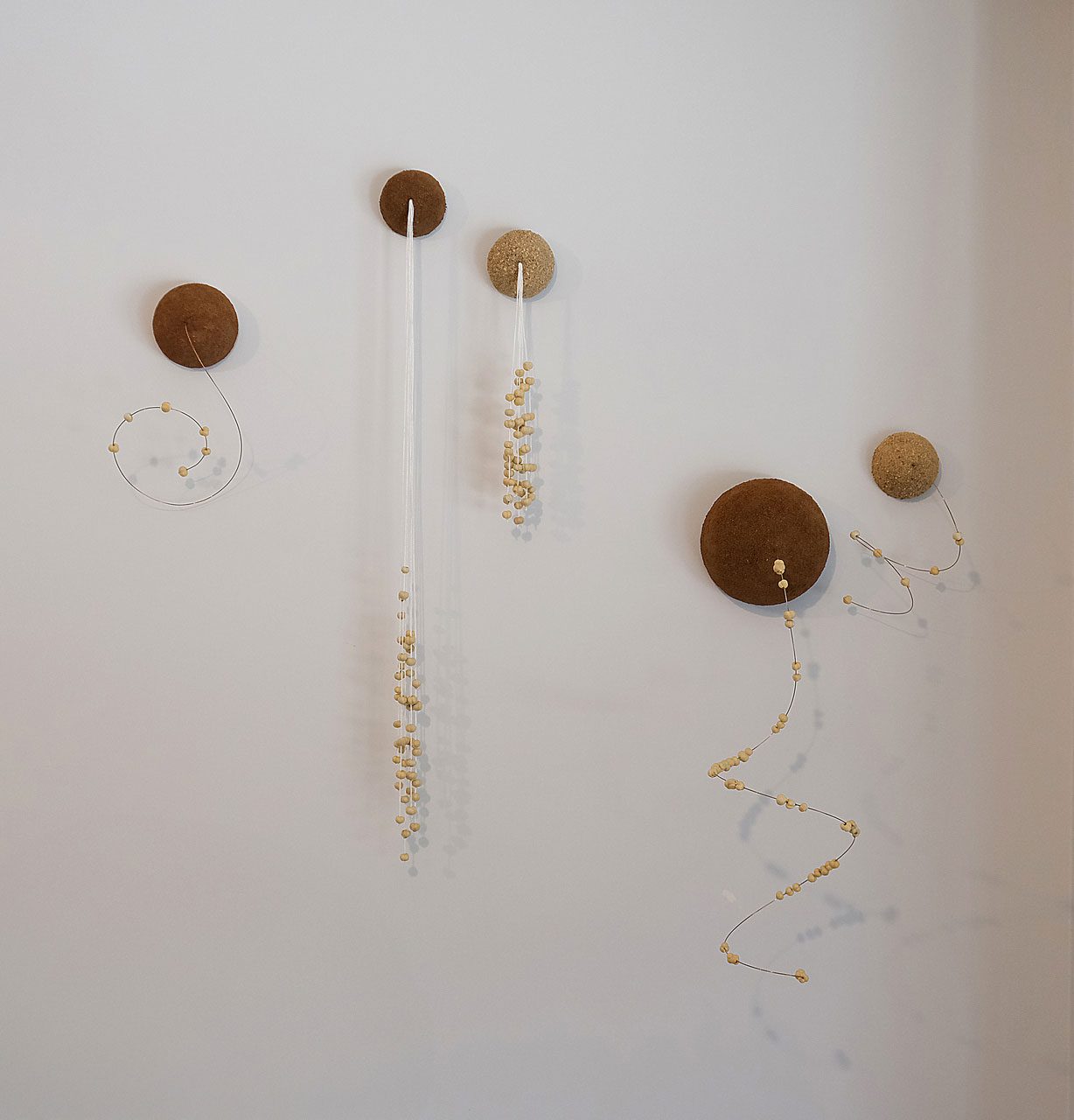
Anıl Önen builds her practice around rituals and daily habits that shape human be- havior. Within these structures, superstitions hold a central place; the artist examines these beliefs in their cultural and psychological contexts through dialogue and research, investigating invisible practices passed down through generations in collective memory. The installation “Kordoneli Koponaki Gipür Güpür Tül”, composed of seed, thread, and half-circle forms covered with rue herb, references a lace type of the same name and continues the plant’s teachings. Rue, which grows in Anatolia, is burned for protection against the evil eye or for cleansing purposes. Unlike other protective herbs, it belongs to the entheogen plant group. This plant contains psychoactive substances with hallucinogenic effects and allows people to experience past-connected memories. For this reason, it is called “grandmother” among plants in its group. Using rue herb as material, Önen presents a layered narrative as both a ritual object and in traditional and scientific contexts. The artist continues intuitive and experimen- tal research through the memory of the plant, positioning rue as a symbolic tool linking individual and collective memory. The forms in the installation evoke both a protective and nourishing transfer, like breast milk, and a bodily and spiritual bond to the past, similar to the umbilical cord.
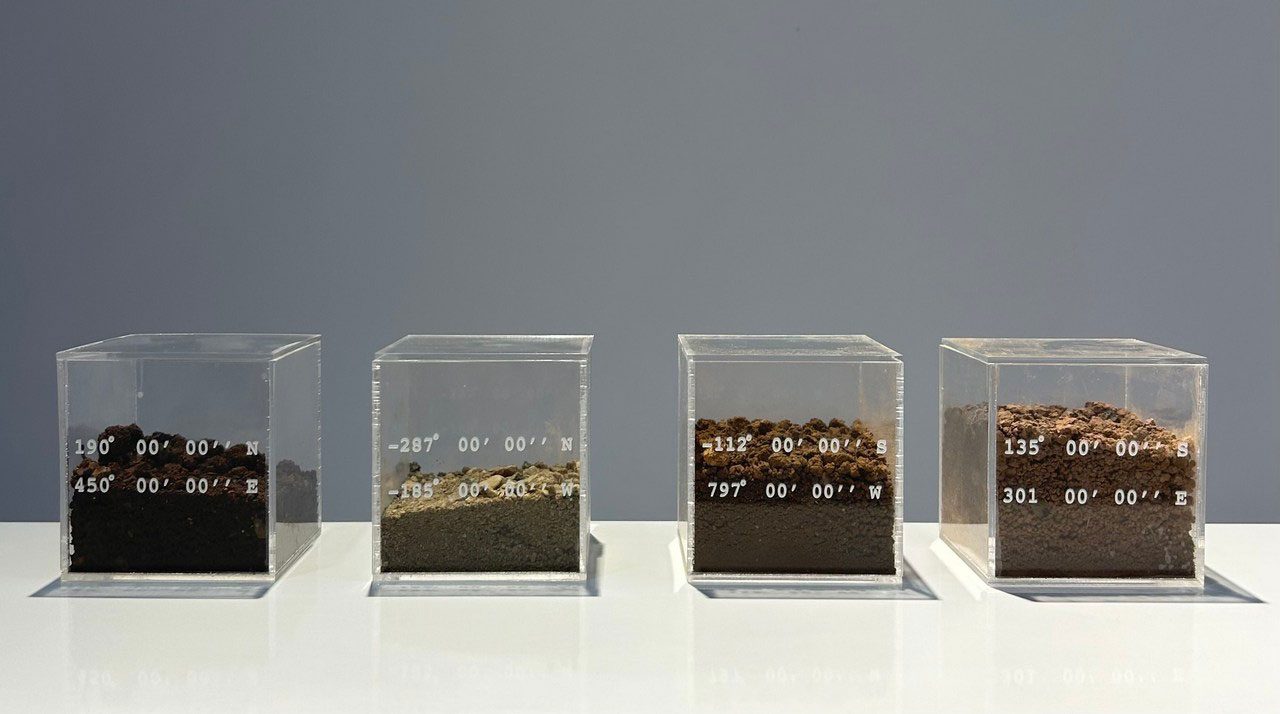
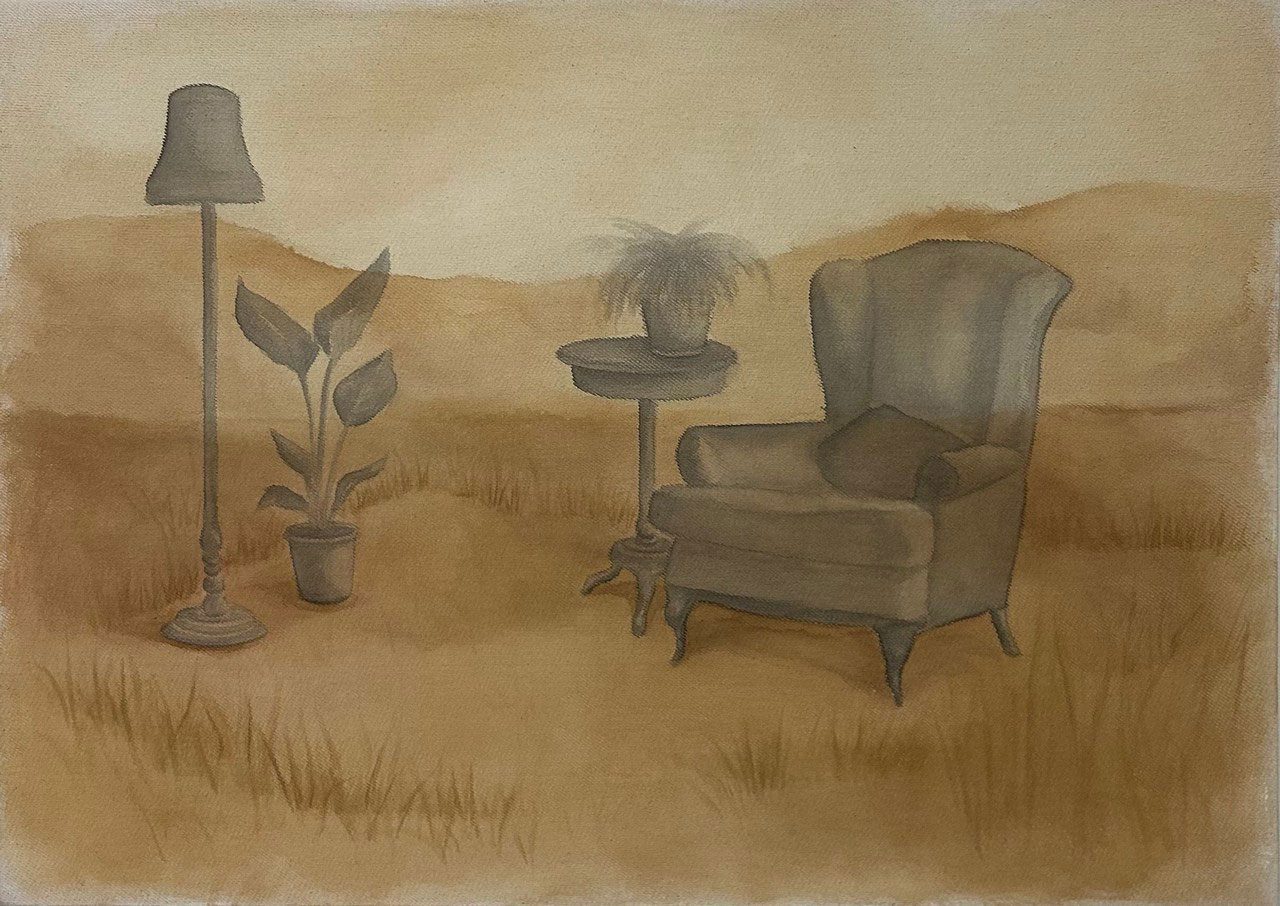
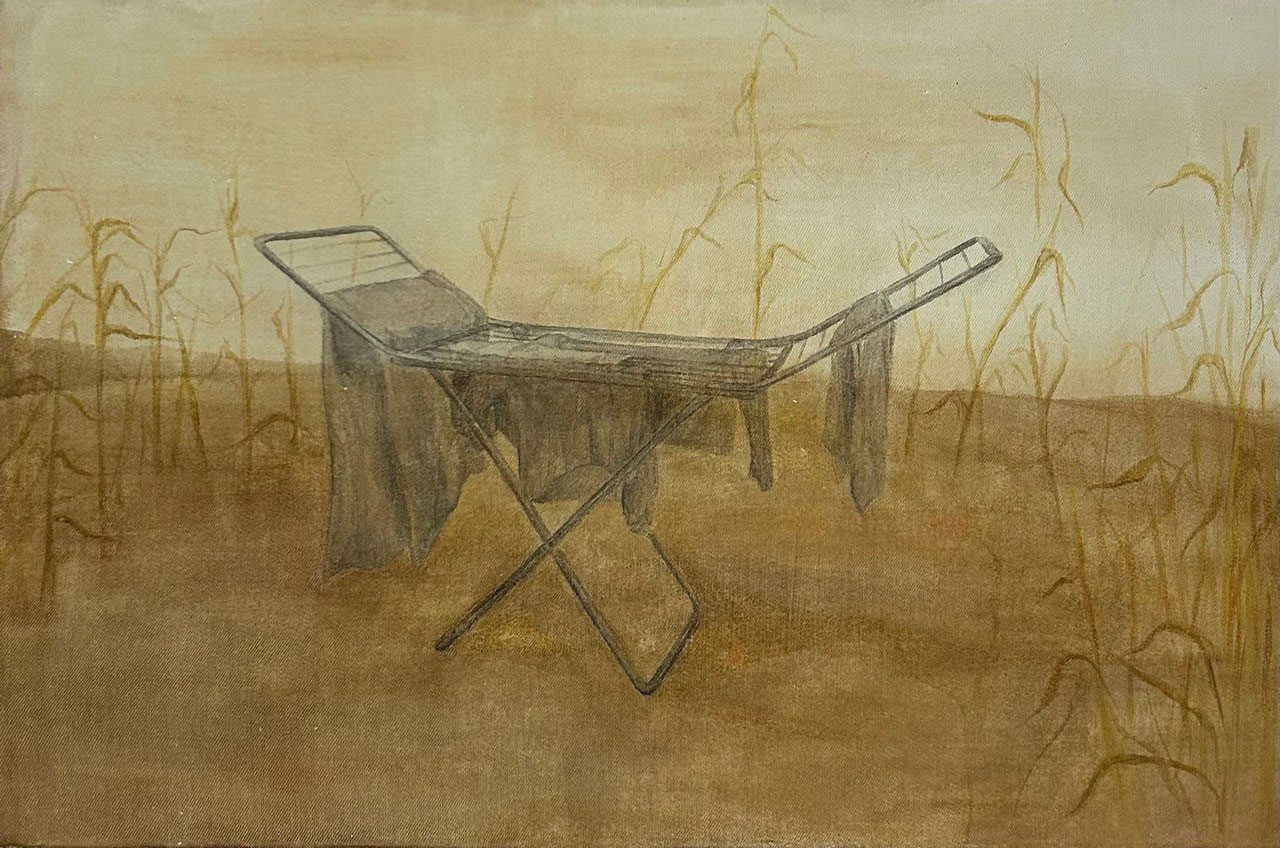
Yeşim Özkan pursues ideas centered around belonging and cultural memory. By questioning the relationship between identity, memory, and place, she focuses on how individuals relate to social and geographical contexts. Themes of migration and displacement form the core of her practice. She aims to express a sense of trans-ter- ritorial belonging through imagery. The “Lost Timeline” series takes inspiration from a map mentioned in geologist Marcia Bjornerud’s book Timefulness. In this map, while different regions of the world are as- signed to time zones, some areas are marked in gray. These gray zones represent land that belongs to no state and thus fall outside any time zone, existing as unclaimed territories. Through painting and installation, the series interrogates this state of state- lessness. The paintings imagine an alternative home composed of belongings that have lost their identity alongside these gray zones, where displaced objects trans- form into heimatlos items. The gray areas beyond time and place are approached not merely as voids, but as potential modes of existence. Meanwhile, the box installations contain soil collected from various geographies, inscribed with coordinates whose minutes and seconds are reset to zero, marking no specific place on earth. Thus, the soil is stripped of its cultural burdens and becomes undefined and timeless.
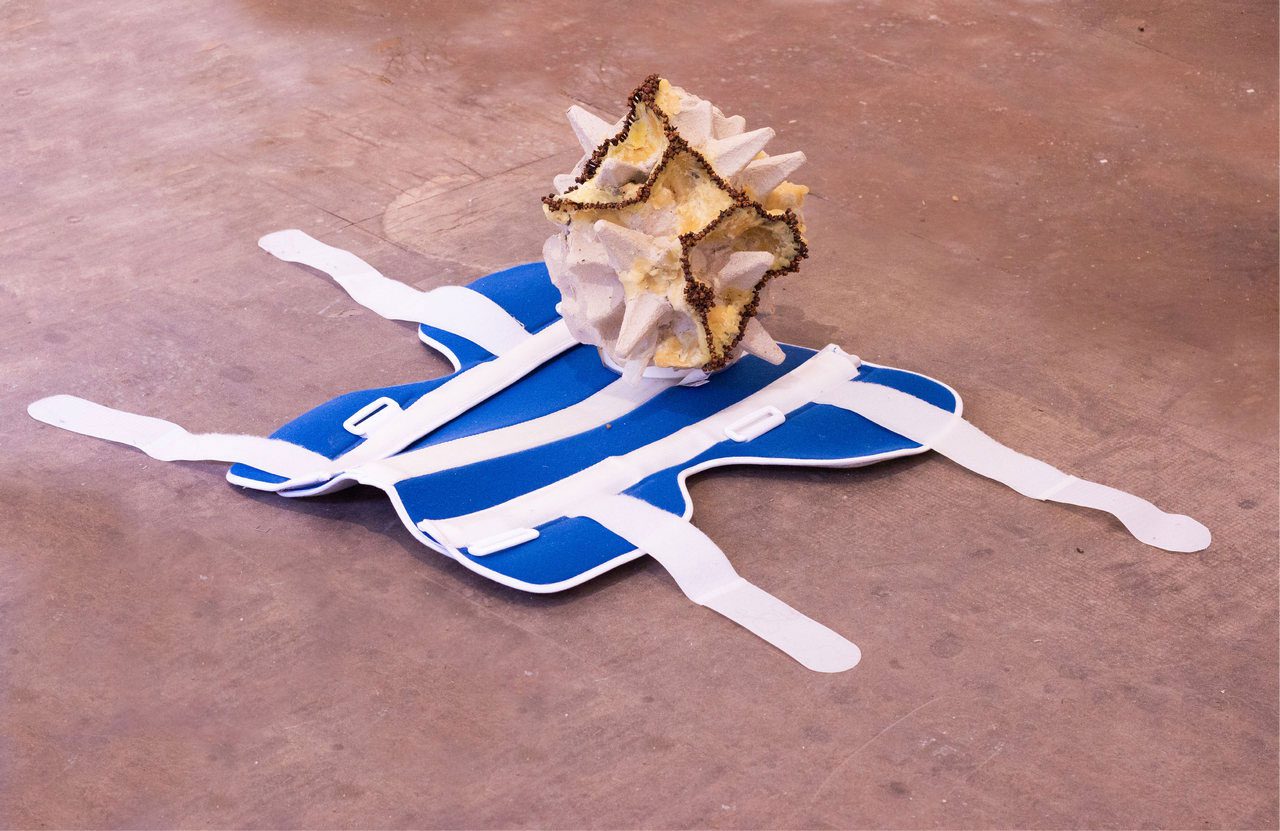
Dilan Perişan centers their practice around concepts of self, otherness, and memory. The notion of otherness is approached not only in relation to human communities but also through objects, waste, and ecological beings. They adopt an approach that blurs Cartesian binaries such as object-subject, nature-culture, and life-death. Perişan engages with objects deemed useless, everyday remnants, and ex-voto items. This personal archival relationship with materials allows for the emergence of new narratives and alternative temporalities. “Soft Limbo” is an installation formed from the transformations of medical and domes- tic waste. These wastes represent not only the memories of the autoimmune body, whose natural defense system mistakenly attacks its own cells, but also paradoxical bodies that actively reproduce it. The work questions the permeability of the body, as well as the boundaries between healing and collapse, and between object and organism. Each form appears like a support while simultaneously bearing traces of a leak. Through this constructed structure, the artist attempts to create a system that is dysfunctional yet living; fragile yet impossible to fix in place.
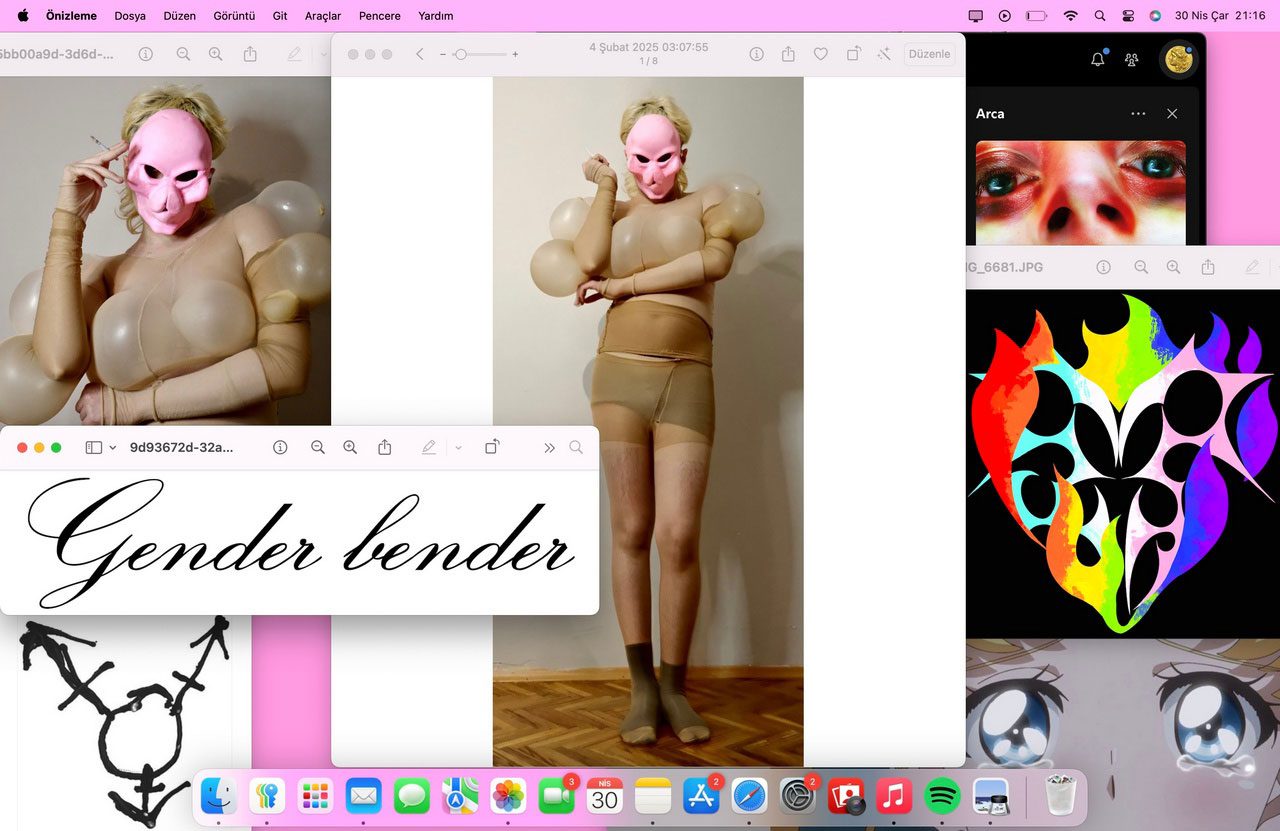
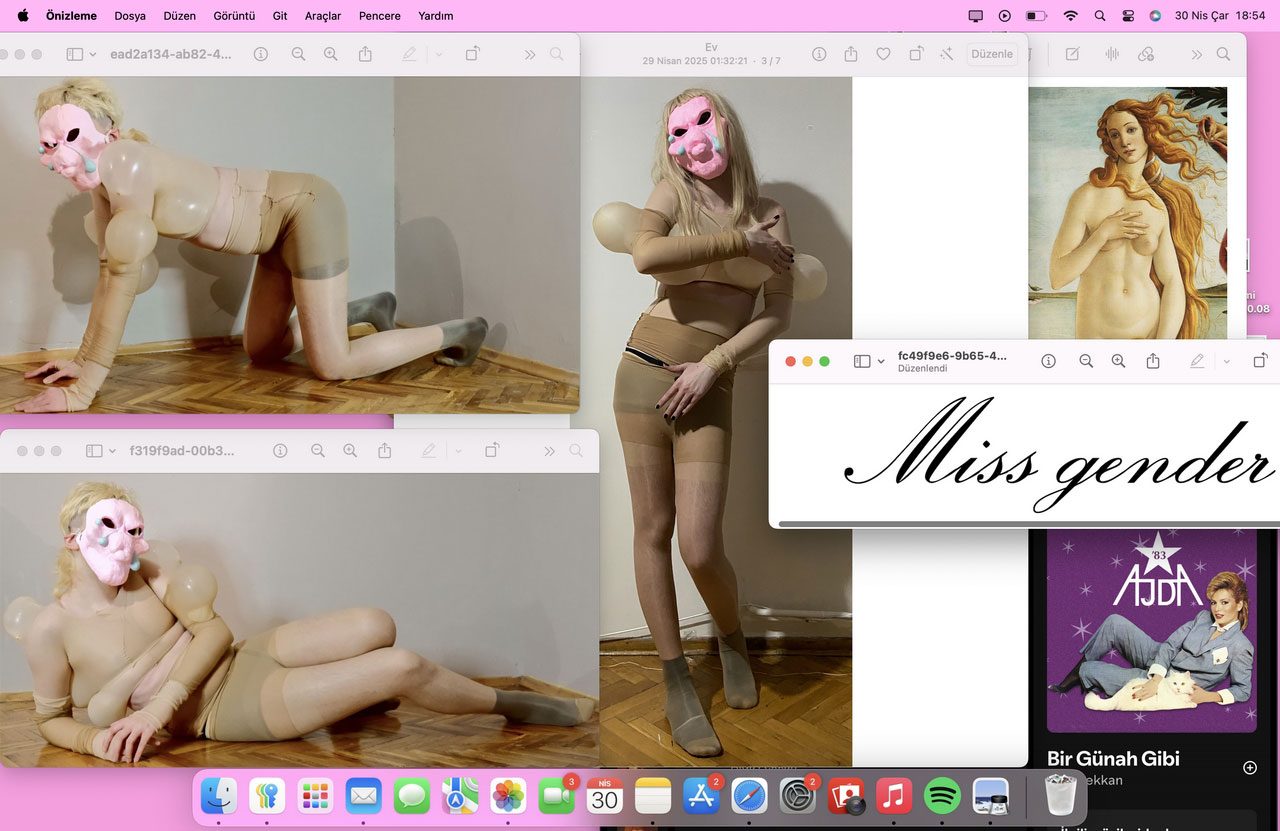
Şahmaran constructs their practice as a space of resistance against normative systems built upon gender. A driving force behind her work is the urge to expose the mechanisms of heterosexism, homophobia, transphobia, and broader societal pressures, particularly in how they assert control over bodies and identities in everyday life. They/them adopts a fluid approach that navigates the edges of the gender binary, aiming to erode fixed definitions both bodily and conceptually through transitions across the spectrum. The recurring figure of the “razor,” which first emerged in digital drawings and later materialized in canvas and ceramic forms, constitutes a sustained narrative within their practice. These images carry not only the trace of a wounded body but also the potential for healing and transformation. In her recent works, they/them increasingly emphasizes multiplicity over fixed identities, underlining the possibility of existing be- yond categorization. “Look at Me Between the Two Genders” is conceived as a critique of the binary structure of gender and opens space for modes of existence situated outside this rigid framework. At the center of the work lies the symbolic figure of the razor—a transitional form that fits nowhere and refuses containment. As a permeable presence at the center of the spectrum, it constantly shifts and morphs. Rather than depicting a linear narrative of growth or transformation, the trio of works gestures toward simultaneously coexisting states within a single body. Rooted in the proposition that “the world is bigger than two,” “Look at Me Between the Two Genders” invites the viewer to imagine ways of being that transcend fixed norms.
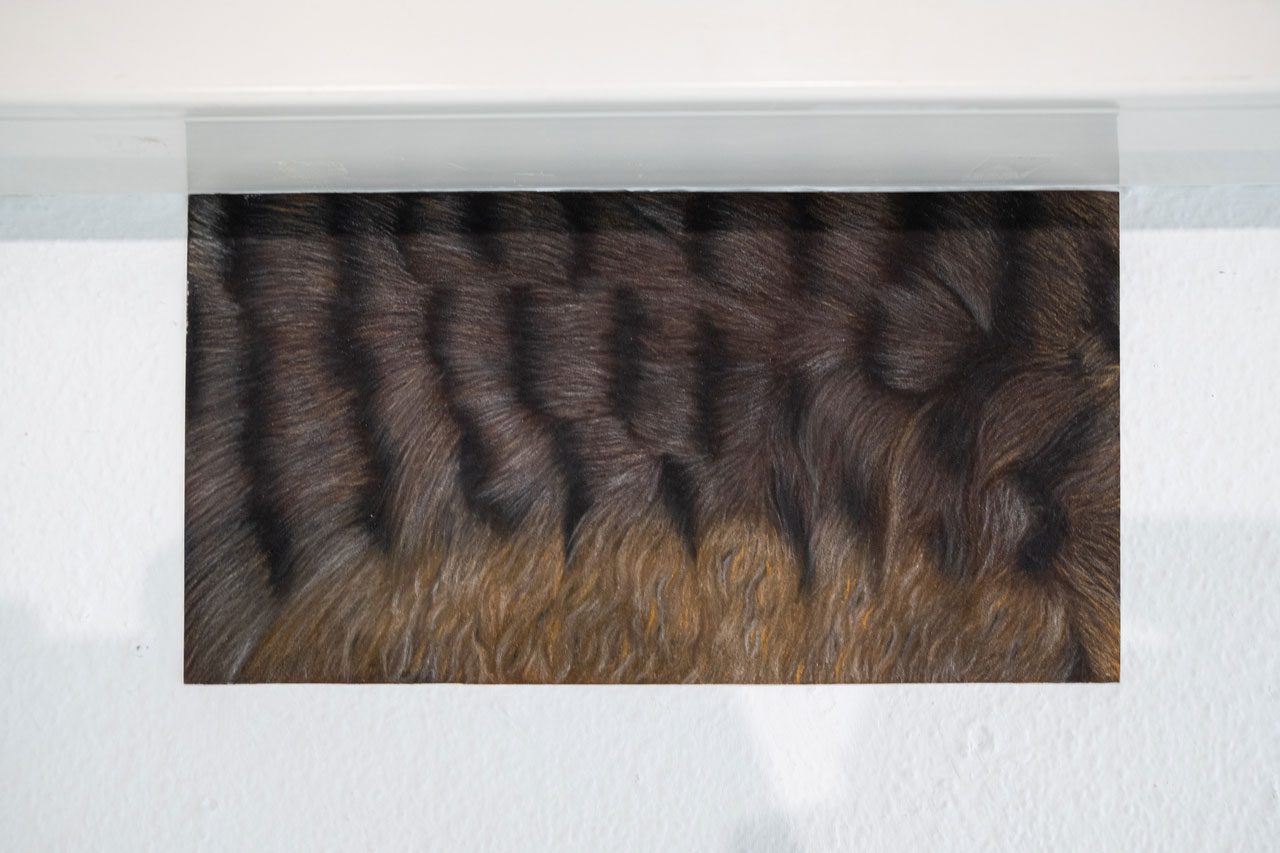
Begüm Yıldırım focuses on exploring relationships between self, body, environment, and mood, investigating non-hierarchical forms of interspecies relations from a post-humanist perspective. While questioning how meaning is shaped through inter- actions between living beings and places, Yıldırım examines emotional states through fragmentation, repetition, and tactile surfaces. The “Sensory Bond” is a triptych installation tracing care, intimacy, and sensory memory in interspecies relationships. Positioned in areas where a cat might be found, it invites viewers toward an intuitive and instinctive engagement. This mode of installation spatially extends the compassionate approach central to the work. Each stroke drawing a fur imitates the moment of stroking a cat, emerging from the artist’s effort to preserve this feeling in memory. Everyday interactions form the personal starting point of the series; these encounters encompass not only time spent with an animal but also leave traces of trust, ritual, and shared life within bodily memory. This perspective, which recognizes animals’ active agency, highlights the importance of mutual communication and meeting in shared intersectional spaces, inviting the viewer to bend down and observe attentively. Inspired by Donna Haraway’s concept of “significant otherness,” “The Sensory Bond” aims to reveal the relationality between humans and animals, emphasizing the personal and sensory dimensions of this bond, and making visible the ethical grounds of cohabitation.
Participating Artists: Anet Sandra Açıkgöz, Şahsenem Altıparmak, Ahmet Dündar, Yasemin Erturan, Merve Karakoç, Deniz Zaide Korkmaz, Ezgi Lemur, Anıl Önen, Yeşim Özkan, Dilan Perişan, Şahmaran, Begüm Yıldırım
Photo: Ahmet Dündar, Texts I received, 2024, Raspberry Pi, screen, WhatsApp messages, scrap aluminum casting, steel wire 50 x 30 x 5 cm, Courtesy the artist and Zilberman Gallery
Info: Zilberman Gallery, İstiklal Cad. No.163 Mısır Apartmanı, Beyoğlu / Istanbul, Turkey, Duration: 2-23/8/2025, Days & Hours: Tue-Sat 11:00-19:00, www.zilbermangallery.com/
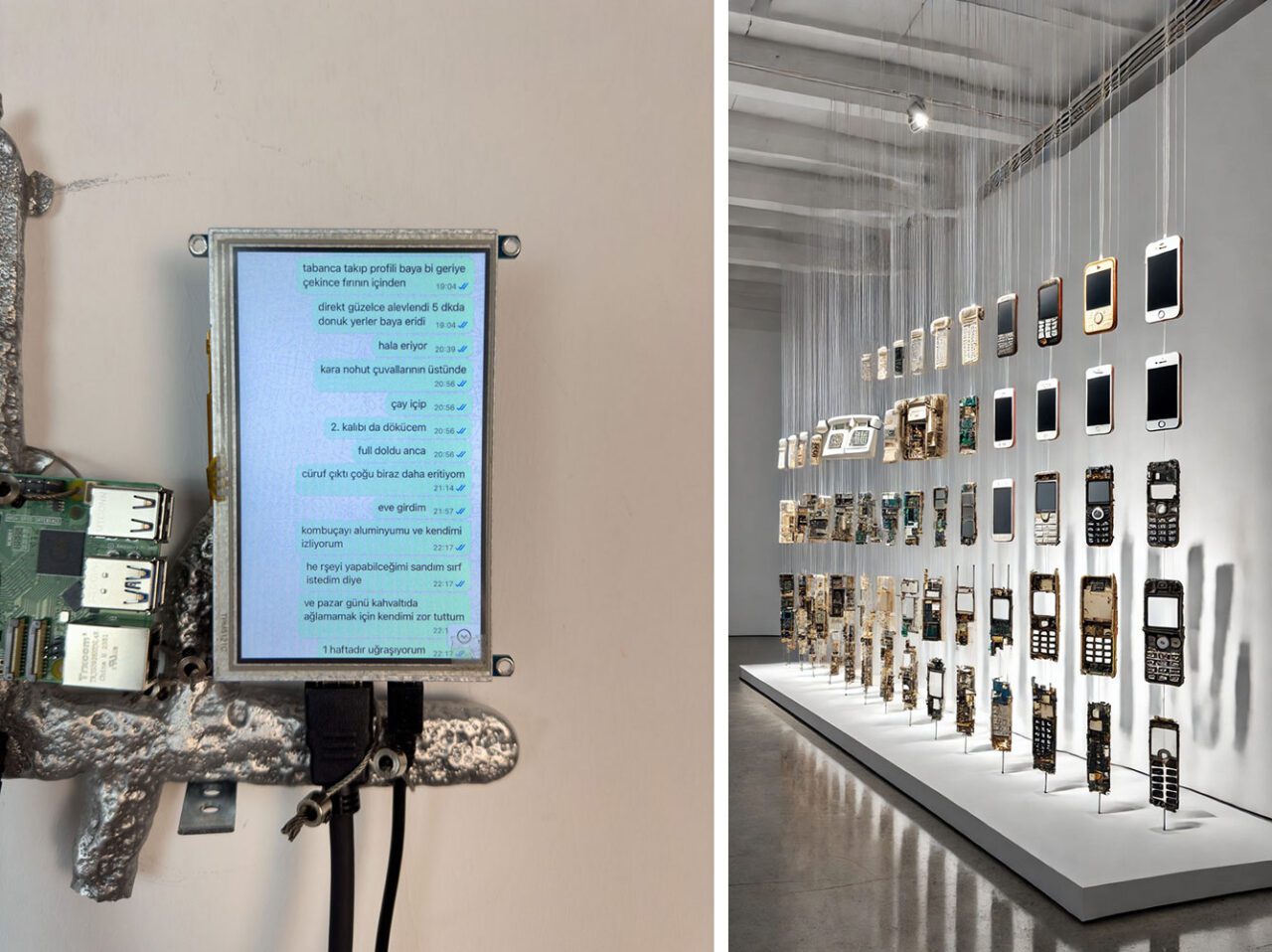
Right: Şahsenem Altıparmak, Memory of Network, 2025, Telephone parts: keypads, displays, circuit boards, microchips, 200 x 170 x 60 cm, Courtesy the artist and Zilberman Gallery