PRESENTATION: Magdalena Abakanowicz

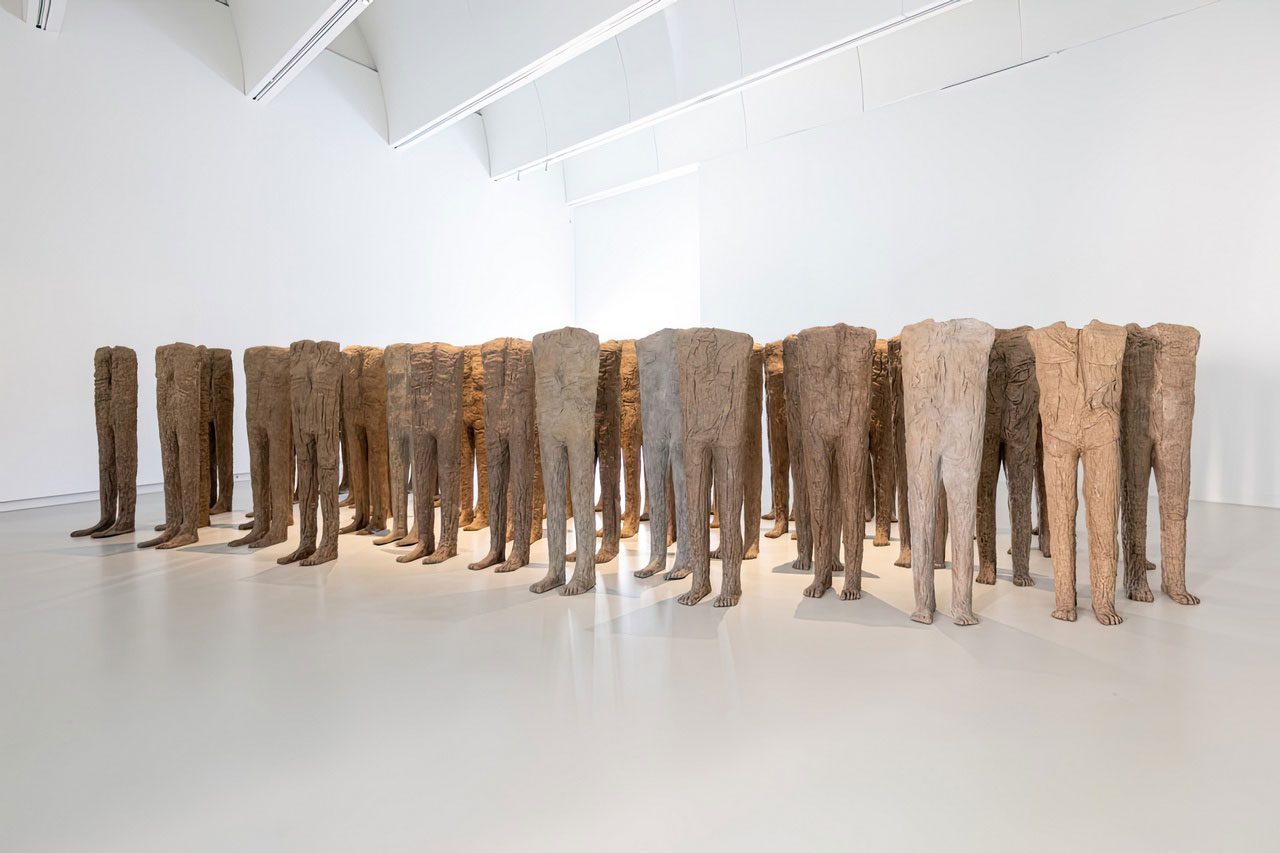
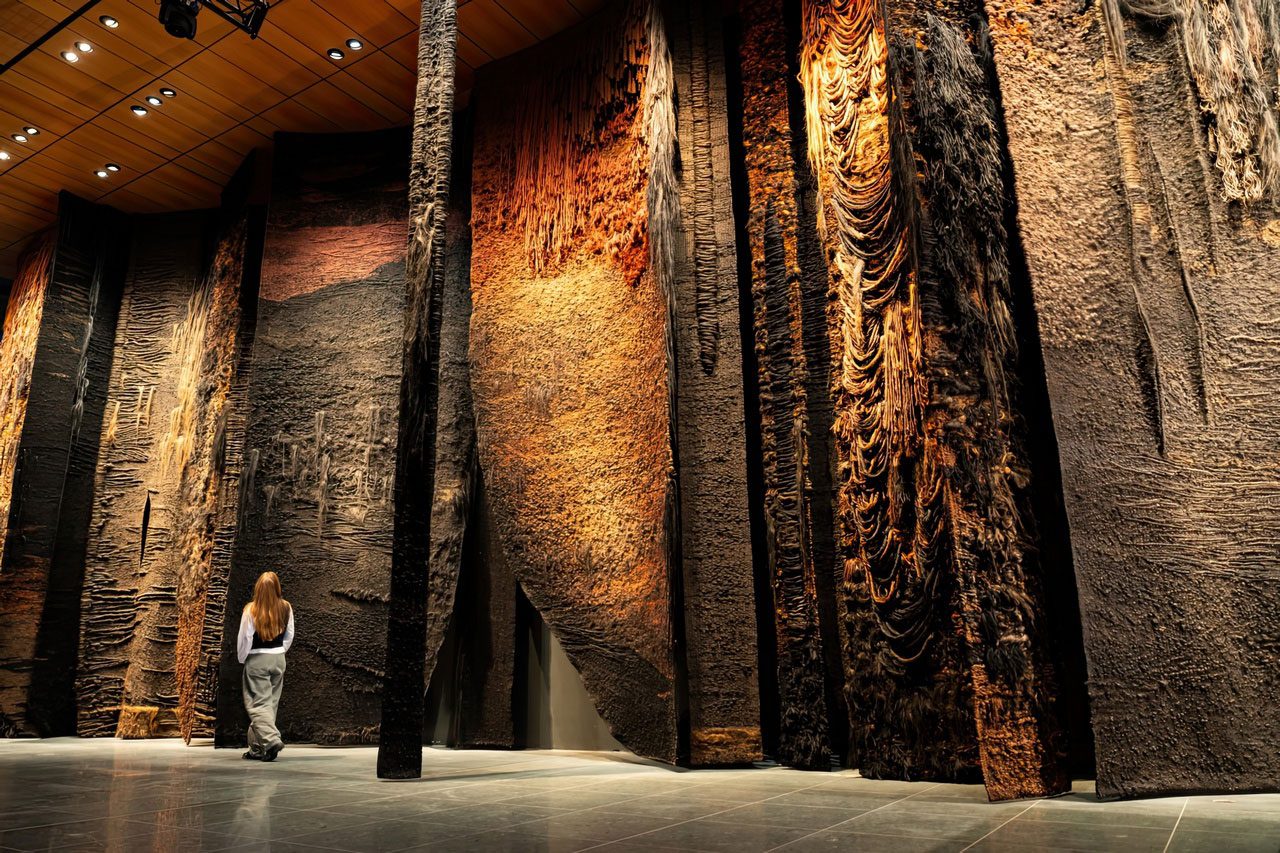
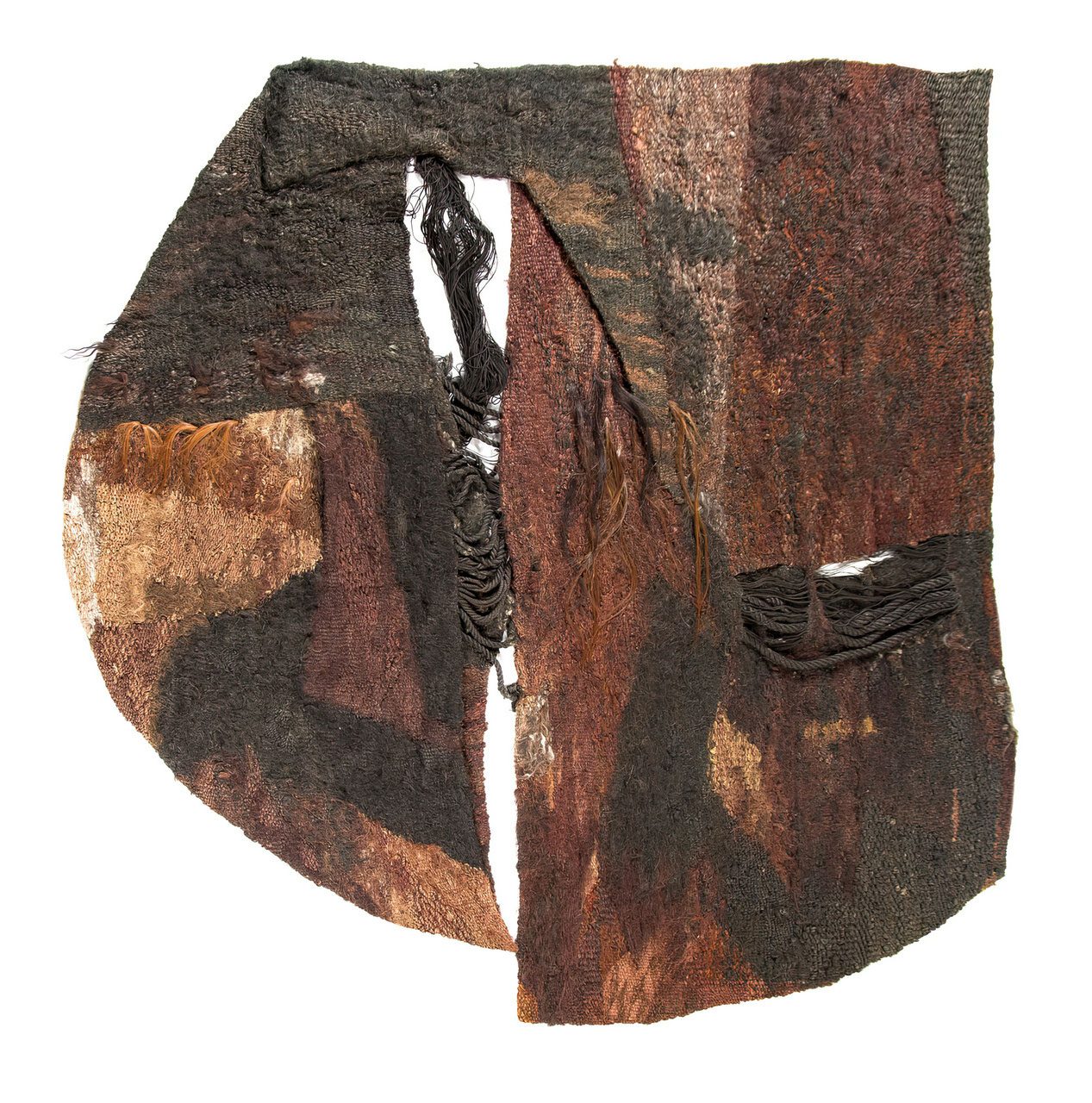
Magdalena Abakanowicz was a pioneer of fiber-based sculpture and installation in the 1960s. She began making abstract fiber works in the 1950s, when Polish government was advocating socialist realism. Her earliest works were monumental hanging textiles, which she named “Abakans.” They function as both objects and spaces. She turned to figurative textile works in the 1970s, creating the headless and fragmented human forms for which she is best known.
By Dimitris Lempesis
Photo: TextielMuseum Archive
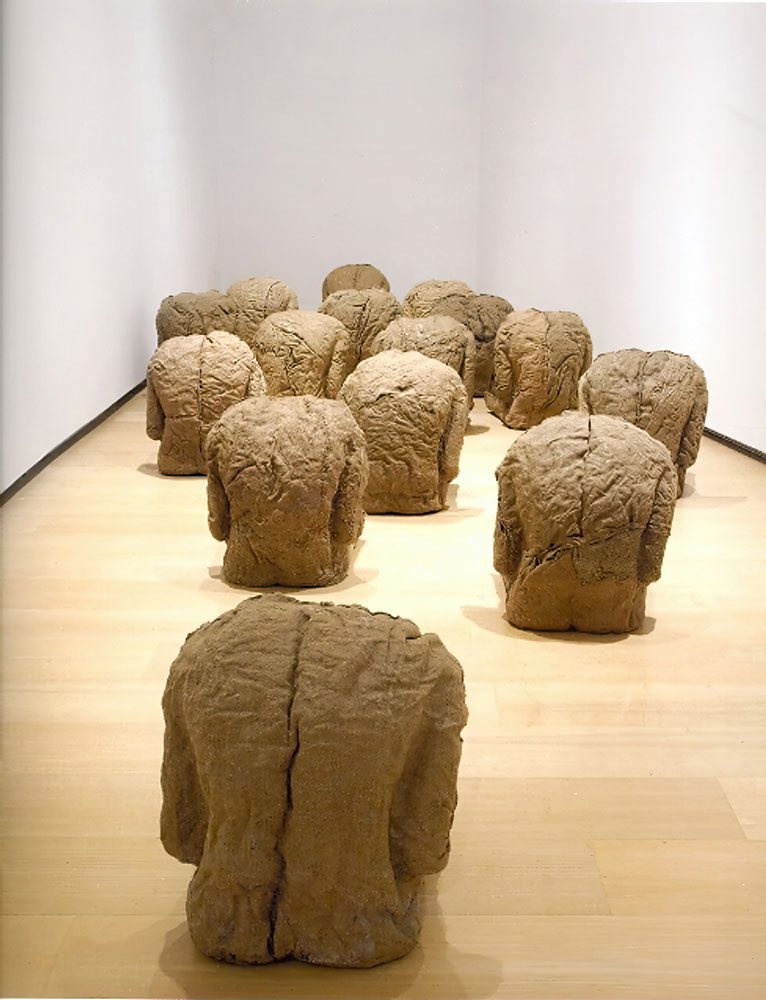
Two leading Dutch museums—Het Noordbrabants Museum and the TextielMuseum—join forces to present a sweeping three-part retrospective dedicated to the trailblazing Polish artist Magdalena Abakanowicz. This major project offers an in-depth exploration of her world-renowned “Abakans,” alongside lesser-known sculptures, drawings, films, and immersive installations. Celebrated as a pioneer of installation art and one of the most influential post-war Polish artists, Abakanowicz’s work remains profoundly relevant, reflecting on the complexities of the human condition. Throughout her prolific career, Abakanowicz grappled with urgent ecological, geopolitical, and existential questions. Her monumental, often haunting installations investigate themes of loss, trauma, resilience, and collective identity. At the core of the exhibitions are two major shows: “Everything is Made of Fiber” at the TextielMuseum and “Human Nature” at Het Noordbrabants Museum. Both exhibitions trace their origins to Abakanowicz’s seminal public artwork “Bois le Duc” (1971), located in the Provinciehuis of North Brabant. Abakanowicz rose to international prominence in 1967 with her revolutionary three-dimensional textile sculptures known as “Abakans”—a term derived from her own name. These soft, organic forms defied the conventions of both painting and sculpture, breaking away from flatness and tradition. In 1973, she turned her focus to the human figure, creating humanoid forms that became a central motif in her practice through the 1980s and beyond. These faceless, often fragmented bodies conveyed a sense of anonymity, vulnerability, and alienation—powerfully influenced by her personal experiences living under totalitarian rule in communist Poland. By the 1990s, Abakanowicz’s vision expanded into nature-based installations, where her affinity with the organic world manifested in powerful outdoor works that echoed ancient rituals and the endurance of the human spirit. The exhibition “Everything is Made of Fiber” centers on Abakanowicz’s groundbreaking textile works, with a monumental installation of her iconic Abakans as the centerpiece. It explores the evolution of textile art and its liberation from the confines of “applied” or “decorative” status—categories historically associated with craft and often marginalized in the fine art canon. For decades, textiles were dismissed as mere handicraft, and the fact that many textile artists were women contributed to the medium’s devaluation. Abakanowicz’s work radically transformed this perception. She elevated fiber into a medium of powerful artistic expression, positioning it on equal footing with sculpture and painting. Her legacy reshaped the discourse around textile art, inspiring generations of artists who work in fiber today. The companion exhibition “Human Nature” rereads Abakanowicz’s oeuvre through the lens of contemporary issues such as climate change, war, and displacement, particularly in Eastern Europe. It invites viewers to consider humanity not as the ruler of nature, but as an intrinsic, fragile part of it—a poignant perspective in the age of the Anthropocene. What sets “Human Nature” apart is its interhistorical approach. By placing Abakanowicz in dialogue with contemporary artists such as Kader Attia, Marlene Dumas, Anish Kapoor, Kimsooja, and Diana Thater, each featured in a dedicated gallery space, the exhibition opens up new interpretations of her work. This cross-generational conversation continues through specially commissioned pieces by Kristina Benjocki, Stijn Verhoeff, and choreographer Nicole Beutler, creating a dynamic, multi-voiced response to Abakanowicz’s enduring themes.
Magdalena Abakanowicz was born in 1930 as Marta Abakanowicz into a noble Polish family of mixed Polish, Russian, and Tatar heritage. Her early years were marked by displacement and violence. In 1943, her mother lost an arm during a Nazi attack, and in 1944 the family fled their estate ahead of the Soviet advance, losing their home and social standing. These early traumas became a wellspring for Abakanowicz’s lifelong exploration of memory, survival, and collective identity.She studied at the School of Fine Arts in Sopot in 1949 and graduated from the Academy of Fine Arts in Warsaw in 1954. By 1956, she had begun her career as an independent artist, quickly gaining attention for her unconventional woven forms. While she initially worked in textiles, Abakanowicz’s practice grew to encompass drawing, painting, and later, sculptural installations using materials like burlap, rope, resin, bronze, stone, and iron. Her later works—often groupings of life-sized, headless human forms—include “Heads” (1975), “Backs” (1976–82), and “Embryology” (1978–81), all composed of tactile, organic materials. Though these figures shared similar shapes and postures, each was subtly unique, embodying both individuality and collectivity. Her large-scale outdoor installations—such as “Katarsis” (1985), “Becalmed Beings” (1993), “Space of Stone” (2003), and the monumental “Agora” (2006), comprised of 106 cast-iron figures—remain some of her most iconic and powerful contributions to public art. Magdalena Abakanowicz reshaped the way we understand materials, the body, and the collective experience of being human. Her work continues to resonate today, as it addresses themes that are more urgent than ever—identity, loss, resilience, and the fragile interplay between humanity and nature. Together “Everything is Made of Fiber” and “Human Nature” offer a rich, multifaceted reappraisal of an artist whose vision continues to challenge, inspire, and transform.
Photo: Magdalena Abakanowicz, Red Abakan III, 1970-1971. Photo: Arnaud Conne. © The Marta Magdalena Abakanowicz Kosmowska and Jan Kosmowski Foundation, Warsaw
Info: 1: Curators: Marta Kowalewska, Sjouk Hoitsma, TextielMuseum, Goirkestraat 96, Tilburg, The Netherlands, Duration: 18/4-24/8/2025, Days & Hours: Tue-Fri 10:00-17:00, Sat-Sun 12:00-17:00, https://textielmuseum.nl/. 2: Curators: Jacqueline Grandjean, Magdalena Sajnog, Els Hoek, Helmie van Limpt, Het Noordbrabants Museum, Verwersstraat 41, ‘s-Hertogenbosch, The Netherlands, Duration: 18/4-24/8/2025, Days & Hours: Tue-Sun 11:00-17:00, www.hetnoordbrabantsmuseum.nl/. 3. Province of North Brabant, Brabantlaan 1 ‘s-Hertogenbosch, The Netherlands, Duration: 18/4-24/8/2025, Days & Hours: Mon-Fri 7:00-18:00, www.brabant.nl/