PRESENTATION: Solange Pessoa-Catch the sun with your hand
 Solange Pessoa is known for her poetic works that intersect and contemplate nature, the human body, and the forces that shape existence. Her practice often delves into the realms of the organic and the metaphysical, with a focus on the materiality of life. Pessoa’s work is influenced by her surroundings, particularly the natural environment of her native Minas Gerais, Brazil, in which the mining of iron ore, gemstones, gold, and other minerals, is a prevalent force.
By Efi Michalarou
Photo: Aspen Art Museum Archive
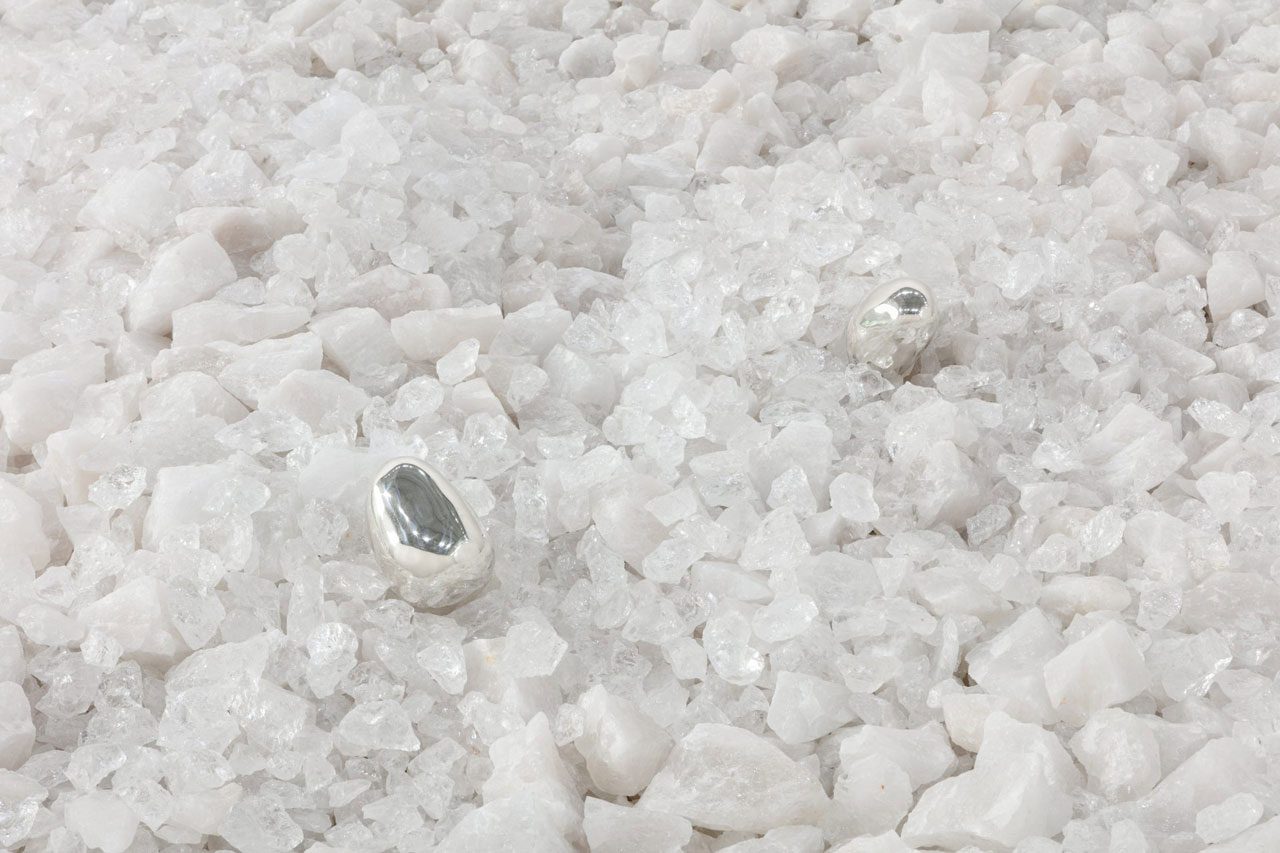
Solange Pessoa’s work is rooted in the telluric relationship with the landscape and the body, revealing hidden aspects of the earth. Through dreamlike installations, sculptures, drawings, ceramics, and paintings, Pessoa entwines the geological with the unconscious of the human species to unearth the connection between matter and memory. Many of her works are imbued with a sense of ritual and spiritual energy, drawing from the symbolic traditions of Minas Gerais in southeastern Brazil, a land with complex histories of biodiversity, industry, and colonial conflict. Pessoa’s practice is marked by a commitment to exploring the boundaries between the tangible and the intangible. Her works challenge the viewer to reconsider the body and nature not just as physical entities but as vessels for deeper meanings and emotional truths. Since the 1980s, Pessoa has explored the transmutation of bodily fluids and organic matter such as blood and human hair to recount the cycles of life and death. Pessoa’s exhibition “Catch the sun with your hand” brings together four bodies of work across soapstone, ceramics, crystals, and organic materials. Many of her installations, including those in this exhibition, require years to complete, and even then, they are not fixed, remaining subject to change and evolving like cells that replicate, aggregate, and expand their biological nature. The works are: “Bags – Aspen version” (1994–2025) Pessoa’s Bags installation, seen here on the Museum’s lower level, was first created in 1994 and is continually adapted for each new setting. The iteration of “Bags – Aspen version” (2023–25) has been reworked in response to the natural environment of the Roaring Fork Valley and the American West. For these installations, Pessoa fills towering walls of burlap sacks with soil, plant matter, bones, seeds, spices, and poems to create a living, universal, multisensory archive. Visitors are encouraged to sift through the abundant materials spilling into and from the sculptures, and to sense the living lands of Minas Gerais and Aspen. Visitors encounter printed images of Christo and Jeanne-Claude’s environmental installation Valley Curtain in nearby Rifle, CO, and albums from Brazilian musicians Milton Nascimento and Gal Costa as an ode to the Tropicália movement, a Brazilian artistic and musical movement that emerged in the late 1960s as a countercultural revolution against Brazil’s military dictatorship of 1964–85. “Deliria Deveras” (2021–24): features fourteen silver pieces inserted and distributed over twenty tons of crystal mined from the artist’s hometown. Light plays a central role, constantly changing the installation’s physical appearance and challenging our sense of perception. According to Pessoa, “materials exist in connection with thoughts and intuitions. They call us and choose us, they attract our perception and curiosity, and their untransferable nature and mysteries require research and close observation”.
Works from Pessoa’s “Florasceas” series (2019)—abstract red ceramic vessels with curved edges—are installed in the corridor outside the galleries, emerging from the wall like bodily protuberances. The product of meticulous shaping by Pessoa, these works signify a break from the stark geometries of Brazilian modernism. Touch emerges as a primary sense for the artist, who gives form to corporeal sensation. On the Museum rooftop, Pessoa’s carved soapstone sculptures (pedra-sabão) demonstrate the pliability of materials as metaphoric resources. For Pessoa, soapstone is an intimate yet foreign medium that was once ubiquitous within eighteenth century colonial architectures, including fountains and statues. Here, Pessoa returns soapstone to a more primordial state, shaping these forms with her own hands, leaving them to weather under the sun and mark time’s passage. “NIHIL NOVI SUB SOLE (fragments)” 2019–21): Working outdoors has been a constant in Pessoa’s forty-year practice. On the Museum rooftop, Pessoa’s carved soapstone sculptures, whose collective title, :NIHIL NOVI SUB SOLE”, translates as “nothing new under the sun,” demonstrate the pliability of materials as metaphoric resources. For Pessoa, soapstone is an intimate yet foreign medium suffused with history and distant memories. Once ubiquitous as a material for eighteenth-century colonial architecture, including fountains and statues, soapstone is here returned to a more primordial state: the artist shapes it with her hands, leaving her sculptures to weather under the sun, and allowing for natural encounters to transform the work. The coils, swirls, and vine-like marks that adorn the sculptures’ surfaces appear as symbols from an outlying past, echoing the mountainous landscape of Minas Gerais.
Photo: Solange Pessoa, Bags – Bregenz version(detail), 1994–2023, (detail) Courtesy of the artist and Mendes Wood DM, São Paulo, Brussels, Paris, New York. Copyright The Artist. Photo by Markus Tretter
Info: Curator: Claude Adjil, Aspen Art Museum, 637 East Hyman Avenuem Aspen, CO, USA, Duration: 2/7-26/10/2025, Days & Hours: Tue-Sun 10:00-18:00, https://aspenartmuseum.org/