
PRESENTATION: Anselm Kiefer
The language of material plays an essential role in the work of Anselm Kiefer, most of whose pictures have a geological sedimentary texture. For the past forty years, his work has been developing in a process of accumulation, mingling and reworking of themes, motifs and constellations which recur and overlap repeatedly in diverse media. Highly symbolic connections emerge from lead, concrete, dried plants, glass, barbed wire and other heterogeneous materials.
By Dimitris Lempesis
Photo: White Cube Gallery Archive
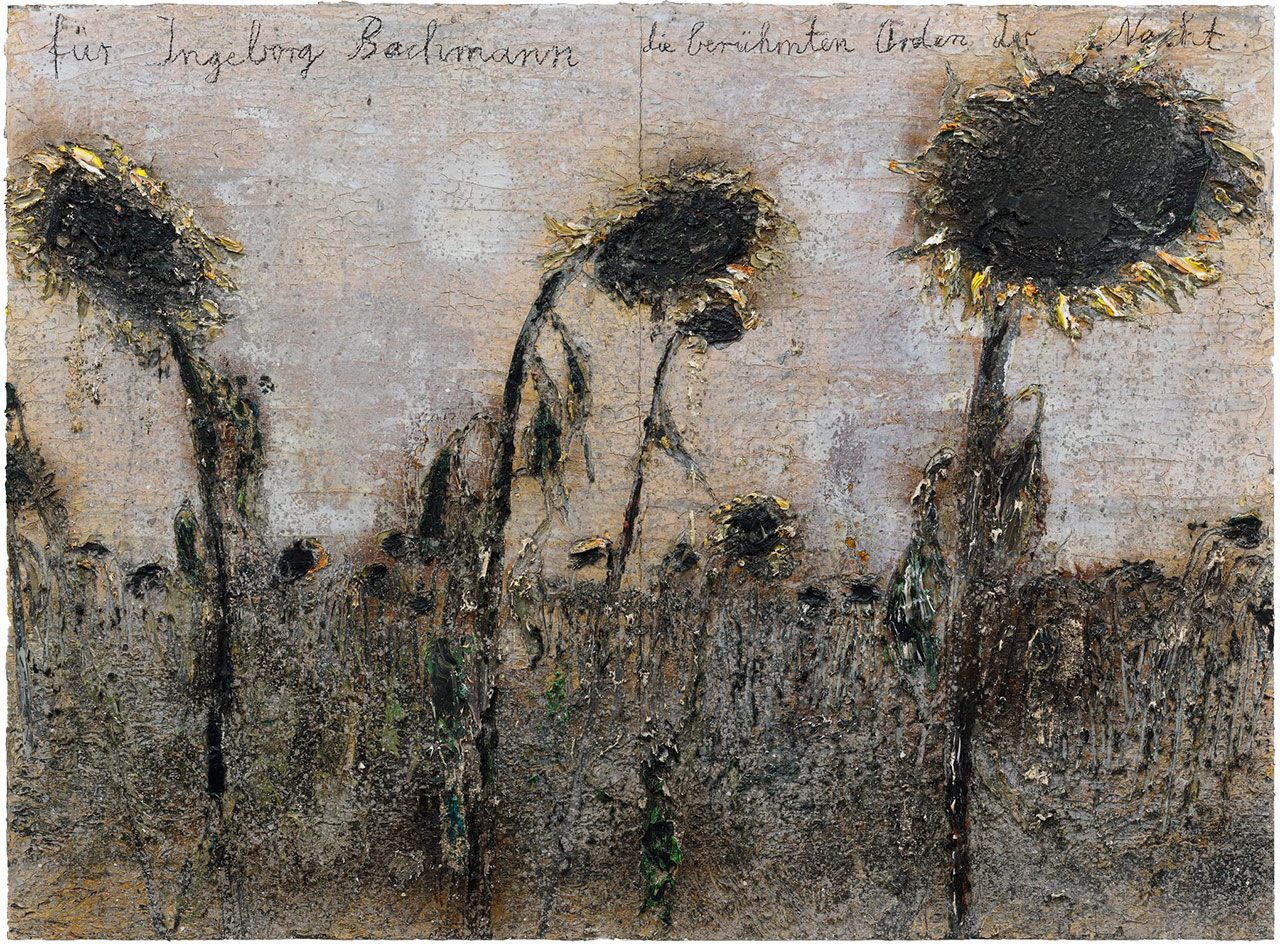
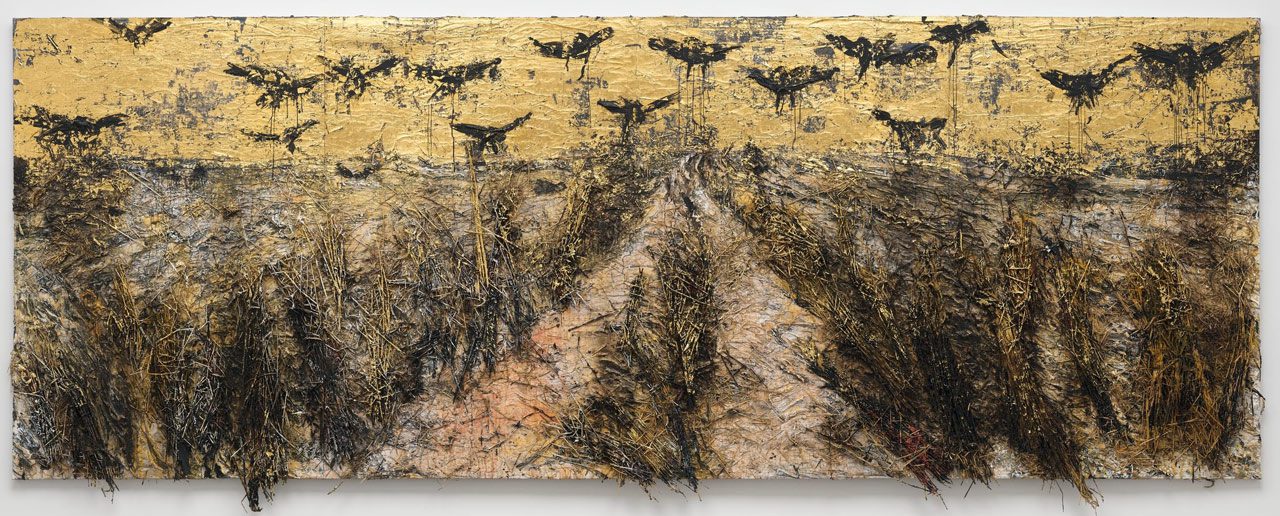
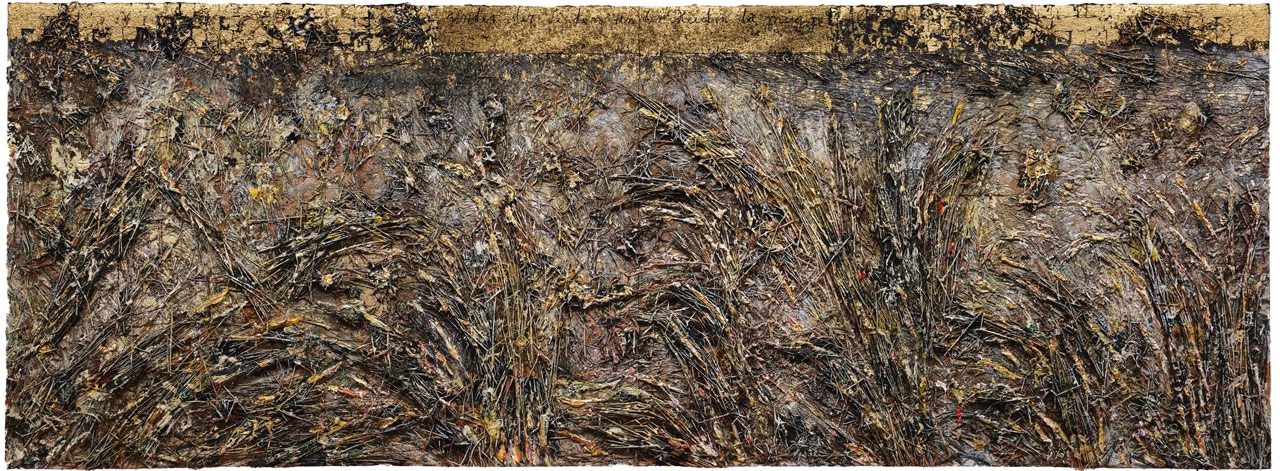
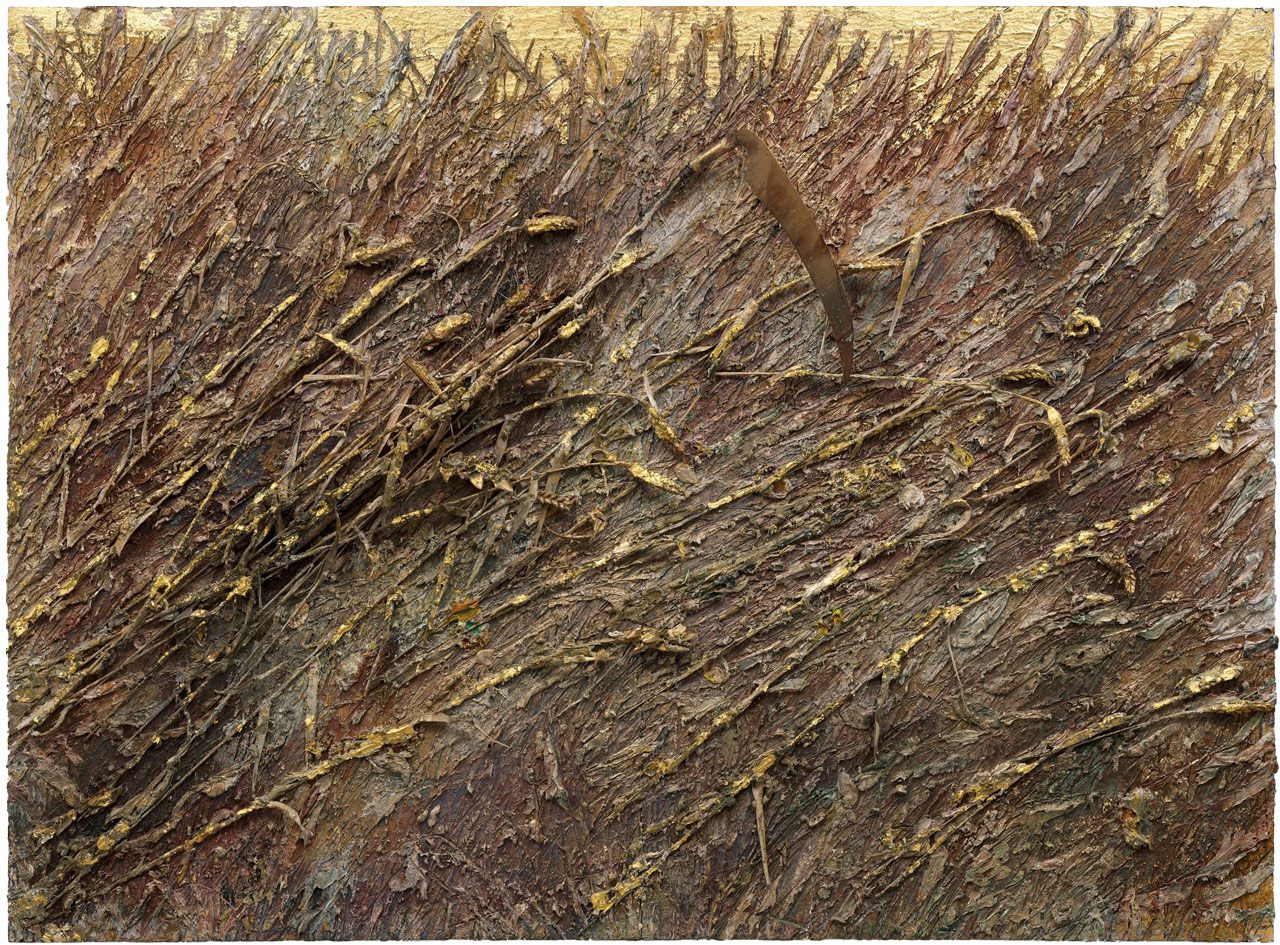
In his latest solo exhibition at White Cube Mason’s Yard, Anselm Kiefer revisits a formative artistic kinship that has haunted his practice since youth: a dialogue with the landscapes of Vincent van Gogh. Though more than a century separates their lifetimes, Kiefer—like Van Gogh—approaches landscape not merely as subject but as site: a charged terrain for philosophical inquiry and expressive transformation, where the material weight of paint is both medium and metaphysical agent. Here, the landscape becomes a living palimpsest—etched with memory, emotion, and myth. Kiefer’s affinity for Van Gogh reaches back to a defining journey he undertook at the age of eighteen in 1963, tracing the Dutch artist’s path from the Netherlands through Belgium and Paris, and finally to Arles—where Van Gogh, in his final and most incandescent period, produced many of his iconic canvases. These same works now serve as quiet interlocutors for Kiefer’s own visionary language. The Mason’s Yard exhibition reveals striking parallels between the two artists: their shared belief in landscape as a vessel of existential reckoning and affective intensity, and their mutual embrace of a tactile, sensuous painterly vocabulary. Yet within these resonances, Kiefer’s singular voice emerges, charged with the historical and symbolic gravitas that defines his oeuvre. On the ground floor, Kiefer’s monumental sunflower series offers a meditative counterpoint to Van Gogh’s exuberant tributes to the same motif. Eschewing the Dutch master’s radiant yellows, Kiefer renders the flower in heavy impasto, swathed in scorched earth tones, ashen greys, and brittle textures. These sunflowers are not emblems of vitality, but figures of endurance, grief, and time. In his characteristic fusion of image and inscription, Kiefer embeds poetic and mythological fragments into the surface—invoking the tale of Clytie, the nymph transfigured by love and loss into a flower eternally turned to the sun. Elsewhere, a passage from William Blake’s 1794 poem “Ah! Sun-flower” imbues the image with an aching lyricism, capturing the flower’s fatigue and longing for an unreachable “golden clime.” Kiefer’s sunflowers droop under the burden of hope and memory, yet they rise stubbornly from the earth, anthropomorphic sentinels reaching toward a tarnished sky. Through this poetic invocation, Kiefer infuses the natural world with a layered spiritual and historical charge. His landscapes are not innocent scenes but ritual grounds—woven from burnt straw, clay, dried flora, charcoal and ash—where decay and renewal unfold in an alchemical cycle. Nature, in Kiefer’s hands, becomes a repository of collective memory, absorbing the residues of myth, language, war, trauma, and time. This tension between beauty and ruin is extended in his wheat field paintings, where Kiefer more directly engages Van Gogh’s palette. Here, fields of radiant gold evoke not only the fullness of harvest but also its inherent fragility. For Van Gogh, the reaped field symbolized life’s impermanence and the inevitability of death. Kiefer draws out this paradox further, suggesting that yellow—the colour of exuberance—is also the hue of sickness, betrayal, and entropy. Through the shimmering use of gold leaf, these fields take on a devotional aura, sacred and mournful at once. Descending to the lower ground floor, one encounters works steeped in symbolic complexity. The motif of the scythe—a blade both generative and destructive—recurs throughout, evoking the double-edged nature of harvest and mortality. Charred wooden elements scattered across the surface recall the aftermath of fire, a devastation that paradoxically enriches the soil. Titles such as “O Halme, ihr Halme” (2019–24) and “Oh Halme der Nacht” (Oh Stalks of the Night) (2019–21) allude to the poetry of Paul Celan, whose elliptical meditations on loss, silence, and memory resonate deeply with Kiefer’s reckoning with post-war German identity. Other works venture into a more lyrical register. “Under der Linden an der Heiden” (2019), titled after a medieval poem by Walther von der Vogelweide, evokes an Edenic moment of union beneath a linden tree—a natural canopy that shelters love and sanctifies human connection. Yet in Kiefer’s hands, such moments are not preserved in idyllic stasis; they are gilded, weathered, and refracted through the lens of loss and transcendence. His landscapes shimmer with mortal sorrow and the faint glow of spiritual ascent. At the heart of the exhibition, the sculptural installation “Steigend, steigend, sinke nieder” (Rising, Rising, Falling Down) (2016–24) extends Kiefer’s material experimentation into the realm of three dimensions. Housed within a floor vitrine, the work suspends a desiccated sunflower stalk upside down from a cracked terrain affixed to the vitrine’s ceiling. Its scattered seeds fall onto an open leaden book—a convergence of organic decay and symbolic weight. Referencing both Van Gogh’s “La Berceuse” and Goethe’s “Faust”, the piece bridges art historical homage with metaphysical meditation. The use of lead, a recurring element in Kiefer’s practice, underscores the work’s alchemical undertone: simultaneously heavy with historical burden and luminous with transformative potential. Across this exhibition, Kiefer constructs a vast and resonant dialogue—not only with Van Gogh, but with the broader continuum of artistic and intellectual history. His paintings and installations become sites of convergence where poetry, philosophy, myth and memory interlace. Through citation and reinvention, Kiefer crafts a visual language that transcends the physical to reach toward the numinous. His landscapes are not just scenes, but testaments—spaces where destruction becomes fertile, and where the ghosts of the past bloom in ashes.
Photo: Anselm Kiefer, für Ingeborg Bachmann 2023-25, Emulsion, oil, acrylic, shellac, gold leaf and ash on canvas, 280 x 380 cm | 110 1/4 x 149 5/8 in., © Anselm Kiefer, Courtesy the artist and White Cube Gallery
Info: White Cube Gallery, 25 – 26 Mason’s Yard, London, United Kingdom, Duration: 25/6-16/8/2025, Days & Hours: Tue-Sat 10:00-18:00, www.whitecube.com/
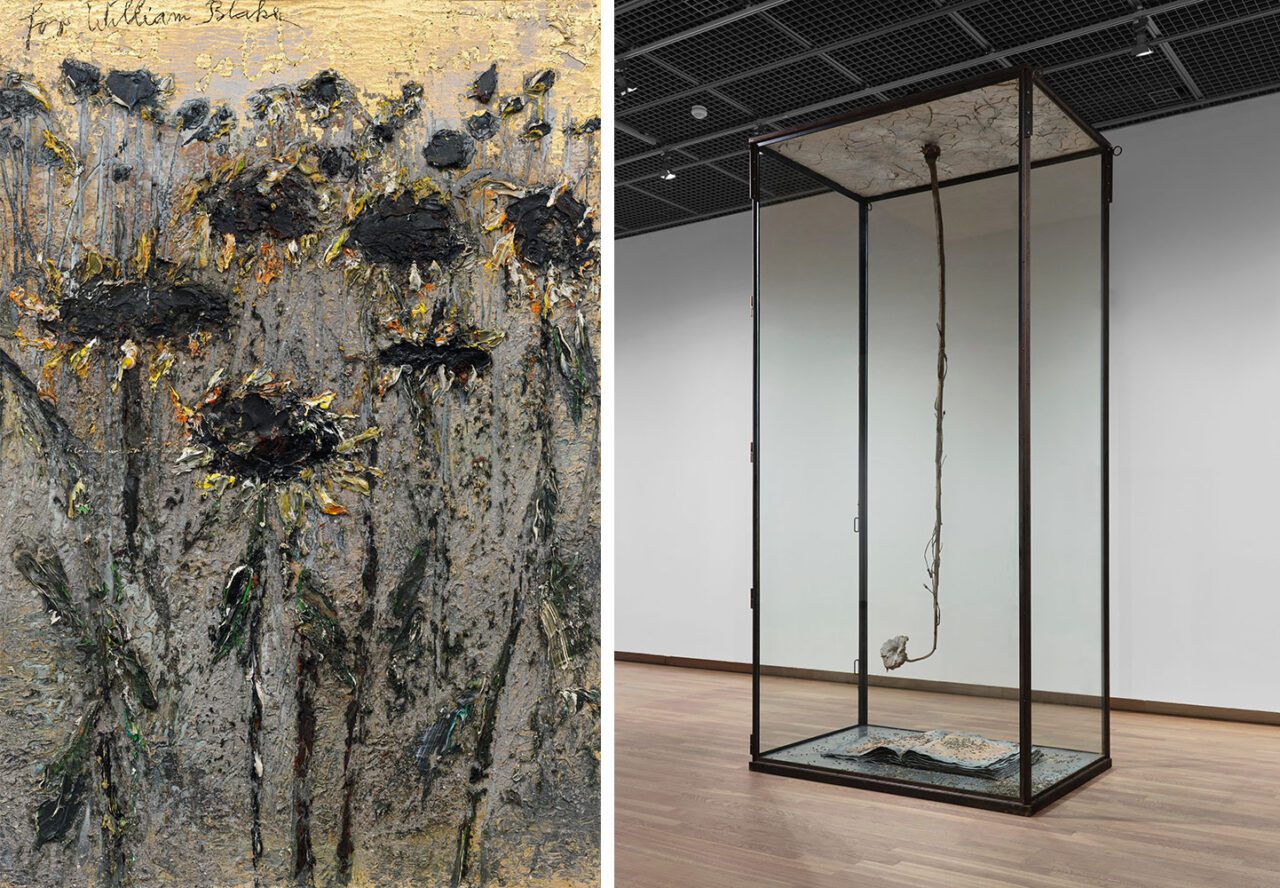
Right: Anselm Kiefer, Steigend, steigend, sinke nieder (Rising, Rising, Falling Down), 2016-24, Glass, steel, lead, terracotta, plaster and resin, 452 x 221 x 140 cm | 177 15/16 x 87 x 55 1/8 in., © Anselm Kiefer, Courtesy the artist and White Cube Gallery