
ART CITIES: London-Anna Perach
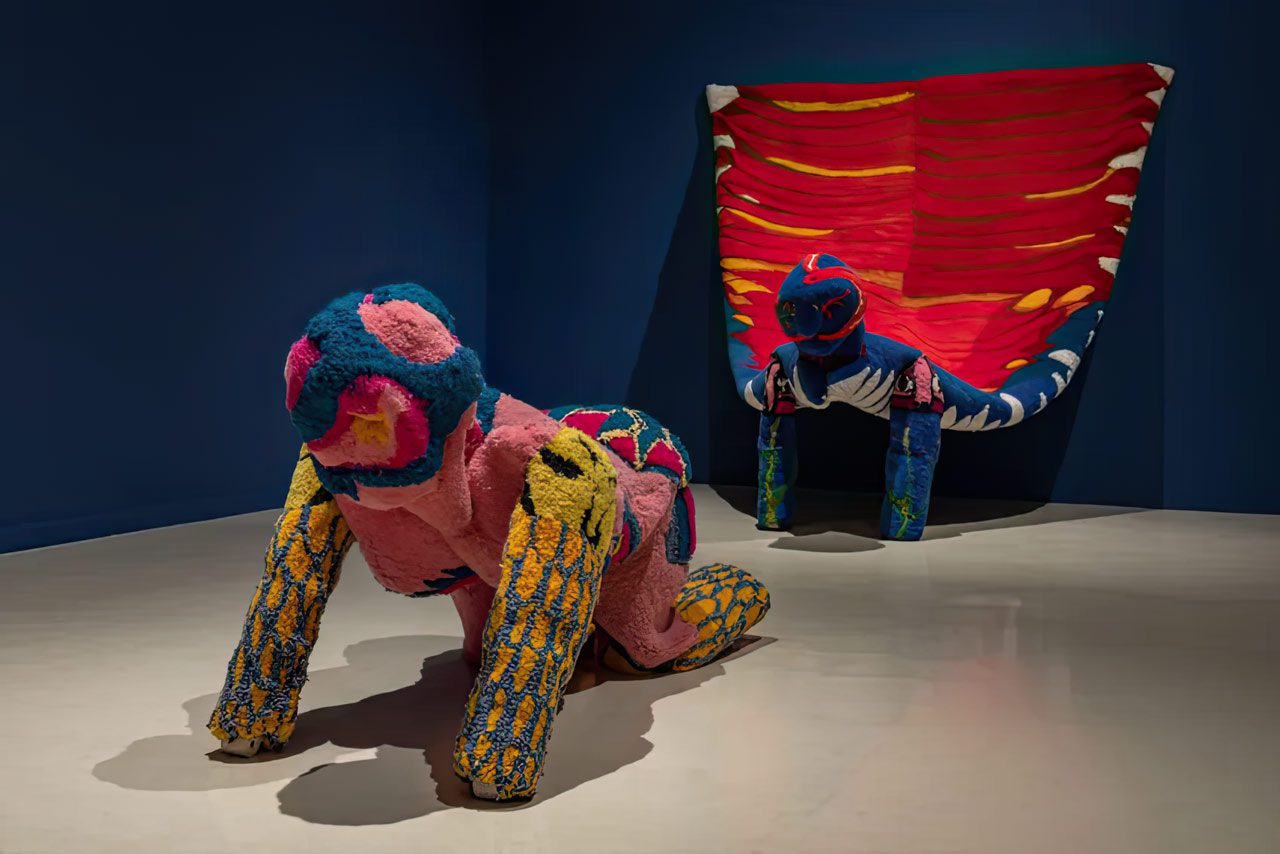
Anna Perach’s practice explores the dynamic between personal and cultural myths. Specifically she is interested in how our private narratives are deeply rooted in ancient folklore and storytelling. In her work Perach interweave female archetypes into sculptural hybrids in order to examine ideas of identity, gender, and craft. Her main medium of work is wearable sculpture and performance. She works in a technique called tufting, making hand-made carpet textile, which then transforms into wearable sculptures.
By Dimitris Lempesis
Photo: Richard Saltoun Gallery Archive
Anna Perach’s exhibition title, “A Leap of Sympathy”, draws from philosopher Henri Bergson, who emphasized intuition and lived experience over strict rationalism in our understanding of reality. Bergson suggests that, since we cannot empirically prove another person’s internal experience, we must take a ‘leap of sympathy’—a leap of trust—to relate to them. This idea finds resonance in Perach’s exhibition, unfolding across the gallery’s three spaces like the chapters of a storybook, and bringing together a new body of tufted sculptures, drawings and glass sculptures. These works continue the artist’s investigation into the intersections of the psyche, gender, and identity through the primary medium of textiles—traditionally associated with the feminine and the domestic. Perach’s sculptures thread the line between the beautiful and ornamental as well as the grotesque and eerie, challenging the boundaries between fine art and craft. Using tufting, a traditional and labor-intensive textile technique, the artist reimagines archetypes as hybrid forms that question prevailing cultural myths surrounding gender. Central to Perach’s practice is an exploration of the “monstrous” body—a concept that feminist theorist Donna Haraway uses to imagine new, counter-hegemonic forms of existence, adaptation and imagination in a fractured world. Thus, vilified female archetypes—such as witches and monsters, figures often marginalized for transgressing social norms—are frequently Perach’s protagonists, through whom she reflects on contemporary societal perceptions of femininity and otherness. Such reflections are encapsulated in the work “Olimpia”, the focal point of the exhibition. The installation features two large-scale feminine sculptures in rococo inspired dresses: one is a wearable piece, activated by a performer, while the other is controlled by a clockwork structure operated from within the wearable sculpture. This marks the very first time the artist is using robotics in her work. In “Olimpia”, she looks at the historical casting of the feminine form as frivolous, overly emotional and unruly, threatening religious and scientific categorization. As a result, it has been subjugated and coerced into alignment with the dominant narratives of each era. Perach draws connections between these Western systems of control and their impact on the female body, reflecting on what our contemporary attitudes reveal about broader societal anxieties and fantasies. Inspired by E.T.A. Hoffmann’s Gothic fiction “The Tales of Hoffmann”, Olimpia takes its name from the automaton Olimpia, who becomes the object of a young man’s obsessive desire, as he believes her to be a real woman. Her mechanical nature is ultimately exposed during a violent struggle between her creators, which leads to her destruction. Perach focuses on the moment when Olimpia is first introduced to society by singing an area at a ball. She interprets Olimpia and Clara (two central figures in Hoffmann’s story) as representations of the self’s divided nature: Clara embodies societal norms of logic, while Olimpia represents the repressed, chaotic aspects subjected to patriarchal control. This work also draws from psychoanalytic theory, particularly Freud’s notion of the doppelgänger, which he describes as a mechanism that enables the repression of unbearable psychic content by splitting the self. Though seemingly forgotten, the repressed inevitably resurfaces, exposing a “monstrous truth” that was always present. Through “Olimpia”, Perach examines what threatening, suppressed content the female body might hold—and what happens when it inevitably emerges. The work also engages with the psychological rupture that occurs when one’s perception of what is human is disrupted. In Hoffmann’s tale, Nathaniel experiences a psychotic breakdown when Olimpia is revealed to be a machine, her humanity an illusion. This central piece is complemented by a series of drawings that depict fragments of Olimpia’s story, adding further context and narrative depth to both the sculptural work and the exhibition as a whole. Another key body of work, “The Uncanny Valley”, comprises twelve tufted heads mounted on wooden structures, forming a macabre procession that guides viewers through the gallery. Many of these heads play on the idea of the gaze, featuring additional eyes, a single oversized eye, no eyes at all, or even zippered eyes—playing with the tension between visibility and concealment, perception and illusion. Inspired by the severed heads that surround Baba Yaga’s house in the Russian folktale Vasilisa the Beautiful, the work engages with themes of identity and transformation. Perach’s tufting technique imbues each head with a distinct yet eerily familiar presence, rendering them vessels of cultural memory while evoking the unsettling sensation of the uncanny valley—a term coined by Japanese roboticist Masahiro Mori in 1970 to describe the discomfort experienced when encountering a figure that appears almost human, yet disturbingly not quite. While “Olimpia” and “The Uncanny Valley” explore external skins, Perach’s two new glass sculptures shift focus to the body’s underlying anatomical structure. Continuing her engagement with glass as a material, these works take the form of two life-sized human ribcages—one featuring flayed, skin-like elements suspended from its frame—intensifying the tension between interior and exterior, exposure and concealment.
Photo: Anna Perach, The Moon Prophecy, 2021. Exhibition view. Performance installation at Herzliya Museum of Contemporary Art. Courtesy the artist
Info: Richard Saltoun Gallery, 41 Dover Street, London, United Kingdom, Duration: 15/5-24/6/2025, Days & Hours: Tue-Fri 10:00-18:00, Sat 11:00-17:00, www.richardsaltoun.com/


Right: Anna Perach, Uncanny Valley (Kokoshnik), 2025 , Axminster yarn, artificial leather, 50 x 30 x 30 cm, © Anna Perach, Courtesy the artist and Richard Saltoun Gallery