ART CITIES: Athens-Servare Intaminatum at the National Observatory of Athens
Certain exhibitions act as mere observers of their era, while others attempt to actively disrupt it. The contemporary group exhibition “Servare Intaminatum. Climate Crisis – From the Invisible to the Visible, or How to Represent the Unthinkable,” curated by Dimitris Trikas, is undoubtedly one of the latter. Opening at the dawn of the summer season on the Hill of the Nymphs and within the spaces of the National Observatory of Athens, it went far beyond the scope of a standard visual arts showcase. Ιt functioned, rather, as a complex platform for dialogue surrounding the climate crisis, the Anthropocene, the relationship between progress and destruction, and the very role of art in a world that appears to be in a permanent state of environmental emergency.
By Valia Katsimpa
Photo: Valia Katsimpa’s Archive
But who is the mastermind behind such a complex endeavor, one that has already left a distinct mark on his curatorial trajectory? Dimitris Trikas, a multifaceted figure in the Greek cultural sphere—known both for his long-standing career as a journalist and radio producer, and as an independent exhibition curator—frequently selects unconventional spaces to realize exhibitions with a strong sociopolitical and philosophical orientation. From the Dromokaiteio Psychiatric Hospital to the Athens Conservatoire and the Eleonas district, he consistently seeks to pose critical, timely questions about the human condition, tackling themes ranging from collective utopias and confinement to the climate crisis and the advent of Artificial Intelligence.
The “Servare Intaminatum” exhibition unfolded in a historically charged space, intricately linked to the vision of the Enlightenment, the faith in knowledge, and human progress. In his recent interview for our magazine, the curator described the Observatory as a “space of urban utopia,” in the sense that it is experienced as a magnificent natural environment within the heart of the capital. The historic Hansen building, constructed in 1842 thanks to a donation by Georgios Sinas, stands as a material expression of the modern certainty that humanity can comprehend and master the world—a certainty that is fundamentally subverted through this exhibition. The curator points out that the very logic that birthed great scientific and technological achievements simultaneously led to the exhaustive exploitation of the natural environment. Thus, for a few days, the Observatory was transformed into the setting of a historical irony: the temple of knowledge became a space for reflection on the catastrophic consequences of the very idea of progress.
Beyond the particularly apt choice of the exhibition’s emblematic title, “Servare Intaminatum” (“To Keep Intact”) – a phrase inscribed on the building’s pediment that associatively functions as a plea for the planet’s protection – one of the most compelling characteristics of the entire event was its approach to the climate crisis. It treated it not merely as an environmental phenomenon, but as an issue with profound sociopolitical ramifications. When asked, the curator explicitly rejects the conventional narrative that places the solution solely on individual responsibility or recycling. He notes that only a fraction of generated waste is actually recycled, while the vast majority is transported to massive landfills in the Global South.
This stance, permeating the majority of the works, shifts the center of gravity from a nature desperately seeking protection to an environment already transformed by the economic and social structures of late modernity. The exhibition acted as a visual manifestation of the Anthropocene—the era where human activity has become the dominant geological force. Embracing this reality, the participating artists produced new works by skillfully repurposing and creatively transforming various forms of discarded materials.
Among the works that stood out were Andreas Lolis’s interventions at various points across the hill: pallets, cardboard boxes, garbage bags, and fallen tree trunks were rendered with the precise detail and monumentality of marble, acting as archaeological remnants of a civilization that consumes and discards relentlessly. Equally interesting within the space of the Observatory was the presence of Dimitris Efeoglou’s huts. Αccording to the curator, these are not proposed as an ecological return to nature, but rather as symbols of inwardness and self-reflection, evoking the philosophical tradition of isolation and contemplation—from Heidegger’s famous cabin to Le Corbusier’s Le Cabanon.
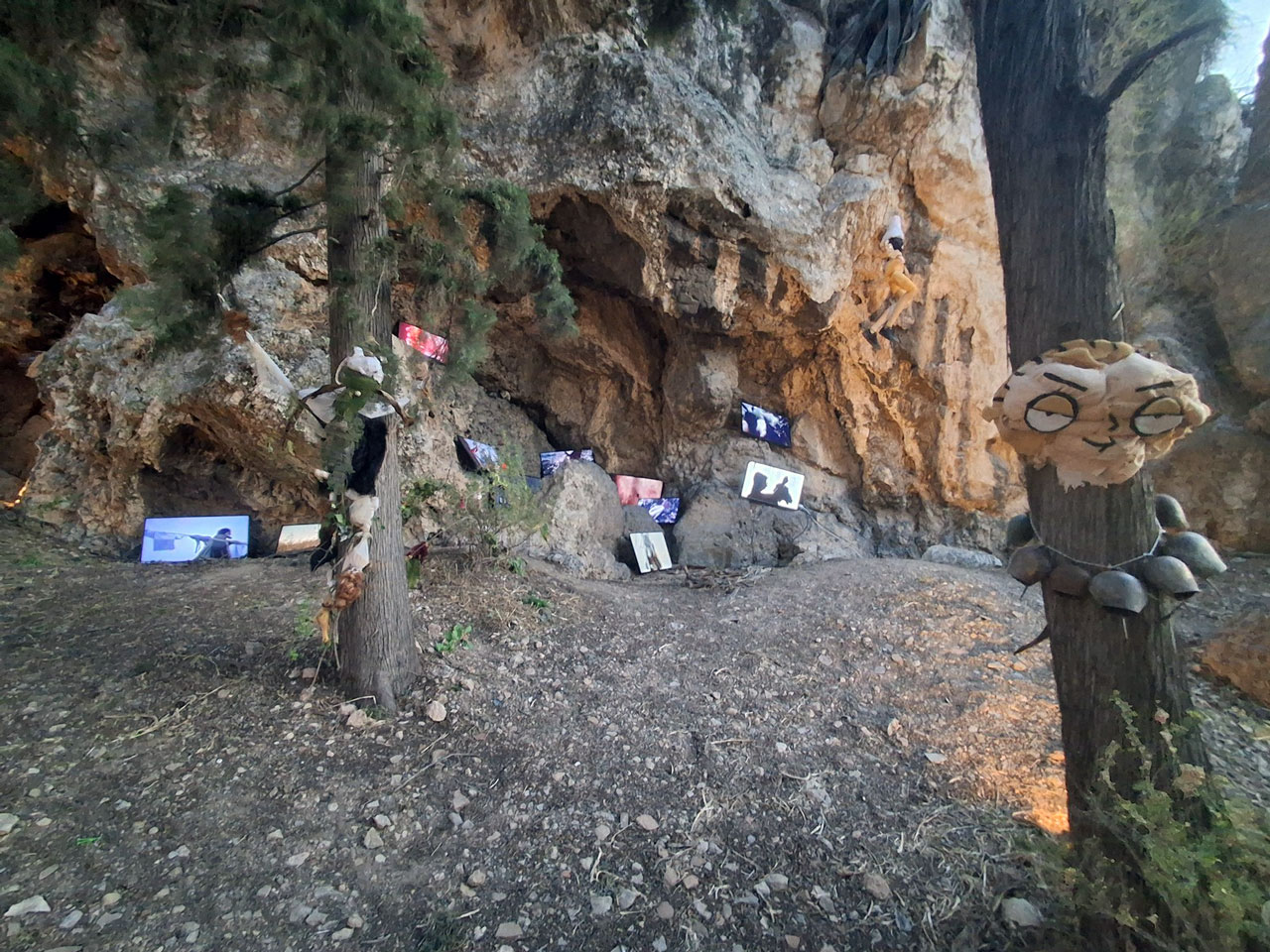
Most of the exhibition’s works were in direct dialogue with the landscape, and in several cases, they were literally embedded within the natural environment, such as the installation by Klajdi Tsano and Anna Provatari inside the caves. Kostas Koinos’s silent landscape guardians, Kostas Tzimoulis’s photographs documenting the traces of failed investments in nature, and the works composed of recycled materials by Peggy Kliafa and Pandora Mouriki created a network of references to the trauma that humanity leaves upon the landscape.
Ultimately, the curator designed a symbolic route for the visitor, guiding them “from the hut to the caves”—from the triumph of science toward primal forms of dwelling. This was not meant as nostalgia, but as a stark reminder of the limits of human omnipotence. It is precisely at this juncture where the problem and the solution coexist: through a profound awareness of our collective responsibility toward an unchecked trajectory of illusory evolution, which leaves our relationship with the environment vulnerable and suspended, deferred as a pressing project forever meant for the “next” generations.
Recognizing the limited and specialized audience that follows contemporary art in Greece, the curator organizes a rich parallel public program for most of his exhibitions, featuring numerous guided tours, talks, and performances. He considers this mediation essential for attracting the uninitiated to the visual arts. Acting as both a detector of the new generation’s trends and a bridge-builder between historical memory and the contemporary avant-garde, Trikas creates polyphonic, site-specific experiences that transform the viewer from a passive observer into an active participant in a broader intellectual dialogue. Just as the impact of a true work of art can be lasting and deafening, carrying within it the seed of change, the trajectory of a successful exhibition does not conclude on its closing date; it remains relevant as long as it sends ripples through society.
Trikas concludes his curatorial text with a few open-ended questions—questions that urgently demand deep comprehension before they can even be answered: “How will we learn to live without acting as parasites? How will we transform waste into memory, crisis into narrative, and destruction into the starting point for another way of living and being?” What is certain is that this particular exhibition did not confine itself to a naive return to nature, nor did it adopt the usual ecological didacticism. Instead, it operated as a multilayered proposition on the contradictions of modernity, the concept of progress, and the inability of contemporary civilization to manage the consequences of its own success. And I think that precisely there, in the aftermath of the exhibition, lies its greatest triumph: while it did not generously offer answers, it compelled us all to grapple with vital questions regarding the planet’s course and to reconsider the terms of our coexistence with the world we have shaped.
Participating Artists: Dimitris Alithinos, Giorgos Drosos, Rania Emmanouilidou, Dimitris Efeoglou, Thodoris Zafeiropoulos, Nikos Iavazzo & Andreas Kalli, Anastasis Karras, Peggy Kliafa, Kostas Koinos, Panagiotis Koulouras, Andreas Lolis, Katerina Botsari, Pandora Mouriki, Eleni Panouklia, Antigoni Pasidi, Anna Provatari, Panos Sklavenitis, Kostas Tzimoulis, Klajdi Tsano, Efi Chaliori, Despina Charitonidi.
Performers: Fani Arapi, FRMK Group / Farmako magazine, Anna Tzakou & Despina Chatzipavlidou, Collectif MASI (Madeleine Anipsitaki and Simon Riedler), Eleni Mesadou, Foteini Kalle.
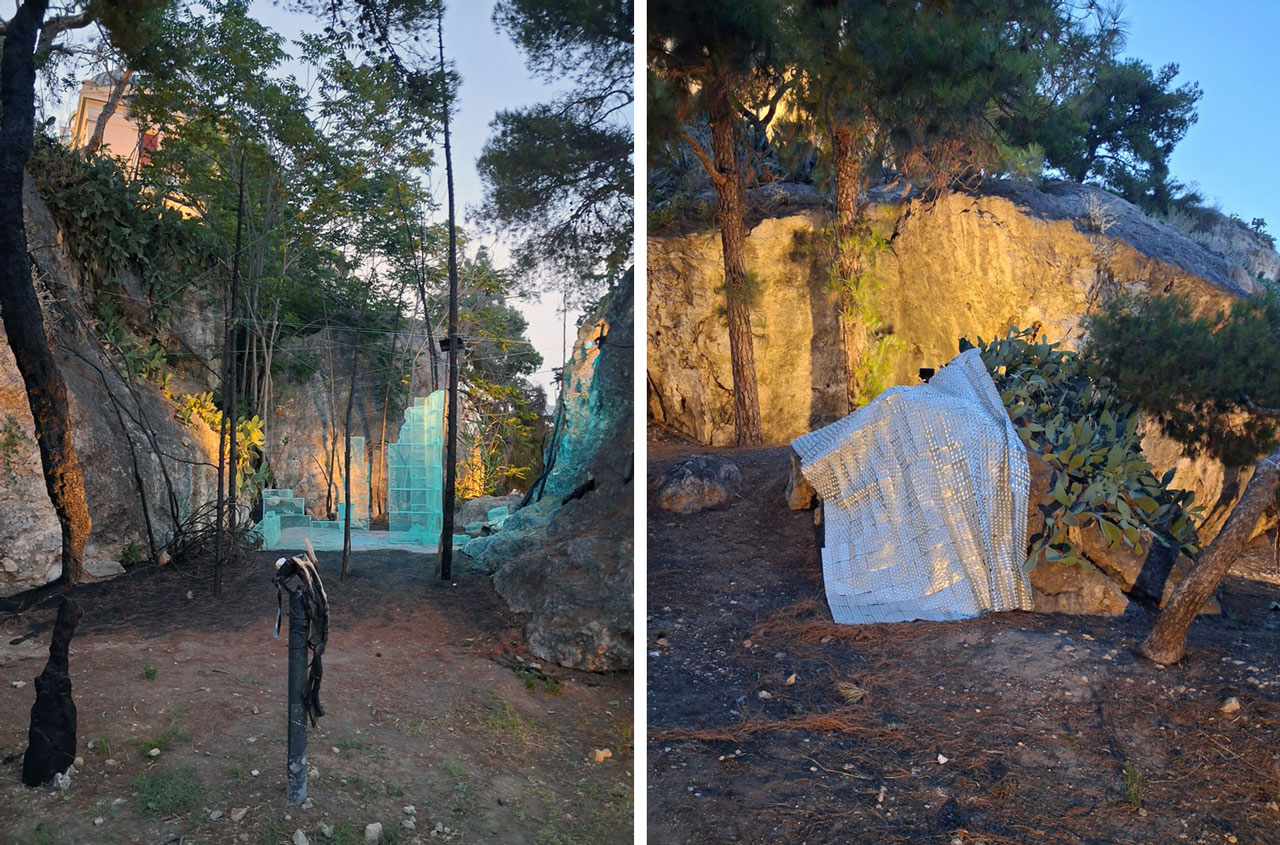
Photo left: Klajdi Tsano, Liminal Terrain, Installation 6 × 18 m | mixed media: wood, plaster, metal, resin, Artwork © the artist, Photo: © & Courtesy Valia Katsimpa. Photo right: Peggy Kliafa, Blanket of Relief, 2026, Empty aluminum pill blister packs, thin wire, fishing line, Dimensions: approx. 344 × 215 cm, Artwork © the artist, Photo: © & Courtesy Valia Katsimpa
Info: Curator: Dimitris Trikas, Curatorial Team: Alexandra Assantourian, Dioni Zoubelou, National Observatory of Athens, Hill of the Nymphs, Athens, Greece, Duration: 4/6-4/7/2026, Days & Hours: Wed-Sat 19:00-22:30
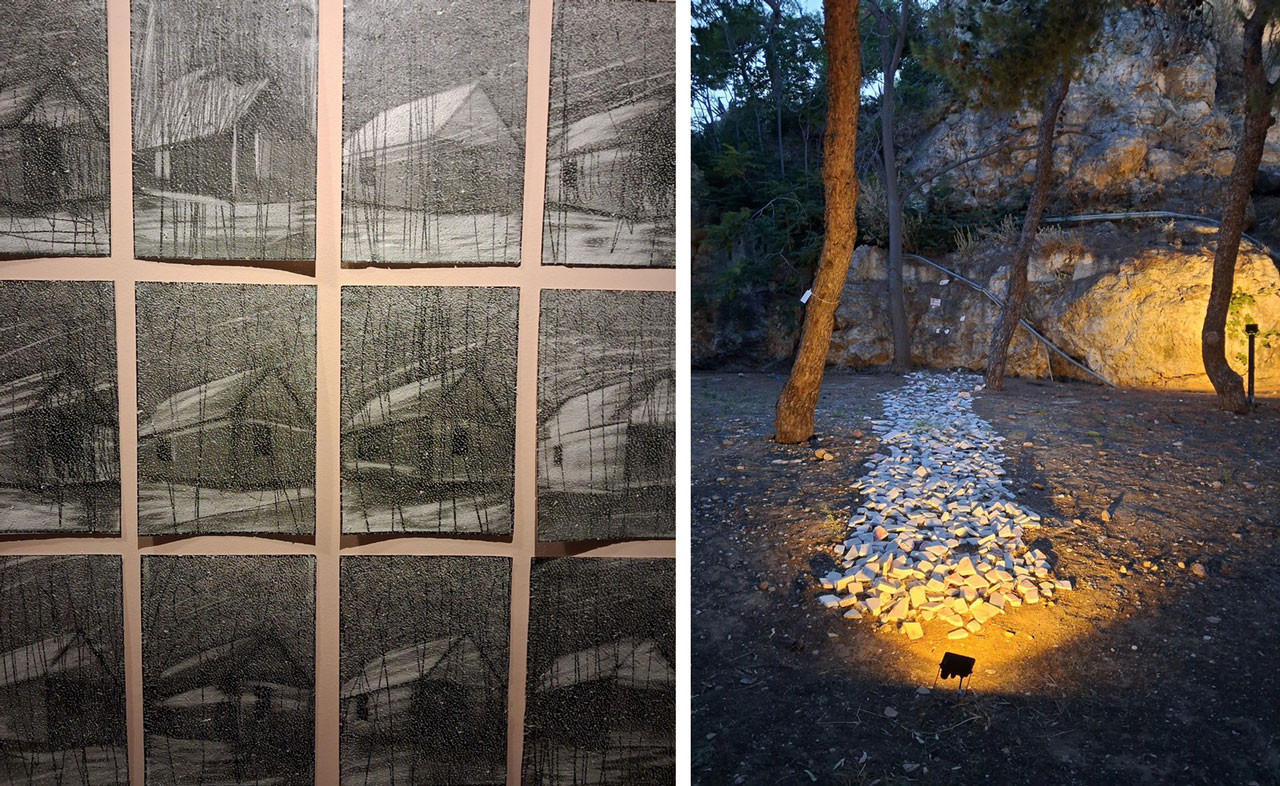
Right: Koulourás Panagiotis, “At Tikhon’s” (“У Тихона”), 2011, Installation, Marble and oil paint, Dimensions: Variable, Artwork © the artist, Photo: © & Courtesy Valia Katsimpa
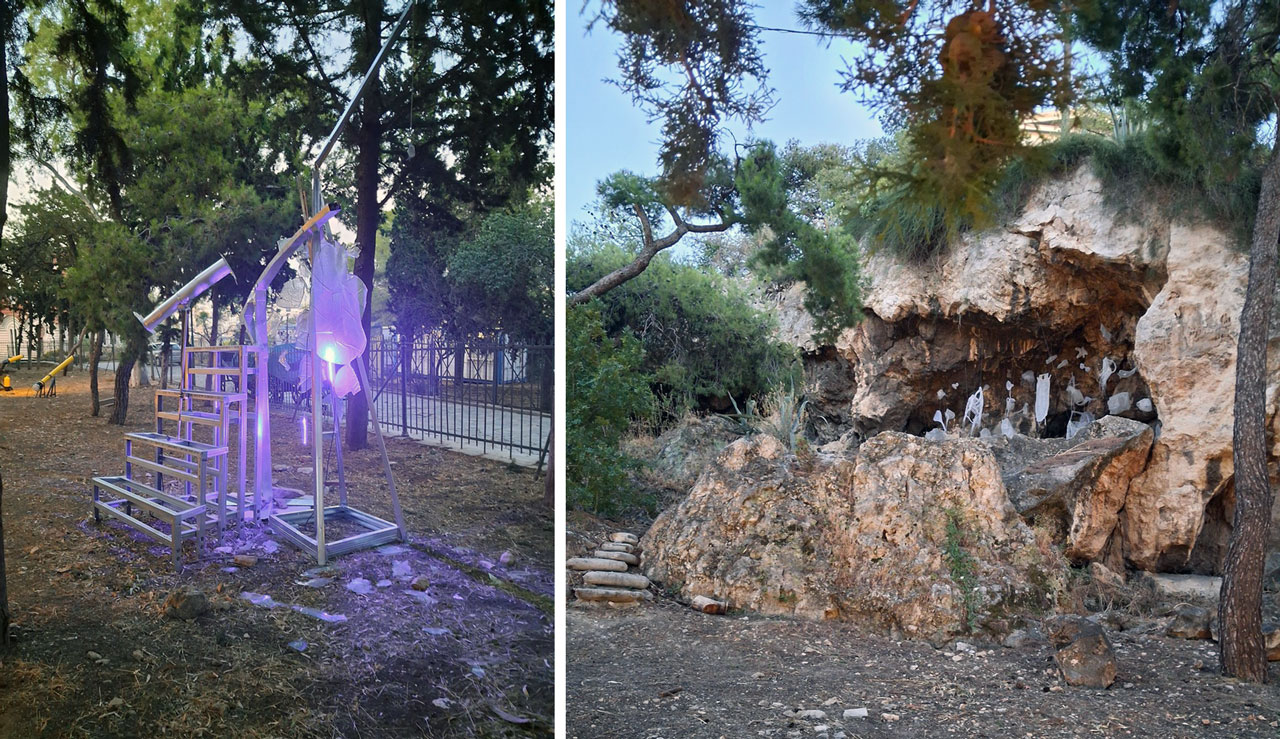
Right: Anna Provatari, enoikó (“to inhabit”), 2025–2026, installation, hot glue and sealing silicone,, variable dimensions, Artwork © the artist, Photo: © & Courtesy Valia Katsimpa