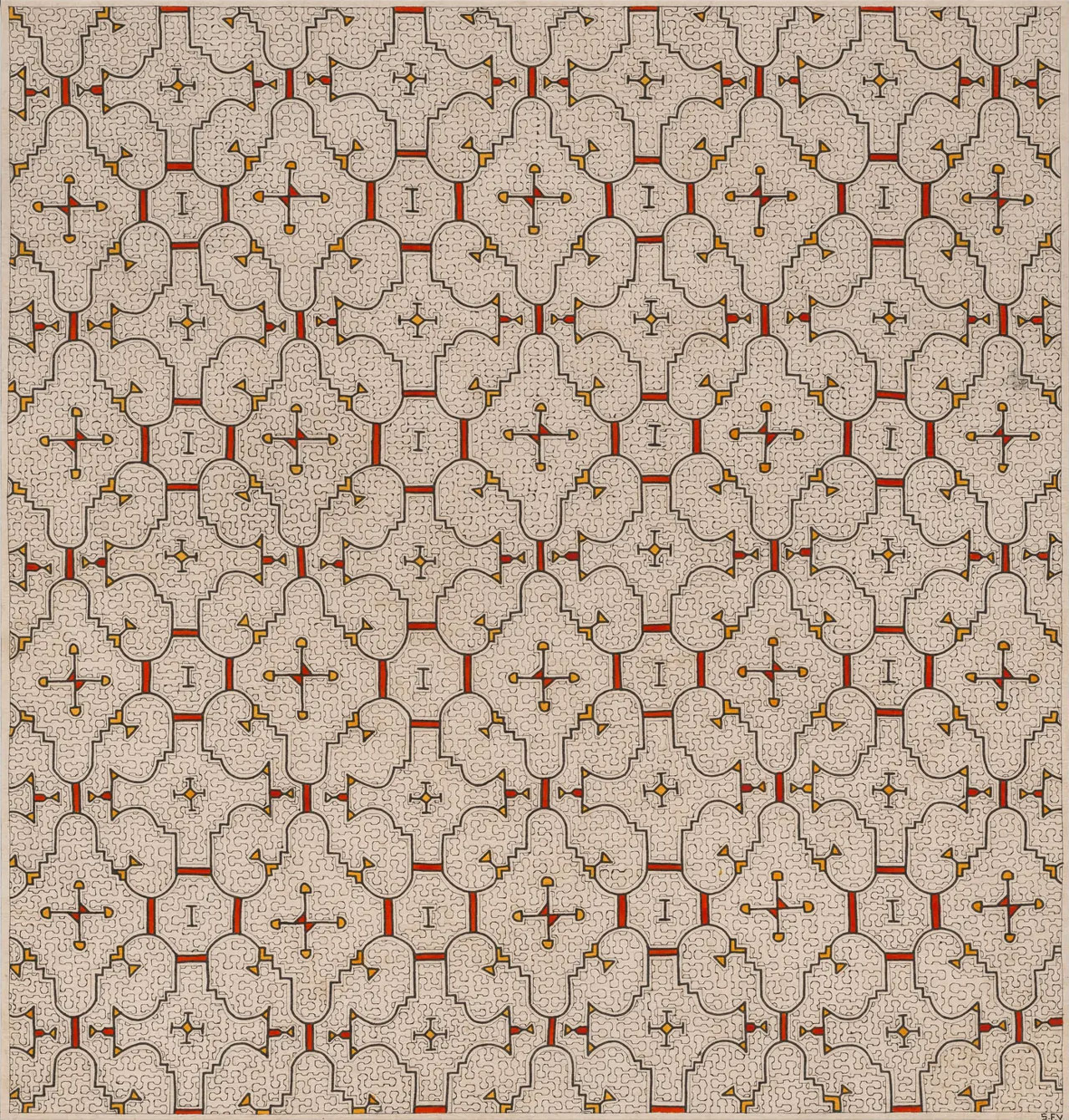
PRESENTATION:Sara Flores-Akinananti
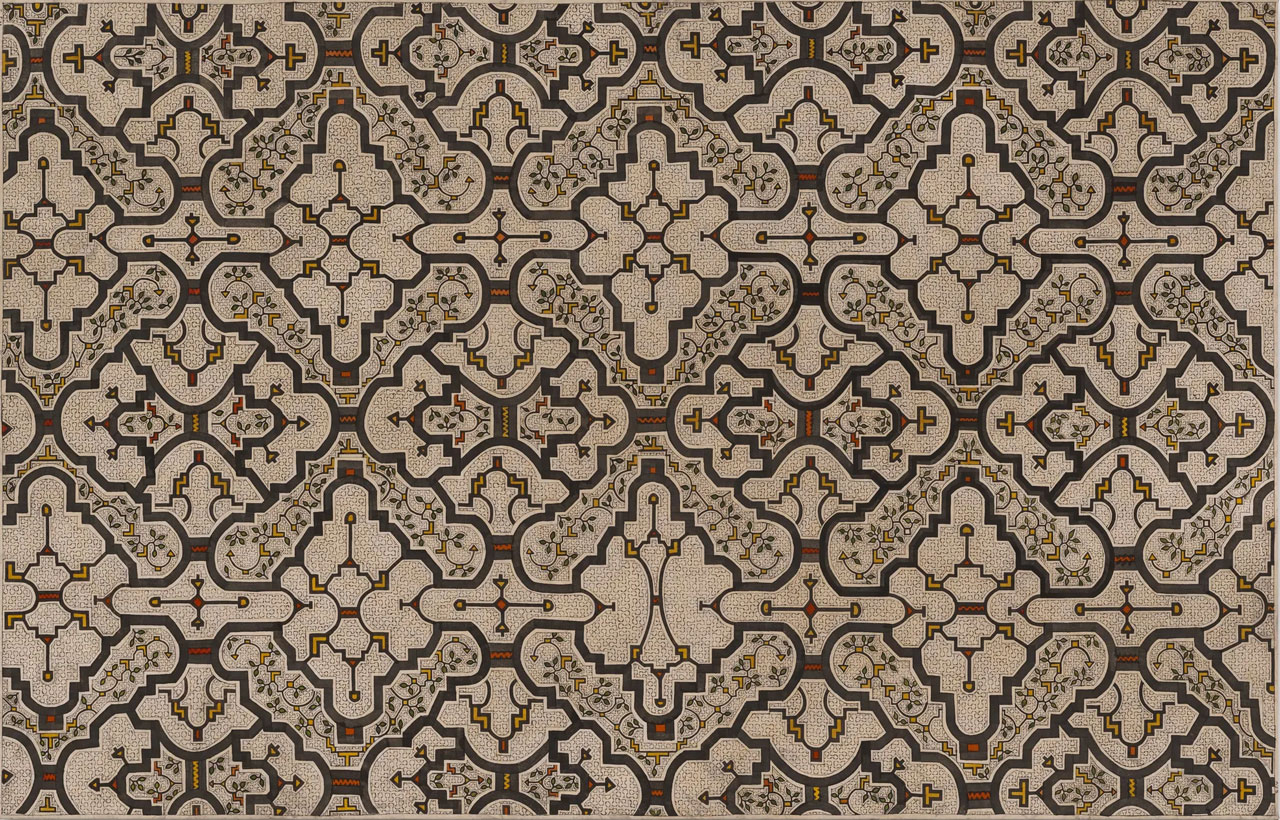
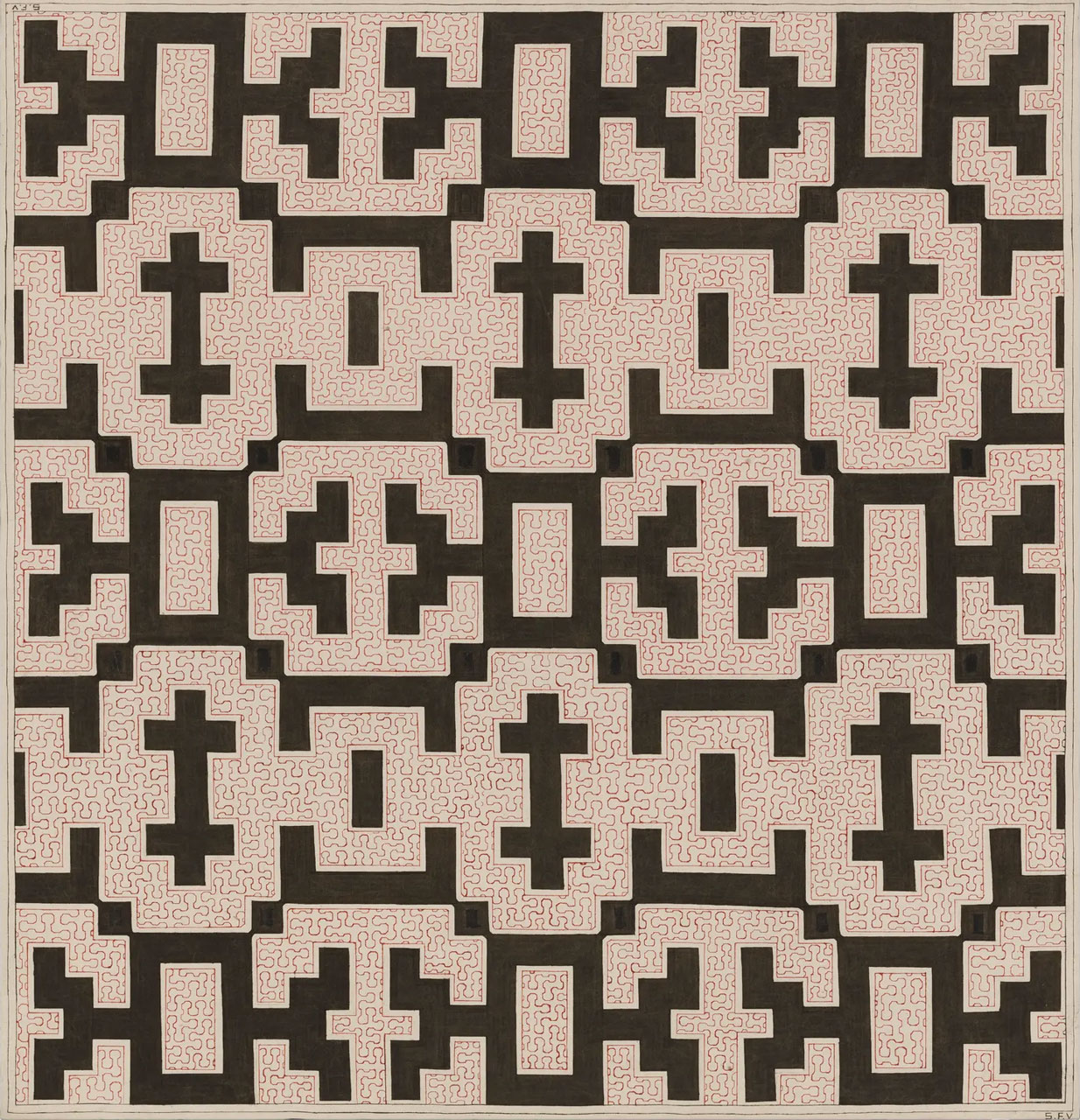
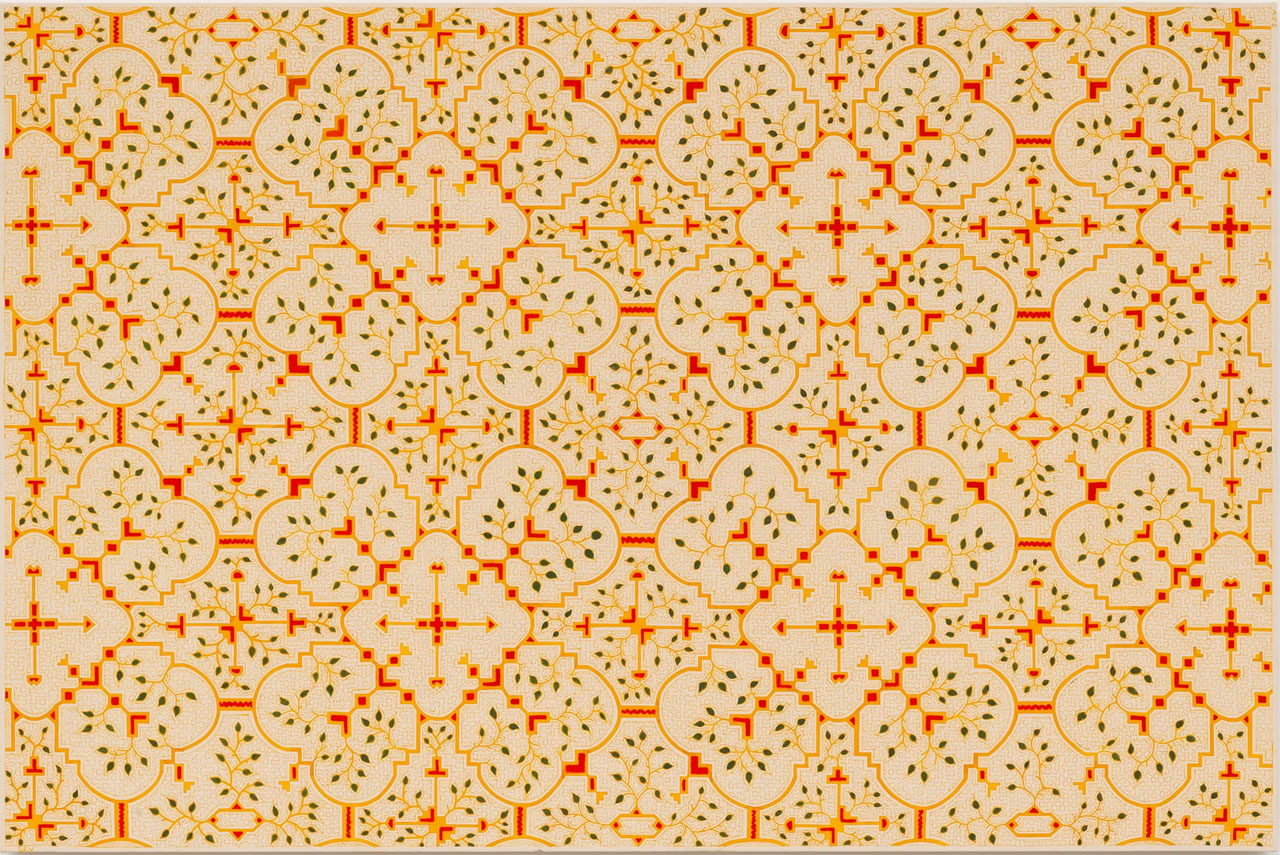
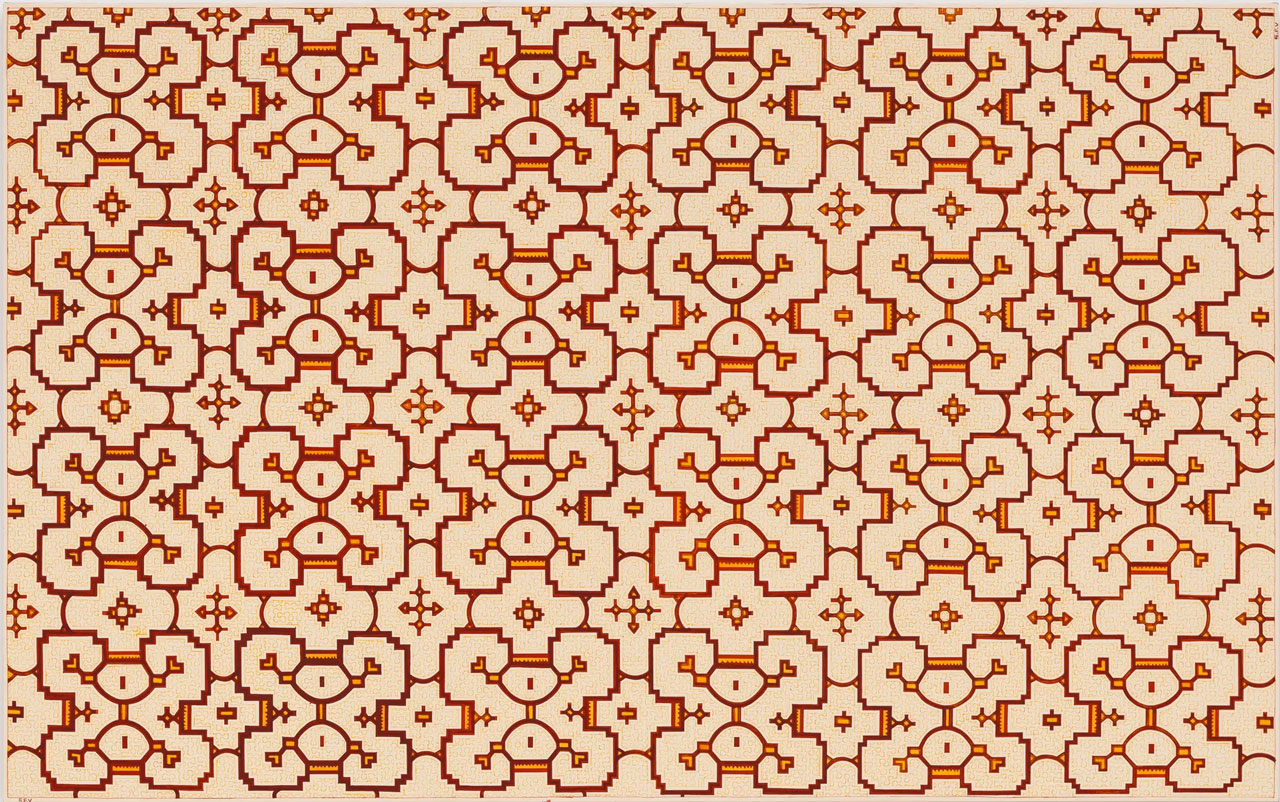
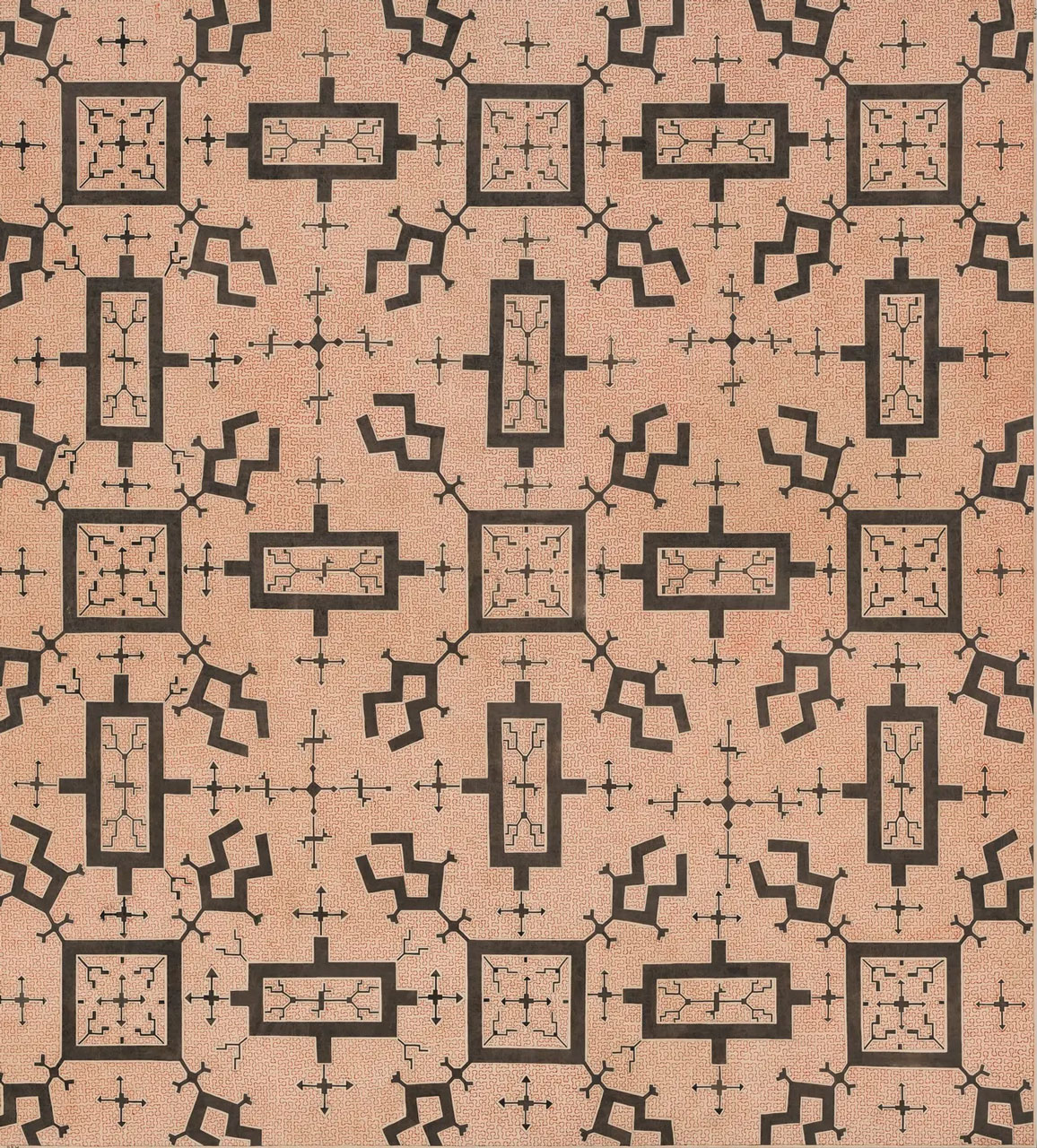
The complex, intricate geometric works of Peruvian artist Sara Flores express the practice of Kené – an ancient medium that is central to the artistic expression of the Shipibo-Konibo nation, an Indigenous people residing along the Ucayali River. Flores’s artistic praxis is rooted in the traditions of her ancestral and cultural heritage and informed by the interconnectivity of the Amazonian ecosystem.
By Dimitris Lempesis
Photo: White Cube Gallery Archive
Through the matrilineal and intergenerational practice of Kené, Sara Flores inherits both the technical knowledge and philosophical principles affiliated with the medium. She applies prepared natural dyes sourced from her immediate environment to create labyrinthine configurations that map neural, psychological, elemental and ecological networks.
“Akinananti” is a major solo exhibition that brings one of the Amazon’s most sophisticated visual traditions into dialogue with contemporary global art and showcases Flores’s masterful Kené works—complex geometric compositions created using natural pigments derived from bark, leaves, berries, and wild cotton gathered from the Amazon rainforest. Produced collaboratively with her daughters, these works embody a matrilineal artistic practice that has been transmitted across generations.
The exhibition’s title carries profound significance. In the Shipibo language, Akinananti refers to work undertaken collectively with love, joy, and mutual care. More than a description of artistic collaboration, it expresses a worldview grounded in reciprocity, interconnectedness, and communal flourishing. Within this framework, human well-being cannot be separated from the health of the community or the environment.
To describe Kené merely as decorative patterning would be to misunderstand its cultural and spiritual importance. For the Shipibo-Konibo people, Kené constitutes a visual language and cosmological system that appears across ceramics, textiles, body painting, healing practices, ritual song, and spiritual knowledge. Its intricate linear structures map relationships between human beings, plants, animals, spirits, and the wider Amazonian ecosystem.
Flores learned this tradition through the matrifocal transmission that characterizes Shipibo-Konibo culture. As she has explained, Kené was passed down through grandmothers, mothers, and daughters, serving as both cultural memory and visual manifesto. While rooted in ancestral knowledge, her work demonstrates that tradition is not static. Instead, it evolves while maintaining continuity with its origins.
Today, Flores creates large-scale canvases that extend far beyond the functional textiles she learned to make as a child. Works such as “Untitled (A Window onto Endlessness) 2” (2025), measuring nearly five meters wide, transform Kené from wearable object into immersive contemporary painting without abandoning its cultural foundations.
In his commissioned essay for the exhibition, art critic Charles Darwent situates Flores within a broader history of modern art by drawing a compelling comparison to Josef Albers and Anni Albers.
Darwent recalls how the Alberses traveled repeatedly to Mexico beginning in 1935, becoming fascinated by pre-Hispanic textiles, ceramics, and carvings. Rather than viewing these objects as ethnographic artifacts, they recognized in them many of the same principles they championed at the Bauhaus: material honesty, formal economy, abstraction, and the dissolution of boundaries between art and craft. For the Alberses, Indigenous makers had anticipated modernist concerns centuries before European modernism articulated them.
This comparison becomes a lens through which to understand Flores’s practice. Like the pre-Columbian artists admired by the Alberses, Flores arrives at forms that resonate strongly with modernist abstraction while emerging from entirely different cultural and intellectual traditions. Her geometric networks, expanding rhythmically across vast canvases, evoke the visual languages of abstraction without being derived from them. Instead, they emerge from Shipibo-Konibo cosmology and lived experience.
One of the most striking observations in Darwent’s essay concerns Flores’s childhood memory of lying beneath a mosquito net and tracing imaginary Kené designs across its woven mesh. The anecdote suggests an unexpected convergence between Indigenous visual knowledge and one of modernism’s defining formal devices: the grid.
Standing before Flores’s paintings, viewers often encounter works that feel remarkably contemporary. Their structured repetitions, optical rhythms, and algorithmic growth patterns invite comparisons with artists such as Bridget Riley and Tess Jaray, both of whom explored pattern, perception, and generative systems. Yet Flores arrived at these visual solutions independently, through inherited cultural knowledge rather than engagement with Western art history.
Her process reflects this balance between structure and discovery. Beginning with a simple drawing, she develops curves, turns, and extensions until the pattern expands across the entire surface. The system is disciplined yet open-ended; the artist knows and does not know where the work will ultimately lead. The resulting compositions exist between control and improvisation, tradition and revelation.
Flores’s growing international prominence also reflects broader changes in the art world. For decades, Indigenous artists were frequently categorized as makers of “folk” or “ethnographic” objects rather than participants in contemporary artistic discourse.
In Peru, institutional recognition came remarkably late. In 2025, at the age of seventy-five, Flores became the first Indigenous artist to receive a solo exhibition at the Museo de Arte de Lima, marking a historic shift within one of the country’s leading cultural institutions.
The significance of Flores’s work extends beyond aesthetics. Her practice remains deeply connected to the Amazon rainforest, whose plants provide both material resources and cultural meaning. Natural dyes extracted from species such as yacushapana, amí, achiote, and guisador become integral components of the artistic process. The preparation of pigments is inseparable from ecological knowledge and spiritual practice.
Photo: Sara Flores, Untitled (Pei Maya Kené, 2025) 2025, Vegetal dyes on wild-cotton canvas, 137.8 x 214.9 cm | 54 1/4 x 84 5/8 in., © Sara Flores, courtesy the artist and White Cube Gallery
Info: White Cube Gallery, 1002 Madison Avenue, New York, NY, USA, Duration: 25/6-14/8/26, Days & Hours: Tue-Sat 10:00-18:00, www.whitecube.com/