PRESENTATION:Karen Kilimnik
For more than four decades, Karen Kilimnik has occupied a singular position in contemporary art. Since the late 1970s, she has worked across an unusually broad range of media, including drawing, painting, collage, photography, video, installation, and her distinctive mise-en-scène sculptures. Yet despite this diversity of forms, her work is guided by a remarkable conceptual consistency.
By Efi Michalarou
Photo: Galerie Eva Presenhuber
Galerie Eva Presenhuber present its ninth solo exhibition with Karen Kilimnik. Throughout her career, Kilimnik has assembled and reconfigured an immense visual archive that draws from European art history, aristocratic culture, romantic landscape painting, military imagery, celebrity culture, fashion, cinema, television, and popular mythology. Rather than presenting these references as straightforward quotations, she transforms them into a fluid network of recurring cultural images that drift across time and reappear in unexpected contexts.
Born in Philadelphia in 1955, Kilimnik emerged during the late 1980s with installations that combined photocopies, found objects, photographs, clothing, and fragments of popular culture in environments that seemed simultaneously chaotic and carefully orchestrated. These early works already revealed her fascination with glamour, celebrity, historical memory, and fantasy. Over time, painting became an increasingly important aspect of her practice, although she continued to move freely between media. Critics have frequently noted her ability to dissolve the boundaries between high and low culture, combining references to Old Master painting with images drawn from magazines, television, and contemporary celebrity culture.
One productive way to understand Kilimnik’s recent work is through the concept of glamour. In everyday language, glamour often refers to luxury, beauty, and social prestige. Yet the term possesses a much deeper history. Derived from the Scottish word glamer, glamour originally referred to a magical spell that altered perception and made the world appear more beautiful than it really was. Its linguistic roots can be traced even further back to the word “grammar,” which in the Middle Ages was associated with specialized knowledge and sometimes even occult power. Glamour therefore concerns not merely beauty but the ability to manipulate appearance itself—to create a compelling illusion that captivates the viewer. This older meaning provides a key to Kilimnik’s art. Her works consistently explore the seductive power of images while simultaneously exposing their artificial construction.
The exhibition’s central sculptural work, “Bouquet Mt Olympus” (2026), embodies this tension. A lavish arrangement of flowers displayed on an elegant Sheraton-style satinwood table immediately recalls the rich tradition of European floral still-life painting. The work evokes the paintings of seventeenth-century Dutch masters such as Rachel Ruysch and Jan Davidsz. de Heem, artists who transformed bouquets into displays of technical virtuosity and visual abundance. Yet floral still lifes historically carried a double meaning. Alongside their decorative appeal, they often functioned as vanitas images, reminding viewers of mortality and the inevitable passage of time.
Kilimnik’s bouquet appears at first to participate in this tradition, but closer inspection reveals an important difference: the flowers are artificial. The expected narrative of natural growth and decay disappears. Instead, beauty becomes a carefully staged illusion. The work shifts attention away from nature and toward representation itself. What appears organic is revealed to be manufactured, transforming the bouquet into a meditation on glamour as aesthetic deception.
This artificial bouquet also recalls the historical role of floral arrangements within spaces of social display. Flowers traditionally occupy transitional zones such as entrance halls, salons, and hotel lobbies, where they signal hospitality, refinement, and prosperity. They function as visual markers of care and cultivation. In this sense, floral arrangements participate in the architecture of social performance, helping to shape how a space is perceived. Kilimnik’s bouquet draws attention to this representative function, suggesting that beauty itself can operate as a form of cultural staging.
The paintings in the exhibition’s first room develop this theme through depictions of luxurious interiors. Works such as “Hotel de Paris, the royal suite foyer – 1940s the Riviera or 1830s France” (2015), “world of perfection, the hotel de Paris, Monte Carlo” (2015), and “The Egerton House hotel, London – tea time” (2007) present ornate rooms filled with flowers, decorative furniture, and aristocratic architectural details. These interiors evoke both nineteenth-century decorative painting and the fantasy spaces of luxury hotels. Yet the temporal coordinates remain deliberately unstable. Historical periods merge together, creating spaces that feel simultaneously real and imagined.
Art historically, these works recall the Dutch tradition of interior painting developed by artists such as Pieter de Hooch and Gerard ter Borch, who used domestic spaces to visualize social order and cultural refinement. Kilimnik appropriates this tradition but transforms it into something far less stable. Her interiors resemble theatrical sets where aristocratic aesthetics, tourism, nostalgia, and fantasy intersect. They are not records of actual places but stages upon which cultural desires are performed.
The relationship between illusion and desire becomes even more apparent in works such as “the mirror of the Indian Ocean” (2015) and “island of the flower rulers” (2025). In the former, an ornate mirror floats against a seascape. The mirror functions as a classical metaphor for painting itself, suggesting reflection, projection, and illusion. In the latter work, an island appears in the distance beyond a beach scattered with flowers, including a conspicuously non-tropical tulip. The tulip’s presence disrupts any claim to realism and emphasizes the fictional nature of the scene. These paintings participate in a long history of imagined paradises and exotic destinations, while simultaneously exposing their construction as cultural fantasies. They evoke the dream of escape that has accompanied tourism and travel imagery since the nineteenth century.
The exhibition’s central gallery focuses on Kilimnik’s recent canvases and collages. These works emerge through a layered process in which collaged source images are transferred onto canvas and subsequently reworked with paint, crystals, and gold accents. Throughout her career, collage has been essential to Kilimnik’s practice. She collects visual fragments from disparate sources and reassembles them into new pictorial worlds. The resulting images are neither straightforward appropriations nor historical quotations. Instead, they function as hybrid constructions in which multiple temporalities coexist.
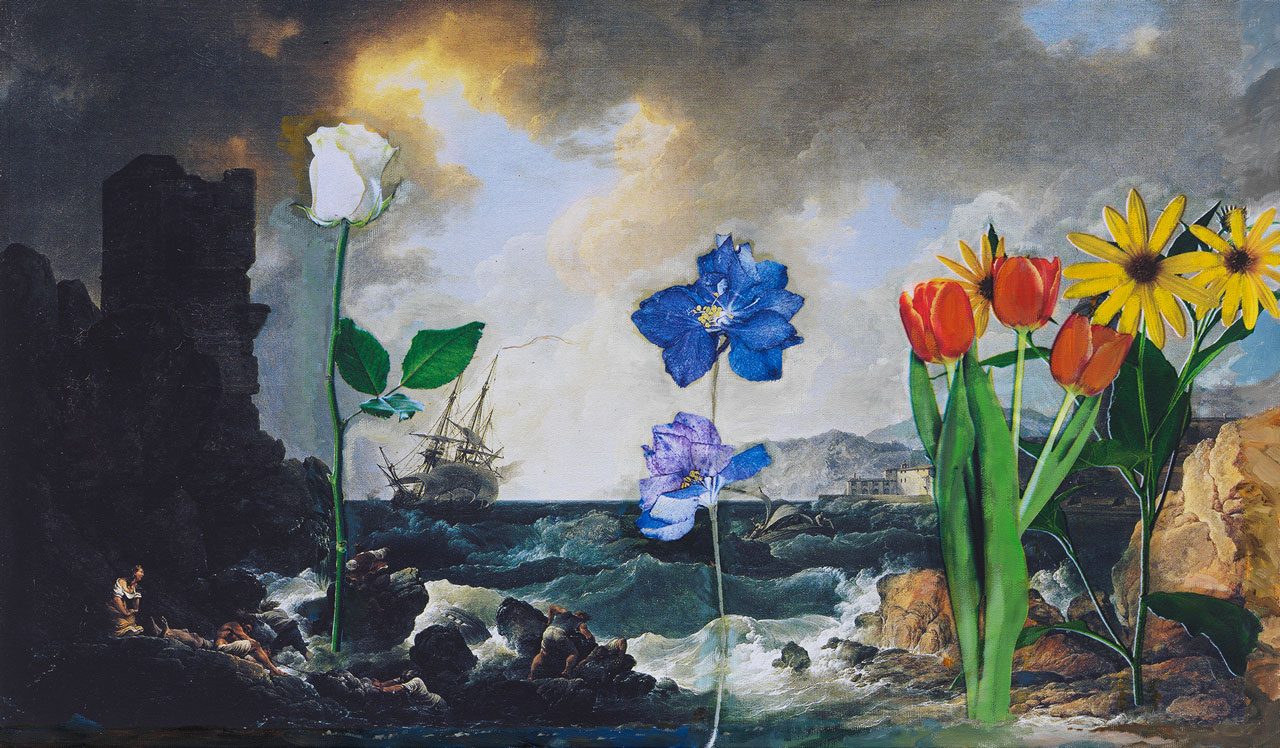
In “fairy valley” (2026), Kilimnik reimagines Philip James de Loutherbourg’s eighteenth-century landscape “Dovedale in Derbyshire”. While the original painting occupies an important position between classical landscape painting and Romanticism, Kilimnik disrupts its atmospheric illusionism by inserting brightly colored floral motifs into the foreground. These decorative forms interrupt the landscape’s depth and draw attention to the painting’s surface. Nature becomes a theatrical backdrop rather than a transparent representation of reality.
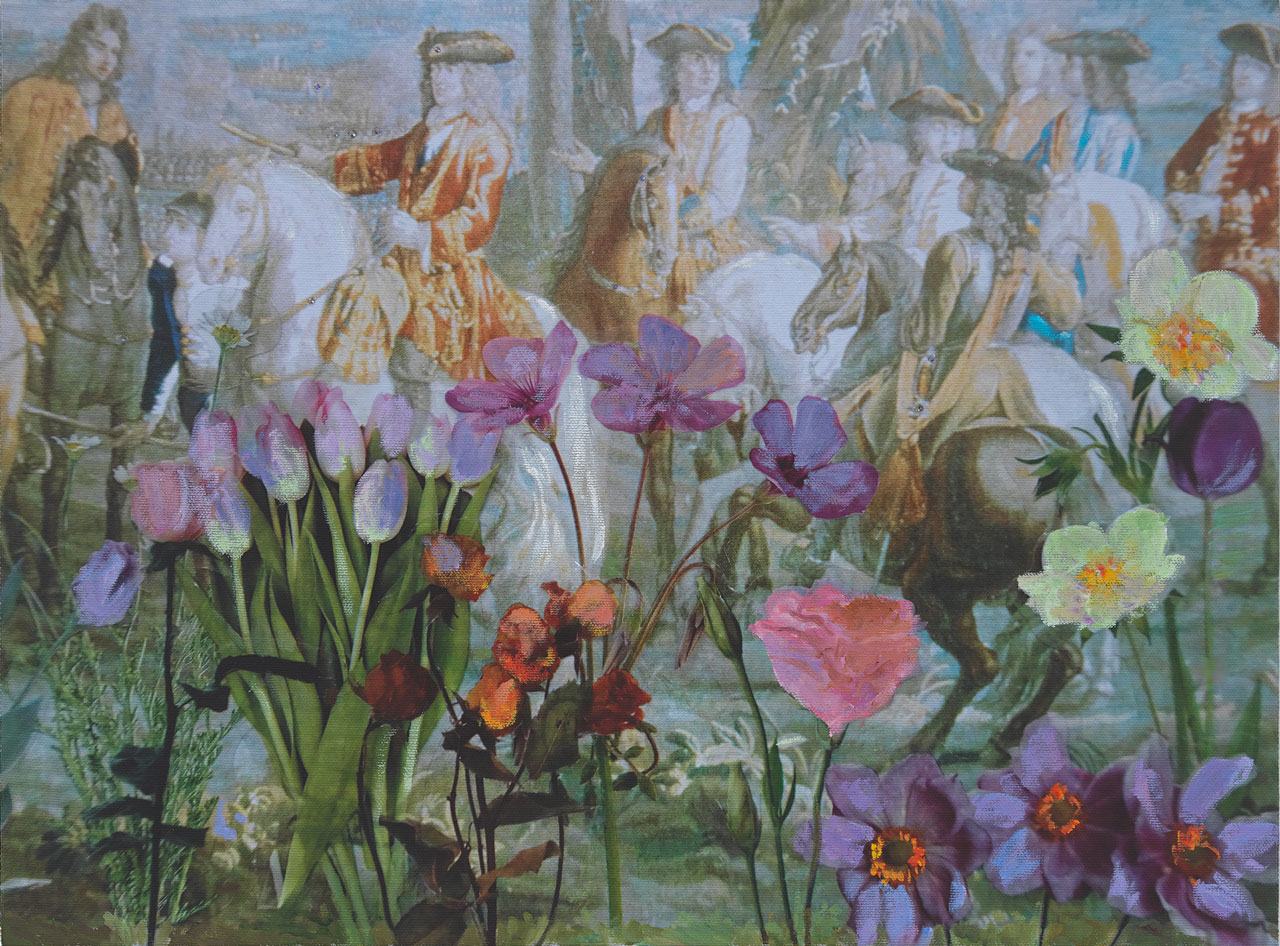
A similar strategy appears in “procession, Flower rulers village, the city” (2026), which references Gerard ter Borch’s depiction of Dutch diplomat Adriaen Pauw entering Münster during the negotiations that led to the Peace of Westphalia. The historical painting celebrates political order and diplomatic achievement. Kilimnik overlays this scene with oversized flowers and ornamental vegetation, destabilizing its authority. The work raises intriguing questions about power, memory, and utopian possibility. The floral interventions may be read as symbols of peace, fantasy, or resistance to the rigid structures embodied by the historical image.
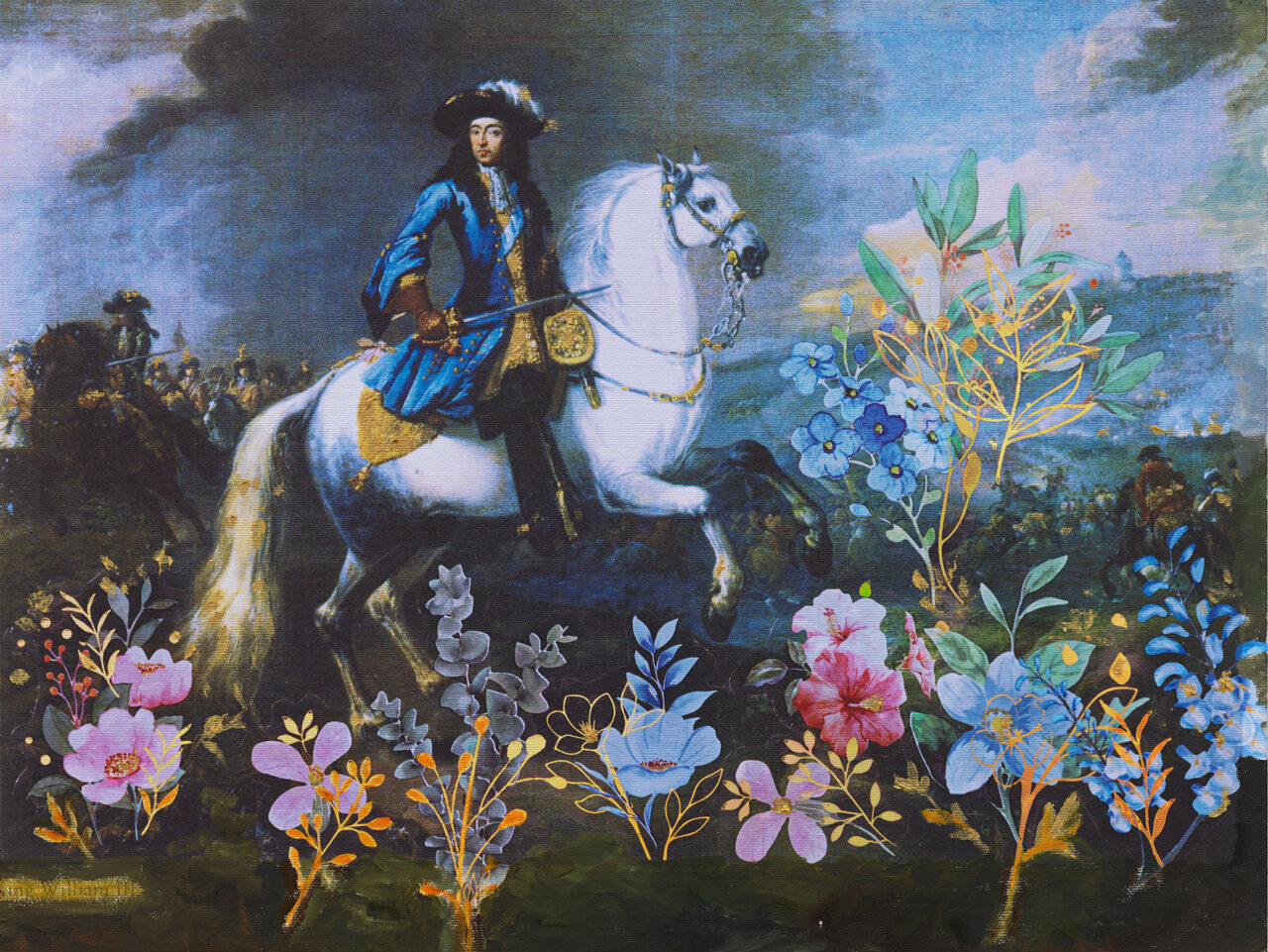
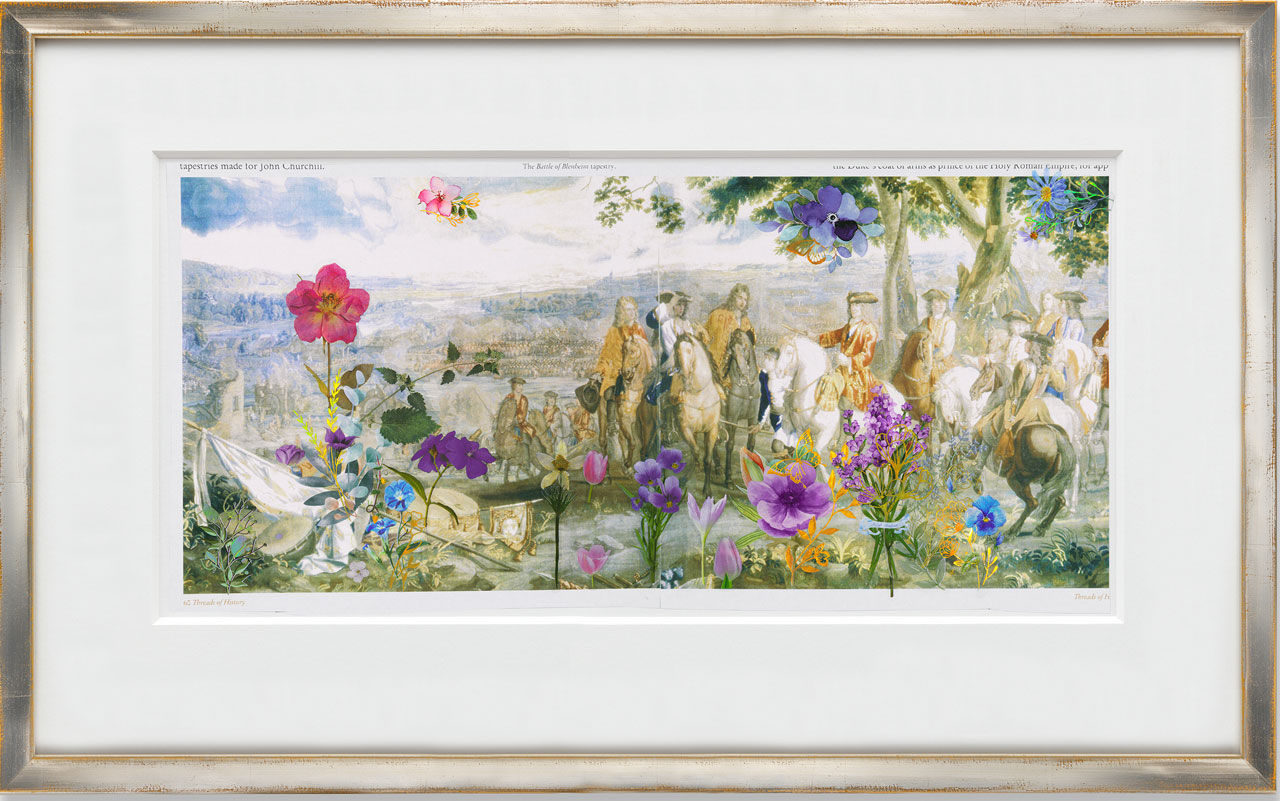
Military imagery receives similar treatment in “The Battle of Flower Lane” (2026) and “The Field Marshall” (2026). Both works draw upon historical representations of warfare and political authority, yet Kilimnik inserts decorative floral elements that undermine their original heroic narratives. Flowers spread across scenes of military organization, softening claims to power and transforming instruments of domination into ornamental spectacles. This strategy recalls her longstanding interest in the relationship between beauty and violence. The juxtaposition of flowers and warfare creates an ambiguity that refuses simple interpretation.
The titles of these works add another layer of complexity. Terms such as “The Field Marshall” and “advanced field camouflage” introduce military language into otherwise idyllic scenes. Camouflage becomes both a military tactic and an aesthetic principle. Beauty itself functions as camouflage, concealing and revealing meanings at the same time. The works suggest that glamour operates similarly: it seduces the eye while masking the structures beneath.
The exhibition concludes with a return to interior spaces. Paintings such as the “Swedish workroom “(2010) and “the cozy living room, the Cotswolds” (2017) reveal Kilimnik’s longstanding fascination with architecture and spatial design. Having studied architecture at Temple University, she remains acutely sensitive to the cultural meanings embedded within interiors. These paintings depict elegant rooms filled with furniture, fireplaces, and decorative details. Like the hotel interiors encountered earlier in the exhibition, they appear suspended between historical reconstruction and theatrical invention.
This ambiguity is particularly evident in a series of works from 2002 depicting variations of the same reading room overlooking a park. Through subtle changes in color, brushwork, and composition, Kilimnik transforms repetition into a form of continuous reinvention. The repeated motif becomes another kind of collage, demonstrating how images evolve through endless acts of reinterpretation.
Works such as “Elton John’s London home” (2010) and “Elton John’s London Living Room” (2010) further complicate these questions. Formally, the paintings resemble historical interiors, yet their titles anchor them within contemporary celebrity culture. Once again, Kilimnik collapses distinctions between past and present, aristocratic refinement and modern fame.
More than forty years into her career, Karen Kilimnik remains resistant to definitive interpretation. Her reluctance to explain her work contributes to its enduring fascination. Rather than offering clear messages, her images operate through suggestion, association, and atmosphere. Historical motifs return as cultural ghosts, drifting through contemporary consciousness. Glamour, fantasy, nostalgia, and art history merge into a visual language that is at once enchanting and unsettling. In an era saturated with images, Kilimnik reminds us that appearances are never innocent. They are constructions, performances, and forms of cultural power. Her art does not resolve these contradictions; it inhabits them, creating spaces where beauty and illusion become inseparable.
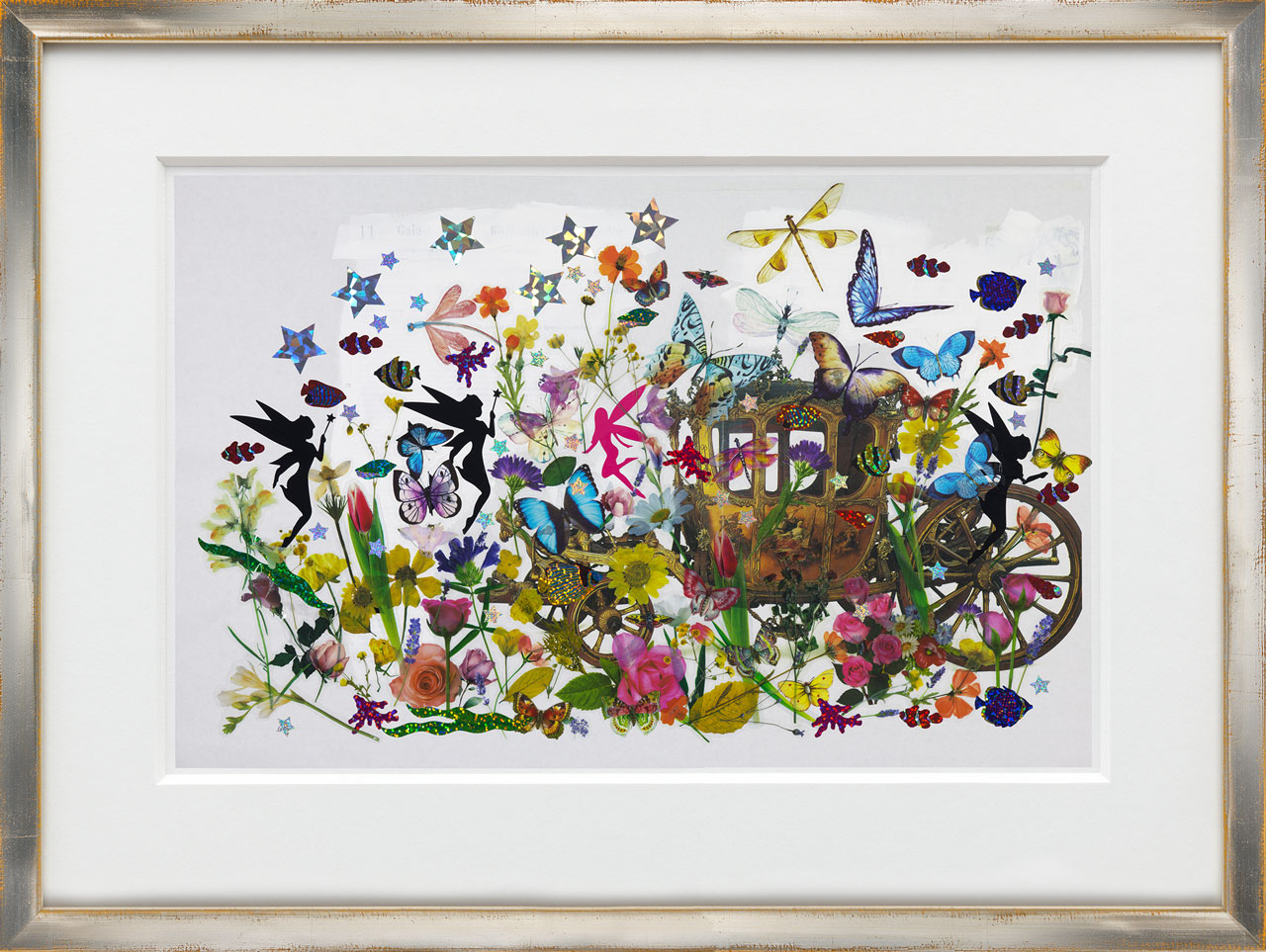
Photo: Karen Kilimnik, nature, 2025, Collage with adhesive stickers and acrylic on color xerox, Sheet 28 x 43 cm / 11 x 17 in, Frame 38.5 x 53 x 3 cm / 15 1/8 x 20 7/8 x 1 1/8 in, © Karen Kilimnik, Courtesy the artist and Galerie Eva Presenhuber
Info: Galerie Eva Presenhuber, Waldmannstrasse 6, Zurich, Switzerland, Duration: 12/6-24/7/2026, Days & Hours: Tue-Fri 11:00-18:00, Sat 11:00-17:00, www.presenhuber.com/
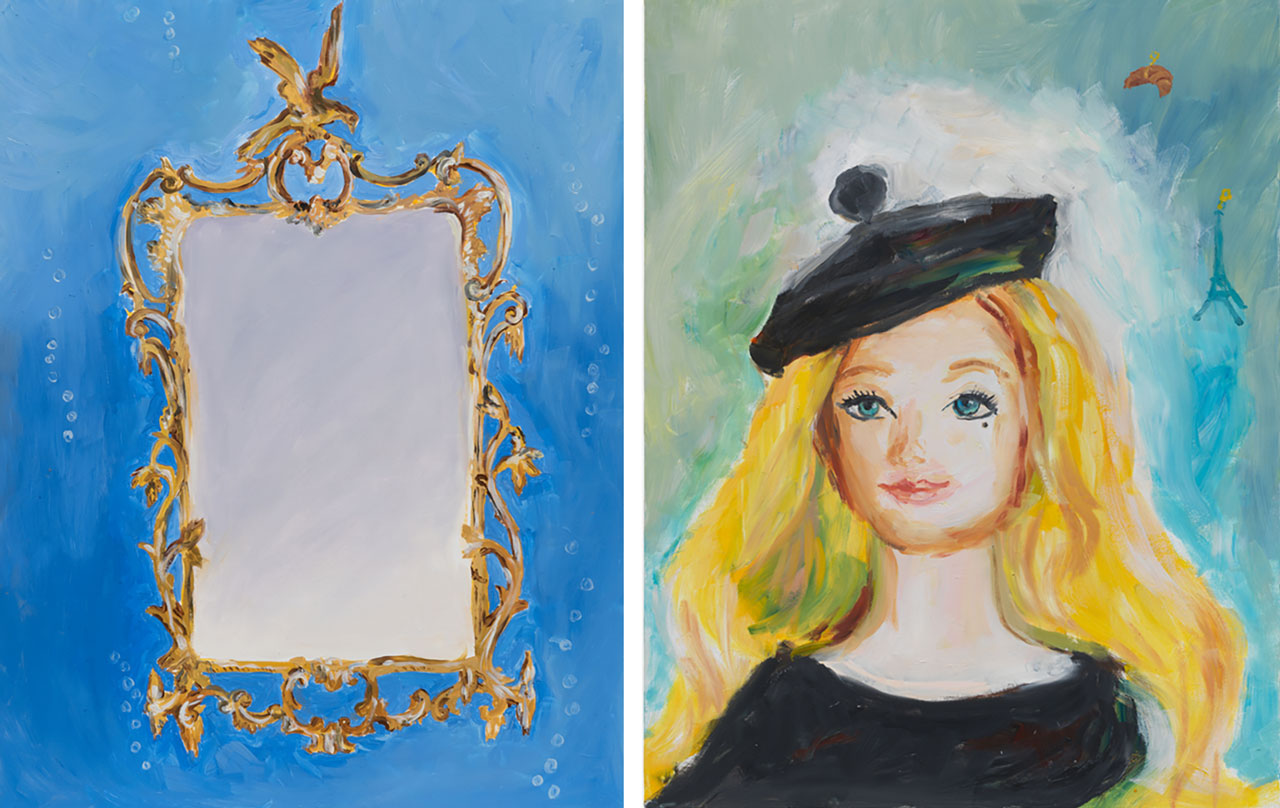
Right: Karen Kilimnik,, Miss France, the Mastermind, 2026, Water soluble oil color on canvas, 45.5 x 35.5 cm / 18 x 14 in, © Karen Kilimnik, Courtesy the artist and Galerie Eva Presenhuber
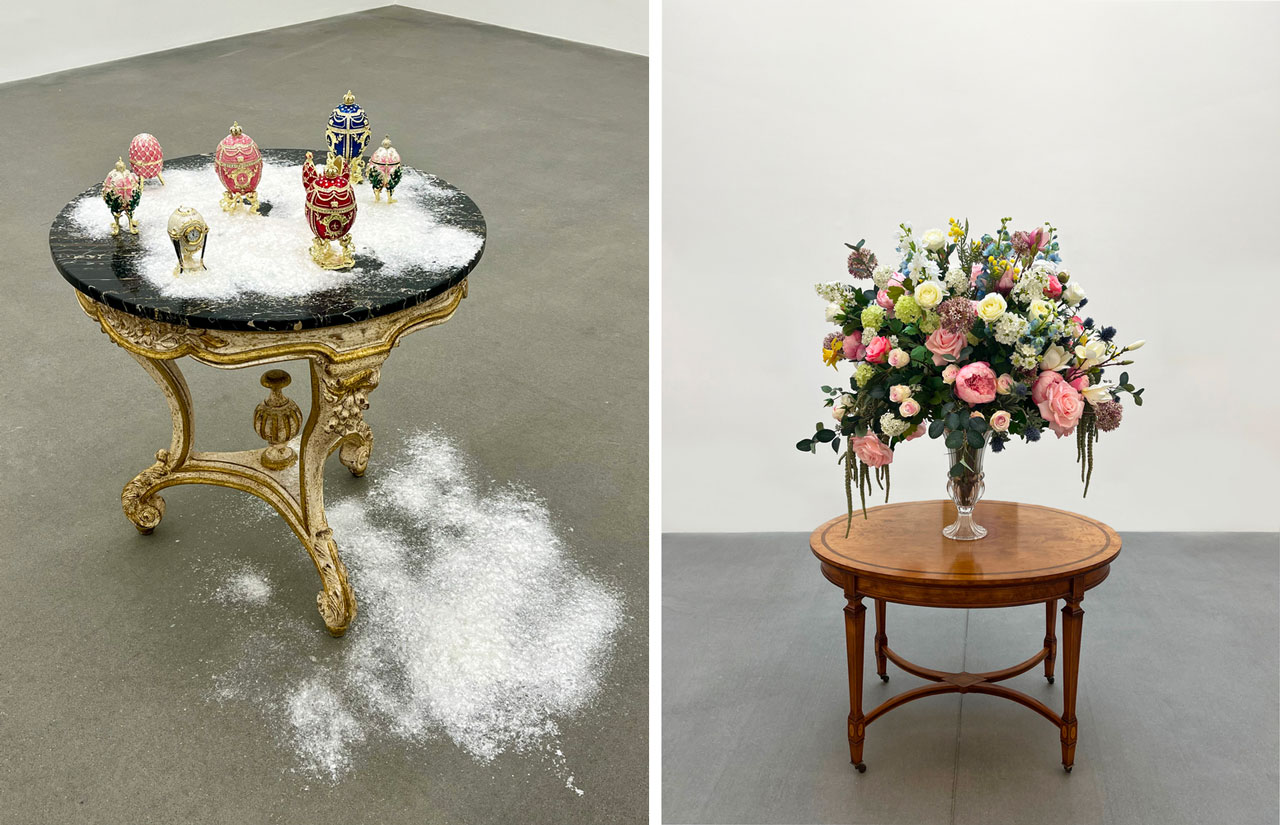
Right: Karen Kilimnik, flower Bouquet Mt Olympus, 2026, Artificial flowers in glass vase on ancient victorian table, Approx. 180 x 110 x 110 cm / 70 7/8 x 43 1/4 x 43 1/4 in, © Karen Kilimnik, Courtesy the artist and Galerie Eva Presenhuber
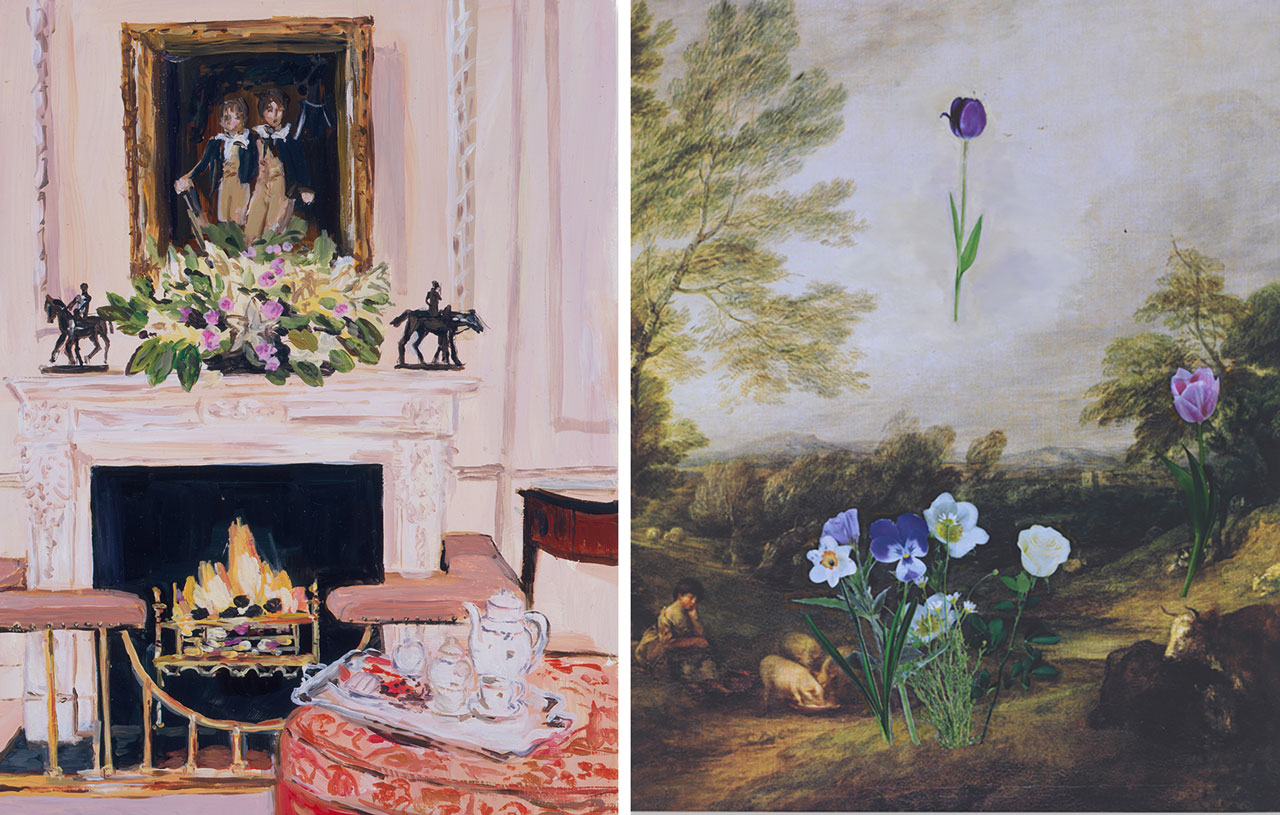
Right: Karen Kilimnik, The Queen of the tulips, 2026, Water soluble oil, acrylic and archival pigment print on primed canvas, 76 x 62 cm / 30 x 24 1/2 in, © Karen Kilimnik, Courtesy the artist and Galerie Eva Presenhuber