PRESENTATION: Cecily Brown-Picture Making
Cecily Brown makes paintings that give the appearance of being in continual flux, alive with the erotic energy of her expressive application and vivid color, shifting restlessly between abstract and figurative modes. as well as to popular culture, she commands an aesthetic that breaks from the strictures of narrative to achieve an extraordinary visual and thematic fluidity. Her vigorous treatment of the nude figure in particular reveals a commitment to wresting conventional subjects free from their anticipated contexts. Punctuating her visual shorthand with moments of startling clarity, Brown maintains an endless, active present.
By Dimitris Lempesia
Photo: Serpentine Galleries Archive
There is a particular charge that comes with seeing a painter return to their point of origin. For Cecily Brown, born in London in 1969 and a presence on the New York art scene for the past thirty years, the journey back to Kensington Gardens—where as a student she haunted the Serpentine galleries, absorbing exhibitions long before she could have imagined headlining one—carries the weight of full-circle narrative. “Picture Making” is being framed as a homecoming, though Brown’s career has hardly been in need of reclamation . What this exhibition offers instead is something more valuable: the chance to witness a major painter in sustained dialogue with the landscape of memory, with the motifs that have driven her practice for three decades, and with a medium she continues to approach with equal parts force, doubt, and pleasure .
The Serpentine’s pitch is deceptively straightforward: an exhibition shaped by the park’s peculiar mix of leisure, romance, and latent threat . Yet Kensington Gardens functions in Brown’s work less as a literal location than as a mental landscape—a space where the boundaries between bodies and their surroundings dissolve with characteristic restlessness. Themes of nature and park life have long structured Brown’s formal explorations, from amorous couples entangled in woodland glades to figures half-lost in undergrowth, and these subjects return here with renewed urgency .
What makes this iteration distinct is the framing. The park becomes a site of memory, mischief, and Britishness, filtered through three decades of American distance . Brown herself has spoken of the Serpentine’s significance to her younger self, describing her student visits to the gallery as formative experiences . There is, in this return, something approaching sentiment—though Brown’s sentimentality has always been tucked behind the veils of her brushwork, those restless, muscular passages that swell toward abstraction before resolving, just barely, into bodies, gestures, encounters.
The exhibition brings together new works created specifically for the Serpentine alongside a selection of key paintings dating back to 2001 . This chronological breadth is crucial to understanding Brown’s method, which is less about dramatic reinvention than about slow, persistent circling. The continuities across twenty-five years of work are striking: lovers pressed together in wooded settings, figures submerged in watery landscapes, scenes suspended between pastoral idyll and erotic charge recur across decades. Yet the repetition is not nostalgic. It suggests a testing of images, as if each return were an attempt to discover how far a motif can be stretched before it fractures.
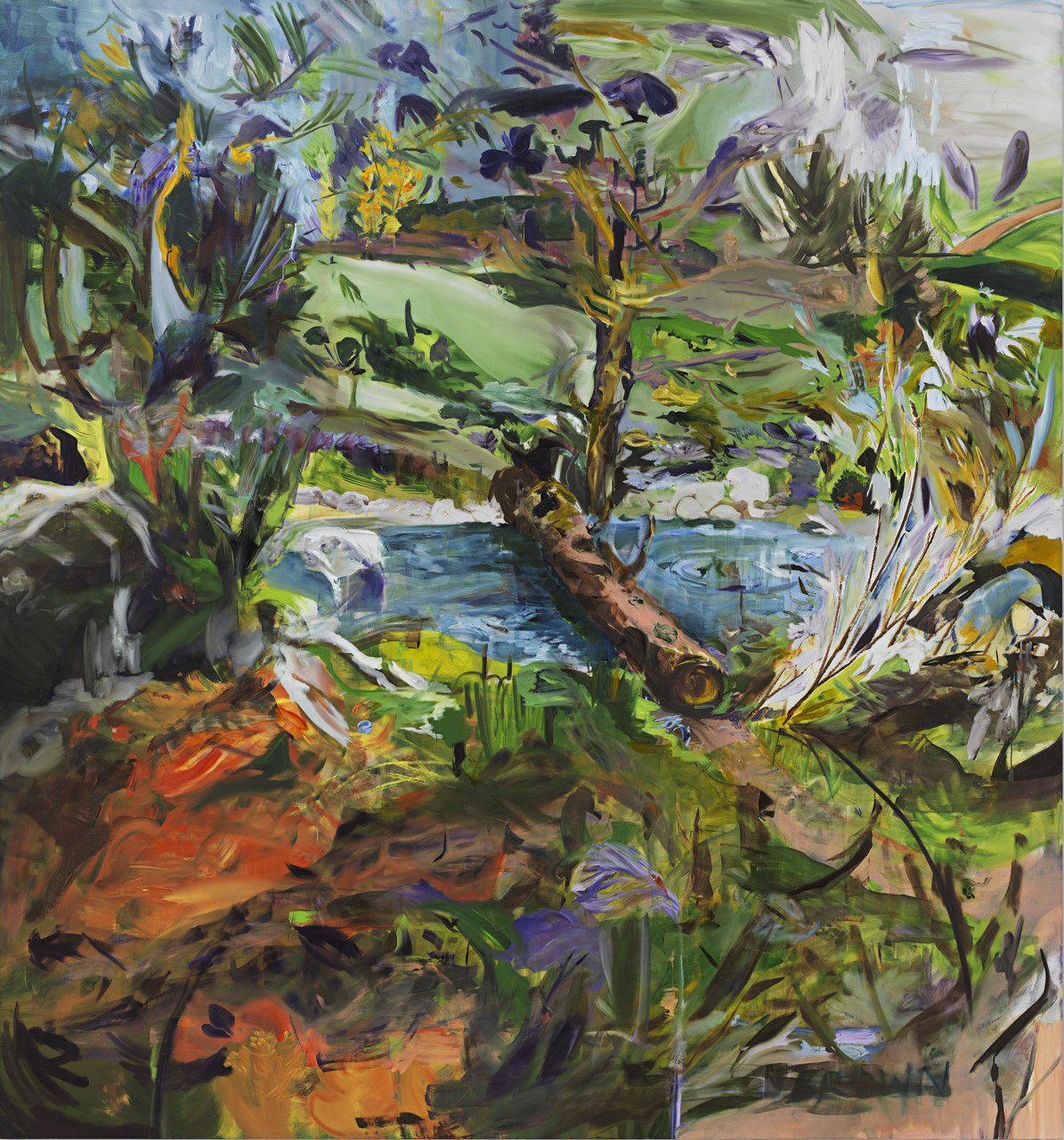
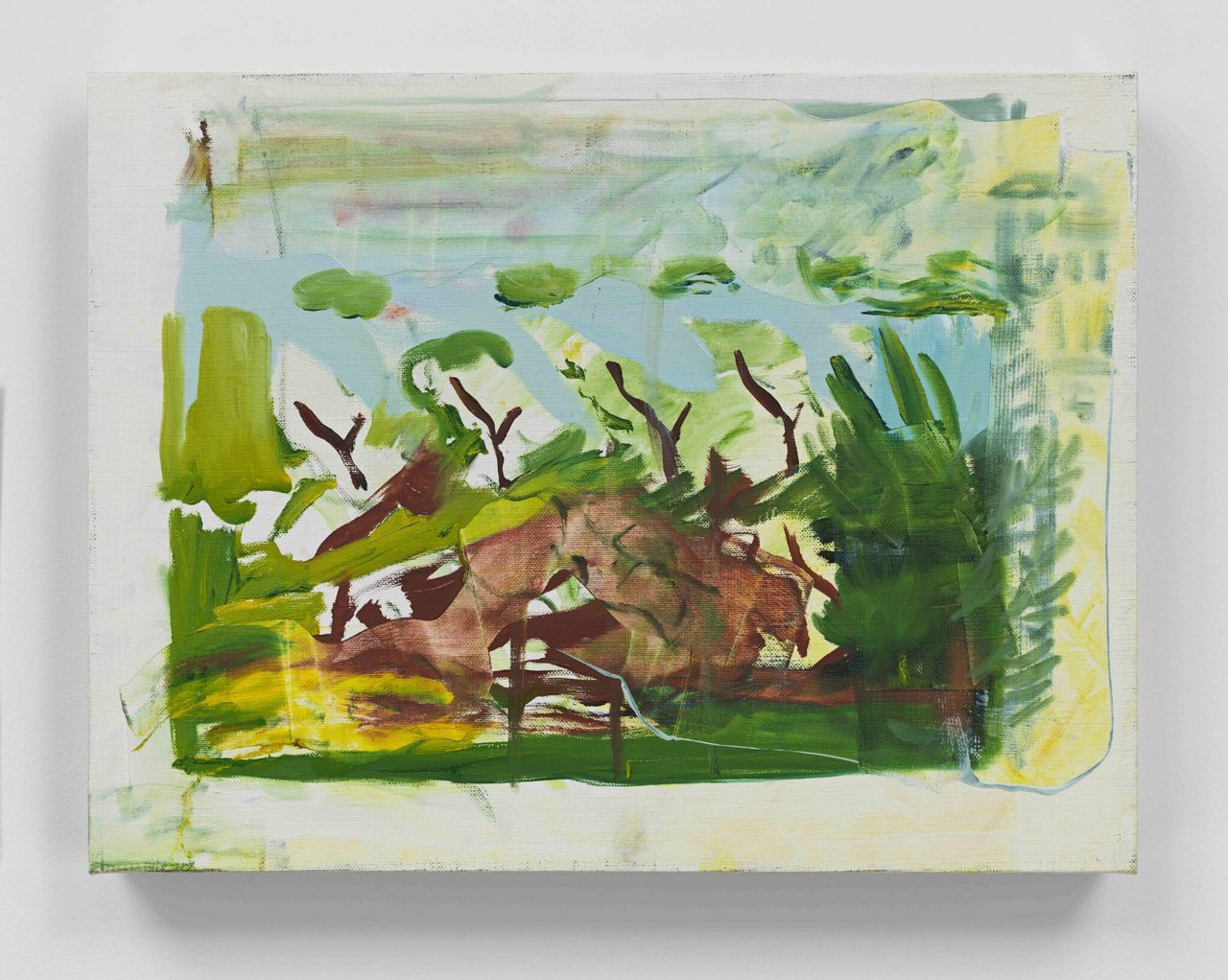
This approach is exemplified in a group of “nature walk” paintings made specifically for the exhibition. The series takes its starting point from a jigsaw puzzle illustration depicting a fallen log acting as a bridge over a river—a composition Brown reworks across different scales, formats, and palettes, treating the subject matter as the point of departure for infinite variation . The method speaks to Brown’s belief in variation as a mode of inquiry, a way of thinking through painting rather than arriving at a finished statement .
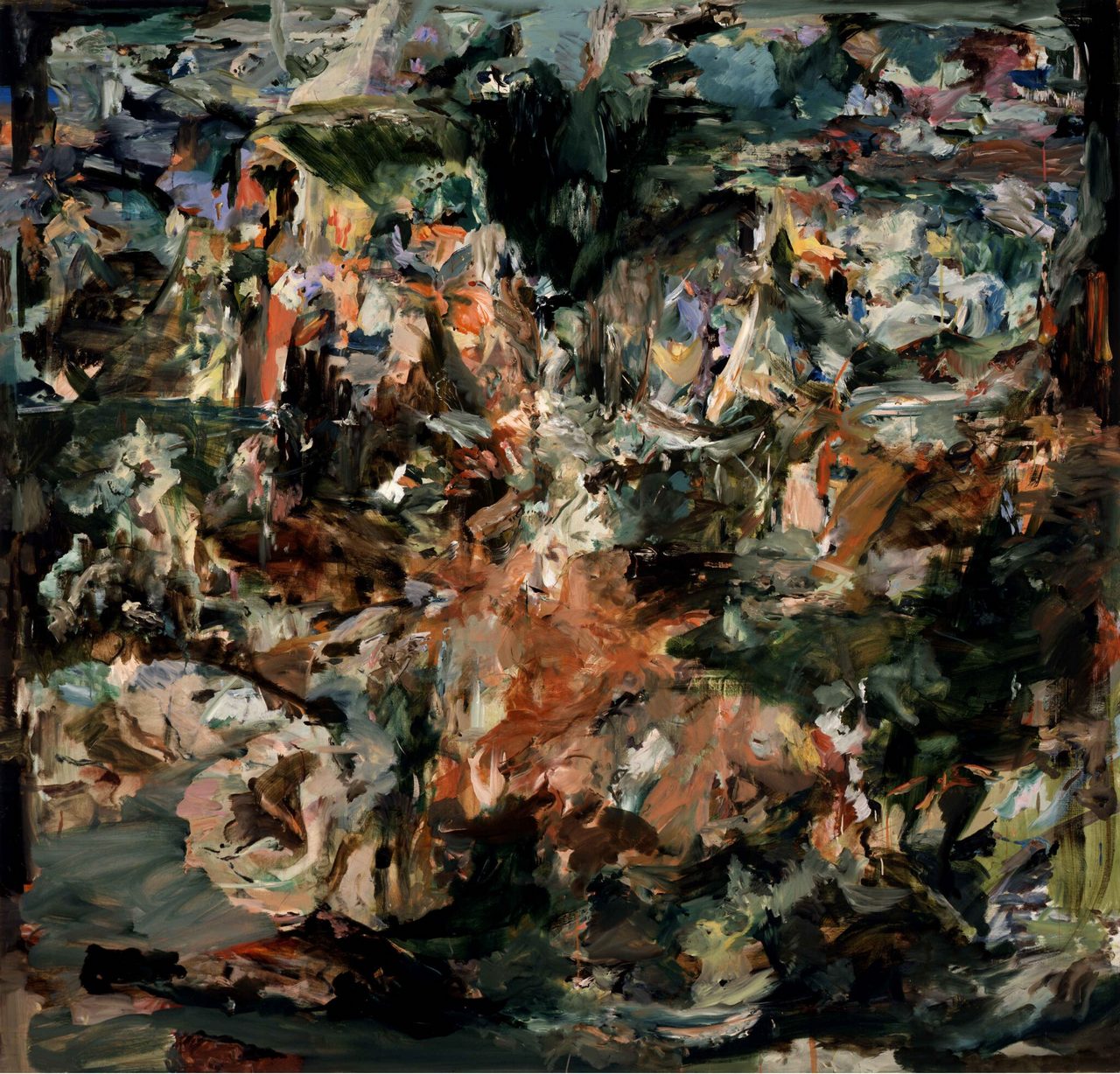
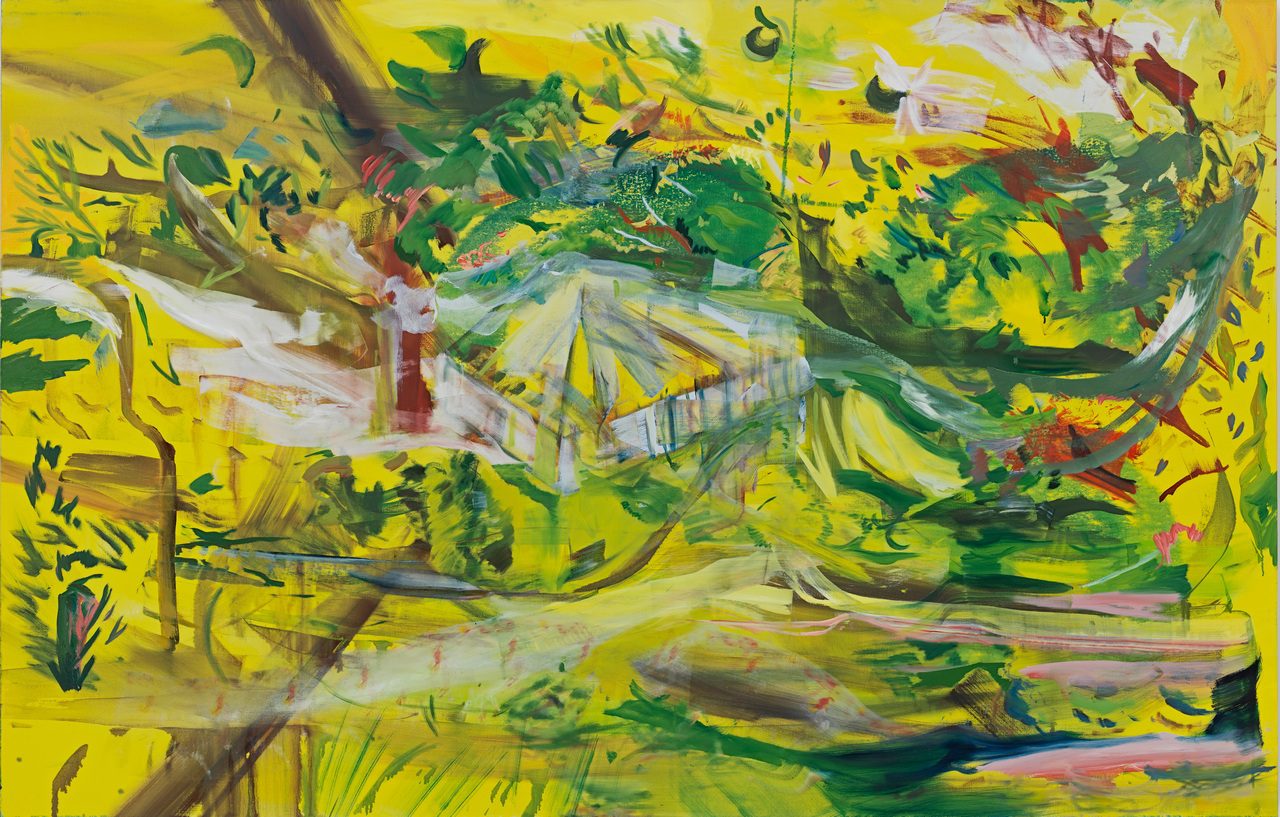
To stand before a Cecily Brown canvas is to encounter the visible record of a body in motion. Brown has long described painting as an intensely physical process led by the medium itself, and the works in “Picture Making” bear the traces of that engagement . In recent canvases such as “Froggy would a-wooing go: and “Little Miss Muffet” (both 2024–2025), perspective collapses under the weight of energetic brushstrokes. Small figures inspired by Victorian fairy paintings flicker at the edges of legibility, appearing and disappearing, thwarting any straightforward narrative interpretation .
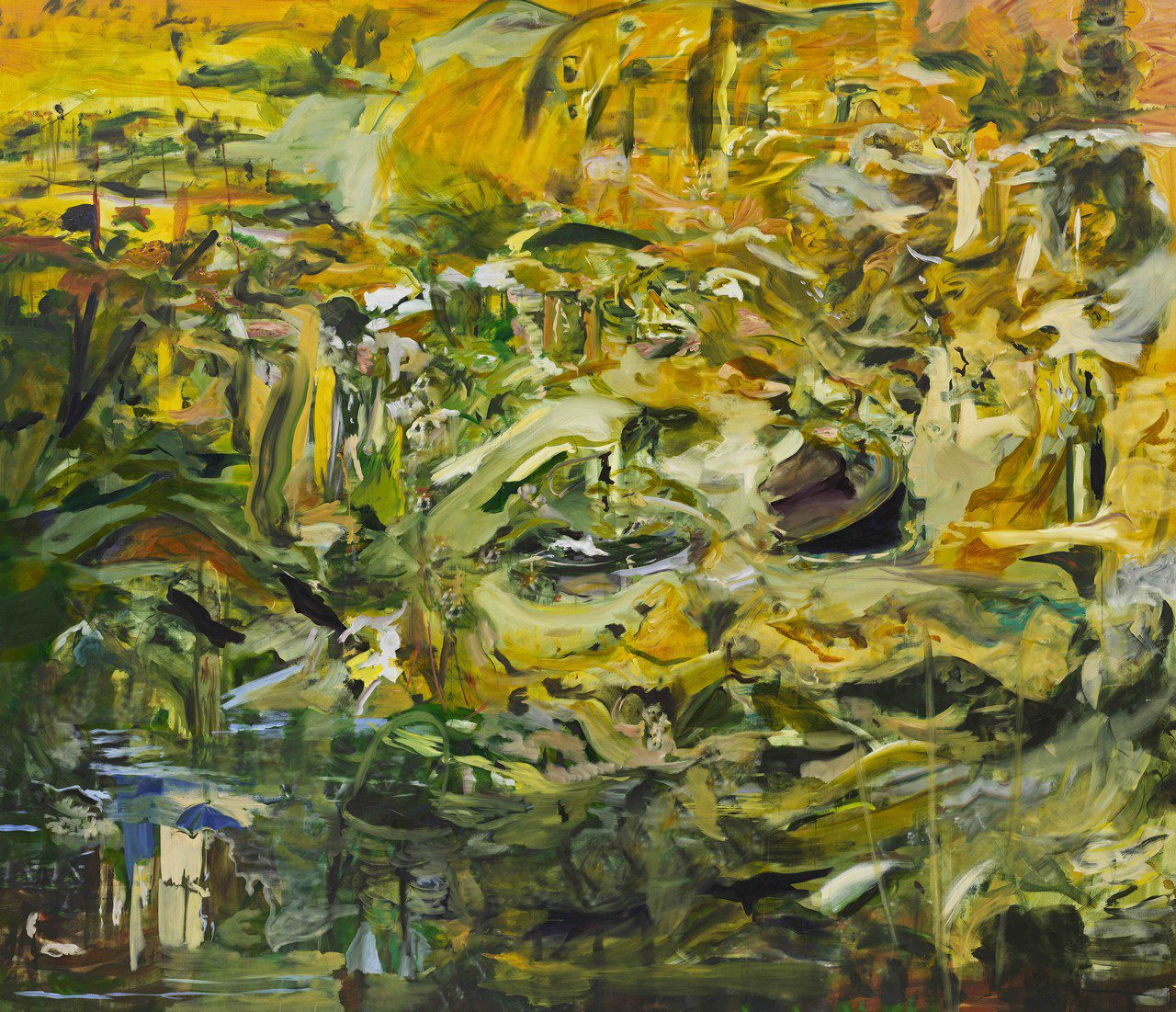
Earlier works, including “Bacchanal” (2001) and “Couple” (2003–2004), foreground Brown’s sensuous handling of paint—a technique that alternates between revealing and concealing its subject . Bodies press together, but their outlines remain unstable, sometimes indistinguishable from the terrain around them. In a series of boating scenes, lovers’ bodies merge with watery surroundings, the dialogue between image and medium intensifying as flesh dissolves into environment . The result is an uneasy fusion in which desire and setting become inseparable .
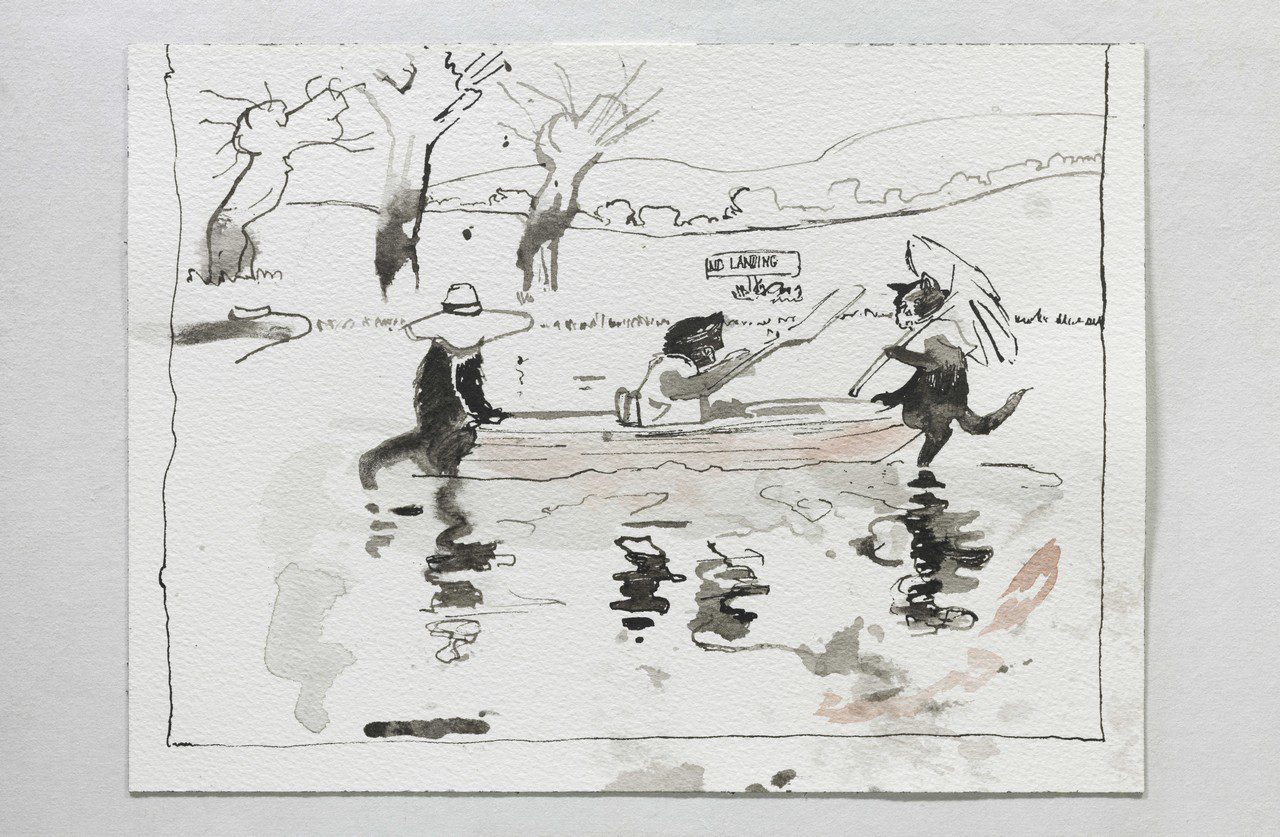
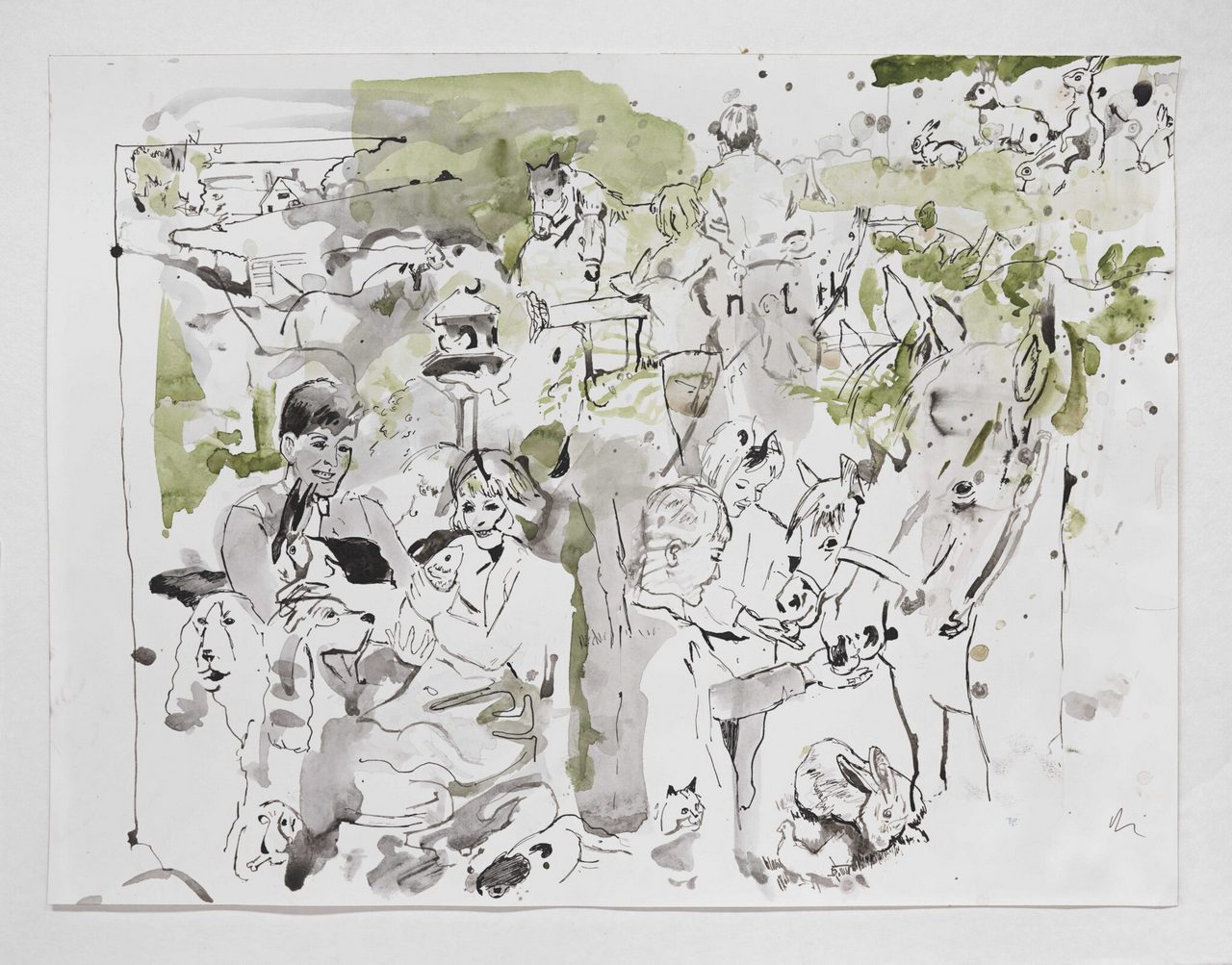
For all the attention lavished on Brown’s large canvases, the exhibition makes space for her monotypes and drawings—works that reveal the illustrator lurking beneath the expressionist bravado . These smaller pieces offer insight into the breadth of Brown’s visual references, which range freely across photographs, illustration, cinema, and art history . Particularly striking is her engagement with children’s literature: the worlds of Beatrix Potter, Kathleen Hale’s *Orlando the Marmalade Cat* series, and vintage Ladybird illustrations surface throughout the drawings, their apparent sweetness offset by darker undercurrents.
Animals appear in these works as stand-ins for human experience, echoing the moral ambiguities of fairy tales and cautionary stories . Brown’s interest in the darker sides of nursery rhymes—the menace lurking beneath the whimsy—finds expression here, the innocence of childhood sources never entirely secure . It is a reminder that Brown’s practice has always been alert to the ways that pleasure and threat, comedy and unease, can coexist within a single image.
Brown’s biography is often narrated as a transatlantic story. Born in London, trained at the Slade School of Fine Art, she moved to New York in 1994 after a formative period at the New York Studio School . The city’s scale and painterly traditions proved decisive. Over three decades, she has developed a practice that converses as much with Willem de Kooning and Francis Bacon as with British narrative painting and illustration . Yet the Serpentine exhibition resists simple ideas of homecoming. Instead, it positions Brown’s work within a longer history of painting as a site of return and revision—a tradition in which repetition becomes a form of thinking.
This is her first major solo presentation of paintings in a UK institution since her 2005 exhibition at Modern Art Oxford . The gap matters. It suggests an artist who has not felt the need to maintain constant visibility in her country of origin, whose reputation has been built instead on the force of the work itself. The Serpentine’s leadership frames the exhibition as a conversation with the park, a kind of site-specific embrace—though one suspects Brown’s real conversation remains with painting, that inexhaustible argument between what can be shown and what refuses to resolve.
In a cultural moment dominated by digital circulation and instant reproduction, there is something almost defiant about Brown’s insistence on painting’s physical presence. Her canvases demand that viewers stand before them, adjust their focus, and allow forms to coalesce over time . Meaning, in this context, is not delivered; it is negotiated. The Serpentine’s long-standing commitment to free public access amplifies this dynamic. Situated in a royal park, the gallery operates at the intersection of leisure and contemplation—much like the paintings themselves, which hover between the casual and the intensely considered .
What emerges from “Picture Making” is an artist in full command of her vocabulary, yet still evidently in pursuit of something unresolved. The paintings on view are not illustrations of ideas but documents of a thinking process—one that moves between scale and intimacy, between the weight of art history and the lightness of children’s book illustration, between the body and the landscape that contains it. A catalogue designed by Irma Boom, featuring correspondence between Brown and the painter Celia Paul alongside a conversation with Hans Ulrich Obrist, promises to extend the exhibition’s concerns into printed form .
For those who have followed Brown’s career across three decades, “Picture Making” offers the satisfaction of seeing familiar motifs handled with renewed energy. For newcomers, it provides an entrance into one of contemporary painting’s most significant practices. And for Brown herself, the exhibition represents something more personal: a return to the galleries she first visited as a young art student, now transformed into the setting for her own homecoming .
Photo: Cecily Brown Players and painted stage, 2024, Oil on linen 33.02 x 43.18 cm (13 x 17 in.) © Cecily Brown, 2026. Photo: Genevieve Hanson
Info: Serpentine Galleries, Serpentine South, Kensington Gardens, London, United Kingdom, Duration: 27/3-6/9/2026, Days & Hours: Mon 12:00-18:00, Tue-Fri 10 :00-18 :00, Sat-Sun 10L00-19 :00, https://www.serpentinegalleries.org/
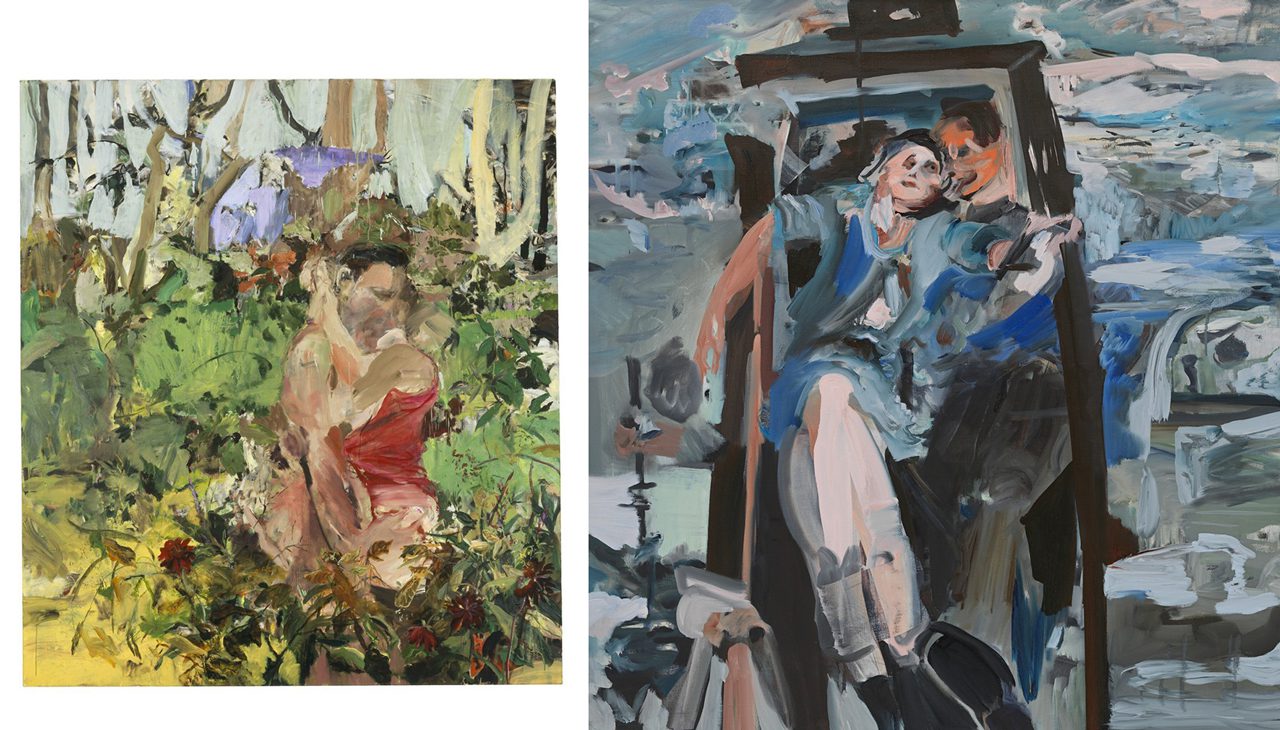
Right: Cecily Brown Untitled (Boating), 2021-2025, Oil on linen 78.74 x 73.66 cm (31 x 29 in.) © Cecily Brown, 2026. Photo: Genevieve Hanson