OPEN CALL: National Taiwan Museum seeks proposals for Democratic Architecture—Architectural Democracy
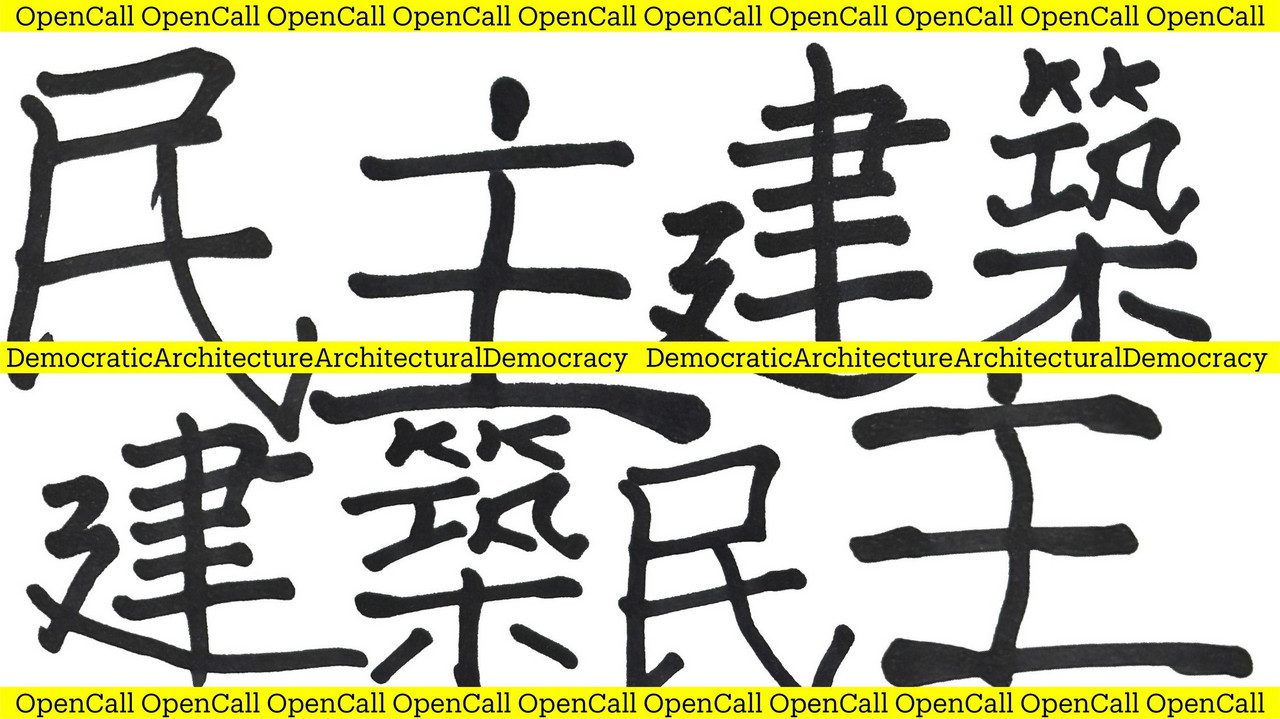
Taiwan will open the first Taiwanese publicly funded center for architecture in December 2026. The opening will be celebrated with an exhibition titled “Democratic Architecture—Architectural Democracy”.
The National Taiwan Museum has commissioned the Alliance for Architectural Modernity (Taiwan) to organize the exhibition, which will take place at the Railway Department Park of the National Taiwan Museum from December 2026 to October 2027.
The curatorial team is composed of Chun-Hsiung Wang, Fabrizio Gallanti, and Wenwen Cai.
The theme of the exhibition aligns with Taiwan’s political and social trajectory since 1996, marked by the affirmation of democratic values and governance models that underpin the island’s contemporary identity.
The exhibition investigates how architecture has contributed, across various contexts, to consolidating and supporting the development of democracy by designing and providing spaces that are appropriated and used by citizens.
Guided by three central questions—What are the spatial archetypes of democratic architecture? How does democracy reshape space to enable public deliberation? How can architecture advance democracy?—the exhibition explores how the ideals and practices of democracy materialize through buildings, collective spaces, and landscapes.
A wide range of case studies from different countries will be presented through diverse interpretive media, including drawings, photographs, models, and videos. The exhibition will be accompanied by a series of publications and a program of public events that will expand its message.
The curatorial team is seeking international submissions for one of the exhibition themes: “New Common”, which responds to the question: How can architecture advance democracy? This theme aims to highlight instances in which citizens have collaborated to control, manage, and benefit from resources that they considered collective, with particular attention to initiatives where the design component has played a significant role.
Such resources may be tangible—such as energy, agricultural production, water, or a specific site—or intangible, such as knowledge transmission or time-exchange. Submissions may document existing conditions or propose speculative projects.
A jury will select five proposals. A budget for the production of each installation within the exhibition will be allocated as well as professional assistance from the National Taiwan Museum and the Alliance for Architectural Modernity.
Jury members
Erwin Viray, senior Advisor of the Sustainability Office in SUTD (Singapore University of Technology and Design), Singapore
James Taylor-Foster, curator of contemporary architecture and design at ArkDes, the Swedish Centre for Architecture, Stockholm
Rachaporn Choochuey, architect, founder of all(zone) and visiting professor of architectural design, Bangkok
Triin Ojari, consultant of Tallinn Urban Planning Department, ex-director of the Estonian Museum of Architecture, Tallinn
Kumiko Ikada, director of Gallery TOTO MA, Tokyo
Submissions
The curatorial team is looking for:
(A) Realized projects: already completed initiatives—buildings, public spaces, natural areas, collective mobilizations with a relevant design component.
(B) Research: studies and documentation around the topic of the New Common, with particular attention to the areas of architecture, landscape architecture, urban politics, spatial practices and focusing on their communication methodologies. Studies can be either general or concentrated on specific local conditions.
(C) Projects: proposals for future actions and interventions. The proposals can be either already developed at the moment of the submission or to be implemented specifically for the exhibition.
Requirements
–One abstract of maximum 1,500 words explaining the proposal. The abstract should clearly indicate the content of the proposal—what it is; its context; how the proposal has responded to local conditions and needs, or how it could respond in the case it does not yet exist; and how the design process is at the service of mobilizing a community of citizens. Also, the abstract should indicate, in broad lines, how the proposal will be presented within the exhibition—formats, media, dimensions.
–One mini-portfolio of maximum five reference projects and/or initiatives by the candidates.
–One CV of the candidates, maximum three pages.
Submission deadline: May 3, 2026