BOOK: Lucas Samaras-Kiss Kill / Perverted Geometry / Inedibles, Pace Publishing
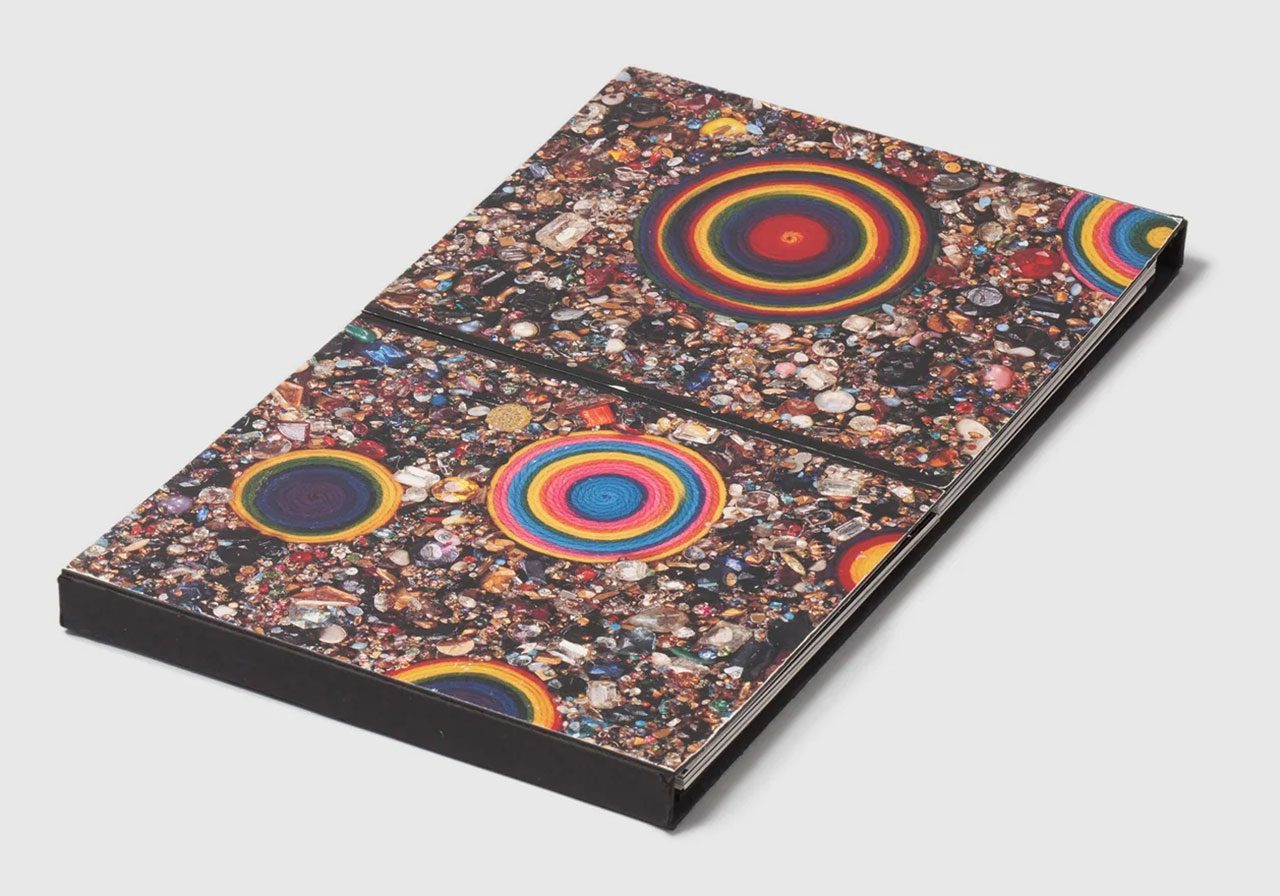
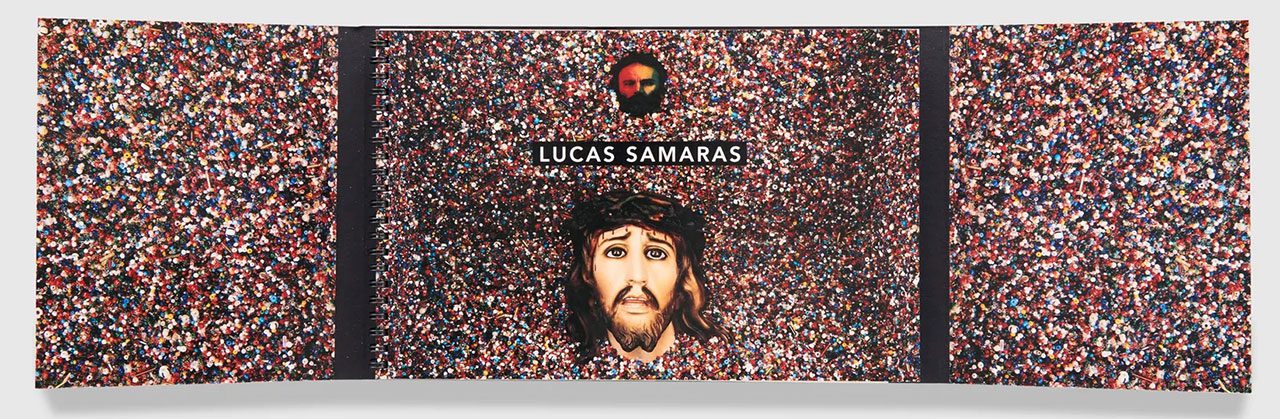
“Lucas Samaras: Kiss Kill / Perverted Geometry / Inedibles” is a unique and ambitious publication that refuses to sit comfortably within the confines of what an exhibition catalog is expected to be. Rather than simply documenting an artist’s work with reproductions and essays, it asserts itself as an extension of Samaras’s practice—a strange, beautiful, unsettling, and wholly tactile object that embodies the very qualities of the artworks it seeks to represent. Published in 1996 by Pace to accompany two overlapping New York exhibitions, the book immediately signals its departure from convention through its physical design. The cover, modeled after Samaras’s jewel-encrusted boxes, opens into a gatefold that feels less like packaging and more like a portal into the artist’s psychological terrain. From the moment the reader encounters the folded surfaces, vibrant colors, and the jewel-box conceit, they are reminded that Samaras’s world is not one of quiet contemplation but of sensory confrontation.
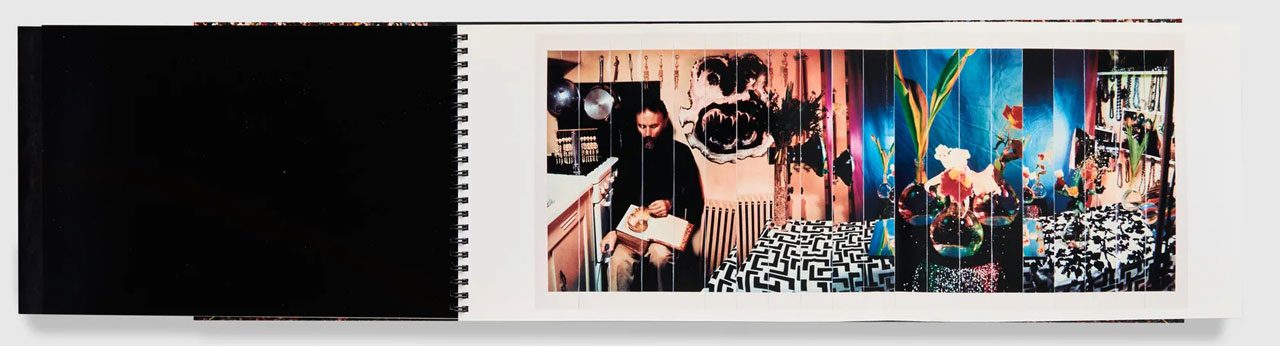
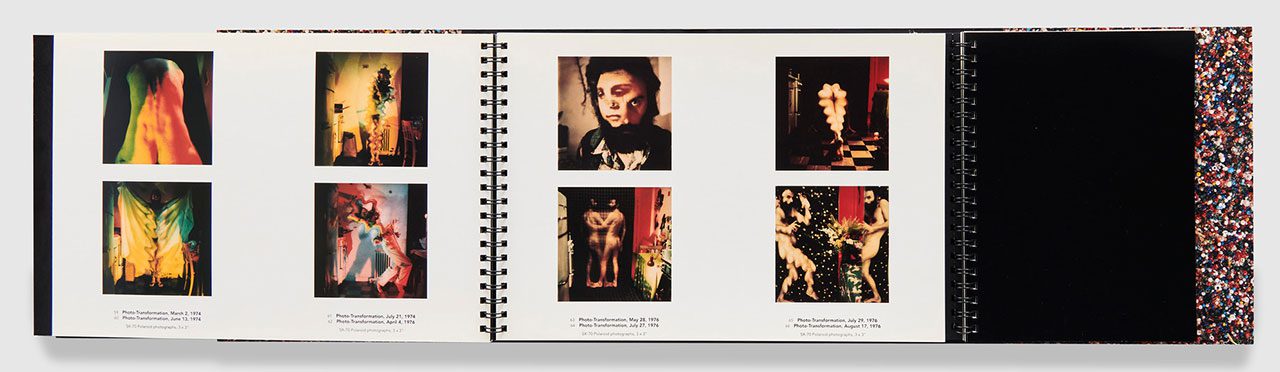
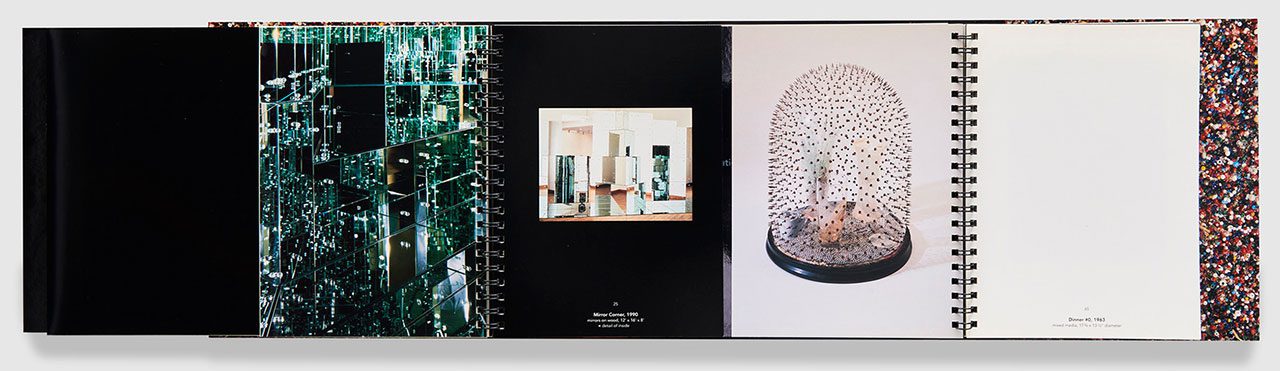
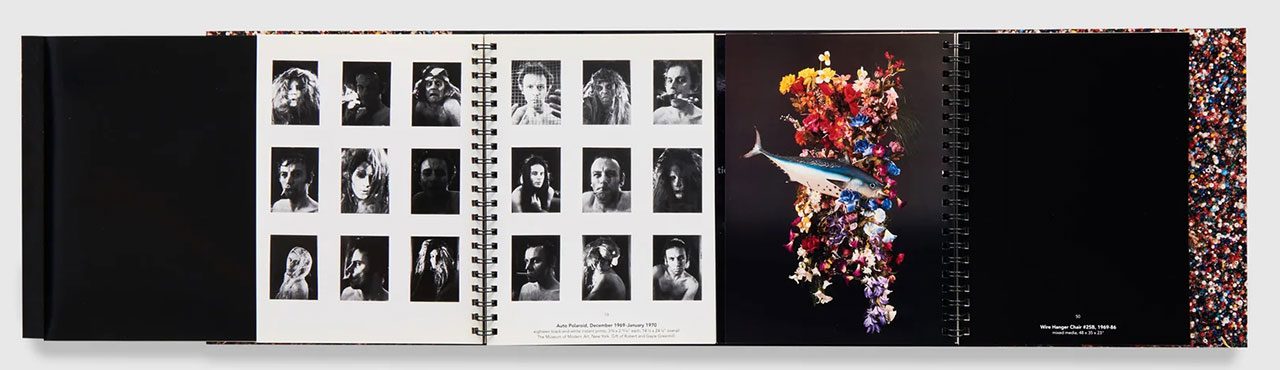
Inside, the structure expands this experience: a panoramic fold-out derived from “Crude Delights” sets the tone for what follows, while five spiral-bound sections—each focusing on a different series—create the sense of navigating not one book but many. These sections contain “Kiss Kill”,” Perverted Geometry”,” Inedibles”, “Self-Absorption” and “Photo-Transformations”, bodies of work that are diverse in form yet united by Samaras’s obsessive attention to the intersections of the body, the psyche, and personal mythology. This layered, almost fragmented format mirrors Samaras’s artistic methods, which frequently involve disruption, distortion, and reassembly. Just as his photographs and sculptures often defy stability, so too does this publication resist linear reading; it asks to be unfolded, flipped, turned, and handled in a way that transforms the act of looking into a performance.
Thematically, the catalog demonstrates how Samaras’s art is deeply autobiographical yet never straightforward. In “Kiss Kill”, for instance, eroticism is inseparable from aggression, and intimacy is inseparable from violence. In “Perverted Geometry”, spatial logic is subverted, turning the rationality of mathematics into something anxious and unstable. In “Inedibles”, ordinary objects are transformed into strange, almost grotesque totems, simultaneously seductive and repulsive. The “Self-Absorption” and “Photo-Transformations” series further extend this autobiographical bent, turning the artist’s own image into a mutable, kaleidoscopic presence that destabilizes the idea of a fixed self. By placing these series side by side, the catalog underscores the way Samaras’s entire career circles around themes of selfhood, embodiment, and distortion—yet always with a playfulness that edges into the uncanny.
One of the catalog’s greatest strengths lies in its design, which amplifies these artistic concerns by creating an object that is as complex and layered as the work it contains. The jewel-box cover, the spiral bindings, and the fold-outs create a tactile dimension that makes the catalog feel alive. This sensory richness heightens the viewing experience, forcing the reader to engage with the book as they would with a sculptural object, rather than as a flat repository of images. The vivid reproductions, saturated colors, and experimental sequencing contribute to an energy that captures the “fantastical” qualities of Samaras’s work. It is not simply a catalog of images, but an environment that echoes the provocations, discomforts, and delights of the art itself.
Yet the book is not without its limitations. For all its visual and physical ingenuity, it offers relatively little in the way of critical text or interpretive framing. Aside from a short excerpt from “Crude Delights” and a few brief notes, the catalog provides minimal commentary, leaving much of the interpretive burden on the viewer. For scholars or readers looking for analytical depth or historical grounding, this absence may feel frustrating. Similarly, while the book’s elaborate format enhances its identity as an art object, it also makes it somewhat unwieldy as a reference tool. The spirals, fold-outs, and layered design demand space and attention, making the catalog less accessible for casual reading.
Nevertheless, these considerations seem almost deliberate, as if the book’s very structure embodies Samaras’s resistance to easy interpretation. His art has always unsettled boundaries—between attraction and repulsion, beauty and grotesque, intimacy and alienation—and the catalog sustains this tension. What some may see as a lack of text is also an invitation to confront the work directly, without the mediation of curatorial voice or theoretical scaffolding. The reader is left alone with the images and the object, just as Samaras’s art often leaves the viewer alone with their own discomforts and fascinations.
In the end, “Kiss Kill / Perverted Geometry / Inedibles” is not best approached as a catalog in the traditional sense but as a continuation of Samaras’s practice, a portable exhibition that captures his singular vision in both form and content. It is a book that demands to be touched, unfolded, and experienced physically, a book that resists passive consumption and instead enlists the reader as an active participant. For admirers of Samaras’s provocative, psychologically charged, and surreal work, this catalog offers an experience as audacious and unforgettable as the art it contains. For those unfamiliar, it serves as an uncompromising introduction to an artist who has always rejected compromise. As such, it stands as a rare and compelling example of how design, content, and artistic vision can merge into a seamless, immersive statement—an artifact that is at once documentation, artwork, and provocation.-Dimitris Lempesis